

Why Trim, Not Just Payload, Determines Two-Person Kayak Performance
A two-person inflatable kayak can be rated for 400 lbs yet still paddle poorly if that weight sits in the wrong place. The real problem is not total capacity — it is trim, the fore-and-aft and lateral balance of load around the kayak's center of buoyancy. Poor trim shows up as bow steering, stern drag, excessive yaw in crosswinds, and a hull that feels sluggish regardless of paddle input. Before adjusting anything, confirm the kayak's rated payload and person capacity from the manufacturer datasheet; typical tandem recreational inflatables commonly fall in the 350–500 lb (160–227 kg) range, but this varies by tube diameter, floor construction, and chamber count, so verify against the specific model.
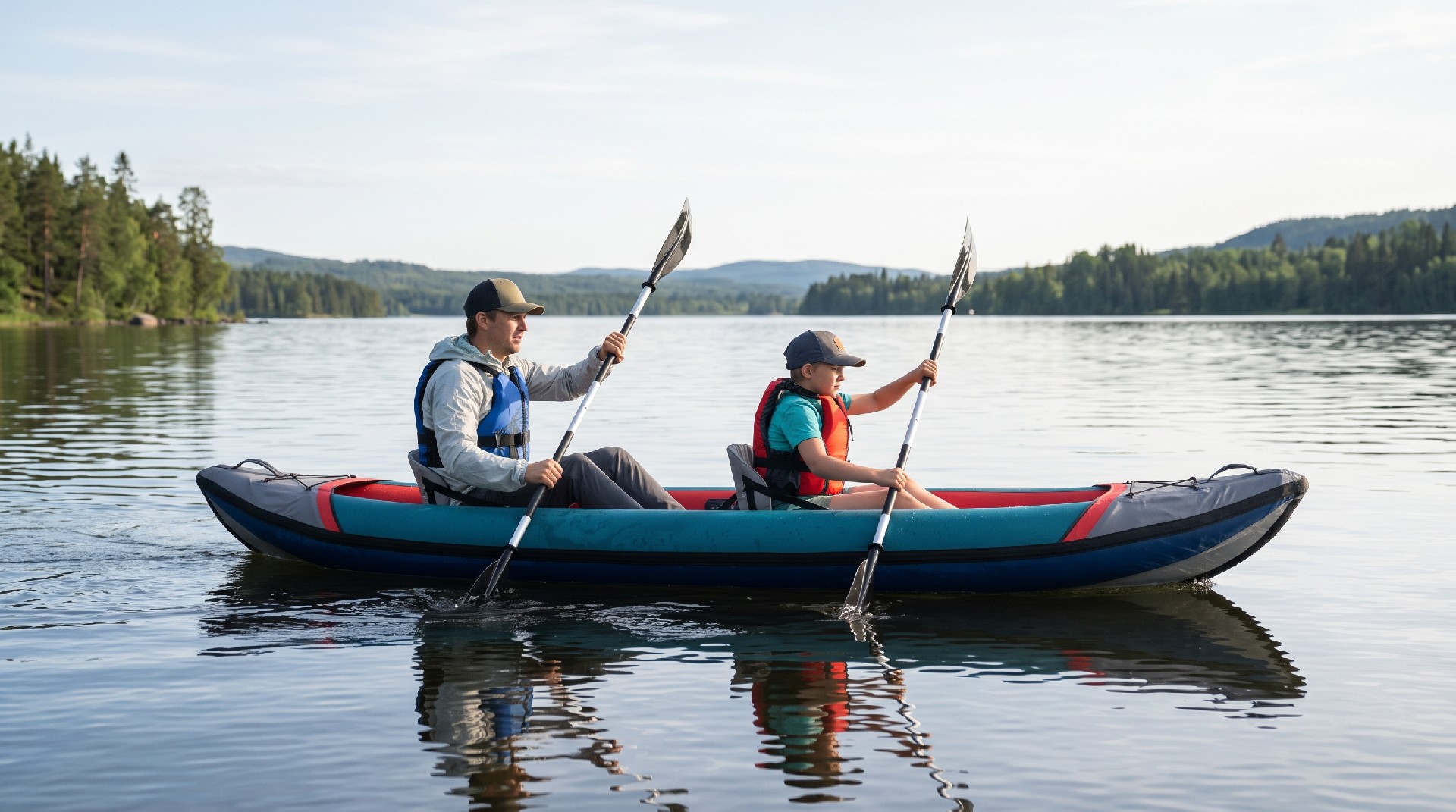
How Inflatable Hull Geometry Responds to Off-Center Loads
Unlike a rigid kayak, an inflatable hull changes shape under load. The tube diameter, floor type (drop-stitch versus I-beam versus slat), and working pressure all influence how much the hull deflects when a paddler sits forward or aft. Drop-stitch floors resist compression better than I-beam floors, so they tolerate a wider trim window. Lower pressure increases hull flex, which amplifies any imbalance. Commonly specified working pressures for recreational inflatable kayaks fall between 1.5 and 3 PSI for side tubes, with drop-stitch floors often targeting 6–10 PSI, but these figures are supplier- and model-dependent and should be confirmed on the final datasheet.
Three structural factors control how a tandem inflatable reacts to weight placement:
Rocker profile — more rocker means the bow and stern sit higher, so moving weight forward has an outsized effect on bow lift.
Chamber count — a two-chamber side-tube design distributes load differently than a three- or four-chamber hull; more chambers generally improve redundancy but add valves and inspection points.
Seat rail position — fixed seat mounts limit trim adjustment range, while adjustable or removable seats allow finer fore-aft tuning.
Front vs. Rear Paddler: Who Carries the Load?
In most tandem inflatables, the rear paddler is heavier and provides more propulsion, while the front paddler sets cadence and visibility. If the rear seat is too far back, the stern squats, the bow rises, and the kayak plows rather than glides. If the front paddler is significantly heavier than the rear, the bow digs in on flat water but performs better in chop. The practical fix is not to match body weights but to position the combined center of gravity slightly aft of the hull's midpoint — typically 45–55% of the waterline length from the bow, depending on hull design. This is a buyer-side target, not a universal rule, and should be validated on the water.
| Trim Variable | Typical Commercial Target | Why It Matters | Buyer Check |
|---|---|---|---|
| Combined center of gravity | 45–55% of waterline length from bow | Controls bow rise vs stern squat; affects tracking and drag | Paddle sample with heaviest intended front and rear paddlers |
| Rear seat position | Adjustable range of at least 6 in (150 mm) | Largest single trim correction lever for uneven paddler weights | Confirm rail lock security under dynamic load |
| Floor pressure (drop-stitch) | 6–10 PSI typical, supplier-dependent | Higher pressure reduces hull squat under rear paddler | Verify pump capability and pressure gauge accuracy |
| Side tube pressure | 1.5–3 PSI typical for recreational tandem | Affects hull stiffness, tracking, and load response | Check datasheet for model-specific rating |
| Payload margin | 15–20% headroom above expected load | Preserves freeboard and trim range as gear is added | Calculate with heaviest paddlers plus typical gear weight |
| Chamber count | 3 or more air chambers preferred | Improves redundancy and trim tolerance after partial deflation | Identify valve locations and isolation capability |
| Gear stowage location | Centerline, low, between seats | Prevents lateral list and weathercocking in crosswinds | Verify D-ring and bungee layout supports centerline mounting |
Field Adjustments That Actually Change Trim
Once on the water, trim can be adjusted through four levers: seat position, gear placement, inflation pressure, and paddler posture. Seat position offers the largest correction range and should be the first adjustment. Gear placement — dry bags, cooler, bilge pump — should be used to fine-tune lateral balance and to offset a lighter paddler. Inflation pressure affects hull stiffness: a slightly firmer floor reduces squat under the rear paddler, while softer side tubes can absorb small imbalances but reduce tracking.
Lateral balance matters as much as fore-aft trim, especially in crosswinds or when one paddler is much stronger. A kayak that lists to one side will weathercock, forcing the stronger paddler to compensate with corrective strokes. Keep heavy gear centered and low. If a cooler or battery box must be carried, place it between the seats rather than against one tube.
[IMAGE_2]
Buyer Checklist: Specifying a Tandem Inflatable That Tolerates Real-World Loading
Before purchasing a two-person inflatable kayak for rental, resort, or guided use, verify these decision points against the intended paddler mix and typical gear load:
Adjustable seat range — how far forward and aft can each seat move, and does the rail lock securely under load?
Floor stiffness — drop-stitch floors at higher pressure reduce squat and improve trim tolerance; confirm the pressure rating and pump capability.
Chamber redundancy — a two-person kayak with three or more air chambers is easier to trim after a puncture and safer under partial deflation.
Payload margin — target at least 15–20% headroom above the expected combined paddler and gear weight to preserve freeboard and trim range.
Gear attachment points — D-rings and bungee layouts should allow centerline stowage, not just tube-side mounting.
Sample acceptance test — paddle the sample with the heaviest intended front and rear paddlers before approving a production run.
The right tandem inflatable is not the one with the highest payload rating. It is the one whose trim envelope matches your actual paddler mix, gear load, and water conditions. If most of your users are similar in weight, a fixed-seat design may be sufficient. If your fleet sees a wide range of paddler sizes or carries significant gear, prioritize adjustable seating, a stiff drop-stitch floor, and at least three air chambers. Verify all pressure, payload, and chamber specifications against the supplier's final datasheet and, where applicable, the relevant ISO 6185 classification for the intended boat category.
