

Why Chlorine Alternatives Are Gaining Ground in Small Backyard Pools
Small inflatable pools—typically 6 to 12 feet in diameter and holding 500 to 2,500 gallons—present a unique water-treatment challenge. Their low water volume means chlorine levels can spike or crash within hours, and many owners report skin irritation, faded swimwear, and the unmistakable odor of chloramines. For buyers researching best alternatives to chlorine for maintaining small backyard inflatable pools, the decision is not simply about avoiding a chemical smell. It is about matching a sanitation method to a small water body that heats quickly, loses sanitizer fast, and cannot be drained and refilled as casually as many assume.
This guide evaluates the leading chlorine alternatives—bromine, hydrogen peroxide, ozone, UV, copper-silver ionization, and saltwater systems—specifically for small inflatable pools. It covers water chemistry, equipment compatibility, operating cost, and the practical limits that manufacturers of inflatable pools often do not explain. The focus stays on the inflatable pool class: vinyl or PVC liners, low-volume water, modest filtration, and seasonal or year-round residential use. If you operate a rental fleet, resort, or commercial aquatic facility, different standards and dosing protocols apply.
What Makes Small Inflatable Pools Chemically Different
Before comparing alternatives, buyers need to understand three physical realities of small inflatable pools.
Low Volume Amplifies Every Dose
A 10-foot round inflatable pool holding roughly 1,200 gallons responds to chemical changes far faster than a 20,000-gallon in-ground pool. A dose that would be negligible in a large pool can push a small pool's sanitizer or oxidizer level to an uncomfortable or ineffective concentration. Alternatives that require precise dosing—such as hydrogen peroxide or bromine tablets—demand more frequent testing in this context.
Filtration Is Usually Minimal
Many small inflatable pools ship with cartridge filters rated for a few hundred gallons per hour. These filters capture debris but do not sanitize. Any chlorine alternative must either work downstream of the filter or be dosed directly into the water. High-flow ozone or UV systems may not integrate with the small, proprietary hose fittings found on many inflatable pools.
Water Temperature and Sunlight Drive Demand
Shallow water in a dark or clear vinyl pool heats rapidly. Warmer water increases biological demand and accelerates sanitizer consumption. UV sunlight degrades chlorine and hydrogen peroxide, but it does not degrade bromine at the same rate. Copper-silver ions are largely unaffected by sunlight. These differences matter when a pool sits in direct sun for eight hours a day.
Chlorine Alternatives Compared for Inflatable Pool Use
The table below summarizes how each alternative performs against the constraints of small inflatable pools. Values are typical commercial ranges or buyer-side targets, not universal specifications. Actual performance depends on water volume, bather load, filtration, sun exposure, and product formulation.
| Alternative | Typical Target Level | Residual Effect | Key Limitation in Small Inflatable Pools |
|---|---|---|---|
| Bromine | 3-5 ppm | Yes | Acidic; lowers pH; not stabilized against sunlight |
| Hydrogen Peroxide | 30-50 ppm | Limited without stabilizer | Degrades quickly in sun and warm water; high dose volume |
| Ozone | No residual target | No | Requires separate circulation loop; respiratory hazard if not degassed |
| UV | No residual target | No | No residual; lamp replacement; electricity use |
| Copper-Silver Ions | 0.2-0.4 ppm Cu; 0.01-0.02 ppm Ag | Yes | Slow-acting; staining risk; electrode replacement cost |
| Saltwater (SCG) | 1-3 ppm chlorine equivalent | Yes (as chlorine) | Not chlorine-free; needs compatible pump; corrosive to some liners |
Bromine: The Closest Drop-In Alternative
Bromine is the most straightforward chlorine alternative for small inflatable pools. It sanitizes effectively across a wider pH range than chlorine, which is useful when an inflatable pool's pH drifts after rain or heavy use. Bromine is less irritating to skin and eyes for many swimmers, and it does not produce the same chloramine odor.
Dosing and Compatibility
Bromine is commonly sold as tablets, granules, or a two-part system (sodium bromide plus an oxidizer). For a small inflatable pool, tablets in a floating dispenser or a small bromine feeder are the most practical. Typical target bromine levels are 3 to 5 ppm, though buyers should verify against the product label and local health guidance if the pool is used by the public.
Bromine is compatible with vinyl and PVC liners at normal doses. However, bromine tablets are acidic and can lower pH and total alkalinity over time. In a 1,000-gallon inflatable pool, pH may need checking every one to two days during heavy use. Bromine also cannot be stabilized against sunlight the way cyanuric acid stabilizes chlorine, so outdoor pools in full sun may consume bromine faster.
Best For and Not Ideal For
Best for: Owners who want a simple, familiar tablet or granular routine and are willing to test frequently.
Not ideal for: Pools with very low volume (under 500 gallons) where precise dosing is difficult, or users who want to avoid acidic additives.
Hydrogen Peroxide: Gentle but Demanding
Hydrogen peroxide (H2O2) is a strong oxidizer that breaks down into water and oxygen, leaving no chlorinated byproducts. It is popular in some European and eco-oriented pool markets. For small inflatable pools, it is appealing because it does not smell, does not bleach swimwear as aggressively as chlorine, and is relatively gentle on skin.
The Practical Limits
Hydrogen peroxide is not a residual sanitizer in the same way chlorine or bromine is. It oxidizes contaminants but does not maintain a persistent disinfecting residual unless a stabilized or slow-release formulation is used. Typical target concentrations for pool use are 30 to 50 ppm, which is far higher than chlorine's 1 to 3 ppm. This means larger volumes of product and more frequent testing.
Hydrogen peroxide is also sensitive to UV light and warm water, both common in small inflatable pools. It can degrade within hours in direct sun. Filtration and circulation must be adequate to distribute the product evenly. Many cartridge filters on inflatable pools are not designed for the flow rates needed to mix a full dose quickly.
Best For and Not Ideal For
Best for: Shaded pools with low bather load and owners willing to test and dose daily.
Not ideal for: High-use pools, full-sun installations, or buyers who want a low-maintenance routine.
Ozone and UV: Equipment-Based Sanitation
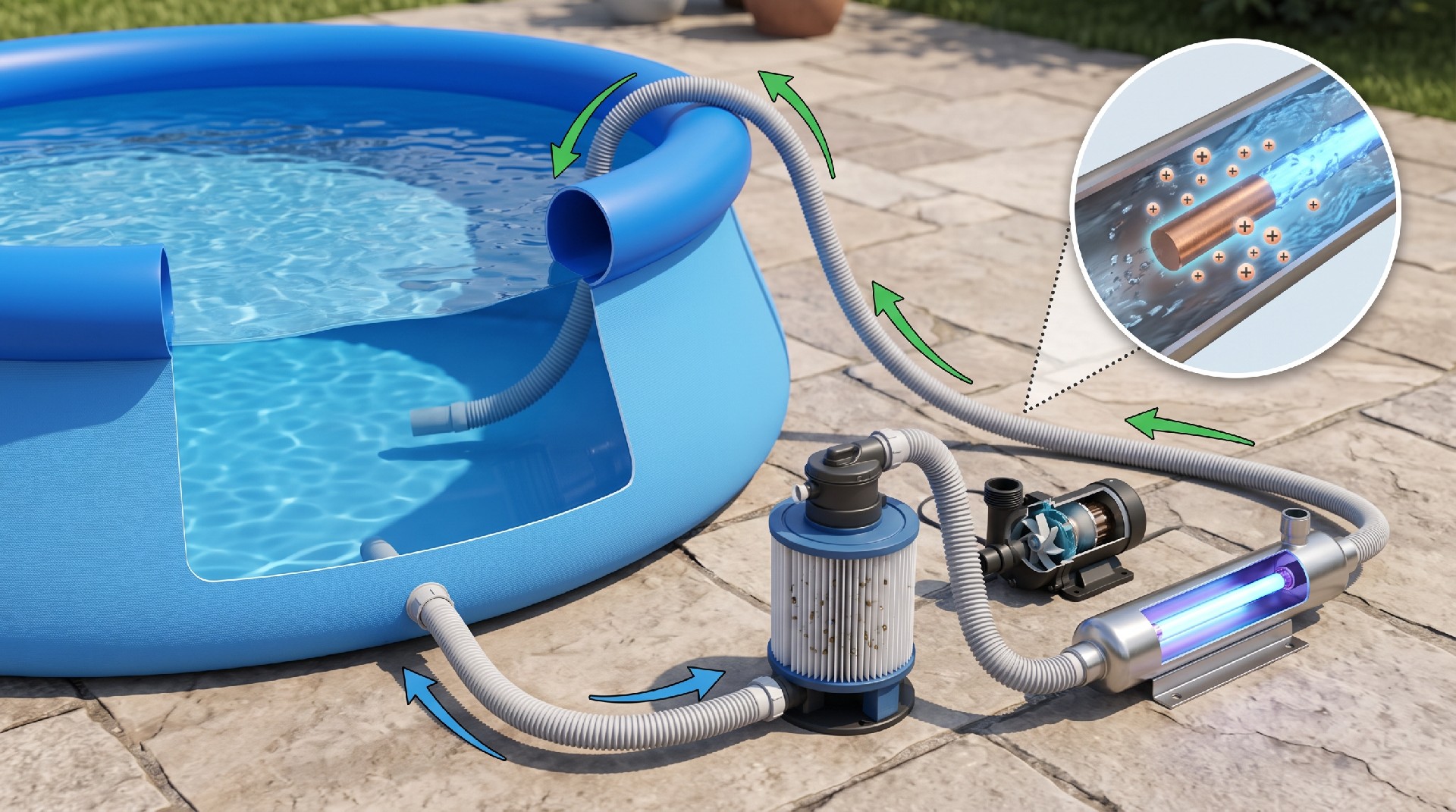
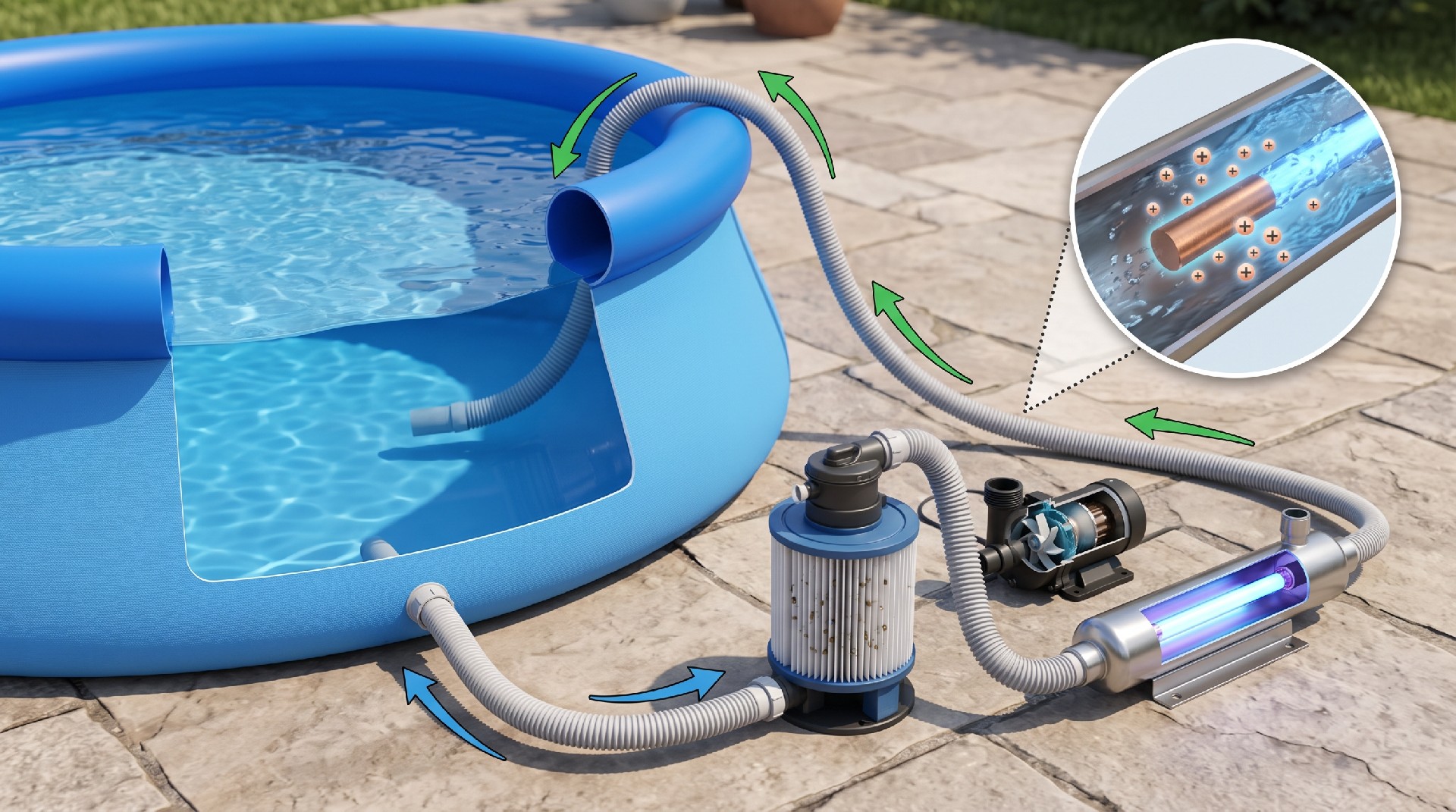
Ozone and UV are point-of-contact sanitizers. Water passes through a chamber where it is exposed to ozone gas or ultraviolet light, and contaminants are destroyed. Neither leaves a residual in the pool water. For small inflatable pools, this is both an advantage and a limitation.
Integration Challenges
Most small inflatable pools use proprietary hose connectors and low-power pumps. Adding an ozone generator or UV sterilizer typically requires a separate circulation loop, a small booster pump, and custom plumbing. This can cost more than the pool itself and may void the pool's warranty if modifications are made.
Ozone is a respiratory irritant and must not be injected directly into the pool water where swimmers are present. It requires a degassing chamber or a contact tank. UV systems are safer but consume electricity continuously and require lamp replacement every 9 to 12 months.
Best For and Not Ideal For
Best for: Technically inclined owners with larger inflatable pools (1,500+ gallons) who want to reduce chemical use.
Not ideal for: Small, low-cost inflatable pools where the equipment cost and plumbing complexity outweigh the benefit.
Copper-Silver Ionization: Residual Without Halogens
Copper-silver ionization releases trace amounts of copper and silver ions into the water. These ions have biocidal properties and persist longer than chlorine or hydrogen peroxide. The system is often marketed as a chlorine-free or low-chlorine option.
Dosing and Risks
Typical target concentrations are 0.2 to 0.4 ppm copper and 0.01 to 0.02 ppm silver. These levels are not irritating to skin and do not produce chloramines. However, copper can stain vinyl liners and turn blond hair green if levels exceed the target range. Silver is expensive, and the electrode cartridges require periodic replacement.
Copper-silver ionization is slower-acting than chlorine or bromine. It may not respond quickly enough to a sudden contamination event, such as a diaper leak or a bird dropping. Many suppliers recommend pairing it with a low-level oxidizer, which reintroduces a chemical routine.
Best For and Not Ideal For
Best for: Owners who want a low-residual, low-odor system and are willing to monitor copper levels and replace electrodes.
Not ideal for: Pools with frequent heavy bather loads or owners who want a simple, low-cost setup.
Saltwater Systems: Chlorine by Another Name
Saltwater pools use a salt chlorine generator (SCG) to convert dissolved salt into chlorine through electrolysis. The water feels softer and does not require storing or handling chlorine tablets. For small inflatable pools, however, saltwater systems have a significant catch: the salt cell and control unit are often designed for larger pools and require a minimum flow rate and water volume.
Compatibility and Cost
Small inflatable pools may not have a pump powerful enough to drive an SCG. Adding a compatible pump and filter can double or triple the total system cost. Salt is also corrosive to some inflatable pool materials, particularly lower-grade PVC, and can damage nearby grass or landscaping if the pool is drained frequently.
Technically, saltwater systems are not a chlorine alternative—they are a chlorine delivery method. Buyers seeking to avoid chlorine entirely should look elsewhere.
Best For and Not Ideal For
Best for: Larger inflatable pools (2,000+ gallons) with a pump that can support an SCG, and owners who want softer water.
Not ideal for: Small, budget inflatable pools or buyers who want a genuinely chlorine-free pool.
Buyer Checklist: Choosing a Chlorine Alternative for Your Inflatable Pool
Use this sequence to narrow the decision before purchasing any system or chemical.
Confirm pool volume: Measure or calculate gallons. Alternatives that require precise dosing become harder below 1,000 gallons.
Check pump and filter compatibility: Ozone, UV, and salt systems need specific flow rates and fittings. Verify with the pool manufacturer or a qualified technician.
Assess sun exposure: Full-sun pools degrade hydrogen peroxide and chlorine rapidly. Bromine and copper-silver ions are more stable.
Estimate bather load: Heavy use demands a fast-acting residual sanitizer. Copper-silver and UV alone may not keep up.
Verify liner compatibility: Salt, bromine, and hydrogen peroxide can affect vinyl or PVC differently. Check the pool's warranty and material guidance.
Plan a testing routine: Every alternative requires testing. Choose a method you will realistically follow several times per week.
Confirm local regulations: If the pool is used by anyone outside your household, or if you operate it commercially, different rules may apply. Verify with local health authorities.
Final Decision: Matching the Alternative to the Pool and the Owner
There is no universal best chlorine alternative for small backyard inflatable pools. The right choice depends on water volume, sun exposure, bather load, filtration capacity, and the owner's willingness to test and dose.
Choose bromine when you want the closest drop-in replacement for chlorine, accept acidic pH drift, and will test every one to two days. Choose hydrogen peroxide only for shaded, low-use pools and only if you will commit to daily testing and dosing. Choose ozone or UV as a supplemental system for larger inflatable pools where you can manage the plumbing and electricity. Choose copper-silver ionization if you want a low-residual system and will monitor copper levels and replace electrodes. Avoid saltwater systems for small inflatable pools unless the pump and liner are explicitly compatible.
For most small inflatable pool owners, bromine offers the best balance of effectiveness, simplicity, and cost. For those who want to avoid halogens entirely, copper-silver ionization paired with a periodic oxidizer is the most practical residual option, provided the owner accepts the monitoring burden. In every case, verify product claims against the actual pool volume, pump capacity, and liner material before committing to a full season's routine.
