

Why Standard Pool-Lounger Anchoring Fails in Gusty Backyards
An inflatable pool lounger that drifts across the deck or flips against a fence in a 25 mph gust is not a comfort problem—it is a product-design and anchoring-planning problem. Most residential loungers are engineered for buoyancy and relaxation, not for wind exposure in an open backyard. The dominant failure mode is not puncture; it is lift and lateral displacement caused by the lounger acting as a low-profile wing. When wind gets under the leading edge, the lounger can slide, rotate, or tumble, dragging towels, drinks, and sometimes a user with it.
Anchoring a pool lounger against strong backyard wind requires three coordinated decisions: point loading (where force enters the product), load distribution (how that force spreads across seams and chambers), and site-specific tethering (what the anchor connects to and how much slack it allows). This article treats the lounger as a lightweight inflatable structure and explains how to keep it in place without damaging seams, vinyl, or the backyard surface.
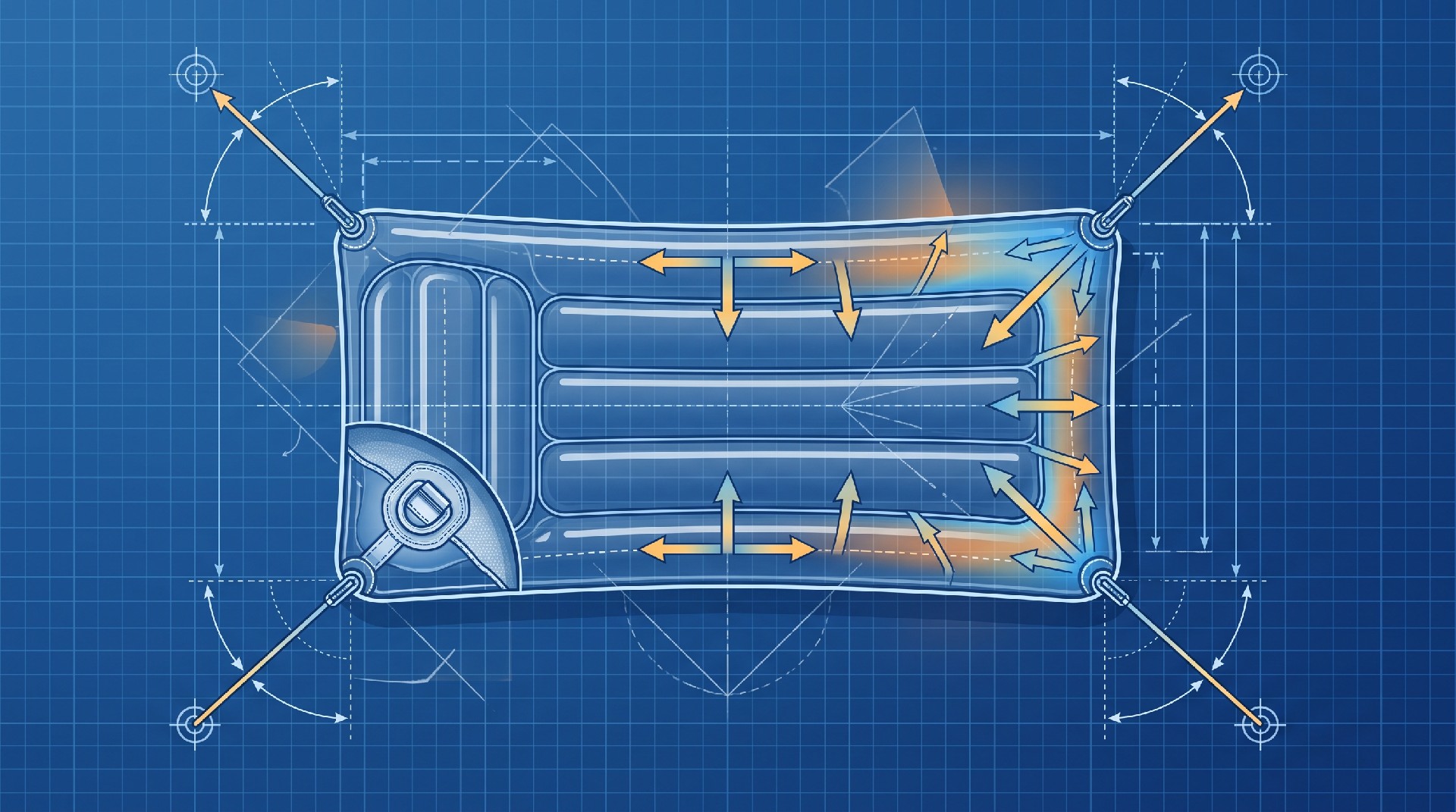
Understand the Wind Forces Acting on a Floating or Deck Lounger
A pool lounger experiences different forces depending on whether it is in the water, on a deck, or partially inflated during storage. In water, wind pushes the exposed upper hull and backrest; on a deck, the entire planform catches air. The relevant variables are exposed area, wind speed, surface friction, and tether geometry.
Typical commercial-range inflatable loungers use 0.35–0.60 mm PVC or TPU sheet, with single or dual air chambers. Lighter residential models may use 0.25–0.35 mm vinyl. These materials are flexible by design, so an anchor point that concentrates load on a single seam or valve patch can cause creep, delamination, or tear-out long before the anchor itself fails.
Three force paths you must control
Lift: wind passing over the top surface creates low pressure; air entering underneath creates high pressure. The lounger rises at the leading edge.
Drag: lateral force pushes the lounger downwind, especially when the backrest acts as a sail.
Rotation: asymmetric anchoring causes the lounger to pivot around a single tether point, twisting seams and valves.
The anchoring plan must address all three. A single rope tied to one D-ring will control drag but not lift or rotation. A four-point tether system controls all three but requires reinforced attachment points that most residential loungers do not have from the factory.
Anchor-Point Options: Factory D-Rings, Aftermarket Patches, and External Frames
Before choosing a tether strategy, identify what the lounger can safely accept. The weakest link is usually the attachment interface, not the rope or the ground anchor.
Factory-installed D-rings and grab handles
Some commercial-grade pool loungers include molded D-rings or reinforced grab handles. These are commonly specified for point-load targets of 80–150 kg in static pull tests, but that figure is supplier-dependent and must be verified against the final datasheet. A factory D-ring designed for a person grabbing it during entry is not automatically rated for continuous wind loading.
Aftermarket adhesive patches and heat-welded tabs
Adhesive D-ring patches can work on PVC and TPU surfaces if the installer follows surface-prep and cure-time instructions. Heat-welded tabs are stronger but require a qualified repair station. For a lounger exposed to regular strong wind, heat-welded or factory-welded attachment points are preferable to adhesive patches. Adhesive patches are best for temporary, low-load use.
External anchor frames and sandbag cradles
When the lounger itself cannot accept high point loads, use an external frame: a strap that wraps around the entire inflated body, or a sandbag cradle that holds the lounger without piercing or pulling on a single seam. This distributes load across a wider area and avoids D-ring pull-out.
Matching Tether Configuration to Backyard Conditions
The right tether layout depends on wind direction, surface, and whether the lounger is in water or on deck. The table below summarizes practical configurations for a typical residential backyard inflatable pool lounger in the 1.5–2.0 m length class.
| Anchoring Scenario | Recommended Configuration | Typical Load Target | Key Risk to Control |
|---|---|---|---|
| Floating lounger in pool, moderate wind | Two corner tethers to deck sandbags + one suction anchor on tile | 10–25 kg horizontal pull per point (buyer target, verify) | Suction-cup release on textured or dirty tile |
| Floating lounger in pool, strong gusty wind | Four-point tether to fixed deck posts or weighted anchors | 20–40 kg per point (typical commercial target, supplier-dependent) | Seam tear at D-ring patch if not welded |
| Deck lounger, open patio | Full-body strap + high-friction mat + two corner tethers | 15–30 kg per point (buyer target) | Lateral sliding on smooth composite decking |
| Deck lounger, sheltered patio | Two corner tethers to furniture legs or sandbags | 5–15 kg per point (typical light-duty range) | Rotation around single-point tether |
| Partially inflated lounger, temporary outdoor storage | Full-body cradle strap + deflation if possible | No point-load target; distribute across body | Flapping damage at valves and seams |
| Residential lounger with no rated D-rings | External sandbag cradle, no direct tether to lounger hardware | No point-load target; rely on friction and weight | Adhesive patch failure if aftermarket D-rings are added |
| Commercial-grade lounger with welded D-rings | Four-point tether to rated ground anchors | 80–150 kg static pull rating commonly specified (verify datasheet) | Anchor-point corrosion or UV degradation over time |
In-water anchoring
For a floating lounger in a backyard pool, the anchor must resist wind while allowing normal drifting. Options include weighted tethers to pool fittings, suction-cup anchor points on smooth tile, or a sandbag on the deck connected to a corner D-ring. Avoid tying to pool ladders or handrails unless the manufacturer confirms those fittings are load-rated for horizontal pull.
Deck and patio anchoring
On a hard surface, wind can slide the lounger even without lift. Use high-friction mats under the lounger plus corner tethers to fixed points such as deck posts, furniture legs, or weighted sandbags. Do not anchor to lightweight plastic furniture; it will move with the lounger.
Storage and partial-inflation scenarios
A partially inflated lounger has more flapping surface and is harder to control. If the lounger must stay outside between uses, deflate it or anchor it with a full-body strap system. A partially inflated lounger anchored only at one point can tear at the valve or seam.
Buyer Checklist: What to Verify Before Relying on an Anchor System
Attachment point rating: Ask the supplier for the static pull-test value of each D-ring or handle. Typical commercial targets are 80–150 kg, but this is not universal.
Seam construction: Welded seams generally handle concentrated loads better than stitched or glued seams. Confirm the seam method before using high-tension tethers.
Valve and chamber layout: Tethers should not cross valves or pull directly on valve patches. Route straps around the chamber body where possible.
Surface compatibility: Suction cups need smooth tile; sandbags work on most surfaces; stakes only work on grass or soft ground.
Wind exposure: A lounger in an open, unobstructed backyard faces higher gust loads than one behind a fence or hedge. Plan for the worst-case gust, not the average breeze.
User safety: Tethers can become trip hazards or entanglement risks. Use high-visibility line and keep slack controlled.
Decision Guide: Choosing the Right Anchoring Strategy
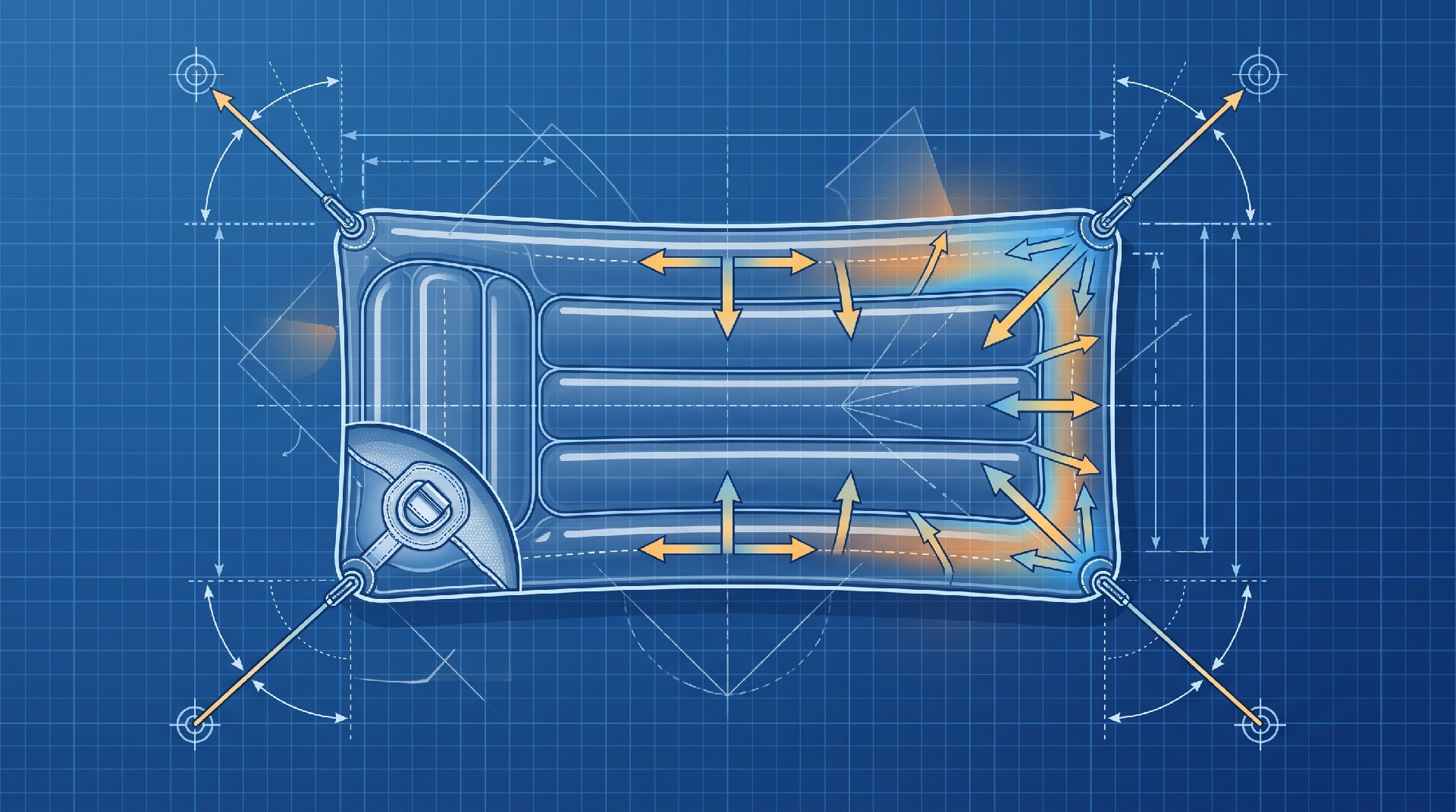
Choose a four-point factory D-ring system when: the lounger is commercial-grade, used in an exposed pool area, and the supplier provides pull-test documentation for each attachment point. This is the most reliable configuration for strong, recurring wind.
Choose a full-body strap or cradle system when: the lounger has no rated attachment points, or when you want to avoid any point loading on seams. This is the safest option for residential loungers with glued or lightly reinforced fittings.
Choose weighted sandbags and friction mats when: the lounger is on a deck and you need a temporary, non-damaging setup. This works for moderate wind but may not hold in severe gusts.
Avoid single-point tethers when: the lounger is large, the wind is strong, or the attachment point is a grab handle not rated for continuous load. A single tether allows rotation and can concentrate force on one seam.
Verify before you rely on any anchor: confirm the attachment-point rating, seam method, and tether geometry with the supplier or a qualified inflatable repair technician. No universal anchor specification applies to every pool lounger, because material, chamber design, and attachment construction vary widely. If the lounger will be exposed to frequent strong wind, specify a model with factory-welded D-rings and a documented pull-test value, or plan to use an external cradle system that does not depend on the lounger’s own hardware.
