

Why Packing Method Determines Whether Your Rings Survive the Trip
The dominant failure mode for inflatable swimming rings on international beach holidays is not puncture during use—it is valve damage and seam stress caused by compression during transport. A ring packed flat under a suitcase lid can arrive with a deformed valve seat, a partially delaminated seam, or a pinhole at the inflation point. The packing method you choose directly controls whether the ring inflates cleanly on the beach or fails in the first five minutes.
This guide covers the practical packing sequence for recreational and light-commercial inflatable swimming rings, including material considerations, valve protection, pressure management, and the space-versus-protection tradeoff that determines your checked-luggage strategy.
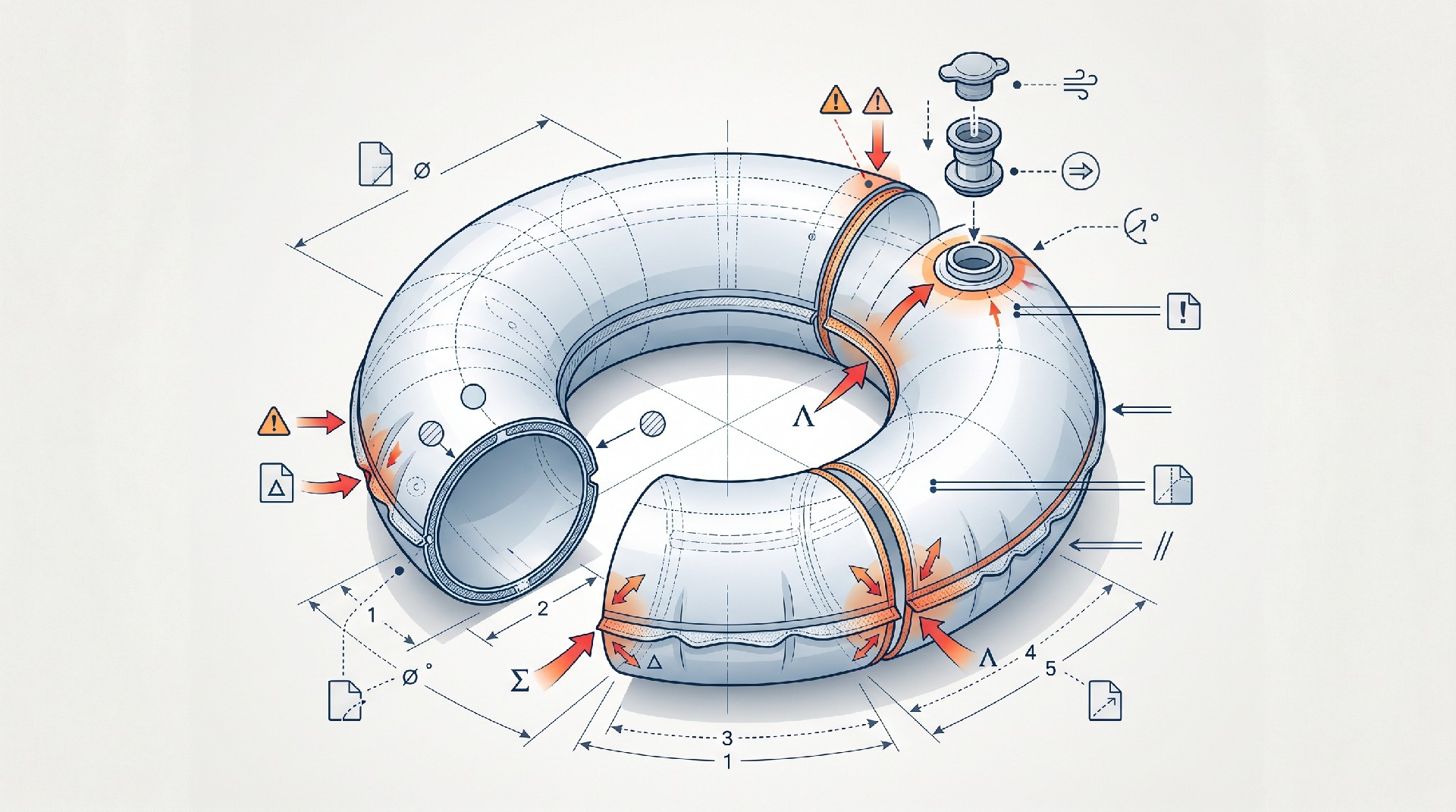
Understand What You Are Packing Before You Fold It
Inflatable swimming rings are typically made from 0.18–0.30 mm PVC film, though TPU and laminated nylon variants exist at higher price points. The material thickness, valve type, and seam construction determine how aggressively you can fold the ring without causing permanent deformation.
Valve Types and Their Packing Vulnerability
Pinch valve (Boston valve): The most common on recreational rings. The internal diaphragm can crease if folded sharply and left compressed for days. Pack with the valve stem extended, not pushed in.
Spring-loaded valve: More durable under compression but the spring can take a set if the valve is depressed continuously. Avoid placing heavy items directly on the valve.
Plastic screw valve: The cap and threads are the weak point. Cross-threading during repacking is common when sand is present. Keep the cap on and clean the threads before the return trip.
Seam Construction and Fold Lines
Heat-sealed seams are standard on mass-market rings. The seam itself is stronger than the surrounding film, but repeated folding along the same seam line creates a fatigue point. For international travel, vary the fold pattern on the outbound and return legs if the ring will be packed for more than 72 hours.
Typical commercial range: Recreational rings from 60 cm to 120 cm diameter use 0.18–0.25 mm PVC. Larger rings and those marketed for adults often use 0.25–0.30 mm film with reinforced seams. Verify the actual gauge against the product datasheet—do not assume thicker is always better, because thicker film resists folding and may require more luggage space.
The Packing Sequence: Deflate, Clean, Protect, Compress
Step 1: Deflate Completely—Not Partially
A partially deflated ring is the worst packing state. The trapped air expands during flight as cabin pressure drops, stressing seams from the inside. Deflate until the film is flat and wrinkle-free with no residual air pockets. Open the valve and roll the ring from the far side toward the valve to push air out, then close the valve only after the ring is fully flat.
Step 2: Remove Sand, Salt, and Moisture
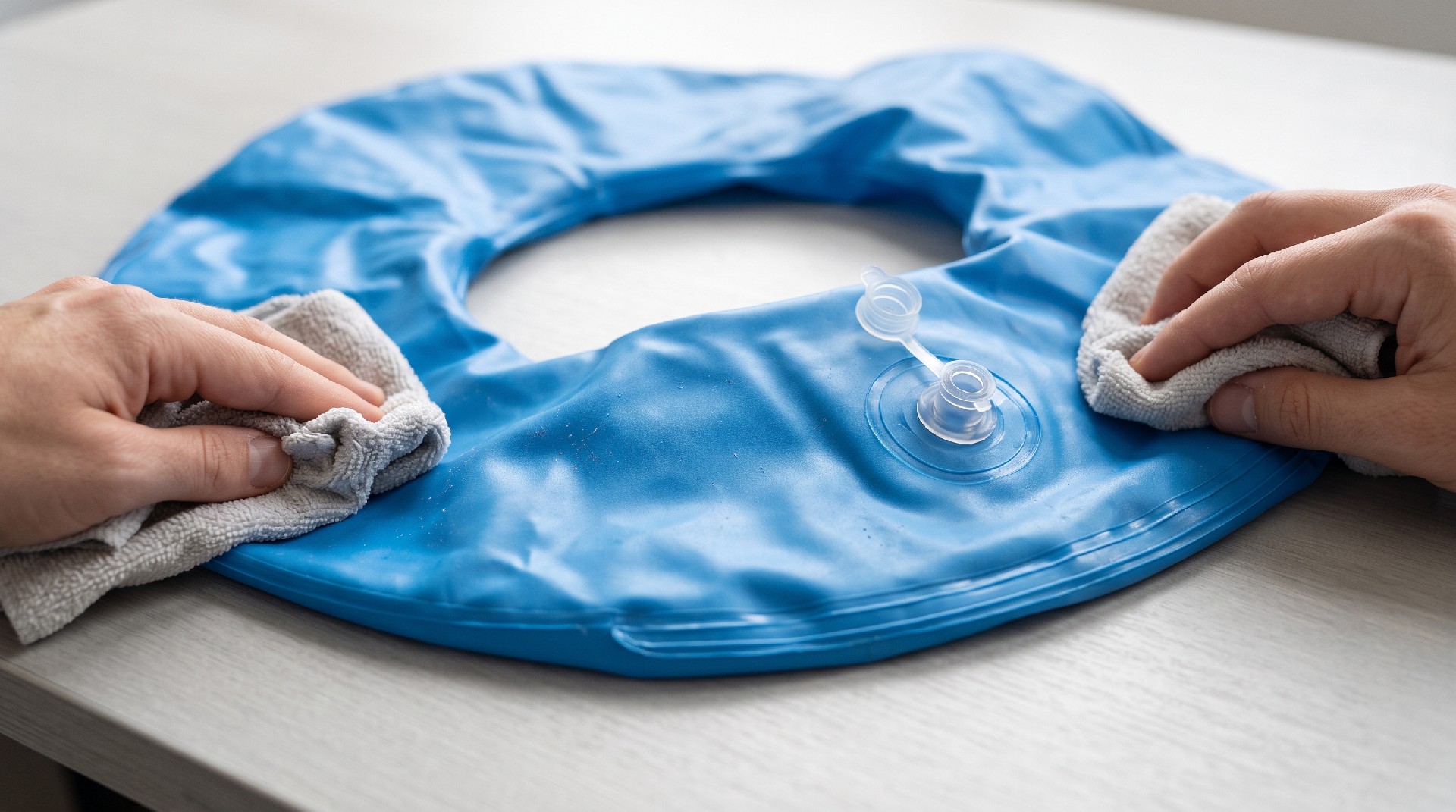
Sand granules trapped in the fold creases act as abrasives during transport. Rinse the ring with fresh water, dry it completely with a microfiber cloth, and inspect the valve area for grit. Salt residue attracts moisture and can degrade PVC plasticizers over time, making the film brittle on subsequent trips.
Step 3: Protect the Valve
Wrap the valve stem in a small piece of soft cloth or bubble wrap and secure it with a rubber band—not tape, which leaves adhesive residue. The goal is to prevent the valve from being compressed against the ring body or poked by adjacent items in the luggage.
Step 4: Fold Along Curves, Not Straight Lines
Inflatable rings are toroids. Folding them flat requires converting the curve into straight segments, which concentrates stress at the fold vertices. Fold in thirds or quarters along the natural curve, then fold the resulting arc in half. Avoid creasing the same point repeatedly.
| Packing Method | Best For | Typical Packed Volume (90 cm ring) | Risk Level | Key Precaution |
|---|---|---|---|---|
| Rolled | Short trips, pinch valves | 25–30 cm diameter × 15–20 cm length | Low | Roll from far side toward valve to expel air |
| Flat-packed | Long trips, multiple rings | 40 × 30 × 10 cm | Medium | Re-fold every 72 hours; vary fold lines |
| Vacuum-compressed | Maximum space savings | 30 × 20 × 8 cm | High | Screw valves only; unpack immediately on arrival |
| Carry-on (rolled) | Budget airlines, no checked bag | 20–25 cm diameter × 12–18 cm length | Low | Use compression straps, not vacuum bags |
Space Management: Rolled vs. Flat-Packed vs. Vacuum-Compressed
The three practical packing methods for international travel each have distinct tradeoffs:
Rolled: Best for short trips and rings that will be used within 48 hours of arrival. Rolling distributes stress evenly but creates a bulky cylinder. A 90 cm ring typically rolls to approximately 25–30 cm diameter and 15–20 cm length.
Flat-packed: Best for longer trips and multiple rings. Fold the deflated ring into a flat rectangle and place it at the bottom of the suitcase. This method minimizes volume but concentrates fold stress. Do not exceed 72 hours in a flat-packed state without unpacking and re-folding.
Vacuum-compressed: Best for maximum space savings but highest risk. Vacuum bags remove air but also compress the valve and seams under uniform pressure. Use only for rings with screw valves and reinforced seams, and unpack immediately upon arrival. Never vacuum-compress a ring with a pinch valve—the diaphragm can invert and fail to seal.
Buyer-side target: For a family of four traveling with four rings, flat-packing in a single 60 L compression sack typically occupies 15–20% of a standard checked suitcase. Vacuum-compression can reduce this to 8–12% but increases the risk of valve deformation.
Pressure and Temperature: What Happens in the Cargo Hold
Checked luggage compartments are pressurized but not to sea-level equivalence. Cabin pressure at cruising altitude is typically equivalent to 1,800–2,400 m elevation, which means a fully deflated ring with trapped air will expand during flight. This is why complete deflation matters more than any other packing step.
Temperature is the second factor. Cargo holds can drop to 5–10°C on long-haul flights. PVC film becomes stiffer and more prone to cracking at low temperatures. Allow the ring to reach room temperature before inflating—do not inflate a cold ring immediately after arrival, as the film may crack at the fold lines.
Return-Trip Packing: The Often-Ignored Half of the Problem
The return packing sequence is where most rings are damaged. Sand, salt, and haste combine to produce poor folds and contaminated valves. Follow the same four-step sequence—deflate, clean, protect, compress—but add one step: inspect the ring in daylight before packing. Look for pinholes, seam separation, and valve wear. A ring that held air all week may have a slow leak that only becomes apparent when packed under pressure.
Decision Checklist for International Beach Holiday Packing
Is the ring completely deflated with no trapped air? (If not, re-deflate.)
Is the valve clean, dry, and protected from compression? (If not, clean and wrap.)
Is the fold pattern varied from the outbound leg? (If not, re-fold along different lines.)
Is the ring packed in a way that allows inspection without full unpacking? (If not, reconsider the packing method.)
Is the return-trip cleaning kit—fresh water, microfiber cloth, valve brush—packed? (If not, add it.)
The packing method that works best for your trip depends on ring material, valve type, trip duration, and available luggage space. Choose rolled packing for short trips and pinch-valve rings, flat-packing for longer trips and multiple rings, and vacuum-compression only when space is critical and the ring has a screw valve with reinforced seams. When in doubt, prioritize valve protection over space savings—a damaged valve makes the ring unusable, while a slightly bulkier pack only costs you a few liters of luggage volume.
