

Start With Water Volume, Not Diameter
For a family of four, the most common sizing mistake is choosing a pool by its outer footprint rather than by usable water volume and wall height. A pool that looks generous on a showroom floor or product photo can feel cramped once four people are actually inside it, and an oversized pool can waste water, chemicals, and heating energy while taking days to reach a comfortable temperature. The practical starting point is to estimate how each family member will use the pool: standing, sitting on the floor, floating, or supervised play for children.
As a working target, many four-person families find that a round inflatable pool with a water depth of roughly 60–75 cm (24–30 in) and a water volume of approximately 3,000–5,000 liters gives enough room for two adults and two children to sit or stand comfortably without constant contact. These figures are typical residential ranges, not fixed rules: actual comfort depends on wall height, floor shape, and whether the pool uses a flat floor or an inflated air floor that reduces usable depth.
Match Pool Dimensions to How Your Family Actually Swims
Once you have a rough volume target, convert it into dimensions. For a family of four, the two most practical shapes are round and rectangular. Round pools distribute water pressure evenly and are usually faster to set up, while rectangular pools provide more straight-line swimming space for the same footprint.
Round pools
A round pool with an outer diameter of about 2.4–3.0 m (8–10 ft) is often the sweet spot for four people. At 2.4 m, two adults can sit facing each other with children between them, but active play is limited. At 3.0 m, four people can move around without stepping on each other, and there is enough room for a small inflatable ring or ball game. Above 3.6 m, the pool starts to behave like a small above-ground pool: longer fill times, more chemical demand, and a larger footprint that may not suit a balcony, small yard, or patio.
Rectangular pools
A rectangular pool measuring roughly 2.6–3.0 m long by 1.6–1.8 m wide can feel more spacious for four because the corners create separate zones. Adults can sit at one end while children play at the other. However, rectangular inflatable pools often have lower walls than round models of similar footprint, so verify the actual water depth rather than the external height.
Depth and wall height
For families with young children, a water depth of 45–60 cm is usually safer and easier to supervise, but adults will find it shallow for soaking. A depth of 60–75 cm suits mixed-age families better, provided children are always supervised and the pool is never left filled and unattended. Pools deeper than 75 cm begin to require more serious safety planning, including fencing or a lockable cover, and are often classified differently for compliance purposes.
Key Sizing Variables Buyers Should Compare
The table below summarizes the decision factors that matter most when sizing an inflatable pool for four people. Treat the values as typical residential targets, not universal specifications, and confirm the final dimensions, water capacity, and safety labeling with the supplier or on the product datasheet.
| Decision Factor | Typical Target for Four People | Why It Matters | Buyer Check |
|---|---|---|---|
| Water volume | 3,000–5,000 liters (typical residential range) | Determines how crowded the pool feels and how much water and chemical treatment is needed | Confirm actual water capacity on the datasheet, not just outer dimensions |
| Outer diameter (round) | 2.4–3.0 m | Balances usable space against footprint, fill time, and storage | Measure available space plus 60 cm clearance on all sides |
| Length x width (rectangular) | 2.6–3.0 m x 1.6–1.8 m | Provides more straight-line space for the same footprint | Check whether wall height reduces usable water depth |
| Usable water depth | 45–60 cm for young children; 60–75 cm for mixed-age families | Affects safety, supervision needs, and adult comfort | Verify water depth separately from external wall height |
| Floor type | Flat floor for depth; air floor for comfort | Air floors reduce usable depth by roughly 5–10 cm | Confirm floor construction and inflation chamber count |
| Liner thickness | 0.30–0.50 mm PVC (seasonal residential use) | Thicker material resists punctures but increases weight and packed volume | Ask for material specification and construction details |
| Drain design | Bottom drain preferred for pools above 3,000 liters | Simplifies emptying and reduces standing water | Confirm drain valve size, hose compatibility, and safe discharge location |
| Setup surface | Level, firm, debris-free surface with 60 cm clearance | Uneven ground increases seam stress and collapse risk | Check slope, deck load capacity, and local safety requirements |
Material, Floor, and Drainage Choices That Affect Usable Size
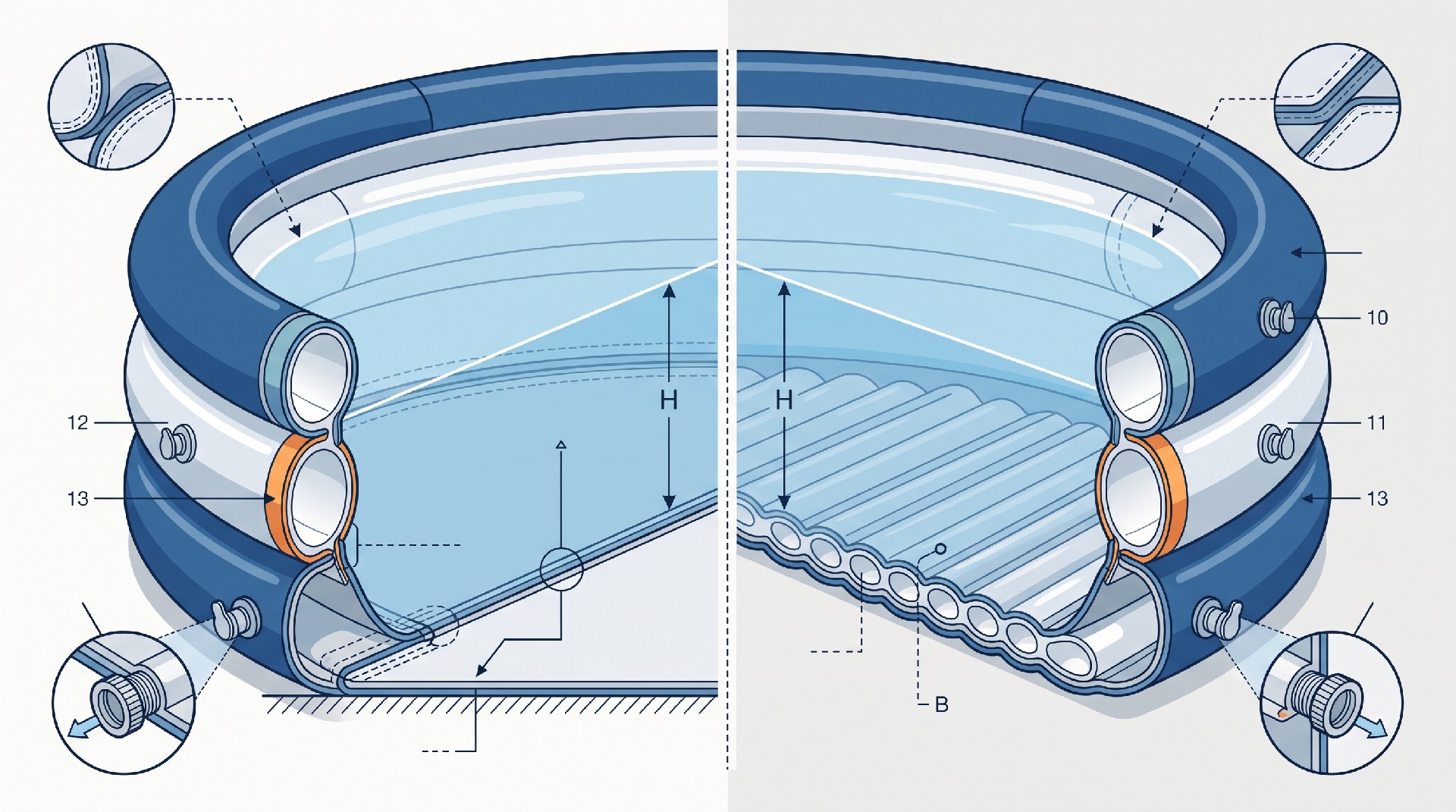
Two pools with identical outer dimensions can feel very different inside. A flat floor gives the full wall height as usable depth and is easier to clean, but it can feel hard underfoot. An inflated air floor adds cushioning and insulation from cold ground, but it typically reduces usable water depth by 5–10 cm and adds an extra inflation chamber that must be maintained.
Liner thickness also matters. Pools made from 0.30–0.50 mm PVC are common for seasonal residential use. Thicker material improves puncture and abrasion resistance but increases weight and packed volume, which matters if the pool will be stored in a small space or moved frequently. Multi-layer PVC with a polyester mesh core generally offers a better strength-to-weight ratio than single-layer film, but the exact construction should be confirmed with the supplier.
Drain design affects how practical a larger pool is. A bottom drain valve lets you empty the pool without lifting or siphoning, but it requires a flat, stable surface and a safe discharge point. A side drain is simpler but leaves more standing water. For a four-person pool in the 3,000–5,000 liter range, a bottom drain plus a garden hose adapter is usually the most convenient setup. Always check local rules for where pool water can be discharged, especially if it has been treated with chlorine or other chemicals.
Setup Surface, Space, and Safety Clearance
An inflatable pool needs a level, firm, debris-free surface. A slope of even a few centimeters can cause uneven wall loading and increase the risk of seam stress or collapse. Measure the outer footprint plus at least 60 cm of clearance on all sides for access, supervision, and safe entry and exit. If the pool will sit on a deck, verify the deck's load capacity: a 4,000-liter pool weighs roughly 4,000 kg in water alone, before accounting for people and the pool structure.
For families with young children, plan the pool location so it is visible from the house and can be covered or emptied after each use. Inflatable pools are not a substitute for constant adult supervision. If the pool will be left filled for extended periods, check whether local safety requirements apply, such as fencing, covers, or alarms, and confirm the product's labeling and instructions for the intended market.
[IMAGE_2]
Decision Sequence for a Family of Four
Use this sequence to narrow the choice before ordering:
Estimate volume first: target roughly 3,000–5,000 liters for mixed adult and child use.
Choose shape by space: round for even loading and quick setup, rectangular for longer swim lines.
Confirm usable depth: 45–60 cm for young children, 60–75 cm for mixed-age families.
Check the floor type: flat floor for maximum depth and easy cleaning, air floor for comfort and insulation.
Verify drainage: bottom drain for larger pools, side drain for smaller or temporary setups.
Measure clearance: outer footprint plus 60 cm on all sides, plus a level surface.
Confirm compliance and labeling: ask the supplier which standards, warnings, and instructions apply to the specific model and market.
Choose a pool near the smaller end of the range if storage space, water cost, or setup time is limited. Choose a larger pool only if you have a level surface, a safe discharge point, and a realistic plan for filling, treating, covering, and emptying it. When in doubt, prioritize usable depth and floor comfort over a few extra centimeters of diameter, because four people in a well-proportioned 2.7 m pool will be more comfortable than four people in a poorly shaped 3.2 m pool.
