

The Sand and Snow Anchoring Problem: Why Standard Stakes Fail
Securing a tent in loose sand or soft snow is a fundamentally different engineering challenge from setting up on firm ground. The search intent behind "Best Ways to Secure Tent Guylines in Loose Sand or Snow" is driven by commercial operators, rental fleet managers, and expedition outfitters who have experienced the operational and financial consequences of inadequate anchoring: collapsed shelters, interrupted events, damaged equipment, and in some cases, safety incidents. The core issue is not stake strength, but holding capacity in a granular, shifting medium. A standard steel or aluminum stake that performs well in compact soil will, in loose sand or snow, simply pull out under moderate wind load, often without warning. This guide focuses on the commercial specification, selection, and deployment of anchoring solutions for tents in these challenging substrates. We will cover specific anchor types, required holding capacities, deployment techniques, and the critical decision factors for bulk procurement.
Understanding Anchor Holding Capacity in Granular Media
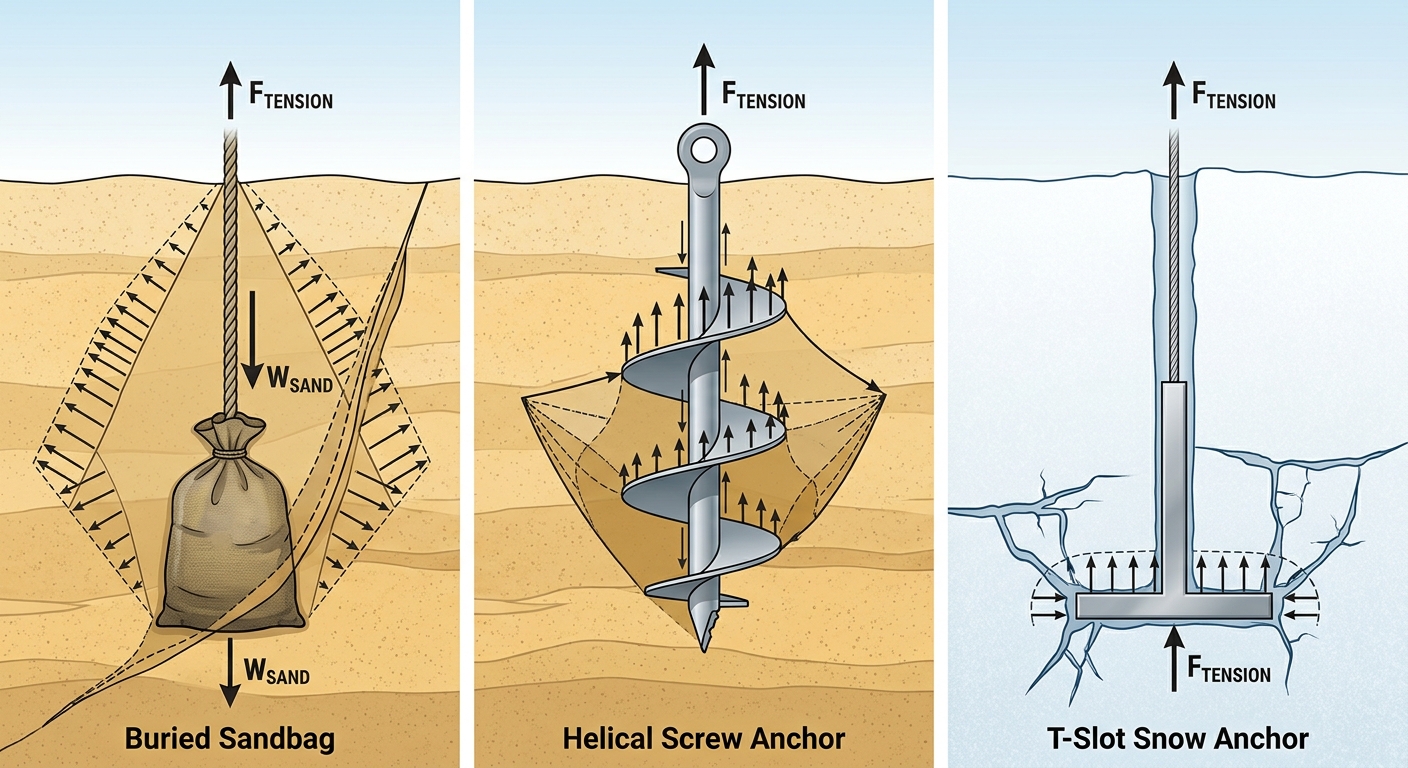
The holding power of an anchor in sand or snow is determined by the surface area of the anchor in contact with the medium, the depth of burial, and the angle of the guyline relative to the anchor's axis. In loose sand, the failure mode is typically shear failure of the sand mass above the anchor. For a flat plate anchor (such as a disk or sandbag), the holding capacity is primarily a function of the burial depth to anchor width ratio (D/B). A target of 30-50 kg (66-110 lbs) per anchor point is a common commercial target for small to medium shelters (up to 20 m²) in wind conditions up to 40 km/h (25 mph). For larger structures or higher wind loads, this target can increase to 75-100 kg (165-220 lbs) per anchor point. For snow, the holding capacity depends on the compaction and cohesion of the snow, which can vary dramatically. Deadman anchors (bags or plates buried horizontally) are more effective in snow than screw anchors, as they rely on the mass of the snow above them. In all cases, the angle of the guyline should ideally be between 45 and 60 degrees from the horizontal to maximize the vertical component of the load, which increases the effective weight of the material above the anchor.
Anchor Type Selection: A Technical Overview
For commercial B2B buyers, the choice of anchor is a balance of holding power, weight, packability, and reusability. The primary types are:
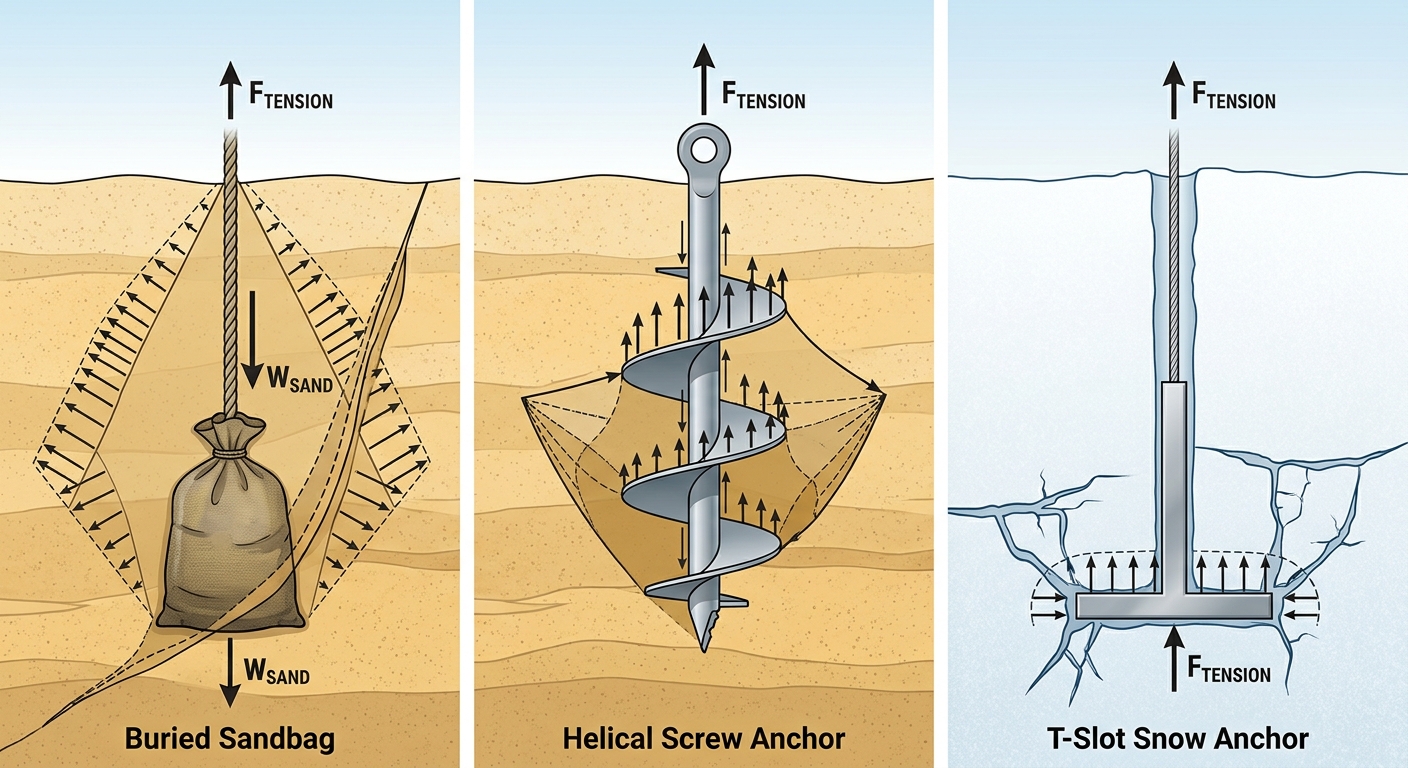
Sand Screw / Helical Anchors: These are corkscrew-shaped stakes with a large helix. They are designed to be twisted into the sand. Their holding capacity comes from the resistance of the sand to the turning motion. They are highly effective in sand but are heavy and can be difficult to remove. Typical working loads are in the range of 45-70 kg (99-154 lbs). They are less effective in snow, as the snow does not provide the same lateral resistance.
Sandbags / Deadman Anchors: This is a bag made of durable PVC or nylon that is filled with sand on-site. It is buried in a trench and the guyline is attached to a webbing loop. The holding capacity is primarily a function of the weight of the bag and the friction between the bag and the sand. A 15-20 kg (33-44 lbs) sandbag can provide a holding capacity of 30-50 kg (66-110 lbs). They are highly reliable, do not require specialist tools, and are effective in both sand and snow (using snow as fill). The key disadvantage is the labor required to dig and bury them.
Snow Anchors (Deadman / T-Slot): These are specialized anchors for snow, typically made of lightweight aluminum or plastic. They are buried horizontally in a T-slot cut into the snow. Their holding capacity is dependent on the snow quality. In firm, compacted snow, they can hold 50-80 kg (110-176 lbs), but in fresh powder, their capacity drops significantly. They are lightweight and packable.
Sand Stakes (Wide Flange): These are stakes with a large, wide blade or flange designed to prevent the stake from pulling through the sand. They provide moderate holding power, typically 15-25 kg (33-55 lbs), making them suitable only for very low wind conditions or as secondary anchors. They are lightweight and low-cost.
Commercial Decision Framework: What to Specify
From a procurement perspective, the selection of an anchoring system must be based on a clear operational risk analysis. A rental operator deploying 50 tents for a beach festival has a different risk profile than a remote expedition outfitter. The key decision variables are:
Maximum Anticipated Wind Load: This determines the required holding capacity. We recommend specifying the anchor's holding capacity based on a design wind speed. For commercial applications, a wind speed of 60-80 km/h (37-50 mph) is often used as the design basis.
Soil/Substrate Conditions: Is the site consistently loose sand, or is there a layer of compacted sand or soil underneath? In snow, is it powder, or is there a hard, crusty layer? This will dictate the dominant anchor type to stock.
Setup and Breakdown Labor: The labor cost of deploying anchors is a significant operational expense. Helical anchors are faster to install than buried sandbags, but are more expensive and heavier. Sandbags are slower but more reliable and can be filled on-site, reducing transport weight.
Product Weight and Packed Volume: For expedition use or remote events, the weight and bulk of the anchors are critical. Sandbags are lightweight when empty, while helical anchors have a high and constant weight.
Reusability and Lifecycle: Helical anchors and snow anchors are intended for multiple uses, while sandbags can be prone to wear from sand abrasion. We recommend a spare-part ratio of 5-10% for webbing loops and tie-downs.
| Anchor Type | Holding Capacity (kg) | Best Substrate | Pros | Cons | Typical Cost (B2B) |
|---|---|---|---|---|---|
| Sand Screw / Helical | 45-70 | Sand, Loose Soil | Fast install, high capacity | Heavy, difficult removal | High |
| Sandbag (Buried) | 30-50 | Sand, Snow (as deadman) | Reliable, cost-effective, packable | Labor intensive, slower | Low-Medium |
| Snow Anchor (T-slot) | 50-80 (compacted snow) | Snow (firm) | Lightweight, packable | Poor in powder snow | Medium |
| Wide-Flange Stake | 15-25 | Sand, Light soil | Lightweight, low cost | Low capacity, easily pulled out | Low |
Deployment and Installation Best Practices
The best anchor in the world will fail if it is not deployed correctly. For optimal performance, follow these commercial guidelines:
Depth is Key: For all buried anchors, the depth of the anchor is the primary determinant of holding power. A sandbag buried 15 cm (6 inches) deep will have significantly less holding capacity than one buried 30 cm (12 inches) deep. The same principle applies to snow anchors.
Angle of Attack: Ensure the guyline is perpendicular to the anchor's axis. For a sandbag, this means the webbing loop should be facing directly towards the tent. For a screw anchor, the shaft should be aligned with the pull direction.
Pre-Tension: All guylines should be pre-tensioned. Once the anchor is set, use a trucker's hitch or a line tensioner to apply a static load to the guyline. This takes up the initial slack in the system and ensures that any wind load is immediately transferred to the anchor. This also helps to seat the anchor in the ground.
Redundancy: For large tents, it is good practice to double up on critical anchor points, especially those on the windward side. This is a simple and effective way to dramatically increase the safety margin of your setup.
Maintenance and Inspection
Regular inspection of anchoring hardware is essential for safety and lifecycle management. Webbing loops on sandbags should be inspected for abrasion and UV degradation; replacement of webbing is a common maintenance task. Metal stakes should be inspected for bending and corrosion; a failure due to a hairline crack in a helical anchor is a significant safety risk. For snow anchors, check for deformation of the metal plates. We recommend an inspection checklist before every deployment, focusing on the condition of webbing, the integrity of attachment points, and the presence of rust or cracks in metal components.
Warranty, Quality, and Supplier Selection
When sourcing anchors and guylines for commercial use, the quality of the materials is non-negotiable. Webbing should be made from high-tenacity polyester or nylon (e.g., 1000D or higher), with UV-stabilized coatings to prevent degradation. Metal components should be galvanized or powder-coated to resist corrosion. Buyers should request material test reports from their supplier. This includes tensile strength tests on webbing and pull-out tests on anchor assemblies. A reputable supplier will have records of these tests and should be able to provide them upon request. It is also advisable to request a sample for pull-testing in your specific substrate before placing a large order. For B2B buyers, the quality control (QC) process is a critical part of the supplier agreement. Ensure that the supplier's QC plan includes inspection of critical dimensions, material strength, and final assembly. A pre-shipment inspection (PSI) should be conducted to verify the quality of the final batch. This is a standard commercial practice to mitigate the risk of receiving substandard product.
Commercial Decision: Build a Systematic Approach
The best way to secure tent guylines in loose sand or snow is to adopt a systematic, engineering-based approach to specification and deployment. The cheapest option is rarely the lowest-cost option when you factor in the risks of failure, operational downtime, and potential equipment damage or injury.
For a typical fleet operation, we recommend a tiered inventory strategy: stock high-weight screw anchors for large shelters and event tents; sandbags and snow anchors for different applications; and a backup stock of simple, wide-flange stakes for low-wind use. Train your team on the specific installation procedures for each anchor type. Document your operational procedures and make them available to your staff. Develop a checklist to ensure all anchors are set correctly. By doing so, you will turn a high-risk, high-labor part of your operations into a dependable system, ensuring safety and reliability for your clients or your team.
Buyer Checklist:
Define your maximum wind load and required holding capacity.
Assess your typical substrate (sand, snow, or mixed).
Evaluate the trade-offs between anchor types (weight, packability, speed, cost).
Request material test reports and tensile strength data from your supplier.
Develop a deployment and inspection SOP (Standard Operating Procedure).
Build a spare-parts inventory (webbing, replacement stakes, tie-downs).
