

What makes an adult pool floating ring genuinely comfortable for commercial use?
For resort operators, pool equipment distributors, and hospitality buyers, the difference between a floating ring that guests use for twenty minutes and one they stay on for two hours is not luck—it is ergonomic design. While color and size are visible differentiators, the real commercial value of adult water floating rings lies in how well the product supports sustained, relaxed floating without causing neck strain, lower-back fatigue, or a feeling of instability. This article focuses specifically on the features that matter for commercial relaxation applications in resorts, hotels, cruise ships, and private clubs, not for towables, water sports, or children's products.
Commercial relevance of ergonomics in pool floats
In a high-turnover resort environment, a floating ring that is uncomfortable will simply not be used, reducing your effective amenity inventory and guest satisfaction scores. Conversely, an ergonomically sound ring can become a key differentiator in guest experience, encouraging longer poolside stays and driving incremental food and beverage revenue. For procurement teams, the commercial decision centers on three pillars: guest comfort, product durability under continuous use, and ease of maintenance.
The primary search intent for "adult water floating rings" in a B2B context is product selection and buying guide, aimed at commercial facility managers and resort buyers in the specification comparison stage. These buyers are evaluating products not for personal use but for a fleet that must withstand daily exposure to sun, chlorine, and repeated guest handling.
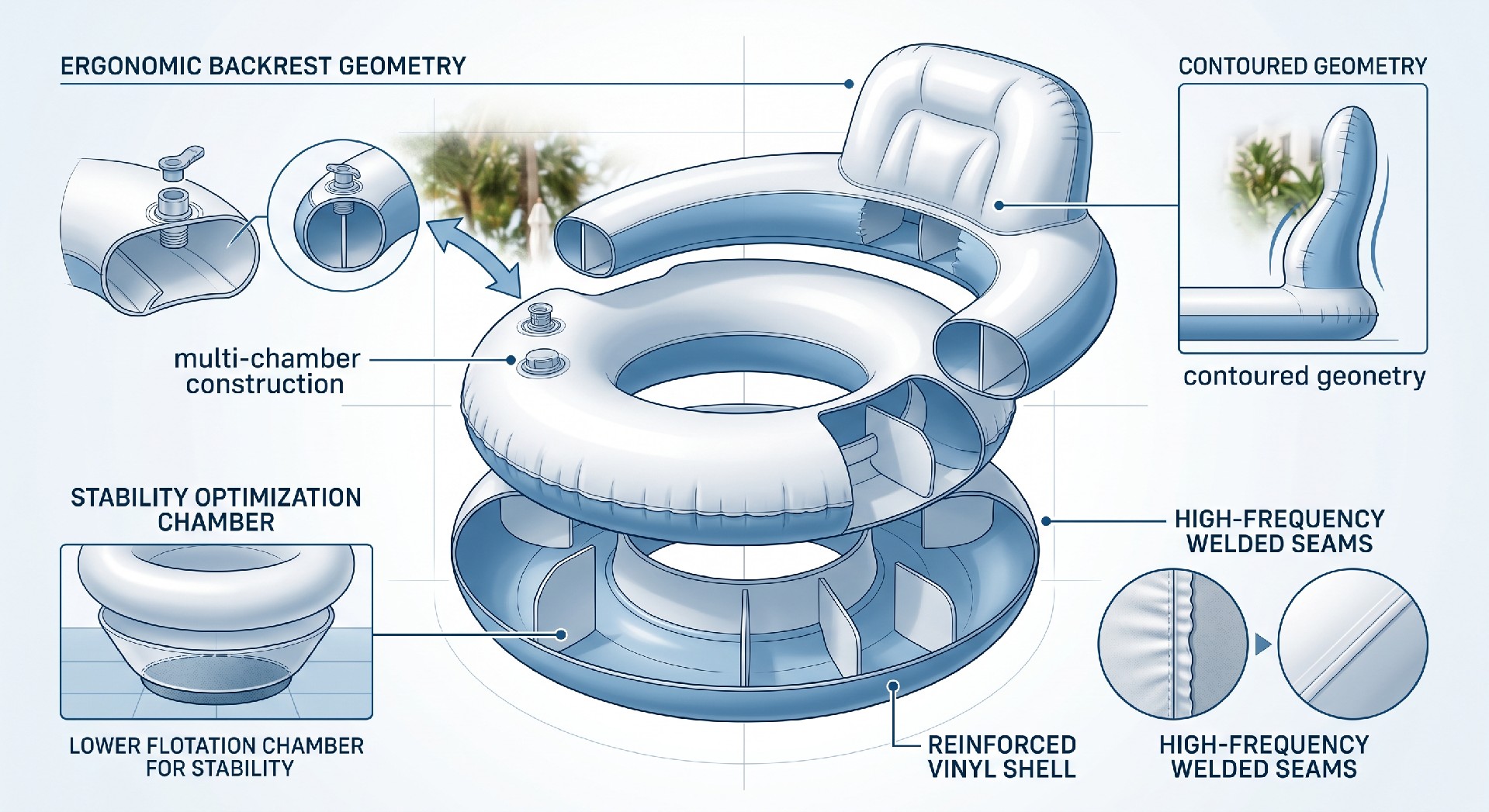
Core ergonomic features that define comfort
When specifying adult water floating rings for a commercial pool environment, the following four ergonomic features are the most critical to evaluate.
1. Contoured backrest and headrest geometry
The most significant comfort factor is the angle and depth of the backrest. A flat ring forces the user's neck into a strained, forward-curved position to keep their head above water. Commercial-grade ergonomic rings feature a raised, sculpted backrest that supports the natural curve of the spine. This is typically achieved through a multi-chamber design or a specifically shaped inflated panel that creates a 30- to 45-degree recline angle. For the end-user, this means they can relax their entire head and neck without active muscle engagement. For the buyer, this feature directly impacts perceived quality and guest satisfaction.
2. Integrated armrests and hand-grip positioning
Adult users naturally rest their arms on the sides of a floating ring. Basic designs have a uniform, cylindrical cross-section, which forces the shoulders into a hunched position. Ergonomic rings incorporate flatter, wider armrest zones, often with subtle indentations or textured grip areas. These features allow the user to relax their shoulder girdle, distributing weight across a larger surface area and reducing pressure points under the armpits. For resort operators, this translates to fewer guests readjusting or shifting, which also means less wear on the PVC from constant gripping and twisting.
3. Balanced center of gravity and flotation distribution
An unstable floating ring is inherently tiring. The user unconsciously engages their core and leg muscles to prevent tipping. Ergonomic rings are engineered with a lower center of gravity. This is often achieved by positioning the air chambers so that more volume is located below the waterline, increasing stability. A well-balanced ring will remain level, even when the user shifts their weight to enter or exit the pool. This stability is crucial for poolside accessibility, allowing guests of varying mobility to mount and dismount safely.
4. Leg and thigh support
Extended floating in a standard ring leaves the legs dangling, which can cause lower-back strain. Premium adult floating rings often include extended leg supports that keep the thighs floating horizontally, maintaining a natural, straight posture. This feature, sometimes referred to as a lounge extension, significantly reduces fatigue and is highly valued by users who intend to float for an hour or more.
Material and construction: support and longevity
Ergonomics is not just about geometry; it is also about pressure retention. A soft, underinflated ring will allow the user to sink lower in the water, changing the intended support angles. Conversely, an over-inflated ring becomes rigid and uncomfortable. Commercial buyers should specify a working pressure range that balances rigidity with comfort. Typical commercial ranges for these products are 0.5 to 0.7 PSI, which provides enough stiffness for support while retaining a yielding quality for comfort.
The material choice directly influences this feel. While 0.20-0.25 mm PVC is common, thicker 0.30 mm or 0.35 mm gauge offers better shape retention over time and resists the stretching that can alter ergonomic geometry after many inflation cycles. A critical construction detail is the seam type. High-frequency (HF) welded seams are superior for these products as they provide a uniform, flat bond that is less likely to create stiff, uncomfortable ridges along the backrest or armrests.
| Feature | Commercial Benefit | Typical Specification | Buyer Verification |
|---|---|---|---|
| Contoured Backrest | Reduces neck and shoulder fatigue, extends float time | 30-45° recline angle | Measure angle on a pre-production sample. Reject if angle is flat (<15°). |
| Balanced Flotation | Prevents tipping, improves safety for mounting/dismounting | Lower center of gravity design | Test stability by entering/exiting the sample in water. |
| Armrests | Reduces shoulder hunching and pressure points | Sculpted or integrated wider zones | Inspect for flat, contoured surfaces rather than simple cylindrical tubes. |
| Leg Support | Reduces lower-back strain during extended use | Extended lounge panel | Determine if this feature is required for your high-end guests. |
| Material Gauge | Ensures shape retention and long-term durability | 0.25-0.35 mm PVC (commercial range) | Request material specifications on the datasheet. Opt for 0.30+ mm for high-use fleets. |
| Seam Construction | Prevents pressure points and seam failure | High-frequency (HF) welded seams | Inspect sample for smooth, flat seams along the backrest and armrests. |
Buyer’s checklist for ergonomic adult pool rings
For commercial buyers moving from specification to supplier shortlist, the following checklist consolidates the key verification points.
Confirm backrest angle: Request a pre-production sample to measure the recline angle. A 30- to 45-degree angle is ideal for neck support. Reject samples that force the head forward.
Test armrest design: Sit on the sample in a pool environment. The armrests should allow the shoulders to sit back naturally. Look for molded or sculpted features, not just a uniform tube shape.
Evaluate stability: Enter and exit the ring. Note the amount of tipping. A stable design will have a low center of gravity, which is often indicated by a thicker bottom chamber.
Verify pressure range: Request the recommended working pressure and measure it during sample testing. The ring should hold its shape without being rock-hard. Verify the material gauge (e.g., 0.30 mm) to ensure long-term shape retention.
Inspect seam construction: Check for smooth, flat HF-welded seams along the backrest and armrests. Seams with thick overlap or glue residue are a sign of poor quality and will create pressure points.
Review test reports: Request evidence of material UV resistance and seam burst strength. For European markets, ensure compliance with REACH regulations for chemical safety in materials that contact skin.
[IMAGE_2]
Investment decision: matching ergonomics to your commercial setting
The choice to invest in premium ergonomic adult water floating rings should be guided by your specific operational profile. The highest-cost option is not always the most suitable, and the cheapest option is rarely the lowest-cost option when you factor in replacement rates and guest complaints.
For luxury resorts and high-end hotels: You should prioritize the most advanced ergonomic features—contoured backrests, integrated armrests, leg support, and the highest gauge material (0.35 mm). The enhanced guest experience justifies the higher initial CapEx, and durability reduces replacement frequency. Choose when your guest satisfaction scores are directly linked to pool amenities and your property commands premium rates.
For mid-range hotels and water parks: A balance of features is key. Prioritize a good backrest and stable flotation, but you may opt for a standard armrest design. A 0.25 to 0.30 mm gauge PVC is acceptable. Avoid rings with no ergonomic features; they will result in unused stock and poor reviews.
For rental and pop-up operations: Durability and ease of cleaning are paramount, but the user experience must still be acceptable. Look for simple contoured designs with rugged construction. You can compromise on the leg support feature if it keeps the product more compact for transport and storage, reducing logistical costs.
For cruise ships and marine environments: UV resistance is non-negotiable. Prioritize material specifications that include UV inhibitors to prevent degradation from sun exposure on deck. A stable design is also critical to mitigate the effects of slight ship movement.
Verify all manufacturer claims against the final datasheet. Insist on a pre-production sample approval process where you can physically assess the ergonomics in your own environment. This removes the guesswork from the procurement process and ensures the product you receive matches the commercial promise.
