

Introduction: The New Era of Aquatic Emergency Response
Drowning remains a leading cause of accidental death globally, with over 236,000 fatalities reported annually . Traditional rescue methods, reliant on human swimmers or hard-shell life rings, often prove too slow or dangerous in high-wave environments. The emergence of remote-controlled rescue buoys, also known as unmanned surface vessels (USVs) for lifesaving, is fundamentally transforming aquatic emergency response. These devices offer a strategic fusion of hydrodynamics, wireless control, and high-capacity buoyancy, enabling rescuers to reach victims faster and more safely than ever before .
From a product design perspective, the engineering challenges are immense. The device must be lightweight enough for rapid deployment yet robust enough to withstand harsh marine conditions. It must achieve high speeds unloaded while maintaining stability and control under a significant payload. This blog post provides a deep dive into the critical design parameters, material science, and performance metrics that define a commercial-grade remote-controlled rescue robot.
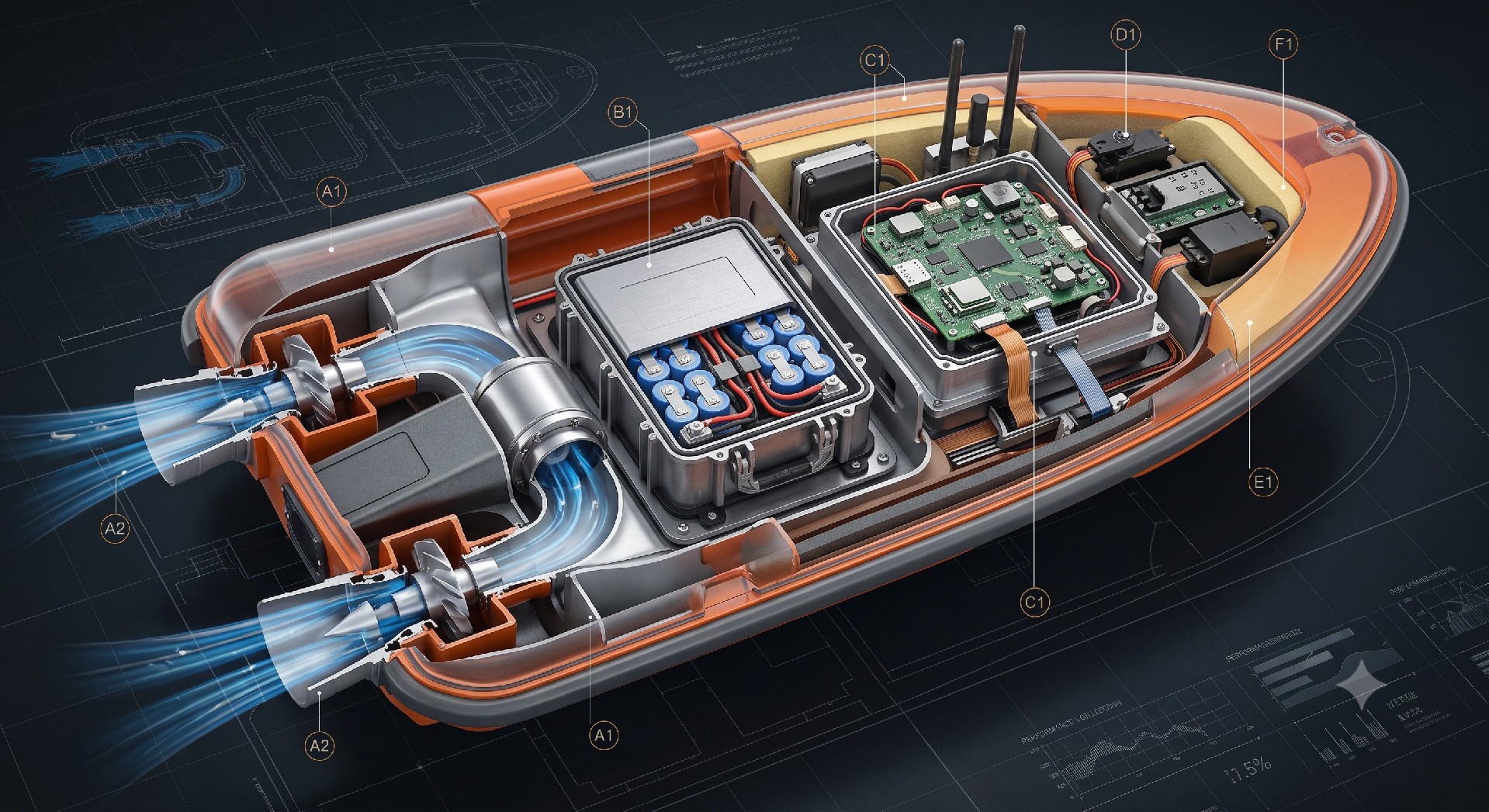
Core Design Philosophy: Speed, Stability, and Buoyancy
The primary design objective of a remote-controlled rescue buoy is to bridge the gap between a victim in distress and the arrival of professional help. The engineering focuses on three interconnected pillars:
High-Speed Transit: To minimize response time, the buoy must achieve high speeds unloaded. The integration of ducted water-jet thrusters or dual electric propellers is a standard approach, with some high-performance models achieving no-load speeds of 7 m/s (25.2 km/h) . This speed is over ten times faster than a swimming lifeguard .
Dynamic Stability: Maintaining stability in currents and waves is crucial for accurate remote control. Many advanced models utilize a Proportional-Integral-Derivative (PID) algorithm within the control system to automatically adjust direction and speed, ensuring the buoy remains responsive to the operator's commands .
Uncompromised Buoyancy: The device must reliably support the weight of multiple individuals, providing a stable platform until rescue teams arrive. Buoyancy ratings in commercial models range from a lift capacity of 225 kg to a floating capacity of 900N (approx. 91.8 kg), with some designed to tow up to 330 kg in the water .
Hydrodynamic Hull Design
The U-shaped design, prevalent in models like the RS1 and OBT1000 PRO II, is a deliberate engineering choice. This configuration creates a catamaran-like effect, which offers several advantages:
Reduced Water Resistance: The twin-hull design minimizes the waterplane area, reducing drag and allowing for higher speeds .
Self-Righting Capability: The buoy is designed to automatically self-right to a driving state if overturned. The RS1 boasts a self-righting time of just 2.3 seconds, a critical safety feature for deployment in rough surf .
Ergonomic Grip: The curved shape provides a natural and secure resting place for the victim, with fixed handles and floating ropes facilitating a secure hold .
Material Science: Structural Integrity in Harsh Environments
The choice of materials is paramount for ensuring the longevity and reliability of a commercial rescue buoy. The device is subjected to UV radiation, saltwater corrosion, impacts, and extreme temperatures, requiring a robust material selection strategy.
Shell Materials
There is a clear division in the market between High-Density Polyethylene (HDPE) and Reinforced PVC for the hull construction:
HDPE: This material is favoured for its durability, environmental friendliness, and resistance to corrosion, wear, and UV radiation. The OBT1000 PRO II, for example, uses HDPE to create a hull that is both anti-collision and flame-retardant . It is a rigid material often used in roto-molded construction, offering excellent impact resistance.
Reinforced PVC: Used in other high-end designs, this material allows for a lighter overall weight. Some advanced models feature a 2.5mm thickness of reinforced PVC to withstand punctures and abrasion . This construction often incorporates a drop-stitch core design to maintain high rigidity, a technique borrowed from premium inflatable SUPs, though the rigid shell designs are more common in current rescue buoy models.
Propulsion & Battery Systems
Reliability in the propulsion system is non-negotiable. Most commercial units utilize ducted propellers, which are encased in a metal shell to protect the user and prevent entanglement with marine debris . The battery systems are typically high-capacity Lithium Iron Phosphate (LiFePO4) units, which offer a longer lifespan and greater thermal stability compared to standard lithium-ion batteries .
| Key Parameter | Technical Specification | Example Model |
|---|---|---|
| Material (Shell) | High-Density Polyethylene (HDPE) / Reinforced PVC (e.g., 2.5mm thickness) | OBT1000 PRO II / JWR-V6-04 |
| Maximum Payload (Buoyancy) | 225 kg (Floatability) / 330 kg (Towing Capacity) | Dolphin 1 / RS1 |
| Max Speed (No-Load) | Up to 6 – 7 m/s (21.6 – 25.2 km/h) | OBT1000 PRO II / RS1 |
| Max Speed (Manned) | Approx. 2 – 3 m/s (with 75 – 80 kg load) | OBT1000 PRO II / RS1 |
| Remote Control Range | 800 – 1000+ meters (with optional GPS/Beidou) | Dolphin 1 / OBT1000 PRO II |
| Endurance | 30 – 80 minutes (continuous use) | Dolphin 1 / RS1 |
| Operating Conditions | 0°C to 50°C (Working), Max Wave Height: Up to 2m, Sea State 3 | OBT1000 PRO II / FReD |
Performance Metrics: A Data-Driven Evaluation
For a B2B buyer, fleet manager, or rescue service director, the technical specifications differentiate a superior product from an average one. The table below provides a comparative analysis of key performance indicators based on leading models currently available on the market.
| Key Parameter | Technical Specification | Example Model |
|---|---|---|
| Material (Shell) | High-Density Polyethylene (HDPE) / Reinforced PVC (e.g., 2.5mm thickness) | OBT1000 PRO II / JWR-V6-04 |
| Maximum Payload (Buoyancy) | 225 kg (Floatability) / 330 kg (Towing Capacity) | Dolphin 1 / RS1 |
| Max Speed (No-Load) | Up to 6 – 7 m/s (21.6 – 25.2 km/h) | OBT1000 PRO II / RS1 |
| Max Speed (Manned) | Approx. 2 – 3 m/s (with 75 – 80 kg load) | OBT1000 PRO II / RS1 |
| Remote Control Range | 800 – 1000+ meters (with optional GPS/Beidou) | Dolphin 1 / OBT1000 PRO II |
| Endurance | 30 – 80 minutes (continuous use) | Dolphin 1 / RS1 |
| Operating Conditions | 0°C to 50°C (Working), Max Wave Height: Up to 2m, Sea State 3 | OBT1000 PRO II / FReD |
Regulatory Compliance and B2B Standards
For commercial and emergency use, adherence to international standards is a prerequisite. Compliance ensures that the equipment meets minimum safety, quality, and performance requirements. The development of specific standards, such as the upcoming Chinese National Standard GB/T 47275-2026 for 'Technical requirements for intelligent life buoys for emergency rescue on water', set to be implemented in July 2026, indicates a global trend toward formalizing these technologies .
Other relevant certifications for B2B sourcing include:
CE Certification: A mandatory conformity mark for products sold in the European Economic Area, indicating compliance with health, safety, and environmental protection standards .
ISO 6185: A specific standard for inflatable boats, which often provides a framework for construction, materials, and safety features that are relevant to rescue buoy hulls .
REACH: Compliance with the EU regulation concerning the Registration, Evaluation, Authorisation, and Restriction of Chemicals, ensuring that materials used are safe .
Commercial Applications and Use Cases
The adoption of remote-controlled rescue drones is expanding across various sectors beyond traditional lifeguarding:
Government and Emergency Services: Used by civil protection services, coast guards, and fire departments for rapid response in rivers, lakes, and coastal areas . In nations like Germany, Switzerland, and China, these devices are integrated into national drowning-prevention programs .
Tourism and Hospitality: High-end resorts and glamping destinations are integrating these devices into their water safety protocols to enhance guest safety and provide a premium, tech-forward experience .
Maritime and Port Operations: Deployed from ships and ferries for man-overboard situations, offering a faster and more precise response than deploying a lifeboat .
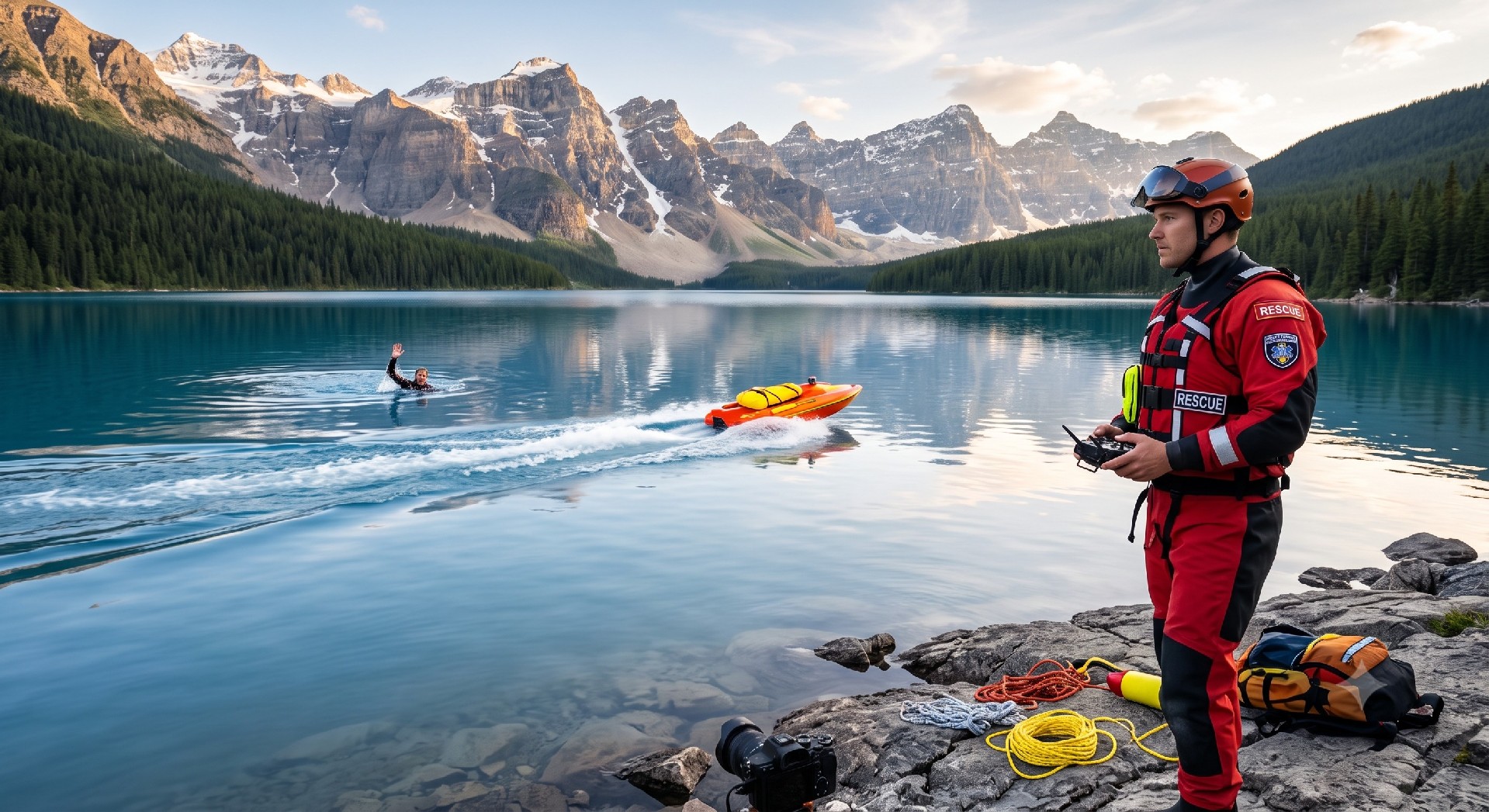
Conclusion: The Future of Aquatic Safety
Remote-controlled rescue buoys represent a quantum leap forward in drowning prevention and water rescue. By understanding the sophisticated interplay of hydrodynamics, material science, and powerful electric propulsion, B2B buyers can make informed decisions that directly impact safety outcomes. The data clearly shows that these devices are not just faster than human swimmers; they are more consistent, safer for rescuers, and capable of operating in conditions where traditional methods would fail.
For fleet managers and safety directors, investing in these advanced USVs is a strategic move to enhance operational capability, reduce liability, and demonstrate a commitment to cutting-edge safety technology. As standards like GB/T 47275-2026 come into effect and technology continues to evolve with AI and autonomous navigation, the commercial-grade remote-controlled rescue buoy will become an indispensable asset for any entity operating on or near the water .
