

Introduction: The High-Stakes Decision of Material Thickness
For B2B buyers, procurement managers, and rental fleet operators, sourcing commercial PVC inflatables is a significant capital expenditure. The single most critical—and most misunderstood—specification on any quote is material thickness. Choosing between a 0.55mm and a 0.9mm PVC tarpaulin isn't just a matter of price; it's a strategic decision that determines your equipment's lifespan, safety compliance, maintenance costs, and ultimately, your return on investment (ROI). This guide cuts through the marketing jargon to provide a data-driven analysis of PVC thickness options, empowering you to make a sourcing decision that aligns with your commercial objectives.
Decoding the Spec Sheet: Beyond the Millimeter
Before comparing thickness options, it is essential to understand that "thickness" is just one variable in a complex material formula. A responsible manufacturer's spec sheet will detail a hierarchy of interdependent factors.
The Core Components of Commercial PVC Fabric
Scrim (Polyester Base Fabric): This is the woven core that provides tensile and tear strength. It is measured in denier (D) and thread count (e.g., 1000D x 1000D / 20x20). A higher denier indicates a thicker yarn, which generally correlates with higher tear resistance, but only if the weave is tight .
PVC Coating: The polyvinyl chloride layers that encapsulate the scrim. This provides airtightness, abrasion resistance, and UV protection. The thickness of this coating, combined with the scrim, determines the fabric's total thickness.
Total Fabric Weight (GSM - Grams per Square Meter): A critical metric often overlooked. Standard commercial PVC is around 610-650 GSM, while heavy-duty materials can exceed 1000 GSM . A thicker material should logically have a higher GSM, but a low-weight, thick material could indicate a porous, foamed coating.
A common industry baseline for commercial inflatable bouncers is 0.55mm/610 GSM 1000D PVC. For high-stress applications like water slides or obstacle courses, spec sheets often call for 0.9mm or heavier material .
The Thickness Spectrum: A Detailed Technical Comparison
The choice between thicknesses is a direct trade-off between strength, weight, and cost. While thickness options can range from 0.2mm to over 2.0mm for specialized applications, commercial inflatables typically fall into three key categories.
| Thickness (Typical) | GSM Range (Typical) | Scrim Denier (Typical) | Key Applications | Commercial Lifespan (Est.) |
|---|---|---|---|---|
| 0.45mm - 0.55mm | 550 - 650 GSM | 1000D | Entry-level bouncers, residential units, occasional-use inflatables | 1-3 seasons (depending on rotation) |
| 0.6mm - 0.7mm | 650 - 850 GSM | 1000D - 1100D | High-turnover rental bouncers, dry obstacle courses, covered slides | 3-5 seasons |
| 0.8mm - 0.9mm | 850 - 1150+ GSM | 1100D - 1300D | Commercial water parks, heavy-use slides, inflatable boats, high-wear zones | 5-7+ seasons |
The Engineering Behind the Material: Seams, Welds, and Standards
Material thickness is a foundational element, but its performance is unlocked by the engineering that holds the product together. Selecting a thick fabric is pointless if the seams are its weakest link.
Seam Integrity and Construction
Heat-Welded Seams: The gold standard for commercial inflatables. High-frequency (HF) welding fuses the PVC layers together, creating a bond that is as strong as, or stronger than, the material itself. Thicker materials (0.9mm+) require more precise welding parameters to ensure a consistent, airtight seal without burning the PVC.
Glued Seams: Inferior for commercial use. Glue degrades over time and under UV exposure, leading to seam failure. This is a red flag on any commercial-grade spec sheet.
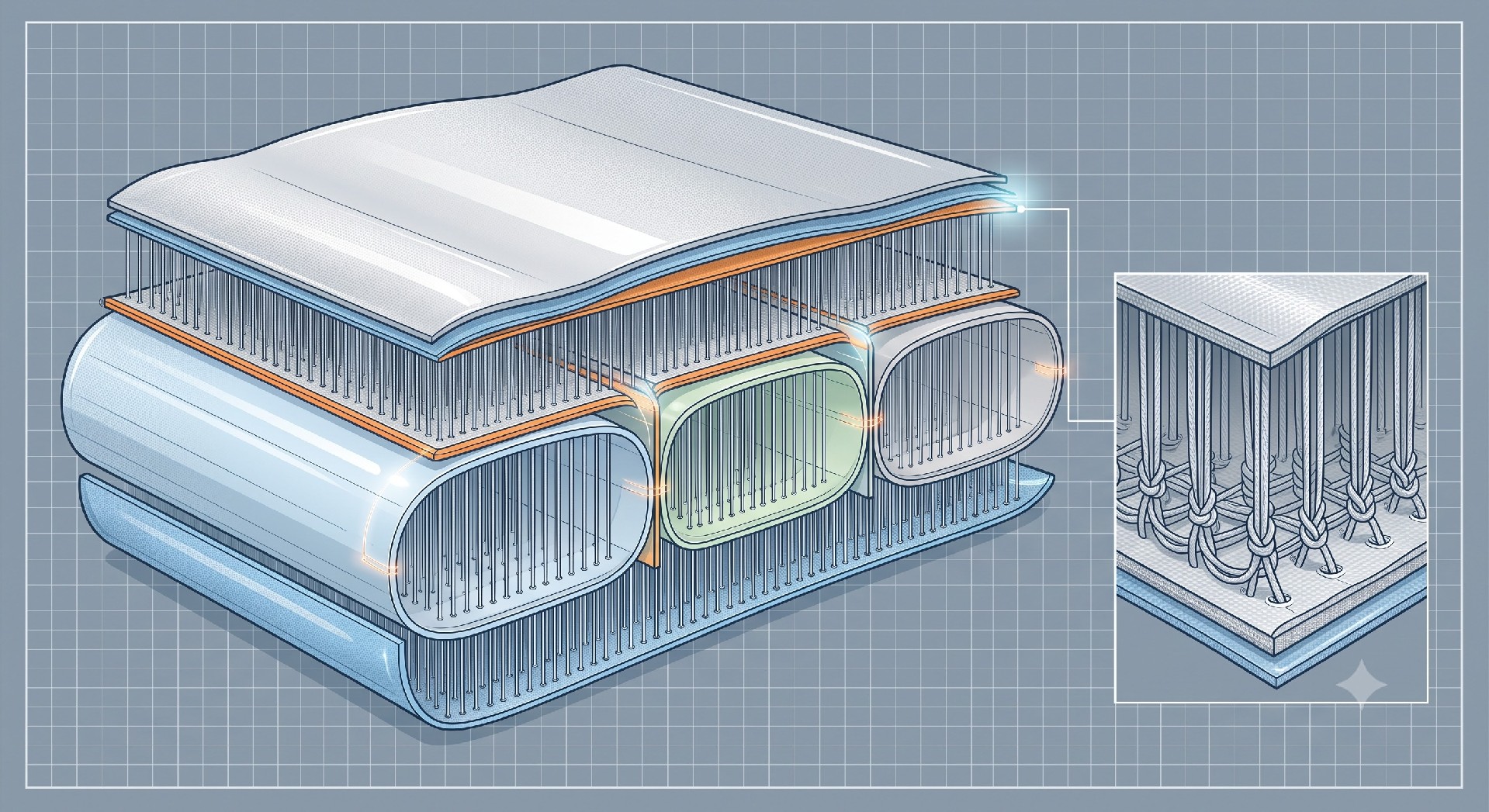
Drop-Stitch Construction: Used for rigid floors and high-pressure inflatables (like paddleboards and water park platforms). Thousands of polyester threads connect the top and bottom fabric layers. The thickness of the fabric panels used in drop-stitch construction is paramount; a failure here leads to catastrophic structural collapse .
Compliance and Safety Standards
Reputable B2B suppliers will certify their products and materials against international standards. These certifications are non-negotiable for insurance and safety compliance.
EN 14960: The European standard for inflatable play equipment, covering structural integrity, anchoring, and material safety, including fire retardancy.
ISO 6185: The standard for inflatable boats and watercraft, specifying requirements for materials, buoyancy, and construction.
REACH: An EU regulation concerning the registration, evaluation, authorization, and restriction of chemicals. REACH-compliant PVC ensures that no harmful phthalates or heavy metals are present.
Always request a material data sheet that references the test method (e.g., ISO 1421 for tensile strength, ISO 4674 for tear resistance) rather than just a stand-alone number .
Commercial Applications: Matching Thickness to Use-Case
The ideal thickness is dictated by the operational environment and expected wear and tear.
Bouncy Castles & Dry Obstacle Courses (0.45mm - 0.55mm): For lower-rotation, weekend-only rentals, a 1000D, 0.55mm material is the cost-effective standard. For high-volume FECs or daily rentals, upgrading to a 0.65mm/1100D material provides significant abrasion resistance .
Water Parks & Slides (0.7mm - 0.9mm): Water acts as a lubricant, but also introduces the risk of punctures from sharp objects underwater. The wet surface can accelerate wear. A 0.9mm PVC with a high-density scrim (e.g., 28x26) is the industry standard for durable water park equipment . For extreme tropical and high-UV environments, marine-grade PVC with enhanced stabilizers is crucial .
Inflatable Boats & High-Pressure Structures (0.9mm - 1.0mm+): Marine and rescue applications demand extreme durability and rigidity. These often use a specialized 0.9mm+ PVC or Hypalon fabric designed to withstand high PSI and saltwater exposure .
[IMAGE_2]
Conclusion: The Commercial Verdict on Thickness
Understanding the thickness options for commercial PVC inflatables is about more than just comparing numbers. It requires a holistic view of material science, seam engineering, and operational demands. While a 0.55mm material offers a lower upfront cost and lighter weight, a 0.9mm material typically delivers a measurable extension in lifespan—often adding one to three seasons of commercial use, especially in high-wear or tropical environments . For B2B sourcing professionals, the path to maximizing ROI is not to choose the cheapest material, but to select the specification that best aligns with your specific operational profile. Insist on detailed spec sheets, request third-party test reports, and treat material thickness as a critical component of your long-term fleet strategy, not merely a line item on a purchase order.
