

Introduction: The Critical Need for High-Speed Deployment in Modern Operations
In the demanding world of defense, search and rescue (SAR), and commercial marine operations, the ability to deploy forces and equipment rapidly is paramount. The modern battlefield and disaster response scenario demand connectors that are not only fast but also robust, reliable, and logistically efficient. While historical landing craft like the World War II-era Landing Craft Assault (LCA) served their purpose with a loaded speed of just 6 knots , contemporary requirements are drastically different. Today's elite units and commercial fleets require inflatable landing assault boats that can match the speed of modern operations, with some advanced designs achieving deployment times measured in seconds and transit speeds exceeding 40 knots .
This guide serves as a definitive B2B sourcing resource for engineers, procurement officers, and fleet managers. We will dissect the engineering behind these high-performance craft, focusing on material science, structural integrity, and the critical specifications that define a superior product. By integrating data-driven analysis and industry standards, we aim to provide a roadmap for selecting inflatable equipment that maximizes operational readiness and return on investment (ROI).
Material Science and Fabric Technology: The Foundation of Durability
The performance and lifespan of a landing assault boat are fundamentally dictated by its construction materials. The shift from traditional hard-shell or simple rubberized fabrics to advanced composites has been revolutionary. Drop-stitch technology, for instance, represents a paradigm shift, allowing for the creation of high-pressure, rigid inflatable structures that mimic the performance of hard-shell boats while retaining the portability of inflatable equipment .
PVC vs. Hypalon: A Comparative Analysis
When sourcing commercial-grade or military-spec inflatable boats, the choice between Reinforced PVC (Polyvinyl Chloride) and CSM (Chlorosulfonated Polyethylene, commonly known as Hypalon) is a primary consideration.
Reinforced PVC (e.g., 1100 Decitex / 1100D): Preferred for its high tensile strength, excellent UV resistance, and superior resistance to abrasion and chemicals when properly formulated. Modern military-grade PVC often utilizes a high-denier polyester scrim (e.g., 1100D) embedded between layers of PVC, providing exceptional puncture resistance. Its thermo-weldability allows for seams that are as strong as the material itself, a critical factor in high-pressure applications .
Hypalon (CSM): Historically prized for its UV and ozone resistance, Hypalon is a synthetic rubber that must be glued, making seam integrity dependent on the quality of the adhesive and the skill of the applicator. While offering good chemical resistance, its complexity in manufacturing and lower resistance to abrasion compared to modern reinforced PVC has seen a shift in preference within the industry, particularly for applications utilizing high-pressure drop-stitch floors.
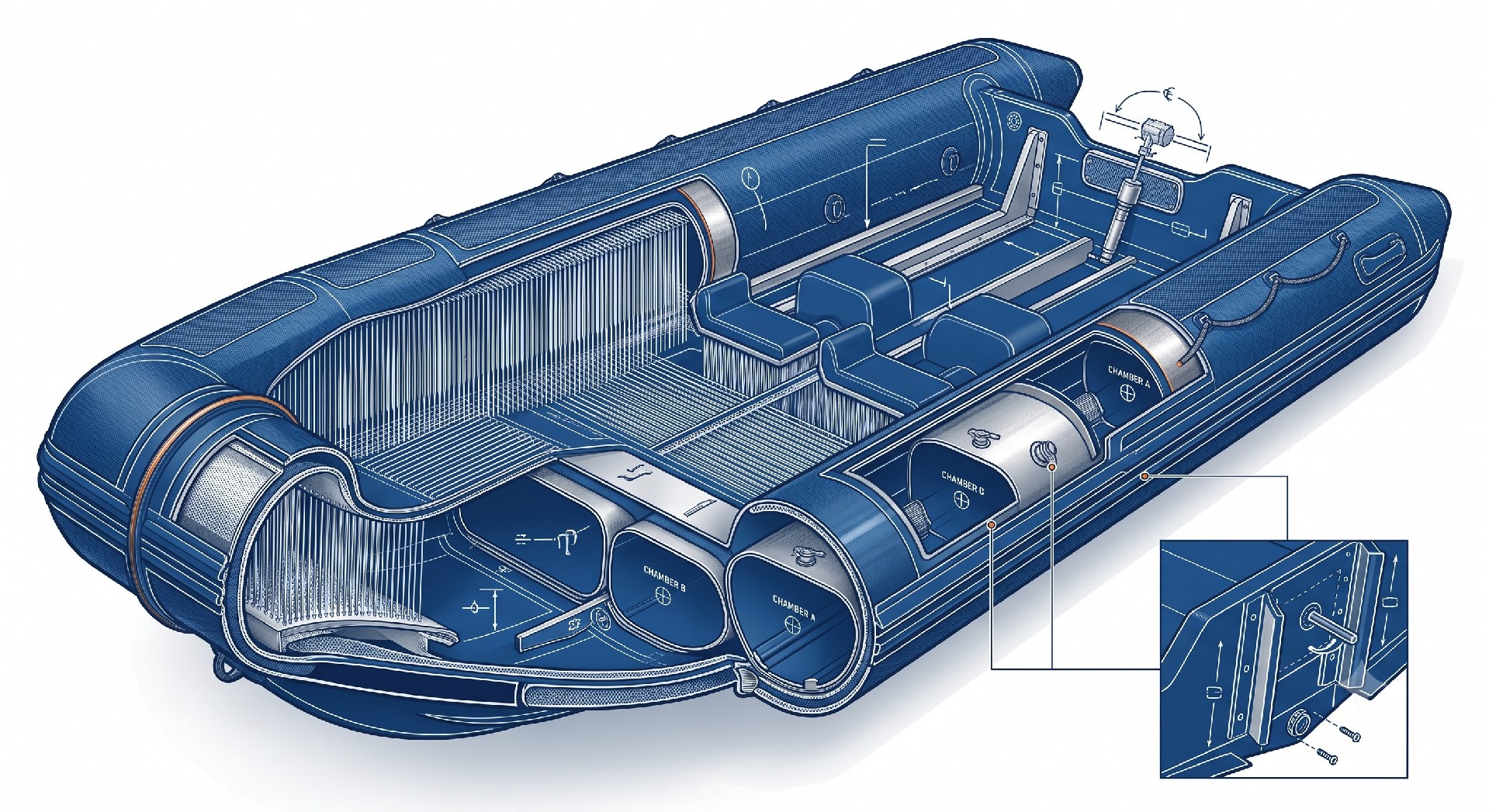
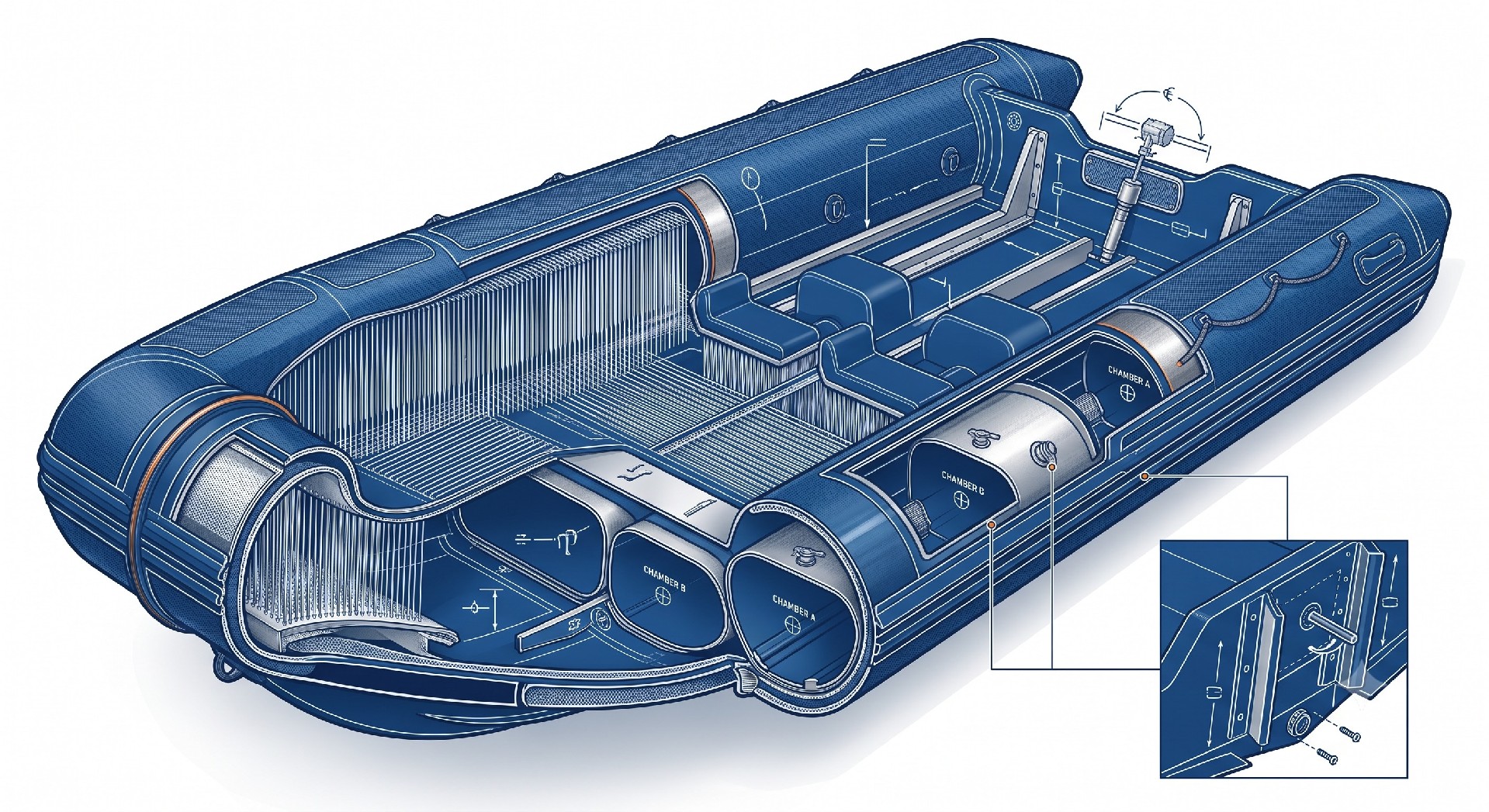
The thickness of the material is a key metric. For heavy-duty landing craft, a material thickness of 0.9mm to 1.2mm in the hull and tubes is standard, with critical wear points reinforced with additional layers or rub strakes. The drop-stitch floor itself is a marvel of engineering, consisting of thousands of high-tenacity polyester threads connecting the top and bottom fabric panels, allowing for inflation pressures of 10-15 PSI (0.7-1.0 bar), creating a rigid, plank-like surface capable of supporting heavy payloads and high-speed planing .
Engineering for Speed and Payload: Hydrodynamics and Structural Integrity
The design of a high-speed landing assault boat is a delicate balance between hydrodynamics, structural strength, and payload capacity. The hull design, whether a deep-V for rough seas or a shallow draft for beach landings, must facilitate rapid planing. High-speed deployment is not just about the engine; it is about the craft's ability to lift out of the water efficiently.
Multi-Chamber Safety and Internal Baffling
Safety in a combat or rescue environment is non-negotiable. Modern inflatable landing craft are divided into multiple independent air chambers. This redundancy ensures that in the event of a puncture, the craft retains sufficient buoyancy to remain afloat and operational. Multi-chamber designs are a standard feature, with high-end models featuring 5 or more independent chambers in the main tubes alone . This is complemented by an inflatable drop-stitch floor, which also acts as a structural component, distributing the load across the craft's footprint.
The use of heat-welded seams (thermo-bonding) is the gold standard for commercial and military-grade equipment. This process fuses the PVC material at a molecular level, creating a seam that is as strong, if not stronger, than the surrounding fabric. This eliminates the risk of adhesive degradation over time, a common failure point in glued constructions. Furthermore, compliance with strict safety standards such as CE (European Conformity), EN71 (Toy Safety Directive), ISO 6185 (Inflatable boats - Construction and performance), and REACH (Registration, Evaluation, Authorisation and Restriction of Chemicals) is mandatory for credible manufacturers, ensuring that materials are safe, non-toxic, and environmentally compliant .
Technical Specifications: The Data-Driven Decision Matrix
To facilitate a precise sourcing decision, we have compiled a technical specification matrix based on industry benchmarks for a typical 4.5m to 5.4m high-speed landing assault boat (e.g., DS-RIB 450/540 class). These figures provide a quantifiable baseline for evaluating different products.
| Key Parameter | Technical Specification (Industry Benchmark) |
|---|---|
| Overall Length (LOA) | 4.5 - 5.4 meters (14.8 - 17.7 ft) |
| Beam (Width) | 2.0 - 2.2 meters (6.5 - 7.2 ft) |
| Hull Material | Reinforced PVC / CSM (Hypalon), 0.9 - 1.2 mm thickness |
| Fabric Denier | 1100 Decitex / 1100D (High Tenacity Polyester Scrim) |
| Drop-Stitch Floor Pressure | 10 - 15 PSI (0.7 - 1.0 bar) |
| Maximum Payload | 400 - 600 kg (880 - 1320 lbs) |
| Maximum Capacity (Persons) | 10 - 12 Personnel |
| Inflation Time (Compressed Air) | ≤ 45 Seconds |
| Chamber Configuration | 5+ Independent Air Chambers (Tubes) + Drop-Stitch Floor |
| Seam Construction | Heat-Welded / Thermo-Bonded (Molecular Fusion) |
| Compliance Standards | CE, ISO 6185, REACH, EN71 |
| Top Speed (with recommended engine) | 30 - 43 Knots |
Commercial Application Scenarios: From Military to Premium Resorts
The versatility of modern landing assault boats extends far beyond traditional military applications. Their unique combination of portability, speed, and payload capacity makes them an invaluable asset across multiple B2B sectors.
Military & Defense: The primary market, where rapid deployment from ships or helicopters is crucial. Their ability to be airlifted via helicopter sling or transported in compact, deflated packages is a strategic advantage. The rapid inflation systems that can deploy a boat in under 45 seconds from a compressed air cylinder are critical for covert operations and quick reaction forces .
Search and Rescue (SAR): Their shallow draft allows them to navigate flooded areas and debris fields that would be inaccessible to larger vessels. The stability provided by the inflatable tubes and rigid floor makes them an ideal platform for personnel recovery and emergency medical evacuation.
Commercial High-Speed Ferrying: In coastal and riverine environments, these craft offer a high-speed, cost-effective alternative to traditional ferries, capable of transporting personnel and equipment to offshore platforms, remote communities, or construction sites.
Premium Water Sports and Glamping Resorts: For luxury resorts aiming to offer premium experiences, these boats provide a high-end, stable platform for guided tours, fishing charters, and remote camping expeditions (glamping). Their aesthetic appeal and robust performance enhance the guest experience, justifying a premium pricing model.
Conclusion: Optimizing ROI Through Strategic Sourcing
Designing and sourcing landing assault boats for high-speed deployment is a complex endeavor that requires a deep understanding of materials, engineering, and operational requirements. The decision between material types (reinforced PVC vs. Hypalon), the adoption of advanced drop-stitch technology, and the integration of multi-chamber safety systems are not just technical choices but strategic business decisions.
By focusing on verifiable technical specifications—such as material thickness, pressure limits, and compliance with international standards—fleet managers can significantly reduce Total Cost of Ownership (TCO). A durable, well-engineered craft with a long operational lifespan minimizes downtime and repair costs, delivering a superior ROI. As the industry evolves, the trend is clear: the future lies in high-pressure, drop-stitch inflatables that offer the performance of rigid boats with the unparalleled logistics and deployment advantages of inflatable equipment. Make your sourcing decision based on data, not just cost, to ensure mission success and long-term profitability.
