

Introduction: The Regulatory Imperative for Commercial Fleets
For B2B procurement specialists and fleet operators, the selection of commercial inflatable boats transcends mere durability—it is a matter of regulatory adherence, operational safety, and long-term financial viability. The international standard ISO 6185 explicitly excludes single-chambered boats from its safety certification for powered vessels . This regulatory stance underscores a critical engineering reality: multi-air chamber design is not a luxury but a fundamental prerequisite for legal commercial operation, particularly for vessels under 8 meters with motors of 15kW and above. This masterclass dissects the engineering specifications, material science, and compliance benchmarks that define commercial-grade multi-chamber inflatable boats, offering a definitive guide for sourcing decisions grounded in data and regulatory rigor.
ISO 6185-3:2024: The Compliance Framework
The latest iteration of ISO 6185-3 (2024) establishes the minimum safety characteristics for design, materials, manufacture, and testing of inflatable boats . Crucially, it mandates that boats in Type VII (design categories C and D, power ≥15kW) and Type VIII (design category B, power ≥75kW) must be fitted with buoyancy tubes on both port and starboard sides, explicitly excluding boats with a single buoyancy chamber . This is the regulatory baseline for any serious commercial venture. Compliance with this standard is often a prerequisite for insurance and legal operation in many jurisdictions, protecting your business from liability and ensuring fleet reliability.
Engineering the Safety Net: Multi-Chamber Architectures
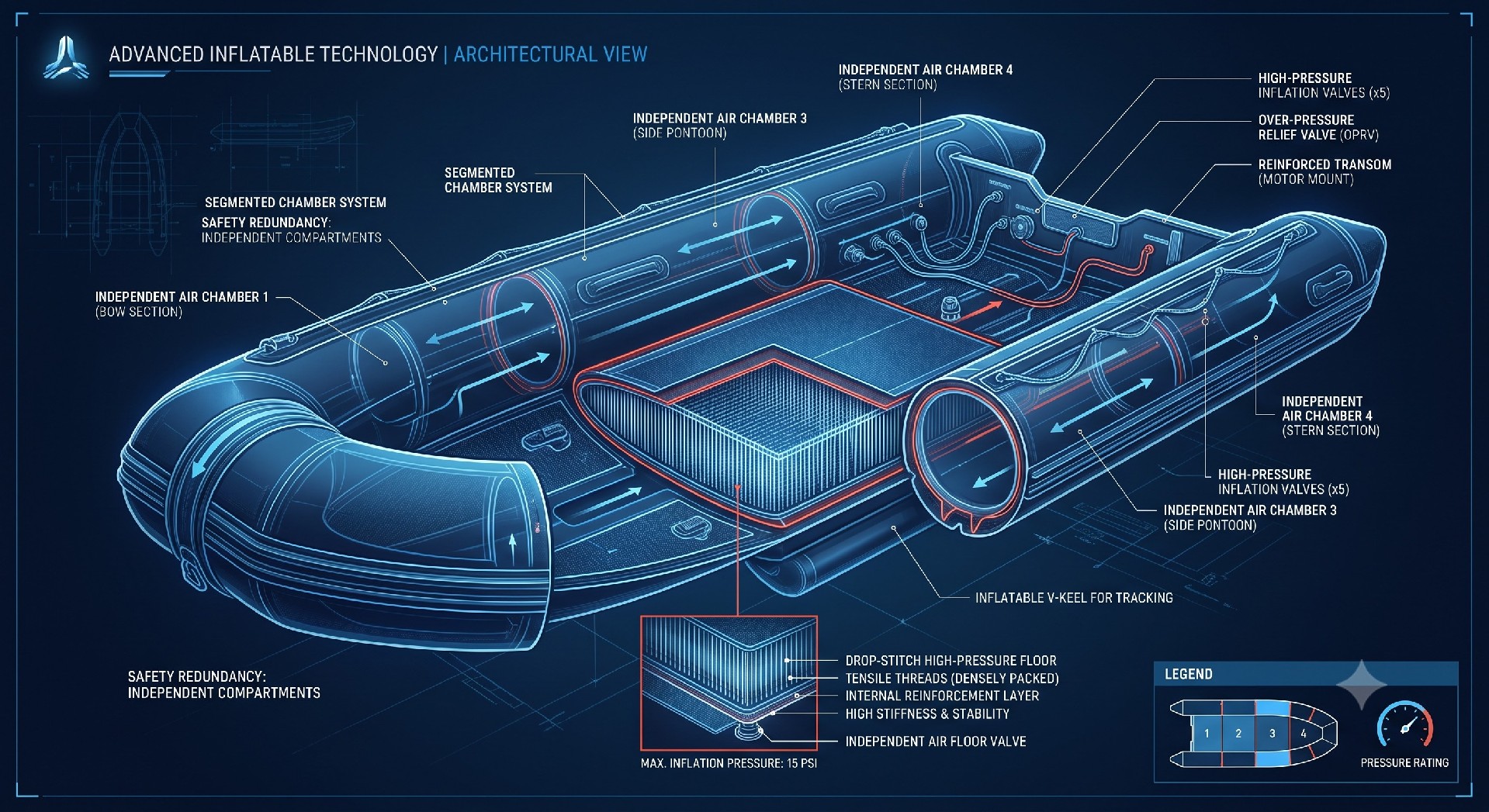
The core safety proposition of multi-chamber design lies in buoyancy redundancy. Commercial-grade vessels typically employ 3 to 6 independent air chambers . This architecture ensures that a puncture in one chamber does not result in catastrophic deflation or capsizing, allowing for controlled navigation to safety. The difference in safety margins is quantifiable: while an entry-level inflatable might feature 3 chambers, professional models can offer 5 or 6 chambers, reducing capsizing risk by up to 40% compared to 3-chamber designs . This directly impacts crew and cargo safety, a non-negotiable factor in any commercial operation.
Material Science: The Foundation of Durability
The protective envelope of these chambers is constructed from advanced materials, with a clear choice between high-grade PVC and Hypalon (CSM) rubber. The selection dictates resistance to UV degradation, abrasion, and chemical exposure—all critical in commercial service.
PVC vs. Hypalon: A Technical Comparison
Reinforced PVC: A standard for many commercial boats, offering excellent strength-to-weight ratios and cost-effectiveness. Commercial grades feature thicknesses from 0.9mm to 1.2mm, often with a 1100D (Denier) polyester reinforcement for enhanced puncture resistance. A 1.2mm Zodiac PVC hull can provide up to 40% higher puncture resistance compared to standard inflatable boats . This material is typically laminated and heat-welded for superior seam integrity.
Hypalon (CSM): The premium choice for extreme environments. Hypalon rubber offers superior resistance to UV degradation, ozone, and harsh chemicals. It is notably more abrasion-resistant than PVC, with some commercial suppliers offering Hypalon that is 20% thicker than standard PVC, resulting in a 50% longer lifespan in harsh environments . Pro models may feature Hypalon thicknesses from 0.8mm (Base) up to 1.04mm (Pro), with tensile strength meeting ASTM D412 standards .
Both material types must meet stringent safety standards, including REACH compliance and tensile strength benchmarks (e.g., ASTM D471 for Hypalon water resistance) .
| Key Parameter | Commercial-Grade Specification |
|---|---|
| ISO Compliance | ISO 6185-3:2024 (Excludes single-chamber boats for powered vessels >15kW) |
| Material Thickness | 0.9mm – 1.2mm Reinforced PVC; 0.8mm – 1.04mm Hypalon (CSM) Rubber |
| Fabric Denier | 1100D PVC; High-grade Hypalon with ASTM D471 compliance |
| Drop-Stitch Pressure | 10–20 PSI (Optimal 12–14 PSI for rigid flooring) |
| Air Chambers | 3 – 6 Independent Chambers (Typical: 3+1 keel, 5, or 6) |
| Max Payload | 300 kg – 850+ kg (e.g., Pro model: 636 kg, DS420: 841 kg) |
| Max Tube Pressure | Up to 0.35 bar (5 PSI) for side tubes |
| Operating Temperature | -20°C to +60°C (ISO 6185 requirement) |
| Seam Construction | Heat-Welded (Superior to glued seams for durability) |
| Certifications | CE, ISO 9001, REACH, USCG (varies by model) |
Drop-Stitch Technology: Achieving Rigidity at High Pressure
A key innovation in modern commercial inflatables is the integration of drop-stitch material, particularly for the hull floor. Drop-stitch fabric consists of two PVC-coated layers connected by thousands of fine, high-tenacity polyester threads . This structure allows for inflation to significantly higher pressures—typically 10-20 PSI, with optimal performance at 12-14 PSI—creating a rigid, plank-like surface that rivals hard-shell boats .
Welded Seams vs. Glued Seams
Seam construction is critical. Heat-welded seams, using techniques like drop-stitch welding, are superior to glued seams. Welding fuses the material at a molecular level, creating an airtight, durable bond that preserves the structural integrity of the internal drop-stitch threads . Glued seams, while simpler, are more susceptible to degradation over time. Commercial-grade boats rely on welded seams to maintain their structural integrity under the high pressure required for drop-stitch rigidity. This is particularly vital for the flooring, as a rigid, flat bottom allows for greater energy transfer from the motor and better planing performance .
Technical Specifications Matrix
The following table summarizes critical specifications for commercial multi-chamber inflatable boats based on industry data and ISO compliance benchmarks.
| Key Parameter | Commercial-Grade Specification |
|---|---|
| ISO Compliance | ISO 6185-3:2024 (Excludes single-chamber boats for powered vessels >15kW) |
| Material Thickness | 0.9mm – 1.2mm Reinforced PVC; 0.8mm – 1.04mm Hypalon (CSM) Rubber |
| Fabric Denier | 1100D PVC; High-grade Hypalon with ASTM D471 compliance |
| Drop-Stitch Pressure | 10–20 PSI (Optimal 12–14 PSI for rigid flooring) |
| Air Chambers | 3 – 6 Independent Chambers (Typical: 3+1 keel, 5, or 6) |
| Max Payload | 300 kg – 850+ kg (e.g., Pro model: 636 kg, DS420: 841 kg) |
| Max Tube Pressure | Up to 0.35 bar (5 PSI) for side tubes |
| Operating Temperature | -20°C to +60°C (ISO 6185 requirement) |
| Seam Construction | Heat-Welded (Superior to glued seams for durability) |
| Certifications | CE, ISO 9001, REACH, USCG (varies by model) |
Commercial Application Scenarios & ROI
The multi-chamber design is the backbone of reliability for various commercial sectors. For high-throughput rental operations, the safety and peace of mind offered by 3-6 chamber designs directly translates to reduced liability and greater customer confidence . In rescue operations, such as those conducted by lifeguard and emergency services, the redundancy is not just an advantage but a mission-critical feature. The NDiver DS420, for example, is a commercial boat with 3+1 (keel) chambers, a 7-person capacity, and a max load of 841 kg, designed for the most demanding rescue operations .
Calculating the Total Cost of Ownership (TCO)
While the upfront cost of a multi-chamber commercial boat is higher than a consumer-grade alternative, the TCO analysis favors the commercial design. Longer material lifespans (reinforced Hypalon lasts up to 50% longer), reduced downtime due to punctures, and compliance with safety regulations (which can lower insurance premiums) contribute to a superior ROI. Furthermore, the ability to withstand rigorous use in harsh environments—operating within a temperature range of -20°C to +60°C as specified by ISO 6185 —ensures year-round operational capability.
Conclusion: Engineering for Safety and Profitability
The multi-air chamber design is the cornerstone of commercial inflatable boat engineering, mandated by international safety standards like ISO 6185-3:2024. For the B2B buyer, the choice is clear: investing in a vessel with a robust, multi-chamber architecture, constructed from high-denier PVC or Hypalon with heat-welded drop-stitch floors, is an investment in safety, operational uptime, and long-term profitability. When sourcing, prioritize certified materials (CE, REACH, ISO 6185), scrutinize the material thickness, PSI capabilities, and chamber count, and understand that true commercial-grade equipment is defined by its adherence to these rigorous engineering and compliance standards. Do not compromise on safety or specification—your fleet's reputation and your bottom line depend on it.
