

Procurement Pain Points: Navigating the High-Strength PVC Equipment Market
For B2B buyers and commercial operators, sourcing High-Strength PVC Water Equipment is a critical investment. Whether you are expanding a rental fleet, equipping a water sports resort, or procuring for rescue operations, the market is flooded with options that vary wildly in durability, safety, and long-term value. The key challenge is moving beyond price-per-unit to evaluate the total cost of ownership, material integrity, and compliance with international standards. This guide provides a data-driven framework to assess manufacturers and ensure your investment yields maximum ROI and operational safety.
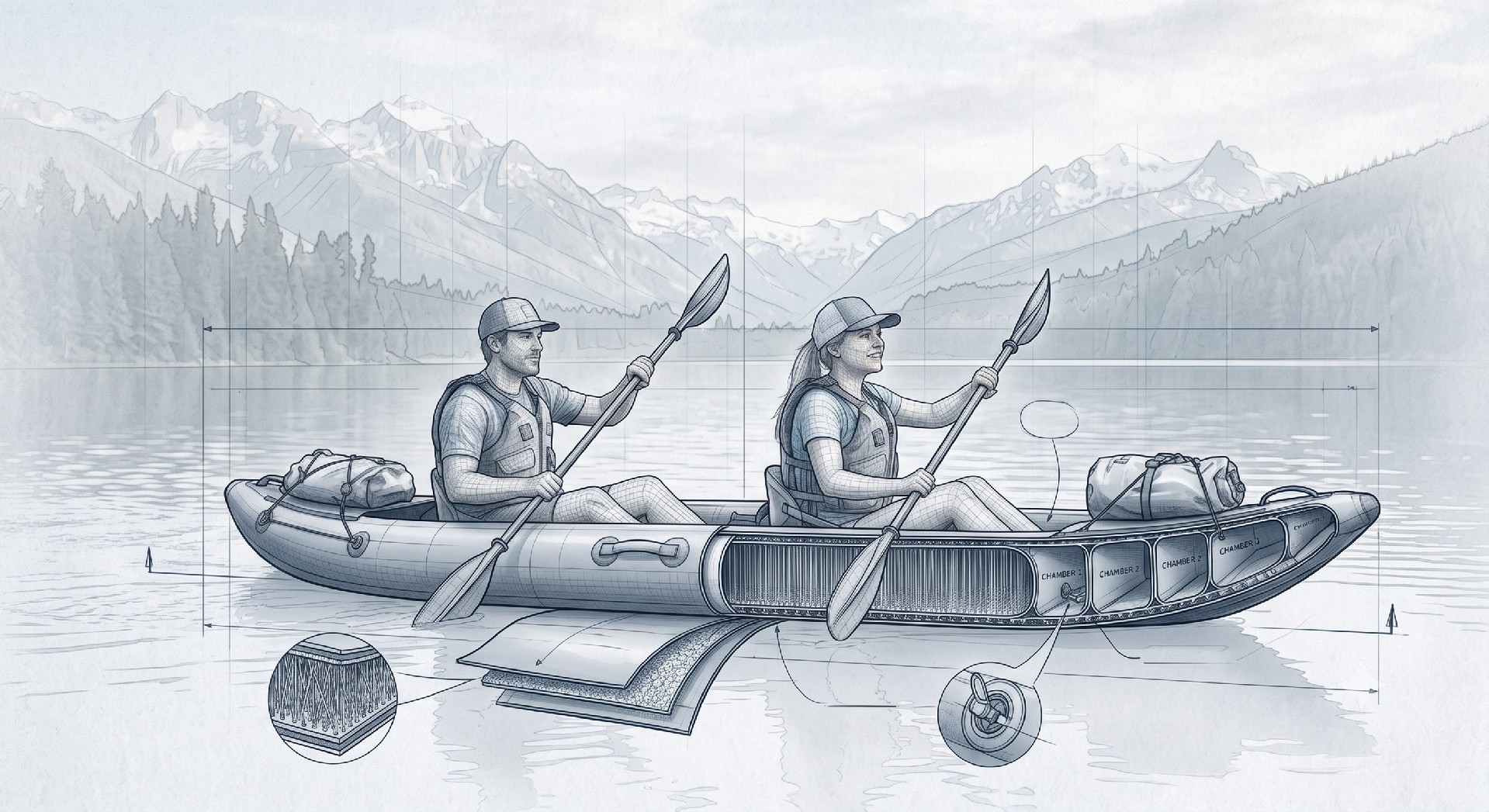
Fabric Technology Deep Dive: The Core of High-Strength PVC
The foundation of any high-strength PVC water equipment is the fabric itself. A superficial assessment of material thickness is insufficient; buyers must demand specific metrics and understand their implications.
Reinforcement and Denier Count
Look for specifications on the textile reinforcement. A high denier count (e.g., 1100D) indicates a denser, more abrasion-resistant fabric. For extreme commercial use, materials often feature a woven polyester scrim sandwiched between PVC layers. This construction provides the tensile strength needed to handle high payloads without stretching, a common failure point in lower-grade products .
Drop-Stitch Core Physics
In high-pressure inflatables (like paddleboards and docks), the drop-stitch core is a game-changer. This technology uses thousands of threads connecting the top and bottom PVC layers. When inflated, these threads hold the material in a rigid, flat shape, creating a structure that mimics a hard shell. When evaluating manufacturers, ask for the maximum sustainable PSI (Pounds per Square Inch). Commercial-grade drop-stitch equipment should comfortably handle 10-15 PSI, while premium offerings can exceed 20 PSI, offering significantly higher rigidity and payload capacity.
Weld Engineering and Seam Integrity
The most advanced material is useless without flawless seams. High-quality manufacturers use high-frequency (HF) heat welding to fuse PVC layers at a molecular level. This creates a bond that is as strong as the surrounding material. In contrast, inferior glued seams are prone to hydrolysis and delamination over time. For critical applications like rescue boats, inspect the seam structure: multi-layer overlap and internal seam taping are hallmarks of superior engineering. Look for evidence of strict quality control, including air-retention tests where the product is left inflated for 24 hours to detect pressure loss.
Technical Specifications Matrix
To objectively compare suppliers, use this benchmark table as a minimum standard for commercial-grade equipment.
| Key Parameter | Technical Specification | Commercial Significance |
|---|---|---|
| Material Thickness | 0.9mm - 1.2mm / 1100D Reinforced PVC | Higher denier and thickness ensure greater puncture and abrasion resistance for high-use commercial fleets. |
| Max Payload | 400 - 800 kg / 880 - 1760 lbs | Directly impacts the number of users or weight of cargo the equipment can safely support. |
| Drop-Stitch PSI | 10 - 22 PSI | Determines structural rigidity. Higher PSI equates to a more stable, hard-shell-like platform. |
| Seam Construction | High-Frequency (HF) Heat-Welded | Provides a molecular bond, superior to glued seams, ensuring long-term durability and air retention. |
| Industry Standards | CE, EN71, REACH, ISO 6185 | Certification assures compliance with international safety, environmental, and quality benchmarks. |
Portability vs. Hard-Shell Alternatives
One of the primary advantages of high-strength PVC equipment is its portability. However, this portability hinges on engineering efficiency. Evaluate the manufacturer's approach to deflation efficiency and storage. A well-designed product should feature high-volume valves that allow for rapid deflation, enabling quick pack-down and reducing labor costs during off-season storage. Additionally, consider the packed weight and size. For a resort or rental operation, the ability to transport equipment in a standard trailer versus a dedicated flatbed truck represents a significant operational cost saving .
Commercial Use Cases and Suitability
The ideal manufacturer offers versatility. Evaluate whether their equipment is suitable for diverse scenarios: high-throughput rentals, premium glamping experiences, or extreme marine environments. For rental applications, look for features like EVA foam deck pads for comfort and multi-chamber safety systems. For glamping, the focus should be on rigidity for stability and a premium finish. The most reliable suppliers will provide detailed guidance on which material and construction specifications best suit your specific end-market .
[IMAGE_2]
Conclusion: A Strategic Sourcing Action Plan
Evaluating a manufacturer of high-strength PVC water equipment requires a strategic, technical approach. By demanding transparency on material specs, weld types, and PSI capabilities, you can identify a partner that delivers durability and safety rather than a liability. Always request samples, ask for test reports, and benchmark their technical specifications against the matrix provided. This rigorous due diligence will ensure your commercial fleet remains reliable, profitable, and compliant with global safety standards.
