

Introduction: The Commercial Opportunity in Baby Pool Water Games
For B2B buyers and outdoor equipment wholesalers, the market for inflatable baby pools represents a significant seasonal revenue stream. However, the products that drive repeat business and high rental margins are those that seamlessly integrate with a variety of fun water games for kids. Moving beyond a simple container for water, a commercially viable baby pool must serve as a durable, safe platform for activities ranging from sensory play to active water games . This guide provides a technical deep-dive into the materials, manufacturing standards, and design specifications that define a premium product, enabling buyers to make data-driven sourcing decisions that maximize ROI and ensure end-user satisfaction.
Fabric Technology and Material Science: The Foundation of Durability
The core of any high-quality inflatable baby pool is the material composition. While many consumer-grade pools use thin PVC, commercial applications demand superior resistance to punctures, UV degradation, and repeated inflation cycles. Leading manufacturers utilize phthalate-free PVC to comply with stringent safety regulations like REACH and CPSIA . The thickness of the material is a primary indicator of durability and air retention.
Material Thickness and Denier Count
Specifications vary widely, but premium products typically utilize material thicknesses of 0.18mm to 0.35mm . For example, the Swim Essentials line features a 0.18mm wall thickness, which is standard for entry-level products . In contrast, heavy-duty or reinforced options, such as the Aischens inflatable pool, feature a 0.35mm gauge to support dynamic play and provide enhanced stability . This increased thickness directly correlates with a higher denier count, offering greater abrasion and puncture resistance, which is critical for withstanding the rigors of active kiddie pool games like toy retrieval or water balloon activities .
Engineering for Safety: Welds, Seams, and Compliance
The structural integrity of an inflatable baby pool is determined by its seam construction and air chamber design. For commercial applications, heat-welded seams are the industry standard, as they provide a molecular bond that is stronger and more airtight than glued seams . This is essential for maintaining consistent air pressure during use and for extending the product's commercial lifespan.
Multi-Chamber Safety and Certification
Safety is paramount, and compliance with international standards is non-negotiable for B2B sourcing. Look for certifications such as EN71 (Parts 1-3), ASTM F963, and CE markings, which ensure the product is free from harmful chemicals and meets mechanical safety requirements . Advanced designs incorporate multi-chamber construction—such as the 2-ring system found in the Swim Essentials baby pool—which provides a critical safety margin . In the event one chamber is compromised, the others maintain the pool's shape and structural integrity, minimizing the risk of collapse during use . This feature is particularly vital for water games that involve children moving around the pool's edge.
Technical Specifications and Performance Metrics
| Key Parameter | Technical Specification / Industry Standard |
|---|---|
| Material Type | Phthalate-free, BPA-free PVC (per REACH & CPSIA) |
| Material Thickness | 0.18 mm (Standard) to 0.35 mm (Heavy-Duty/Reinforced) |
| Maximum User Weight | e.g., 35 kg (Certified for children up to 2-4 years) |
| Water Capacity | e.g., 15 Liters (100cm diameter model) to 30 Liters (115cm model) |
| Number of Air Chambers | 2 (Standard) to Multi-Chamber (for enhanced safety) |
| Compliance Standards | EN71-1-2-3, ASTM F963, CE, RoHS |
| Seam Construction | Heat-Welded Seams (Superior to glued seams) |
| Inflation Time | 2-3 minutes (with high-pressure / smart self-closing valves) |
The following technical benchmarks are essential for evaluating B2B baby pool products. These specifications are drawn from a review of premium products currently available in the market .
Commercial Applications: Sourcing and ROI Acceleration
For rental businesses, resorts, and event planners, choosing the right pool is about more than just the initial purchase price. It is a calculation of Total Cost of Ownership (TCO). Higher-grade materials (e.g., 0.35mm PVC) and robust construction (e.g., heat-welded seams) command a higher upfront cost, but they offer significantly longer commercial lifespans, reducing replacement frequency and warranty claims .
Integration with Fun Water Games
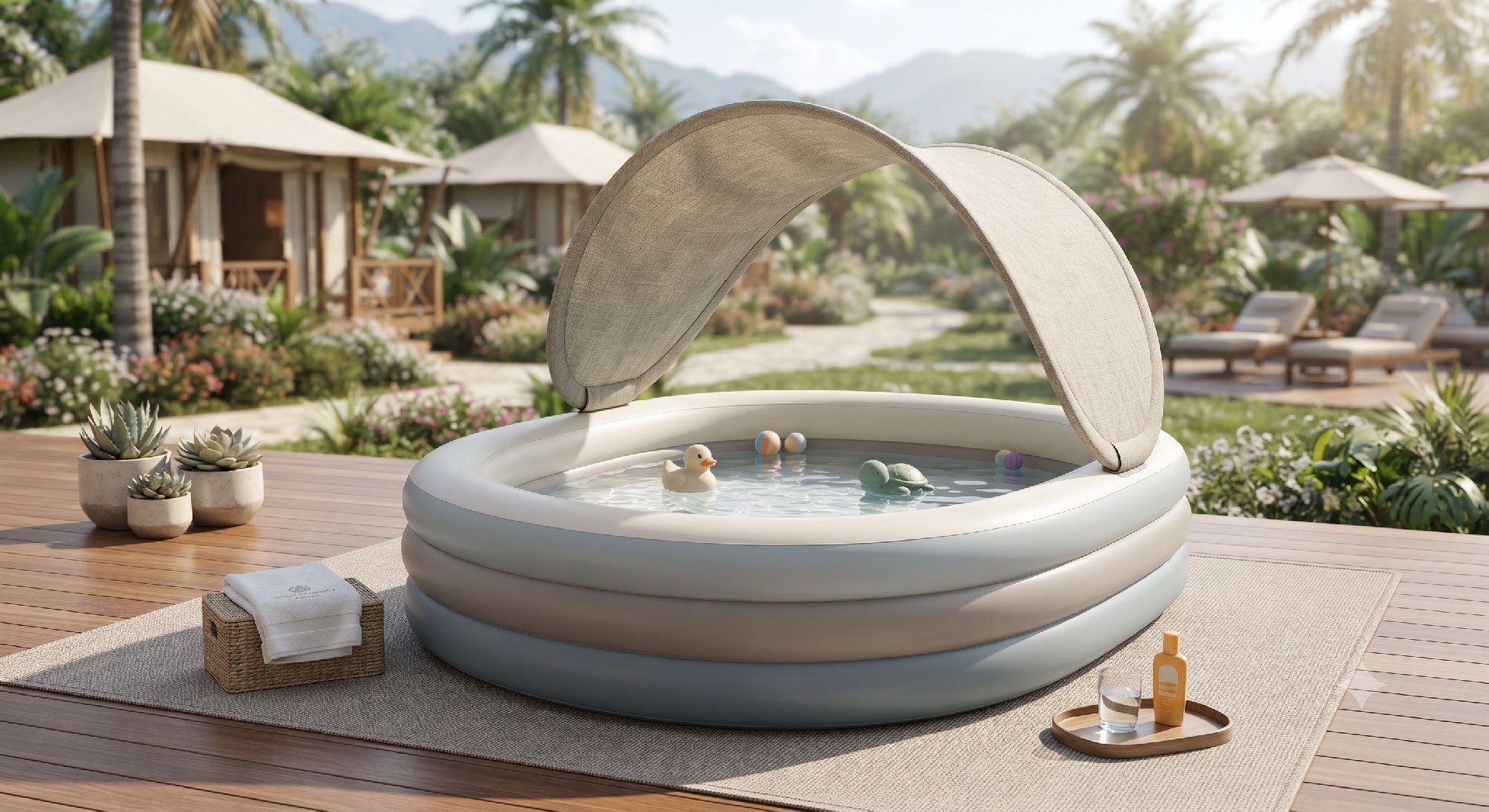
The design of the pool directly impacts its utility as a platform for fun water games. Features like a non-slip floor and integrated airbags enhance safety during active games . A deep basin is essential for activities like fishing for letters or treasure hunts , while a built-in shade canopy adds comfort during prolonged use . Sourcing from specialized Chinese manufacturing hubs, such as Guangdong and Fujian provinces, allows buyers to access suppliers offering fully customizable OEM/ODM options—from material gauge (e.g., 0.25mm PVC) to specific dimensions and UV coatings .
[IMAGE_2]
Conclusion: Strategic Sourcing for the Baby Pool Market
The B2B market for inflatable baby pools is evolving. End consumers are increasingly discerning, and the demand for products that combine water game versatility with safety and durability is growing. By prioritizing phthalate-free materials, confirmed EN71 and REACH compliance, and advanced seam engineering, B2B buyers can partner with suppliers who deliver superior value . This approach not only ensures safety and longevity for commercial use but also allows businesses to effectively market their inventory as the ideal platform for creating unforgettable summer experiences through fun water games for kids.
