

Introduction: The Gulf Market's Demand for Certified Durability
The Middle Eastern inflatable equipment market—spanning the UAE, Saudi Arabia, and Qatar—is experiencing a paradigm shift. Driven by a booming tourism sector, luxury resort developments, and high disposable incomes, the demand for commercial-grade inflatables has never been higher . However, the region presents a unique set of challenges: extreme UV radiation, ambient temperatures reaching 50°C, and saline environments that rapidly degrade substandard materials.
For B2B importers and procurement specialists, navigating the regulatory landscape is just as critical as engineering for the heat. Exporting inflatables to the Middle East requires strict adherence to a complex web of international standards (CE, ISO), regional conformity marks (G-Mark), and specific national import schemes like Saudi Arabia's SABER. This masterclass provides a data-driven technical overview of the materials, specifications, and compliance protocols necessary to succeed in this lucrative market .
Regulatory Framework: Understanding GCC Conformity and National Schemes
Your primary hurdle in exporting inflatables to the Gulf Cooperation Council (GCC) countries is product certification. The most critical certification is the Gulf Conformity Mark (G-Mark), which is mandated by the GCC Standardization Organization (GSO). While historically focused on toys and low-voltage electrical equipment, the scope for recreational and sporting goods is broadening .
The G-Mark application requires comprehensive testing against specific Gulf standards, which often mirror international norms. Importers must be prepared to provide a Product Identity Declaration (PID) and adhere to stringent labeling requirements, including Arabic safety warnings and the mandatory QR code linking to the GCTS (GCC Certification Tracking System) .
Navigating the Saudi Arabian SABER Platform
Saudi Arabia operates a distinct digital portal, SABER, for its Conformity Assessment Program. Exporters must first obtain a Product Certificate of Conformity (PCoC) before applying for a Shipment Certificate (SCoC) for each batch. The SABER platform assesses compliance with Saudi technical regulations. Significantly, as of April 2025, Saudi Arabia began enforcing stricter import controls. For certain product categories, importers are now required to submit a declaration to the Ministry of Industry and Mineral Resources to proceed with SABER certification . While inflatables are not in the immediate 'hardline' category, this signals a tightening of the regulatory environment that all commercial importers must monitor closely.
Bahrain's Industrial Licensing Scheme
In Bahrain, the import and manufacturing of inflatable boats and rafts are subject to an industrial licensing regime. This license is a prerequisite for the importation, manufacturing, and exportation of inflatable craft. The application process involves detailing investment, workforce, and production utilities, highlighting the GCC's unified approach to regulating commercial-grade marine equipment .
Material Deep Dive: Engineering for Extreme UV and Heat Resistance
The success of an inflatable in the Middle East hinges on the robustness of its material science. Standard PVC fails quickly under intense UV radiation and heat, leading to plasticizer migration, delamination, and seam failure. For commercial ROI, material selection is a non-negotiable factor .
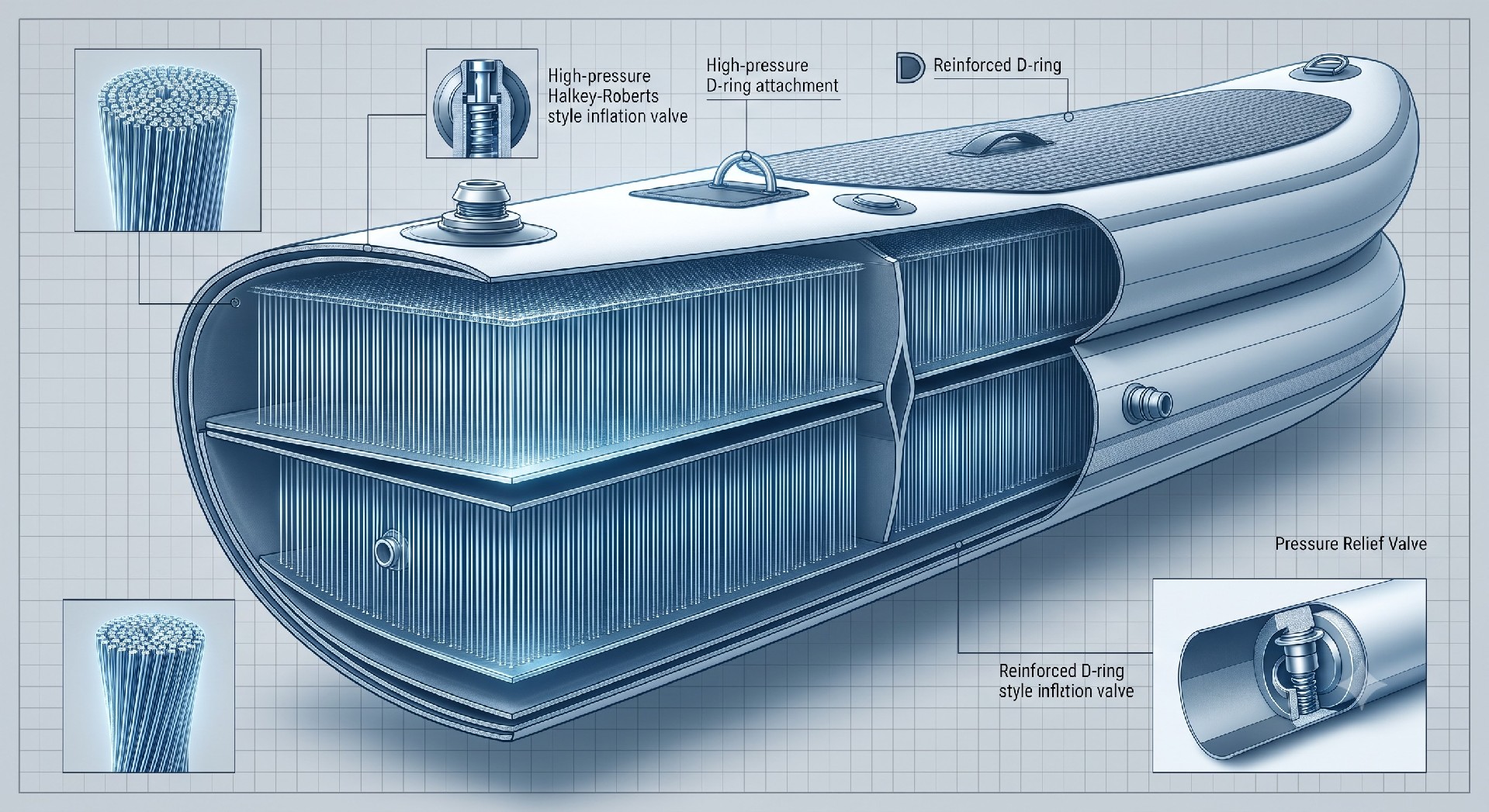
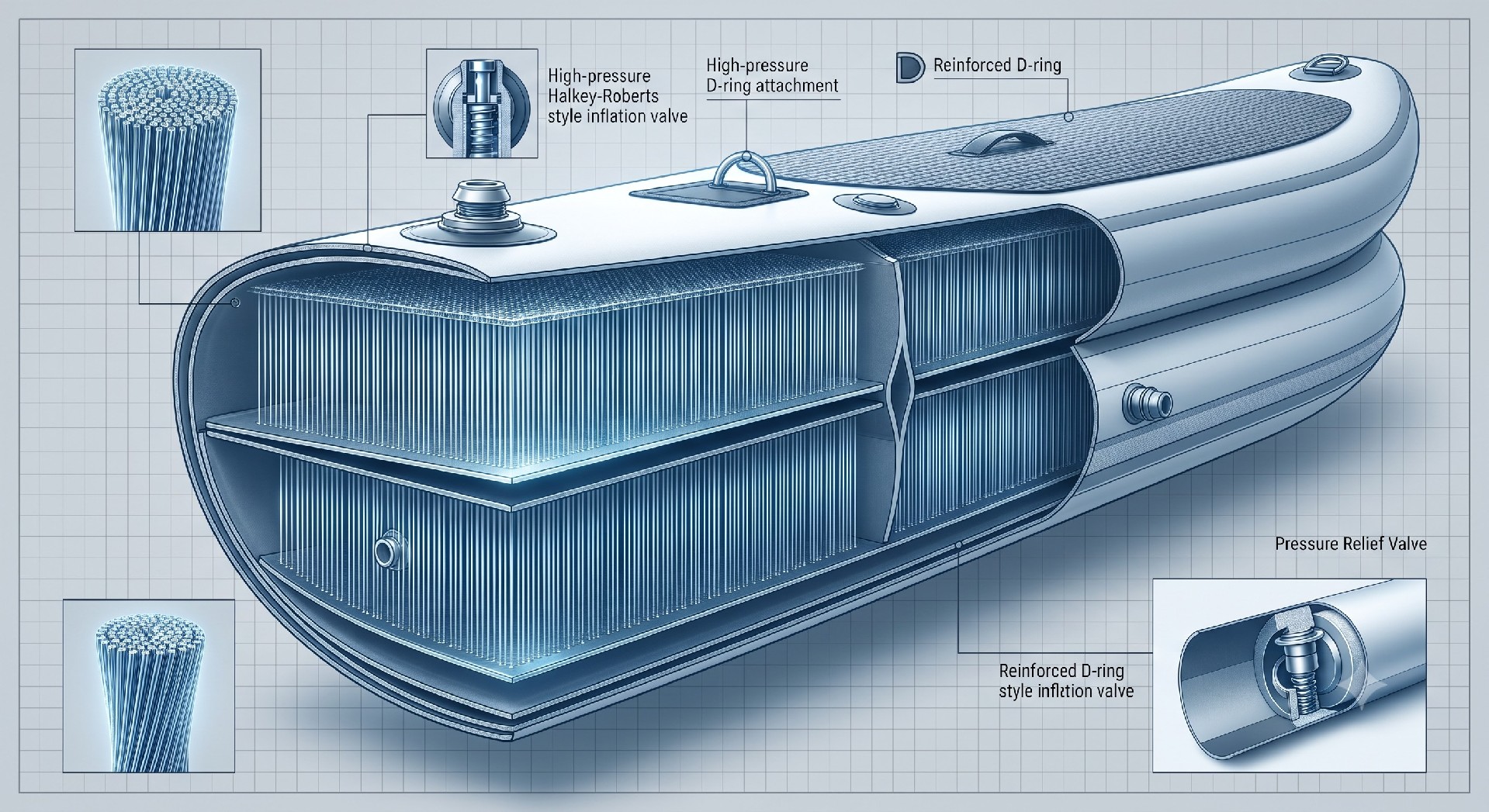
Industry best practices for GCC-exclusive exports demand the use of high-density woven drop-stitch fabric, specifically designed for thermal stability. The gold standard is 1100 Denier (1100D) or higher reinforced PVC with a machine-laminated or fusion double-layer construction. This construction minimizes the use of adhesives that can degrade, offering superior bond strength compared to traditional glued structures .
| Key Parameter | Technical Specification (Commercial Grade - GCC) |
|---|---|
| Material Composition | 0.9mm – 1.2mm / 1100D – 1500D High-Density Woven Drop-Stitch PVC (Fusion or Machine-Laminated) |
| Maximum Working Pressure | 12 – 15 PSI (High-Pressure Core for rigidity) |
| Maximum Payload | > 400 kg (Multi-chamber designs for redundancy) |
| UV Resistance | > 1000 Hours (Stabilized PVC with anti-UV additives) |
| Temperature Range | Operational from -10°C to +60°C (ISO 6185 compliance) |
| Air Chambers | Minimum 3 – 5 Independent Chambers (Safety redundancy) |
| Certification Baseline | REACH Compliant / EN71-1-2-8 / CE |
| Deflation/Packed Size | Optimized for sea freight container efficiency |
Critical Chemical Compliance: REACH and Phthalates
Beyond physical specifications, chemical compliance is mandatory. The GCC often references international chemical safety standards. While the EU's REACH (Registration, Evaluation, Authorisation and Restriction of Chemicals) regulation is specific to Europe, many Gulf buyers and regulators expect compliance with similar standards, particularly regarding the restriction of phthalates. Inflatables intended for children are strictly regulated, with limits on substances classified as endocrine disruptors. Testing standards such as EN71 (Parts 1, 2, 3, and 8) are frequently cited as the benchmark for safety, particularly in non-import dependent retail channels like the UAE .
Comprehensive Technical Specifications
| Key Parameter | Technical Specification (Commercial Grade - GCC) |
|---|---|
| Material Composition | 0.9mm – 1.2mm / 1100D – 1500D High-Density Woven Drop-Stitch PVC (Fusion or Machine-Laminated) |
| Maximum Working Pressure | 12 – 15 PSI (High-Pressure Core for rigidity) |
| Maximum Payload | > 400 kg (Multi-chamber designs for redundancy) |
| UV Resistance | > 1000 Hours (Stabilized PVC with anti-UV additives) |
| Temperature Range | Operational from -10°C to +60°C (ISO 6185 compliance) |
| Air Chambers | Minimum 3 – 5 Independent Chambers (Safety redundancy) |
| Certification Baseline | REACH Compliant / EN71-1-2-8 / CE |
| Deflation/Packed Size | Optimized for sea freight container efficiency |
The following specifications represent the minimum requirements for a commercial-grade inflatable designed to withstand the demands of the Middle Eastern market. These data points are critical for both procurement and ensuring a positive total cost of ownership (TCO).
For high-end commercial operations, moving beyond these baselines is advisable. For example, selecting a woven drop-stitch core rather than knitted ensures a higher PSI capacity and a stiffer, more rigid product, which translates to better performance and a premium feel—a crucial factor in the high-expectation Gulf hospitality sector .
| Key Parameter | Technical Specification (Commercial Grade - GCC) |
|---|---|
| Material Composition | 0.9mm – 1.2mm / 1100D – 1500D High-Density Woven Drop-Stitch PVC (Fusion or Machine-Laminated) |
| Maximum Working Pressure | 12 – 15 PSI (High-Pressure Core for rigidity) |
| Maximum Payload | > 400 kg (Multi-chamber designs for redundancy) |
| UV Resistance | > 1000 Hours (Stabilized PVC with anti-UV additives) |
| Temperature Range | Operational from -10°C to +60°C (ISO 6185 compliance) |
| Air Chambers | Minimum 3 – 5 Independent Chambers (Safety redundancy) |
| Certification Baseline | REACH Compliant / EN71-1-2-8 / CE |
| Deflation/Packed Size | Optimized for sea freight container efficiency |
Commercial Application and Operational Deployment
Understanding the operational context is vital for maximizing profitability. The Middle East is a hub for resort and glamping tourism, where premium experiences are sold at high margins. Equipment reliability is paramount in these settings.
Resort and Glamping Integration
Integrating commercial-grade inflatables into resorts requires more than just rugged construction. It requires understanding the 'heat-resistant' spectrum. UV-resistant color application is crucial—lighter base colors with controlled dark accent zones perform better and reduce heat absorption compared to heavily dark designs, which can lead to dangerous pressure increases within the tube .
Rapid Turnaround and Logistics
For rental fleets, the efficiency of inflation and deflation directly impacts revenue. The spec data on air volume and time are not just numbers; they are operational metrics. A system that allows a 12-minute inflation reduces turnaround time, allowing for higher throughput during peak seasons. Furthermore, optimizing the packing size and weight reduces shipping costs (a major factor in the total landed cost to the region) and improves storage efficiency during off-season periods .
Conclusion: A Strategic Compliance and Procurement Roadmap
Exporting inflatables to the Middle East is a high-reward venture requiring rigorous technical and regulatory preparation. The key takeaways for B2B importers are:
Prioritize Certification: Ensure your supply chain can provide the necessary G-Mark certifications and can successfully navigate the SABER platform for shipments to Saudi Arabia.
Demand Superior Materials: Reject standard PVC in favor of UV-resistant, machine-laminated PVC with woven drop-stitch cores. Insist on REACH compliance documentation.
Validate Specifications: Do not accept 'maximum payload' claims without documented proof. Require specific metrics on fabric thickness (e.g., 0.9mm / 1100D), maximum PSI (e.g., 15 PSI), and ISO 6185 compliance for watercraft .
Audit Your Factory: A professional procurement strategy involves auditing the manufacturer's capability to produce climate-appropriate gear, beyond just their price list .
By aligning procurement strategies with these technical and regulatory frameworks, importers can mitigate risk, ensure long-term durability, and maximize the commercial lifespan of their investments in this dynamic and growing market.
