

Introduction: The Regulatory Wall and the Commercial Opportunity
For B2B buyers and procurement specialists, exporting inflatable equipment to Russia—whether for commercial water sports, resort glamping, or industrial applications—presents a unique dichotomy. On one hand, the Eurasian market offers significant untapped potential; on the other, it is guarded by one of the most stringent regulatory frameworks in the world: the EAC (Eurasian Conformity) certification. The CE mark holds no legal weight here. To successfully navigate this landscape, a deep understanding of the technical regulations, material science, and a robust Total Cost of Ownership (TCO) strategy is not just advantageous—it is mandatory. As of 2026, new regulations mandate that EAC certificates include dynamic encrypted QR codes for enhanced traceability during customs clearance . This guide serves as your definitive blueprint for compliance, covering everything from material specifications to the commercial ROI of certified equipment.
Compliance Foundations: Navigating the EAC Regulatory Framework
Understanding the specific Technical Regulations (TR CU) that apply to your inflatable product is the first and most critical step. Misclassification is a frequent and costly error that can lead to customs rejection and significant financial penalties. The classification of an inflatable hinges on its intended use and user demographic.
1. TR CU 008/2011: Toys and Children's Products
This regulation applies to inflatables intended for children under 14 years of age. This category includes swimming rings, arm bands (water wings), inflatable pools, small inflatable ride-ons, and aquatic toys . Products falling under this scope must obtain an EAC Certificate of Conformity (CoC); a Declaration (DoC) is strictly prohibited .
Chemical Safety: Strict limits on heavy metal migration and phthalates (6P) are enforced .
Physical Safety: Rigorous testing for small parts, sharp edges, and connection strength is mandatory. For instance, handles and straps must withstand a tensile force of at least 200N .
Critical Note: 0-3 year age group testing is the most stringent. Mislabeling can cause test failures .
2. TR CU 026/2012: Small Vessels & Commercial Equipment
This regulation governs larger, performance-oriented inflatables such as kayaks, SUPs, towables, and inflatable leisure craft . These typically require an EAC Declaration of Conformity .
Requirements: Testing focuses on structural integrity, buoyancy, and stability under load.
Exemptions: Products under 100 kg and non-motorized surfboards/wakeboards are exempt from TR CU 026/2012 .
3. TR CU 038/2016: Inflatable Attractions
Large-scale inflatables like bounce houses, slides, and obstacle courses fall under this category, which applies to attractions with biomechanical impact on passengers .
Material Engineering: The Science of Durability and Compliance
Regulatory compliance is inextricably linked to material quality. To withstand rigorous use and pass EAC testing, commercial-grade inflatables must be engineered with specific materials and construction techniques.
Fabric and Reinforcement: Denier and PVC/Hypalon
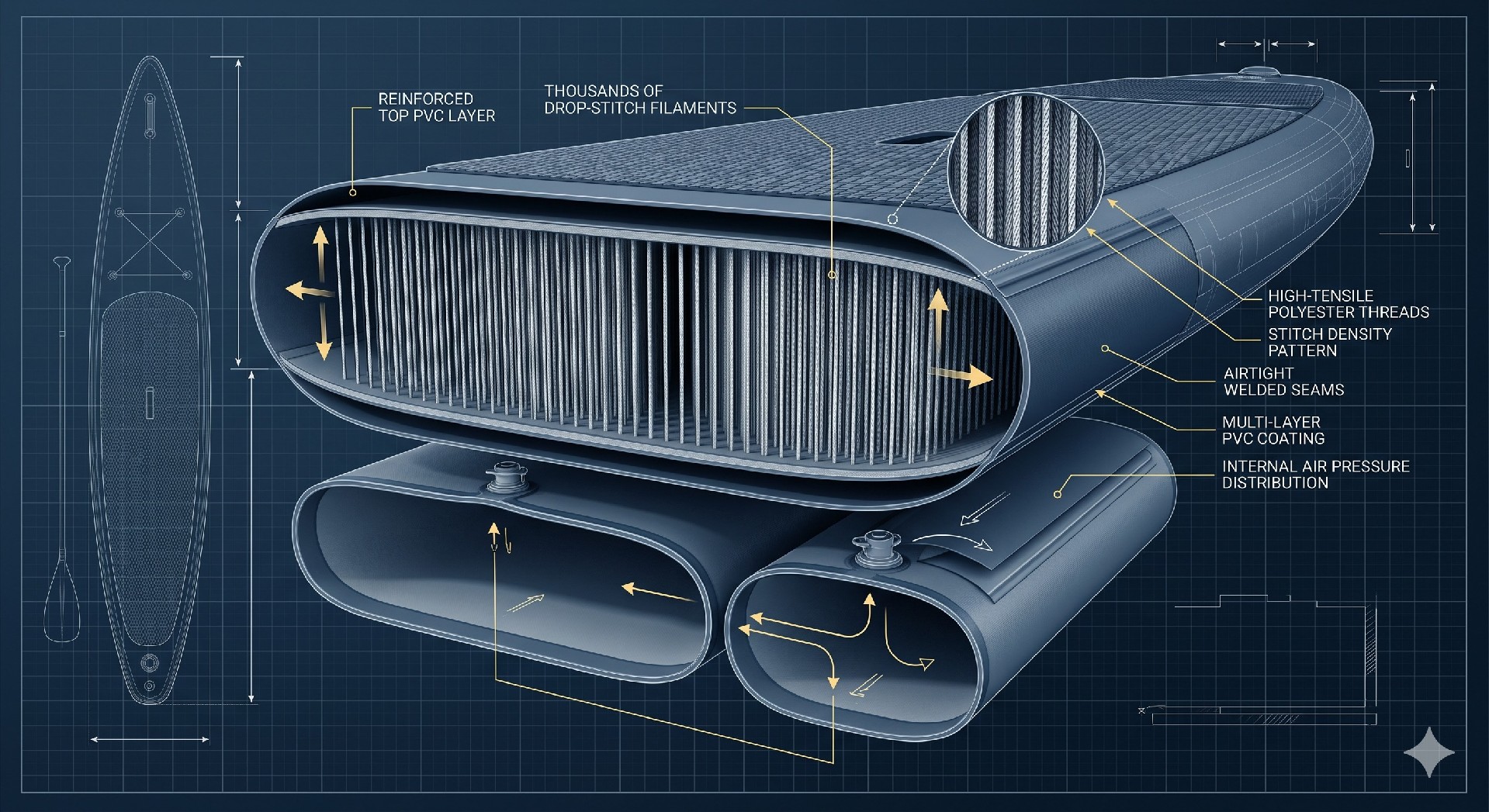
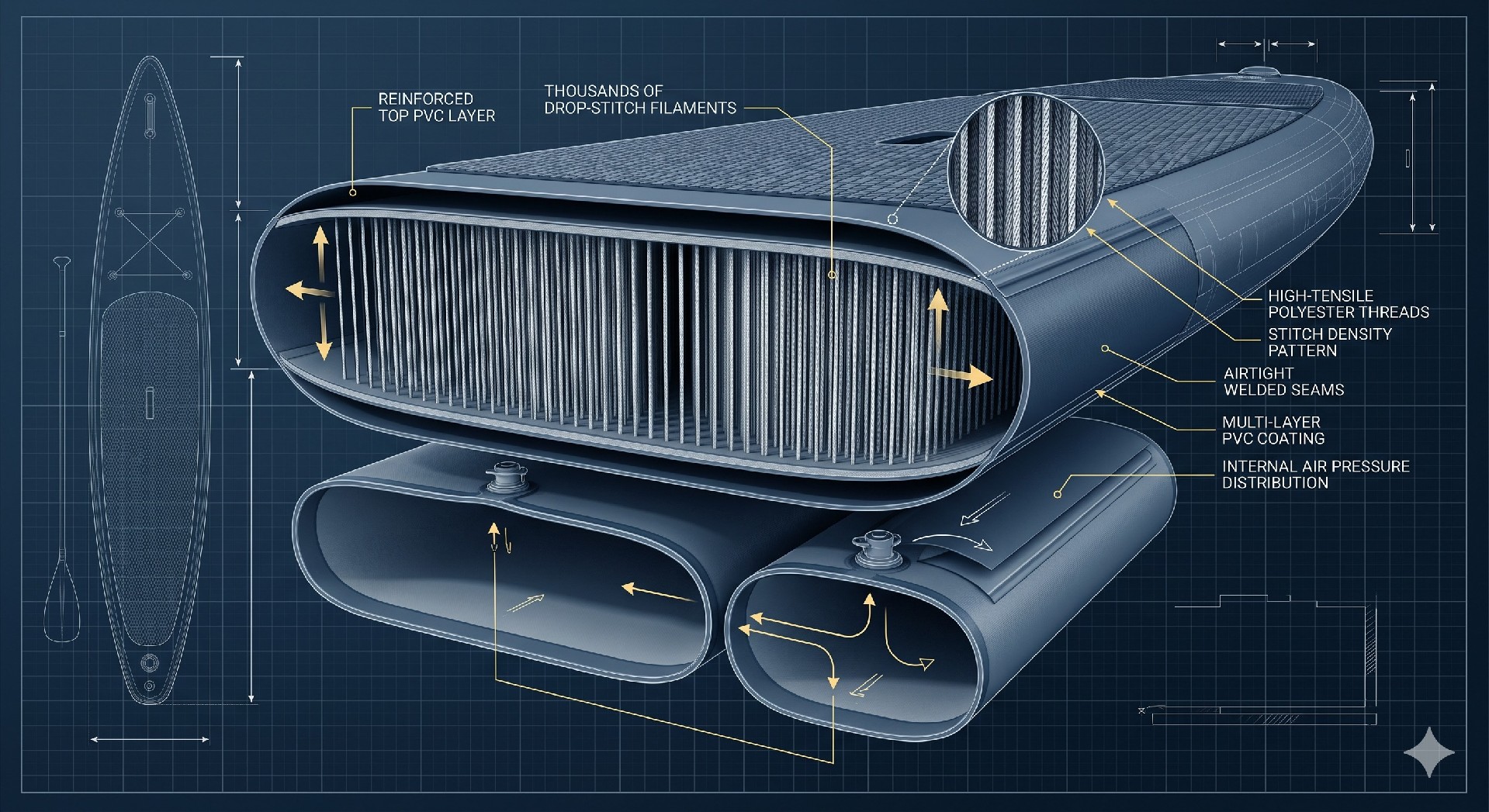
The base fabric's denier (a unit of fiber thickness) directly correlates with its tensile strength and abrasion resistance. High-performance inflatables commonly use 1100D or 1500D reinforced PVC, offering a superior balance of strength and weight. The material thickness, often ranging from 0.9mm to 1.2mm, is a key indicator of puncture and tear resistance . While Hypalon is prized for its UV and chemical resistance, heavy-duty PVC remains the industry standard for its exceptional weldability and cost-effectiveness.
Drop-Stitch Core Engineering: Maintaining PSI
High-pressure inflatables (e.g., stand-up paddle boards) utilize drop-stitch technology, where thousands of threads connect the top and bottom fabric panels. This creates a rigid, plank-like structure capable of holding inflation pressures of 12-15 PSI or higher. The integrity of this core is vital for both performance and safety.
Technical Specifications: A Data-Driven Parameter Matrix
To ensure your selected inflatable meets both EAC requirements and commercial demands, evaluate these critical specifications.
| Key Parameter | Commercial-Grade Inflatables |
|---|---|
| Material Thickness | 0.9mm - 1.2mm (1100D - 1500D Reinforced PVC) |
| Operating Pressure (Drop-Stitch) | 12 - 15 PSI |
| Payload Capacity | Up to 400 kg / 880 lbs |
| Seam Integrity | High-Frequency (HF) Welded / 1.5x Burst Pressure Test |
| Deflation & Packing Time | < 5 minutes with high-pressure valves |
| Compliance Standard | TR CU 008/2011 (Toys) / TR CU 026/2012 (Vessels) |
Seam and Weld Engineering: The Core of Structural Integrity
In inflatable manufacturing, seams are the weakest link. The EAC testing regime reflects this, with rigorous assessments like the 1.5x rated pressure test for 5 minutes, requiring no rupture or deformation . High-frequency (HF) welding is the gold standard for commercial gear, as it melts the PVC layers into a single, homogenous bond that is stronger than the surrounding material. This process ensures airtightness and structural integrity critical for passing the puncture and pressure tests mandated by TR CU 008/2011 .
Total Cost of Ownership (TCO) and ROI for Commercial Buyers
For resort operators, rental fleets, and B2B distributors, the decision to invest in EAC-compliant inflatables is a strategic financial calculation. The upfront cost of certified, high-quality gear is significantly lower than the potential costs of non-compliance. Customs holds, fines, and product seizure can cripple a supply chain. Furthermore, commercial-grade materials—thicker PVC with higher denier counts and robust drop-stitch cores—directly translate to a longer operational lifespan, reducing the frequency of costly replacements and fleet downtime .
Navigating the EAC Certification Process: A Step-by-Step Guide
Securing EAC certification is a structured process that requires meticulous preparation.
Step 1: Appoint a Local Representative: A foreign manufacturer must appoint a legal entity registered in the EAEU (e.g., an importer or authorized representative) to act as the certificate holder. This is non-negotiable .
Step 2: Prepare Russian Technical Documentation: All documents—including manuals, material safety data sheets (MSDS), and product labels—must be translated into Russian. English documents will lead to rejection .
Step 3: Product Testing: Samples (typically 2-5 pieces) must be sent to an EAEU-accredited laboratory for testing based on the applicable TR CU regulations .
Step 4: Factory Audit (if required): For series production or higher-risk classifications, a mandatory factory audit may be required to verify that the manufacturing process aligns with the certified sample. An ISO 9001 quality management system is often a prerequisite .
Step 5: Certification and Labeling: Upon successful testing and audit, the certificate is registered in the unified FGIS database. The final step is affixing the EAC mark (minimum 5mm in size) permanently on the product, packaging, and instruction manual, alongside Russian-language labels and warnings .
Conclusion: Strategic Compliance for Market Success
EAC certification is not a bureaucratic hurdle but a commercial passport to the lucrative EAEU market. For the discerning B2B buyer, it signifies a commitment to quality, safety, and long-term value. By prioritizing technical specifications such as material thickness, PSI capacity, and weld integrity, and by following a rigorous compliance pathway, you mitigate risk and build a reputation for reliability. Partnering with an experienced, EAEU-based certification agency is an investment in smooth customs clearance, legal market access, and ultimately, a profitable venture in the Russian market.
