

Introduction: The High-Stakes Game of Wholesale Inflatable Fishing Boat Procurement
For the discerning B2B procurement manager, sourcing inflatable fishing boats is a complex calculation balancing upfront CapEx against long-term durability and fleet performance. The market is flooded with options, but the true cost of a 'cheap' boat reveals itself in frequent patching, chamber failures, and dissatisfied end-users. This guide cuts through the marketing noise, providing a data-driven framework for evaluating key specifications. We will dissect material science, safety standards, and critical performance metrics to ensure your investment yields maximum ROI and reliability.
Fabric Technology Deep Dive: PVC vs. Hypalon
The cornerstone of any inflatable boat's durability is its fabric. Two materials dominate the commercial market: PVC (Polyvinyl Chloride) and Hypalon (CSM - Chlorosulfonated Polyethylene). Understanding their distinct characteristics is paramount.
1. Reinforced PVC: The Workhorse of the Industry
Modern commercial-grade PVC is a far cry from the brittle material of decades past. It is typically a composite of high-tenacity polyester scrim (measured in Denier) coated with PVC. A key metric is the fabric weight and thickness; wholesale buyers should look for a minimum of 0.9mm thickness with a 1100 Denier base fabric for commercial applications . Higher-end models may offer 1.2mm or 1.5mm for extreme conditions . PVC is favored for its ease of manufacturing, high resistance to abrasion, and excellent value proposition.
2. Hypalon: The Premium Choice for Durability
Hypalon is a synthetic rubber known for its exceptional resistance to UV degradation, ozone, and extreme temperatures. While typically more expensive than PVC, it offers superior longevity, especially in high-sun environments . A critical spec here is the reinforcement ratio; some models integrate up to 35% Hypalon reinforcement, significantly boosting puncture resistance and overall lifespan . For fleets operating in tropical or high-altitude regions with intense UV, the premium for Hypalon can be justified by reduced replacement cycles.
3. Critical Manufacturing Standards
Regardless of material, ensure the supplier adheres to strict quality controls. Look for certifications such as ISO 9001 for quality management and compliance with international safety standards like EN ISO 6185 for inflatable boats . This ensures the material has passed rigorous testing for tensile strength, tear resistance, and seam adhesion.
Structural Engineering: Seams, Chambers, and Drop-Stitch
A boat is only as strong as its construction. Here are the non-negotiable specs to verify.
1. Welded vs. Glued Seams
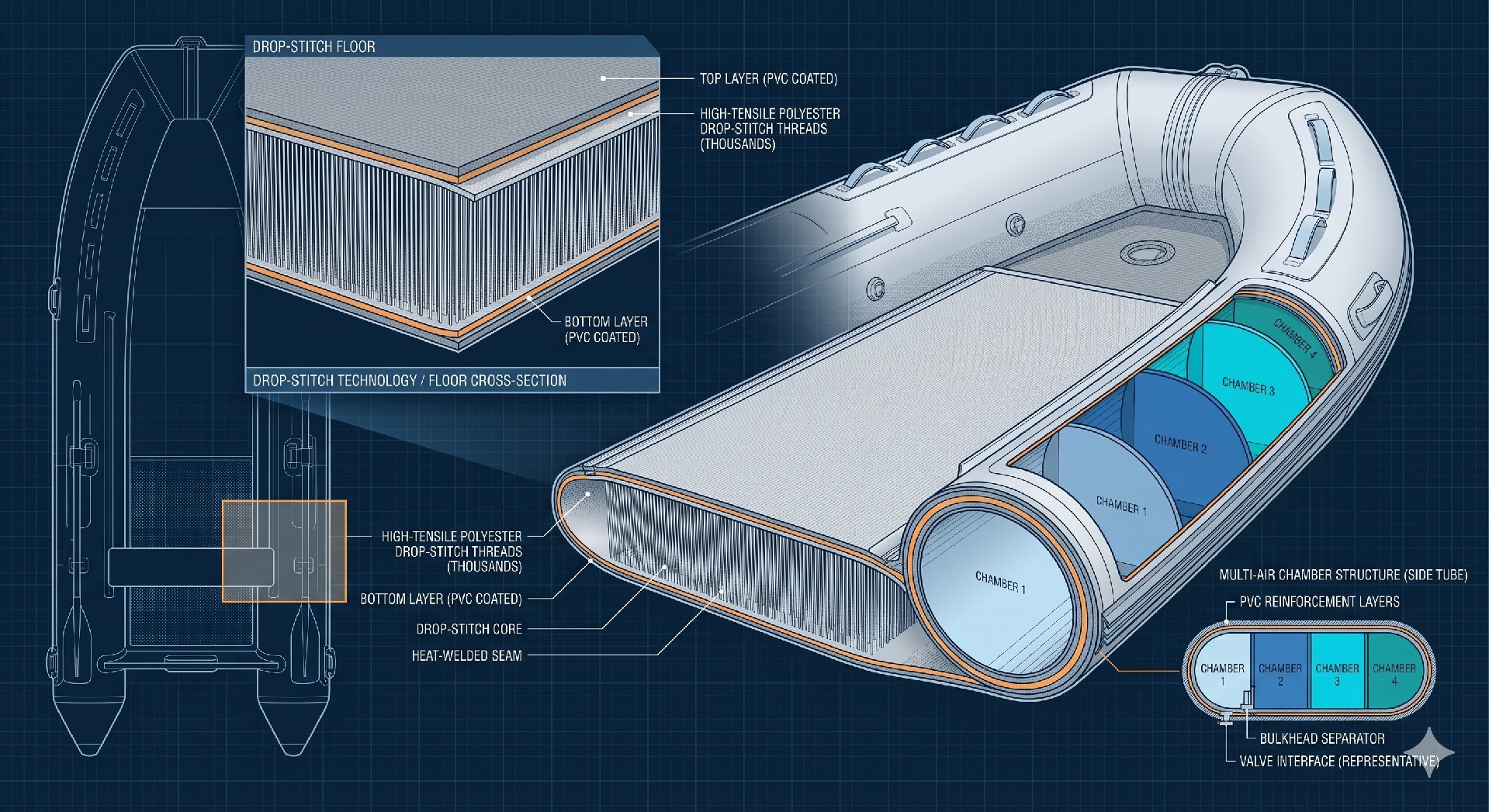
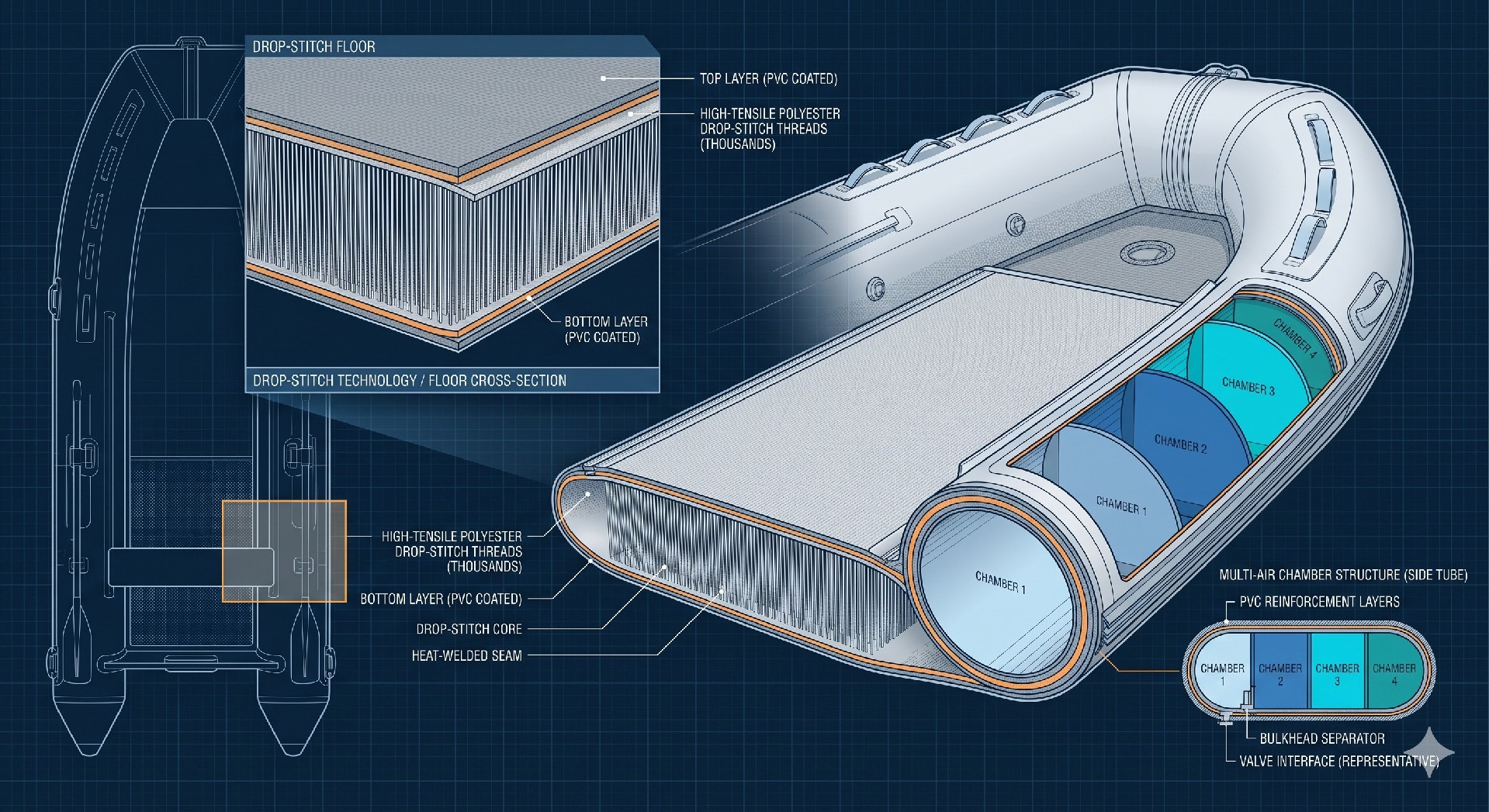
For wholesale commercial use, heat-welded seams are vastly superior to glued seams. Heat welding fuses the material at a molecular level, creating a bond as strong as the fabric itself and far more resistant to aging and chemical breakdown. High-frequency (HF) welding is the industry standard for creating durable, airtight seams .
2. Multi-Chamber Safety Systems
Safety and redundancy are critical. A commercial-grade boat should feature a minimum of 3 to 5 independent air chambers . This ensures that if one chamber is compromised, the boat retains sufficient buoyancy to safely return to shore. This is a non-negotiable spec for any fleet prioritizing user safety and liability reduction.
3. The Drop-Stitch Core (For High-Pressure Floors)
High-pressure drop-stitch floors have revolutionized inflatable boat performance. This construction uses thousands of interwoven threads between two fabric layers, allowing inflation to 10-15 PSI (pounds per square inch), creating a rigid, plank-like surface. This rigidity improves planing, handling, and fuel efficiency when paired with a motor.
Technical Specifications: The B2B Buyer's Matrix
The following table provides a benchmark for the critical specs to review in any supplier proposal.
| Key Parameter | Technical Specification | Commercial Significance |
|---|---|---|
| Material Composition | Reinforced PVC (0.9mm-1.5mm) or Hypalon/CSM | Defines resistance to abrasion, UV, and chemicals. |
| Fabric Denier | 1100D to 1670D (High-tenacity Polyester base) | Higher denier indicates a stronger, more puncture-resistant fabric. |
| Seam Construction | Heat-Welded (High-Frequency welding) | Ensures superior strength and air-tightness compared to glued seams. |
| Minimum Air Chambers | 3-5 independent air chambers | Provides critical safety redundancy; allows safe return if one chamber is punctured. |
| Maximum Payload | Varies by model (e.g., 400kg - 700kg+) | Directly determines the boat's capacity for passengers, motors, and cargo. |
| Maximum Persons | Certified Capacity (e.g., 2-6 persons) | Crucial for safety compliance and liability management. |
| Inflation Pressure (Floor) | 10-15 PSI (Drop-stitch floors) | High pressure creates a rigid, planing-capable floor for better performance. |
| Certifications | CE, EN ISO 6185, ISO 9001 | Validates compliance with international safety and manufacturing standards. |
Commercial Application & ROI Analysis
Beyond the raw specs, understanding how these features translate to commercial success is key.
1. Fleet Turnaround: Inflation and Deflation Efficiency
In a rental scenario, speed is money. A boat that can be fully inflated in 7-10 minutes and deflated quickly for storage significantly accelerates turnaround times . This reduces labor costs and increases rental frequency. Specs to check include the number of air chambers and valve types; larger, high-flow valves (like Leafield or Halkey-Roberts) are preferred for rapid deployment.
2. Payload Capacity and Passenger Safety
Accurate payload and passenger ratings are crucial for safety and insurance purposes. Verify the maximum payload (in kg or lbs) and the maximum number of persons the boat is certified to carry (as per ISO 9650 or similar) . Overloading a boat is a recipe for disaster; ensure the specs provide a sufficient safety margin for your typical use case (e.g., angler with gear).
3. Total Cost of Ownership (TCO)
When comparing quotes, look beyond the unit price. Factor in the expected lifespan of the material. A cheaper PVC boat might need replacing in 3-5 years, while a premium Hypalon boat can last 10-15 years . Considering repairability, warranty terms (many suppliers offer up to 3 years ), and the supplier's reliability and on-time delivery rate (aim for >97%) is essential for a healthy supply chain .
Conclusion: The Sourcing Action Plan
Wholesale procurement of inflatable fishing boats is an investment in your business's reputation and operational efficiency. By prioritizing technical specifications—from fabric thickness and material type to seam construction and safety certifications—you build a fleet that is durable, safe, and profitable. Engage with suppliers who are transparent about their materials and manufacturing processes, and use the data points in this guide to drive your negotiations. A well-chosen fleet is the bedrock of a thriving watersports business.
