

Introduction: The High-Stakes Reality of EU Compliance for Commercial Inflatables
For B2B procurement specialists, resort operators, and rental fleet managers, navigating the labyrinth of European safety standards for inflatable water toys is not merely a bureaucratic hurdle—it is a critical risk management and brand protection strategy. The landscape has shifted dramatically with the recent publication of EN 71-8:2026 and the updated EN ISO 25649 series, redefining how products are classified and tested . Failure to adhere to these mandates can result in costly customs detentions, product recalls, and significant liability issues . This masterclass provides a technical deep dive into the engineering specifications and material science required to achieve and maintain CE compliance, ensuring your fleet meets the rigorous demands of the European market. We will analyze the critical distinctions between aquatic toys and floating leisure articles, dissect the material requirements, and provide actionable data on payload, PSI, and durability.
Decoding the Regulatory Framework: Toys vs. Floating Leisure Articles
The cornerstone of EU compliance is the correct classification of your product. The distinction between a "toy" and a "floating leisure article" dictates which standard applies and the testing regime required. This is the single most common point of confusion for manufacturers and importers.
EN 71-8:2026: The New Benchmark for Inflatable Activity Toys
Historically, inflatable activity toys were a gray area. The 2026 revision of EN 71-8 now explicitly includes them, closing a significant loophole . This standard applies to products intended for children under 14 years of age. Key updates include clear definitions for contained-air (self-inflating) and constant-air (blower-fed) toys, alongside stringent requirements for blowers (positioned at least 2.5m from the toy) and anchorage for larger structures to prevent collapse . A critical safety test mandates that the structure must safely collapse in case of pressure loss, ensuring safe evacuation . If your product is a water trampoline, slide, or obstacle course intended for children, this is your primary compliance pathway .
EN ISO 25649: The Standard for Commercial-Grade Floating Leisure
For larger, commercial-grade inflatables not classified as toys—specifically those with a largest dimension (D1) exceeding 1.20 meters—the EN ISO 25649 series applies . This standard categorizes devices into classes, with Class D covering the most common commercial structures like bouncing platforms, climbing walls, and obstacle courses designed for deep water . The standard outlines rigorous testing for hull strength, air tightness, and body entrapment . It is critical to note that the standard is not applicable to aquatic toys, which fall under the Toy Safety Directive .
General Product Safety Regulation (GPSR) and Chemical Compliance
Regardless of classification, all products must comply with the General Product Safety Regulation and the REACH Regulation . This mandates strict limits on hazardous substances, particularly phthalates (restricted to 0.1% by weight), lead, and cadmium in PVC materials . The SVHC (Substances of Very High Concern) Candidate List also requires notification if substances like Bumetrizole or Melamine exceed 0.1% . Procuring materials with verified REACH compliance is non-negotiable.
Engineering the Specs: Material and Performance Metrics
Compliance is built upon the technical specifications of the materials and construction methods. Here are the critical metrics that engineering teams must specify and verify.
Material Thickness and Denier
The durability and safety of an inflatable are directly tied to its material. For commercial-grade inflatables, we typically specify Reinforced PVC or Hypalon. Key metrics include Denier (fabric weight) and thickness (mm). For high-durability applications, a minimum of 1100D fabric with a thickness of 0.9mm is recommended, providing superior tensile strength and abrasion resistance . The adhesion of coatings on reinforced materials is a specific test requirement under ISO 25649-1:2024 .
Drop-Stitch Core Physics and PSI
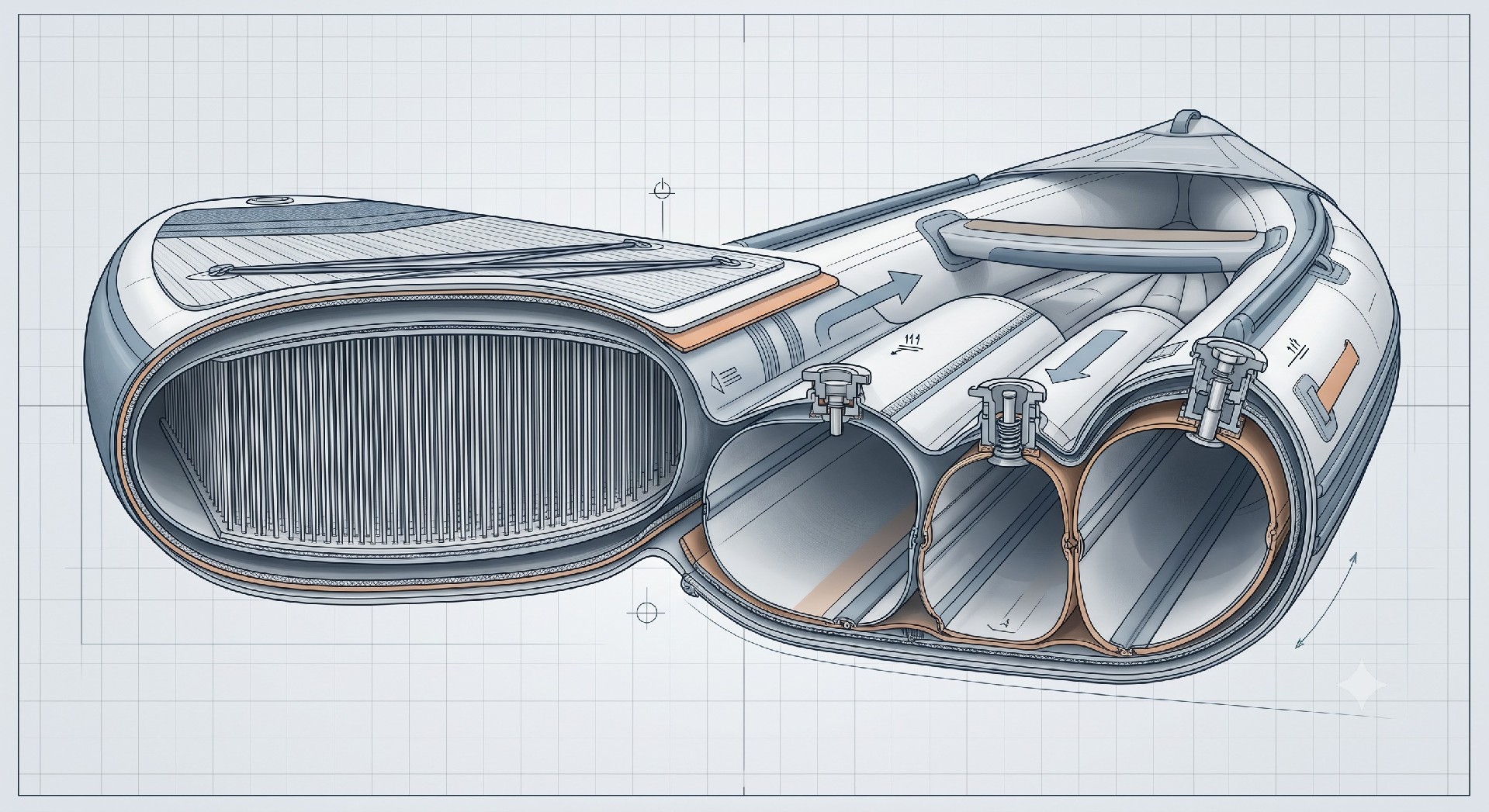
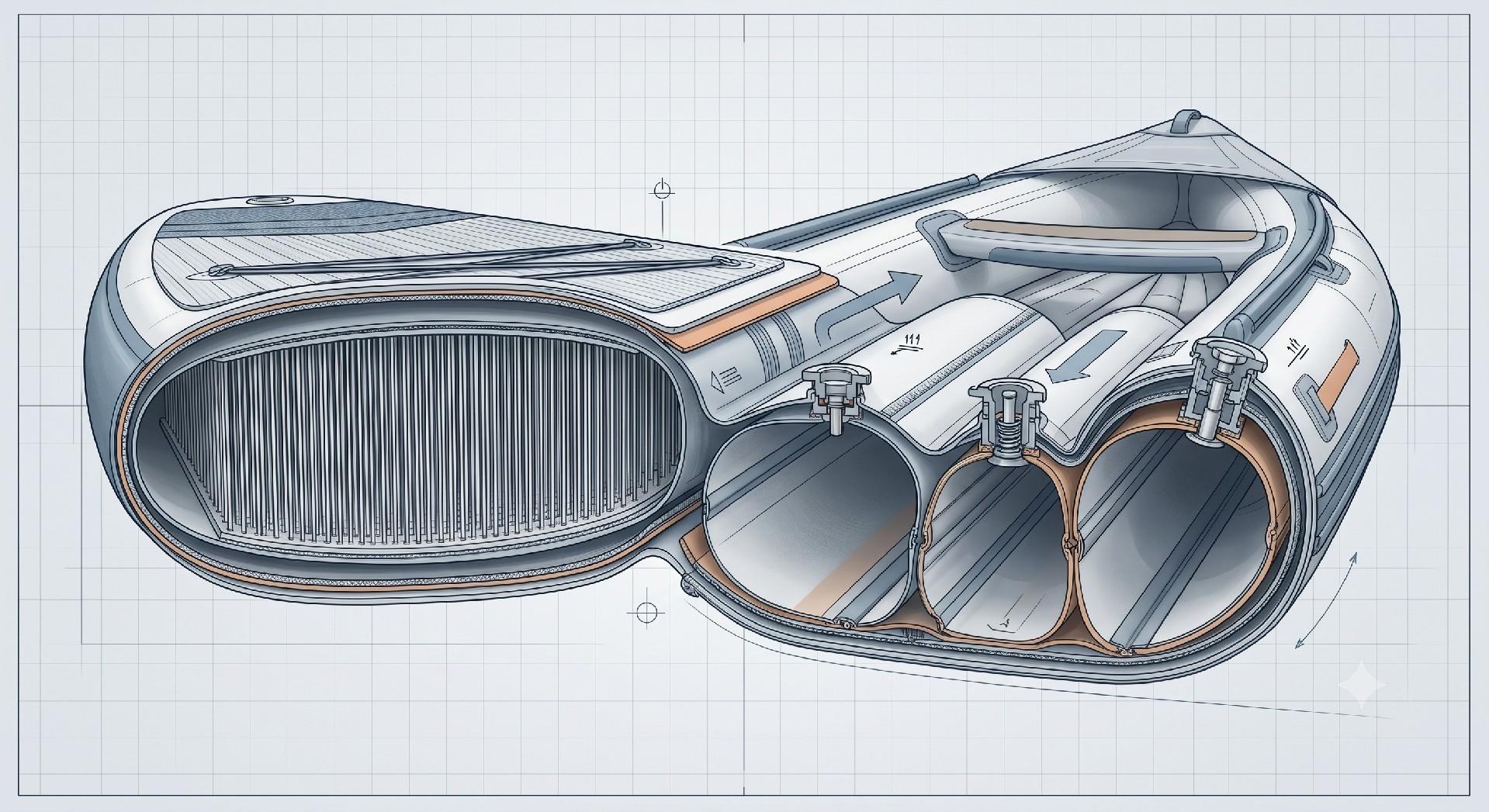
Drop-stitch technology is the gold standard for rigid inflatables, utilizing thousands of threads to maintain a flat, solid surface. The integrity of these cores is defined by their maximum operational pressure, often measured in PSI (pounds per square inch). High-performance drop-stitch floors can operate at 7-10 PSI, providing a near-hard-shell feel. However, the hull must be designed to withstand the design working pressure with a significant safety margin, as per ISO 25649-1 testing .
Seam Integrity: Welded vs. Glued
The longevity of an inflatable is often determined by its seam construction. Heat-welded seams using high-frequency (RF) welding create a molecular bond that is stronger than the base material itself, eliminating the risk of adhesive degradation over time . While glued seams are cheaper, they are prone to failure in high-UV and high-usage commercial environments. For CE compliance, the strength of these seams is validated through rigorous pressure and heat tests .
Technical Specifications Matrix
The following table provides a comparative snapshot of the key technical specifications required for various classes of inflatable water toys under the current EU framework.
| Key Parameter | Aquatic Toy (EN 71-8) | Floating Leisure Article (ISO 25649 Class D) |
|---|---|---|
| Classification | Intended for children under 14; shallow water | Deep water; largest dimension > 1.20m |
| Material Thickness | Minimum 0.45mm PVC | 0.9mm / 1100D Reinforced PVC |
| Maximum Payload | Typically ≤ 50 kg per user | ≥ 400 kg / 880 lbs total |
| Operational PSI | Low pressure (1-2 PSI) | High pressure (7-10 PSI Drop-Stitch) |
| Seam Construction | Glued or RF Welded | RF Heat-Welded |
| Critical Safety Test | Safe collapse on pressure loss | Hull strength & air tightness |
Commercial Application Scenarios: From Resorts to Rescue
Understanding the regulatory landscape allows B2B buyers to make informed sourcing decisions tailored to their specific operational needs. The choice of material and construction directly impacts the Total Cost of Ownership (TCO) and ROI for rental fleets.
Glamping Resorts and Premium Experiences
For high-end resorts, guest retention is paramount. Integrating commercial-grade drop-stitch inflatables with premium UV-resistant coatings ensures the equipment maintains a pristine appearance over multiple seasons, reducing replacement costs . Compliance with EN71-8 or ISO 25649 is essential for insurance and liability coverage.
High-Throughput Rental Operations
Rental operators require equipment that can withstand rapid inflation/deflation cycles and high-frequency use. Multi-chamber designs, which compartmentalize air for safety, are a key engineering requirement. In the event of a puncture, the remaining chambers provide emergency buoyancy, fulfilling the safety expectations of the ISO standard . High-pressure valves with long lifespans are critical to minimizing downtime .
Conclusion: Your Strategic Path to Compliance and Profitability
Navigating EU safety standards requires a shift from viewing compliance as a cost to recognizing it as a strategic advantage. By understanding the nuances of EN 71-8:2026 and EN ISO 25649, and by specifying engineered materials like 1100D reinforced PVC and drop-stitch cores, B2B buyers can ensure product safety, access the lucrative European market, and build a reputation for quality and reliability. Always demand third-party test reports and documented compliance from your suppliers to mitigate risk and ensure seamless customs clearance .
