

Introduction: The Commercial Imperative of Premium Inflatable Pools
The global market for portable and inflatable swimming pools is experiencing unprecedented growth, projected to reach a staggering US$3.4 billion by 2032, with a robust CAGR of 7.7% . For B2B buyers—from resort managers and rental fleet operators to event planners and retailers—this represents a significant opportunity. However, the path to profitability hinges on making informed, technically sound sourcing decisions. This guide serves as your definitive technical roadmap, dissecting the critical engineering specifications, material science, and compliance standards that differentiate a high-ROI commercial asset from a consumer-grade liability. We delve beyond the marketing fluff to provide the data-driven insights you need to maximize durability, safety, and return on investment.
Material Science and Fabric Technology: The Foundation of Durability
The backbone of any high-performance inflatable pool is its material construction. For commercial applications, the choice of fabric and its thickness directly correlate to puncture resistance, UV stability, and overall lifespan. Unlike standard consumer models that often utilize single-layer PVC, heavy-duty commercial pools employ reinforced materials to withstand the rigors of high-frequency use and harsh environmental conditions. We will explore the key metrics that define material quality and longevity 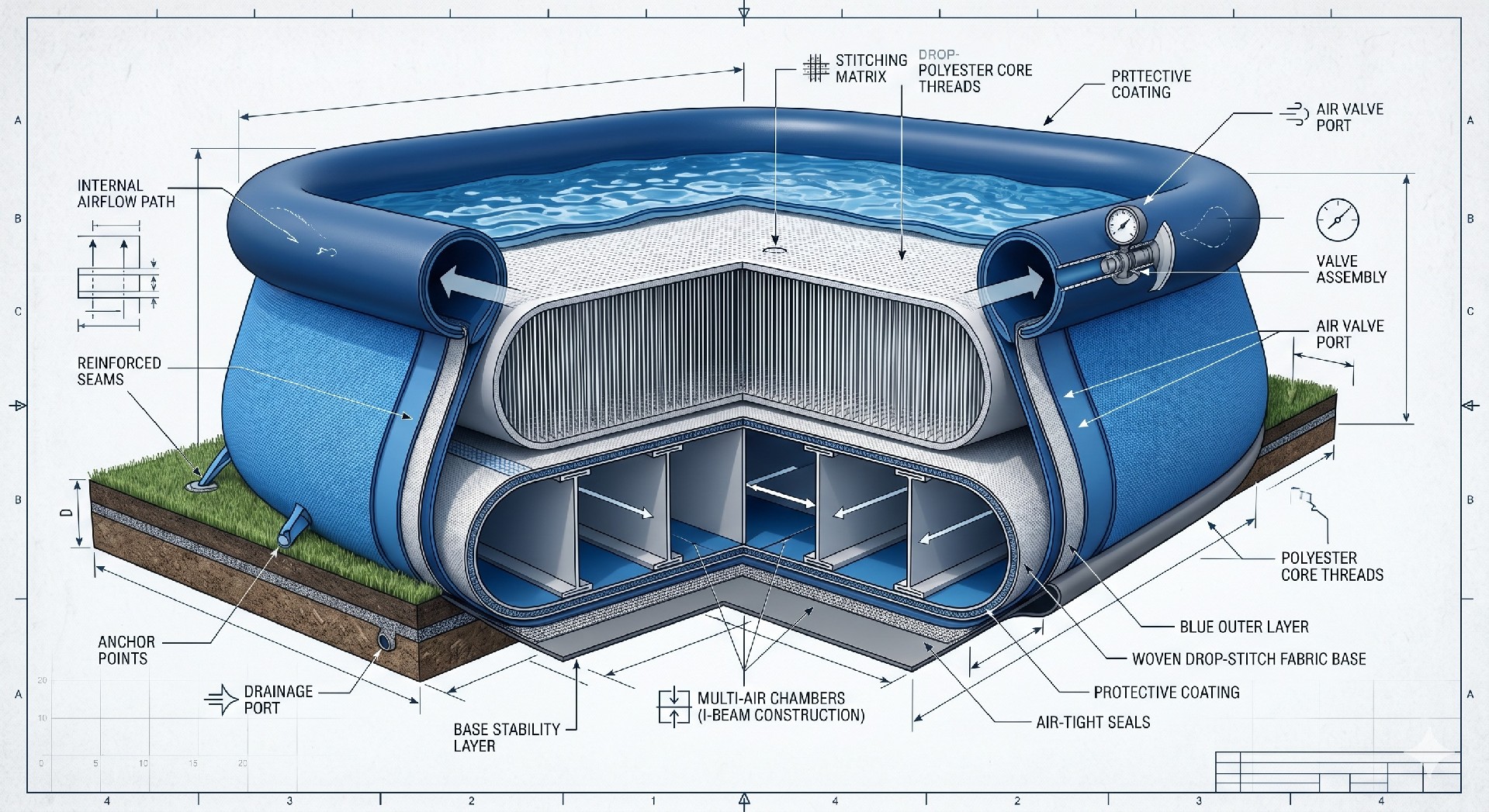 .
.
Understanding Denier Count and PVC Thickness
The thickness and weave density are paramount. For example, a common high-grade specification is 0.9mm / 1100D Reinforced PVC. The 'D' stands for Denier, a unit of measure for the linear mass density of fibers. A higher denier count (e.g., 1100D vs. 840D) indicates a thicker, more robust thread used in the fabric's weave, providing superior abrasion and tear resistance. This heavy-duty construction is essential for commercial settings where pools are frequently set up, taken down, and subjected to high foot traffic. Material thickness, measured in millimeters (e.g., 0.9mm), also contributes to the overall structural rigidity and resistance to punctures from sharp objects, a common hazard in outdoor environments .
Drop-Stitch Core Construction and PSI Limits
For high-end inflatable pools and floating structures, the pinnacle of engineering is the Drop-Stitch construction method. This technology uses thousands of high-tenacity polyester threads that connect the top and bottom fabric layers. When inflated to a high pressure—often exceeding 10 PSI—these threads create an incredibly rigid, flat surface with load-bearing capabilities comparable to a hard-shell boat. This is critical for pools that incorporate integral seating, play decks, or for ensuring the pool walls maintain perfect verticality under the immense hydrostatic pressure of a full water load. Drop-stitch technology allows for payload capacities exceeding 400 kg, making them suitable for families and commercial use.
Engineering for Excellence: Weld Integrity and Seam Construction
The most robust materials can be rendered useless by poor seam construction. In commercial-grade inflatable pools, the standard is high-frequency (HF) heat-welded seams. This process fuses the PVC layers at a molecular level, creating a joint that is as strong as, if not stronger than, the surrounding material. This is a significant upgrade over glued seams, which are susceptible to chemical breakdown (from water treatment chemicals) and physical separation under stress. High-quality pools also feature multi-chamber safety designs, ensuring that a puncture in one chamber does not lead to a catastrophic failure of the entire structure. This is a critical safety feature required for many commercial insurance policies.
Technical Specifications Matrix
For a holistic understanding, the table below synthesizes the key technical parameters that professional buyers must evaluate when comparing wholesale inflatable pool offerings
| Key Parameter | Technical Specification for Commercial-Grade Inflatable Pools |
|---|---|
| Material Thickness & Type | 0.9mm / 1100D Reinforced PVC or higher-grade Drop-Stitch |
| Maximum Static Payload | ≥ 400 kg / 880 lbs (for heavy-duty models) |
| Inflation Technology | High-Frequency Heat-Welded Seams |
| Standard Working PSI | ≤ 10 PSI (for rigid drop-stitch floors/structures) |
| Compliance Standards | CE, EN71, ISO 6185, REACH |
| Key Application | Rental Fleets, Resorts, Glamping, Event Management |
.
Safety, Compliance, and Certification Standards
Adherence to international safety standards is non-negotiable for commercial deployments. Responsible manufacturers will ensure their products meet or exceed rigorous certifications. For the European market, CE certification is mandatory, demonstrating compliance with health, safety, and environmental protection standards. Additionally, specific toy safety standards like EN71 (European Standard for toy safety) are applicable if the pool is marketed for children. Globally, compliance with ISO 6185 is a key benchmark for inflatable boats, and many of these principles are applied to high-quality pool construction, covering material strength, buoyancy, and stability. Furthermore, REACH compliance ensures that the materials used do not contain hazardous substances, a crucial environmental and safety consideration for the modern buyer. The US market, valued at US$622.6 million in 2025, has its own stringent regulations and safety standards that imported products must meet .
Commercial Applications: Case Studies in ROI
The versatility of modern inflatable pools allows for a wide array of profitable B2B applications [IMAGE_2].
High-Throughput Rental Fleets
For rental companies, the key metric is Total Cost of Ownership (TCO). This includes the initial purchase price, but more importantly, the maintenance costs, ease of repair, and lifespan of the product. A pool with a 0.9mm PVC layer and heat-welded seams might have a higher upfront cost but can deliver 5-10 times the service life of a cheaper alternative, significantly lowering the cost-per-rental. Rapid inflation/deflation systems are also crucial for reducing turnaround times and increasing asset utilization during peak seasons. Features like high-capacity air pumps and wide-diameter valve systems can reduce setup time from 20 minutes to under 5 minutes.
Premium Glamping and Resort Experiences
For the glamping and resort industry, the aesthetic and functional quality of an inflatable pool is paramount. These are not mere utilitarian objects but integral parts of the guest experience. Commercial-grade pools offer the opportunity for strategic branding, such as custom-printed logos on the pool walls. They can be integrated into existing hardscaping, creating a high-end, permanent-feeling water feature that enhances property value and guest satisfaction. The ability to cleanly deflate and store the pool during off-seasons also offers operational flexibility that traditional concrete pools cannot match.
Conclusion: Making the Strategic Investment
Investing in an inflatable pool for a commercial enterprise is a strategic decision that requires careful analysis of technical specifications and market trends. As the market expands—with the oval-shaped segment alone projected to grow at an 8.4% CAGR—the opportunity is clear . However, success lies in moving beyond superficial features to understand the engineering principles of durability: material denier, PSI limits, weld integrity, and compliance certifications. By prioritizing these data-driven metrics, B2B buyers can secure a premium asset that ensures safety, minimizes operational downtime, and delivers a measurable return on investment for years to come.
