

Introduction: The B2B Opportunity in High Speed Inflatable Boats
For procurement managers, fleet operators, and outdoor equipment distributors, the high speed inflatable boat segment represents a significant commercial opportunity. Unlike traditional fiberglass vessels, these advanced watercrafts combine portability with performance, offering compelling value for rental fleets, rescue operations, and resort-based water sports. This technical guide delivers a data-driven framework for sourcing, evaluating, and deploying commercial-grade inflatable speed boats that maximize ROI while meeting strict international safety standards like ISO 6185 and CE certification .
Fabric Technology Deep Dive: PVC vs. Hypalon
At the core of every high speed inflatable boat lies the fabric technology that determines durability, weight, and lifespan. B2B buyers must choose between two primary materials: reinforced PVC and Hypalon (CSM).
Reinforced PVC: Cost-Effective Performance
High-quality PVC-coated fabrics dominate the commercial market due to their excellent strength-to-weight ratio. Leading manufacturers use 0.9mm to 1.2mm thick PVC with a 1100D polyester base, offering exceptional abrasion resistance. Inflatable speed boats built with 0.9mm/1100D PVC achieve payload capacities exceeding 400 kg while maintaining manageable package weights . These materials are typically treated with UV stabilizers and anti-chafing stripes to extend operational lifespans in marine environments.
Hypalon (CSM): Extreme Durability
For harsh conditions, Hypalon-reinforced fabrics offer superior resistance to UV degradation, ozone cracking, and chemical exposure. While more expensive, Hypalon excels in professional rescue and military applications where reliability is paramount. The material's ability to be repaired in the field adds to its commercial appeal for fleets operating in remote locations .
Engineering Specifications and Standards
Drop-Stitch Core and PSI Limits
Modern high speed inflatable boats utilize advanced drop-stitch technology for the hull floor, creating a rigid structure that rivals hard-shell boats. This technology allows operating pressures of 8-10 PSI in the floor, delivering a solid platform for high-speed maneuvers. The internal thousands of connecting threads maintain dimensional stability under extreme loads .
Seam Integrity: Welded vs. Glued
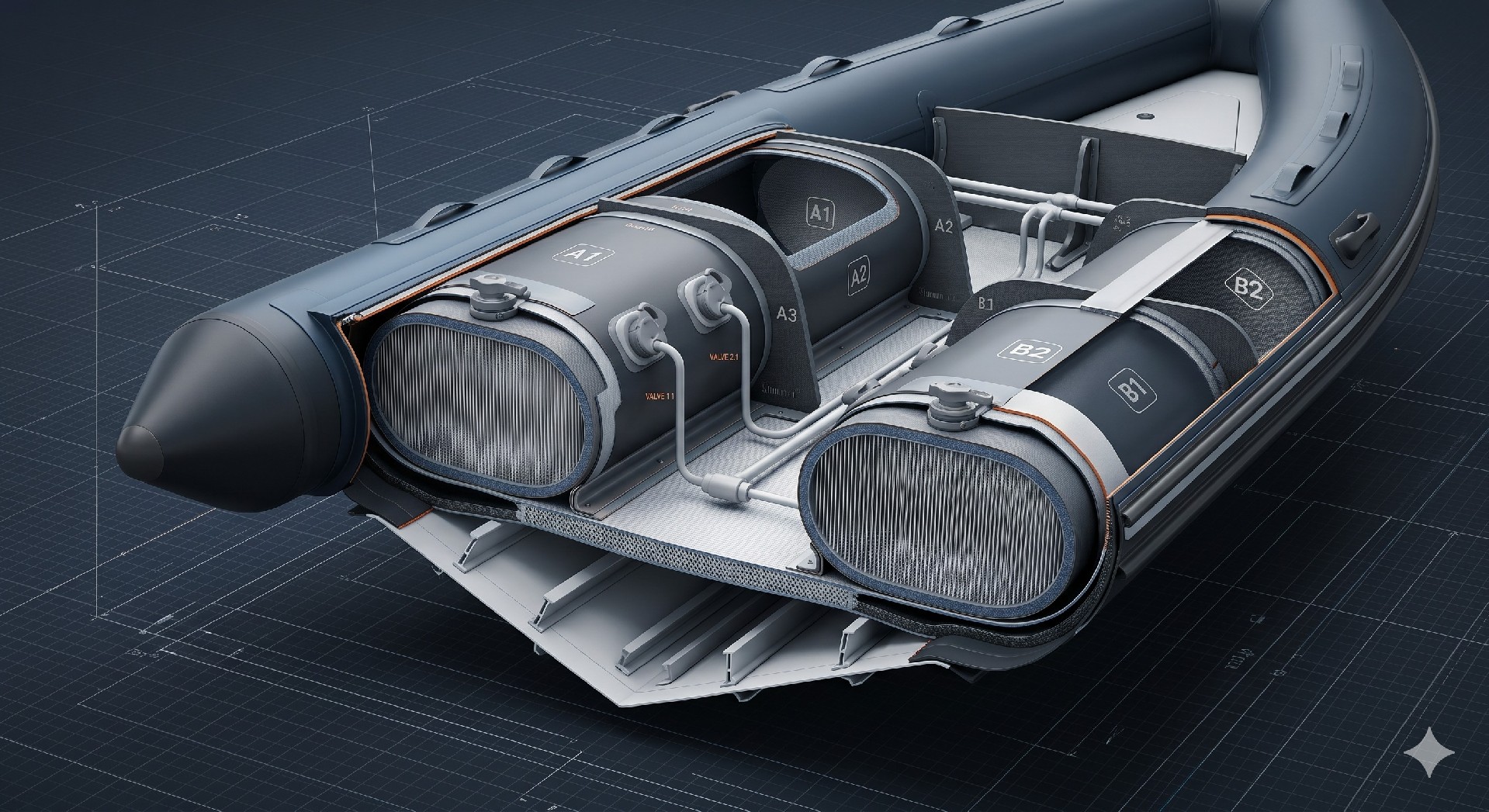
Commercial-grade boats feature heat-welded seams rather than glued constructions. Heat welding creates a molecular bond between fabric layers, offering 85% of the base fabric's tensile strength. Quality control protocols require peel tests on every production batch to ensure seam integrity exceeds ISO 6185 requirements . Multi-chamber designs (3+1, 4+1) provide essential redundancy for safety-critical operations.
Technical Specifications Matrix
| Key Parameter | Technical Specification |
|---|---|
| Material Thickness | 0.9mm / 1100D Reinforced PVC or 1.2mm Hypalon |
| Drop-Stitch PSI (Floor) | 8-10 PSI |
| Maximum Payload | 600 kg - 1,181 kg |
| Multi-Chamber Design | 3+1 to 6+1 Chambers |
| Certifications | CE, EN ISO 6185, KC |
| Typical Top Speed | 25 - 45+ Knots |
| Inflation Time (Electric Pump) | < 5 Minutes |
Commercial Application Scenarios
High-Throughput Rental Fleets
Water sports operators benefit from high speed inflatable boats due to rapid inflation/deflation times and minimal storage requirements. A typical 4.3m boat with 0.9mm PVC can be inflated using high-pressure electric pumps in under 5 minutes, enabling quick turnaround between rentals. With payloads up to 1,000 kg and capacities for 6-8 passengers, these vessels command premium rental rates .
Professional Rescue and Military Operations
The Zodiac FC 470 H2P exemplifies military-grade specification, offering a maximum payload of 1,181 kg with a top speed of 25 knots. Such vessels incorporate speed-tube stabilizers and high-pressure floors for rapid deployment and exceptional stability in search-and-rescue scenarios .
Resort and Glamping Experiences
Luxury resorts integrate inflatable speed boats for guest excursions, leveraging their aesthetic appeal and ease of storage. Customizable configurations with seating arrangements and sunshades enhance the premium guest experience while maintaining compliance with EN ISO 6185 safety standards .
[IMAGE_2]
Conclusion: Strategic Sourcing and ROI
The market for high speed inflatable boats continues to expand, driven by technological advancements and growing demand across commercial sectors. B2B buyers must prioritize material quality, seam integrity, and certification compliance when selecting suppliers. Manufacturers in Shandong province, China, dominate the supply chain, offering CE-certified models at wholesale prices ranging from $848 to $2,200 depending on size and specification . A thorough evaluation of material thickness, payload capacity, and warranty terms (typically 3-5 years for PVC) ensures optimal total cost of ownership. By aligning product specifications with end-user requirements, distributors and operators can capitalize on the growing inflatable speed boat market, delivering reliable performance and consistent profitability.
