

Introduction: The Critical Role of Precision Pressure in B2B Fleet ROI
For B2B buyers, rental operators, and resort procurement managers, understanding the nuances of PVC inflatable boat pressure is not merely a technical detail; it is a direct determinant of fleet longevity, operational safety, and return on investment (ROI). While a standard recreational user might focus on basic inflation, commercial procurement requires a deep dive into the engineering specifications that separate durable commercial assets from consumer-grade equipment. This guide provides a comprehensive analysis of pressure dynamics, material science, and the rigorous standards governing commercial-grade PVC inflatable boats.
An incorrectly inflated boat leads to a cascade of costly issues: reduced fuel efficiency, poor handling, accelerated seam fatigue, and even catastrophic failure. For a rental fleet, a single day of downtime due to a pressure-related blowout can erode profits. Therefore, a data-driven understanding of PVC inflatable boat pressure management is essential for maximizing the total cost of ownership (TCO).
Fabric Technology and the Physics of Pressure
At the heart of every commercial-grade inflatable is the fabric. The material's construction dictates the maximum operating pressure (MOP) the boat can safely withstand. Most high-performance commercial PVC boats utilize reinforced materials like Mehler Haku PVC or high-denier fabrics with specific thicknesses .
Understanding Denier Count and Material Thickness
The 'denier' count of the woven base fabric is a critical metric. For example, a 1100D PVC fabric offers superior puncture and abrasion resistance compared to lighter fabrics, allowing it to maintain structural integrity at higher PSI . The thickness of the PVC coating, often measured in millimeters (e.g., 0.9mm), further contributes to air retention and resistance against UV degradation and mechanical stress. This directly correlates to the boat's ability to maintain consistent PVC inflatable boat pressure under dynamic loads.
Materials like Hypalon, while historically popular, are increasingly being outperformed by advanced PVC formulations that offer comparable durability at a lower cost and with better heat-weld characteristics, crucial for automated manufacturing consistency . We must also note the importance of compliance with environmental standards like REACH, ensuring the PVC used is free from hazardous substances, which is a key consideration for B2B procurement in the EU.
Technical Specifications and Pressure Metrics
The following table presents a comparative analysis of pressure specifications and payload capacities derived from leading models. This data is critical for evaluating the suitability of a boat for specific commercial applications.
| Model & Use Case | Fabric Type / Thickness | Max. Tube Pressure | Max. Floor/Keel Pressure | Max. Payload (kg/lbs) |
|---|---|---|---|---|
| Mercury 240 Dinghy (Leisure/Tender) | Mehler PVC / N/A | 0.25 bar (3.6 PSI) | N/A (I-Beam Floor) | 315 kg / 695 lbs |
| Frontier Rescue Raft (Rescue/Commercial) | Durable PVC / N/A | 0.35 bar (5 PSI) | 0.7 bar (10 PSI) | 850 kg / 1,874 lbs |
| 3D TWA290 Lightweight (Recreation) | Lightweight PVC / N/A | 0.21 bar (3 PSI) | 0.62 bar (9 PSI) | 510 kg / 1,124 lbs |
Tube vs. Floor/Keel Pressure Disparity
A common point of confusion in PVC inflatable boat pressure management is the difference between tube and floor/keel pressure.
Main Tubes: These typically operate at a lower pressure, providing buoyancy and shape. The industry standard often hovers around 0.25 bar (3.6 PSI) .
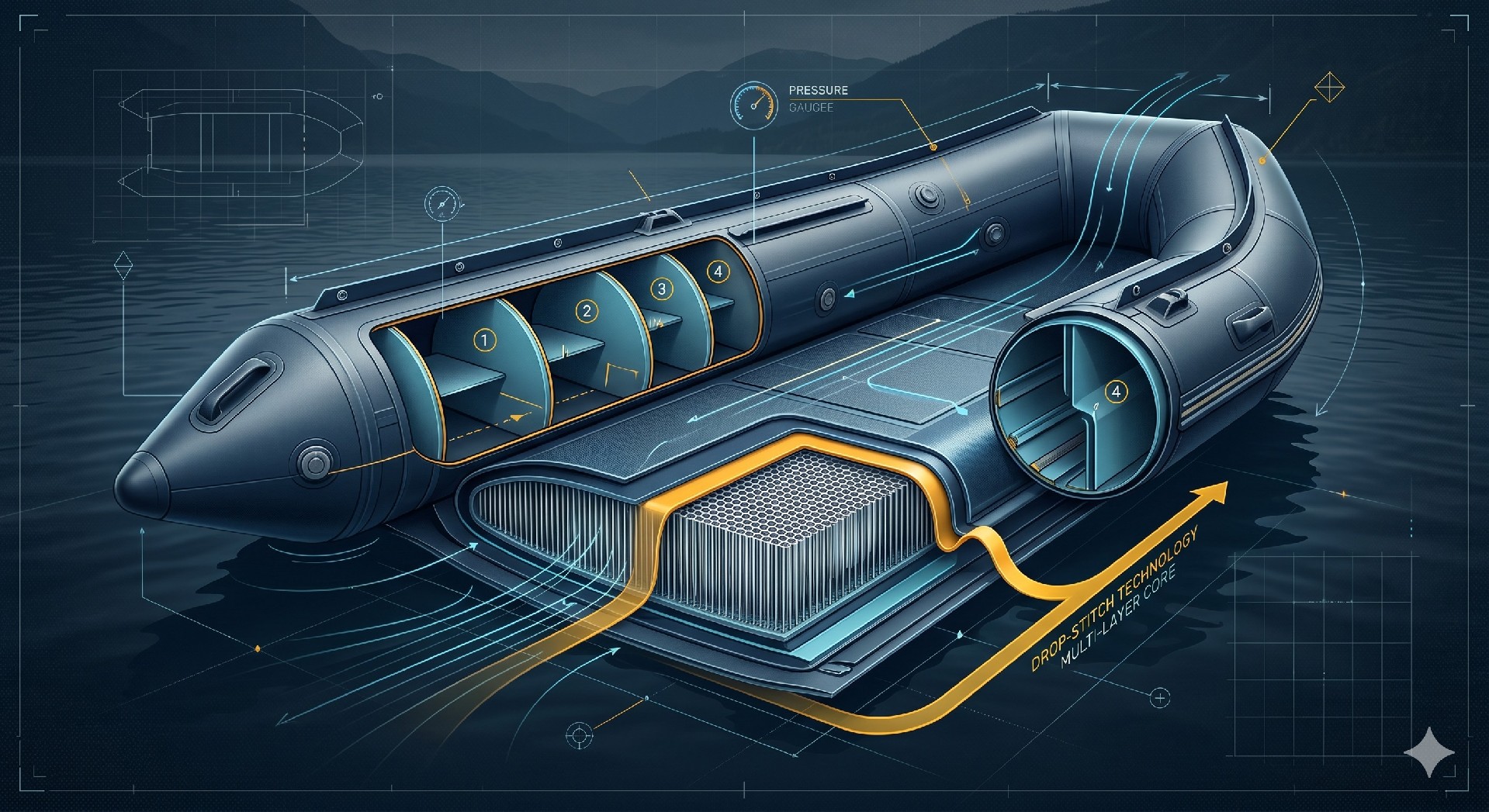
Inflatable Floors (Drop-Stitch) and Keels: These require significantly higher pressure to create a rigid, planing surface. Drop-stitch technology allows for pressures up to and exceeding 0.7 bar (10 PSI) or more, creating a hull as stiff as a fiberglass one . Under-inflating the floor compromises handling and can be dangerous, while over-inflating stresses the drop-stitch core .
For rescue operations, rapid deployment times are a key metric. A rescue boat can be inflated to its operational pressure in approximately 5 minutes using a foot pump . In a B2B setting, investing in high-output electric or gas-powered blowers with pressure-limiting valves can reduce this time significantly, increasing fleet turnover.
Commercial Application Scenarios and Pressure Management
The Impact of Temperature on Pressure
One of the biggest operational challenges is managing the effects of thermal expansion. A boat inflated to the correct pressure in a cool morning can exceed its MOP by the afternoon, increasing the risk of an explosive decompression . As a rule of thumb, a boat inflated to its MOP should have a 10-20 millibar buffer to account for temperature rises . Conversely, a boat left partially inflated in cold storage will lose pressure—approximately 6 millibars per degree Celsius .
[IMAGE_2]
Safety and Compliance: CE and ISO Standards
For B2B operations, compliance with ISO 6185 and CE certifications is non-negotiable. These standards dictate not only the construction and buoyancy requirements but also the pressure relief mechanisms. Multi-chamber designs, often featuring 2+ chambers plus an inflatable floor and keel, provide redundancy in case of a puncture . This ensures that even if one chamber is compromised, the boat retains sufficient buoyancy to return to shore—a critical safety feature for commercial use. These designs are engineered to maintain safety even within their specified PVC inflatable boat pressure ranges.
Conclusion: Making Data-Driven Procurement Decisions
In the B2B outdoor equipment market, the distinction between a profitable fleet and a costly liability often comes down to understanding the technical specifications. PVC inflatable boat pressure is not a 'set and forget' variable; it is a dynamic performance metric that requires rigorous management. From the denier count of the fabric to the inflation sequence and the impact of ambient temperature, each factor plays a critical role in the boat's lifespan and performance.
By prioritizing models with high-quality reinforced PVC, robust heat-welded seams, and certified compliance with international safety standards (CE, ISO 6185), procurement managers can ensure a superior ROI. Incorporating pressure gauges into your operational kits is an inexpensive investment that protects your fleet from the high costs of premature fabric fatigue and seam failure. In the demanding world of commercial rentals and water sports, precision in PVC inflatable boat pressure management is the key to sustainable profitability and safety.
