

Why Commercial Buyers Are Shifting to Premium Inflatable Fishing Kayaks
For years, the commercial water sports industry has been dominated by the logistical headaches of hard-shell kayak fleets: exorbitant shipping costs, massive storage requirements, and complex transportation logistics. The modern inflatable fishing kayak with rod holders has emerged as a disruptive solution, but not all are created equal. For B2B procurement specialists, resort managers, and rental fleet operators, the challenge lies in identifying units that deliver the durability, payload capacity, and angler-centric features required for high-ROI commercial use. This guide offers a comprehensive, data-driven analysis of the engineering, materials, and total cost of ownership (TCO) that separates premium commercial-grade inflatable kayaks from recreational alternatives.
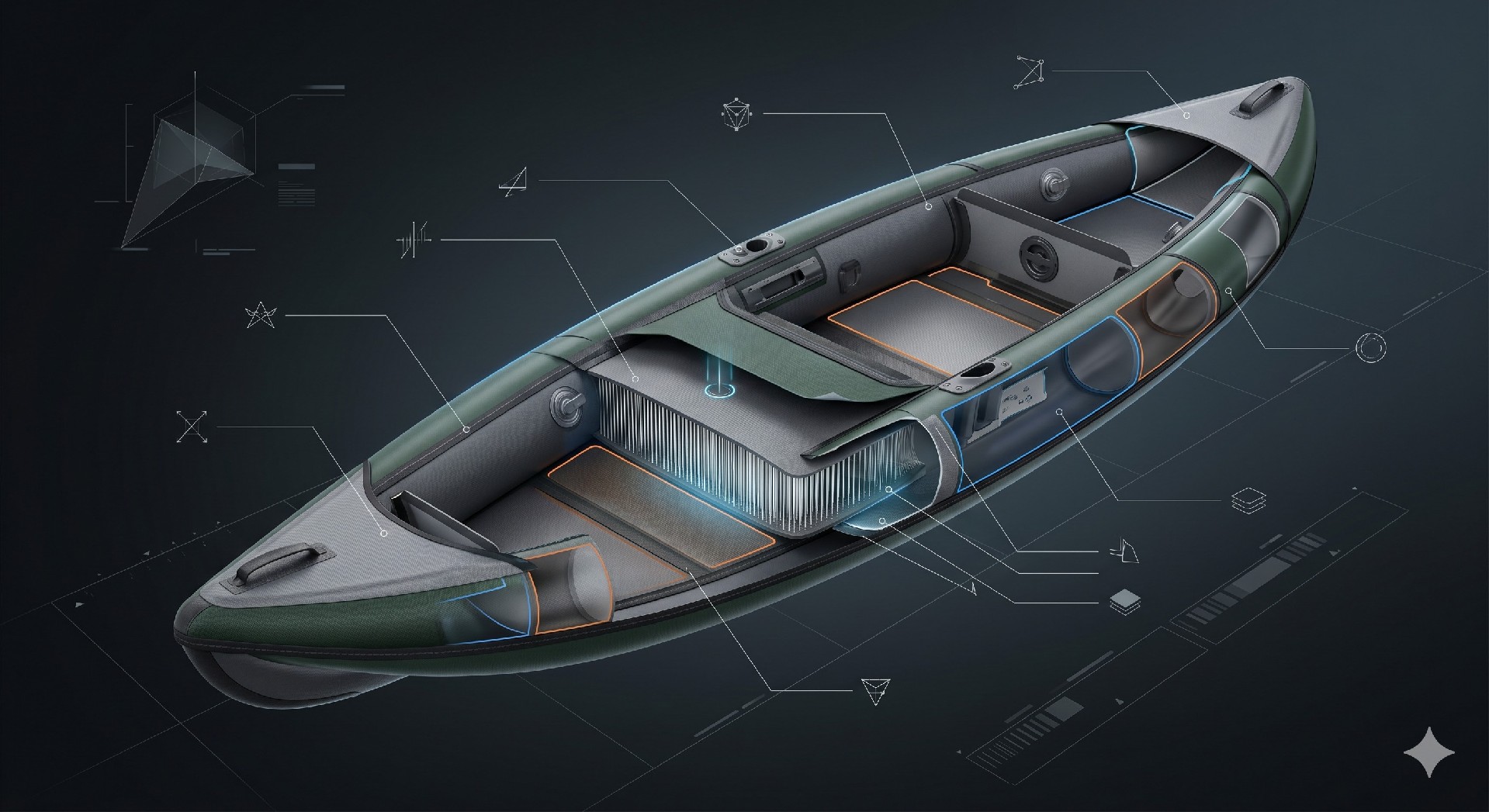
Commercial-Grade Materials Science: PVC, Hypalon, and Drop-Stitch Density
The durability of a commercial inflatable kayak is defined by its fabric technology. The industry standard for high-end, resilient units is moving toward multi-layer reinforced PVC and proprietary composites like Nitrilon®, known for their superior resistance to abrasion, UV degradation, and impact . For resort and rental environments where gear sees daily wear, material thickness is a critical metric. Premium commercial models often utilize 0.9mm to 1.2mm reinforced PVC or specialized films that provide an optimal balance of weight and puncture resistance.
Drop-Stitch Technology and Rigidity Standards
The core technological enabler of modern high-performance inflatable kayaks is the drop-stitch construction. Unlike traditional low-pressure inflatables that offer poor tracking and stability, drop-stitch floors consist of thousands of polyester threads connecting the top and bottom of the chamber. This allows for high-pressure inflation, with commercial-grade floors frequently supporting pressures of up to 10–15 PSI. This ultra-rigid floor creates a standing platform that rivals the stability of hard-shell kayaks, enabling anglers to cast and fight fish while standing . When evaluating specs, look for the maximum PSI rating of the floor chamber; this directly correlates with hull rigidity and performance.
Engineering a Fishing Platform: Integrated Rod Holders and Rigging Systems
While the base kayak is important, the fishing-specific features dictate its value to end-users and, by extension, its commercial appeal. High-quality inflatable fishing kayak with rod holders models move beyond simple accessory mounts. Leading manufacturers are integrating strategic mounting points for versatile accessories. Features like Scotty® bases, universal mounting plates, and H-Rail systems provide a modular platform for rod holders, fish finders, and camera booms . This modularity is crucial for rental fleets, allowing easy customization for different customer needs and quick replacement of damaged components.
Moreover, premium seating solutions such as the Elevated Solis Frame Seat or the Ergoboost system are engineered to improve visibility and comfort, which translates to longer, more productive fishing trips and higher customer satisfaction rates .
| Commercial Specs | Entry-Level Recreational | Premium Commercial (B2B) | Performance Impact |
|---|---|---|---|
| Material & Thickness | Standard PVC (0.6mm - 0.7mm) | Reinforced PVC / Nitrilon (0.9mm - 1.2mm) | Higher resistance to punctures and UV degradation, lower TCO. |
| Max Floor Pressure (PSI) | 2 - 3 PSI | 6 - 15 PSI | Higher PSI equals greater hull rigidity, better tracking, and stand-up capability. |
| Max Payload | ≤ 400 lbs / 181 kg | ≥ 600 - 650 lbs / 272 - 295 kg | Higher capacity supports more gear, battery systems, and larger anglers. |
| Seam Construction | Glued | Heat-Welded / High-Frequency Welded | Welded seams are chemically bonded and superior for long-term durability. |
Total Cost of Ownership (TCO) and ROI for Rental Fleets
For B2B buyers, the initial purchase price is only one variable in a complex financial equation. An inflatable fishing kayak with rod holders offers a distinct financial advantage due to reduced logistics costs. The ability to deflate and pack a kayak into a travel bag dramatically reduces shipping dimensions compared to 12-14 foot hard-shell equivalents, leading to substantial freight savings . Storage is similarly revolutionized; a fleet of 20 inflatable kayaks can fit into the space required for 2-3 hard-shell models, drastically lowering warehousing expenses. Furthermore, the durability of high-end PVC and welded seam construction reduces long-term maintenance and replacement costs, boosting overall fleet ROI.
Safety and Compliance: ISO 6185 and Multi-Chamber Design
Commercial operations must prioritize safety and regulatory compliance. When sourcing an inflatable fishing kayak with rod holders, ensure the unit meets industry standards. Look for certifications such as CE and ISO 6185, which outline safety requirements and performance standards for inflatable boats . A key safety feature in premium models is the multi-chamber design. Should one chamber suffer a puncture, separate air cells provide buoyancy and prevent the kayak from sinking, offering vital emergency reserve time . This feature is non-negotiable for commercial and rescue-oriented applications.
[IMAGE_2]
Deployment Scenarios: Resorts, Rentals, and Guided Tours
The versatility of the inflatable fishing kayak with rod holders makes it a premier asset for various commercial settings. For glamping and luxury resorts, these kayaks offer a premium, amenity-rich experience that can be launched directly from a beachfront, requiring no cumbersome trailer infrastructure . High-volume rental operations benefit from models with rapid inflation systems, like high-output pumps and spring-loaded valves, to minimize turnaround time between rentals and maximize throughput . For guided fishing tours, the integrated rigging and high load capacity (often exceeding 400-650 lbs) allow for a full day's gear, a cooler, and essential supplies .
Strategic Sourcing Action Plan and Verdict
When selecting a manufacturer for your commercial fleet, prioritize vendors that provide transparent specification sheets detailing fabric type (e.g., 1100D Reinforced PVC, Nitrilon®), thickness, and drop-stitch PSI ratings. Insist on heat-welded or high-frequency welded seams over glued seams, as welding creates a chemically bonded, permanent joint that is far more durable . By focusing on these engineering fundamentals and understanding the TCO benefits, B2B buyers can confidently acquire an inflatable fishing kayak that offers a superior return on investment and elevates their customer experience.
