

Introduction: The Commercial Promise of Air Deck Technology
For B2B buyers, fleet managers, and resort operators, the inflatable boat with air deck floor represents a paradigm shift in portable watercraft. It marries the rigidity of a hard-shell hull with the unmatched portability of an inflatable. This guide provides a comprehensive, data-driven analysis of the engineering, materials, and commercial ROI that define this critical marine asset. We explore why this technology has become the go-to solution for commercial rentals, yacht tenders, and rescue operations, focusing on the specifications that truly matter.
Understanding the nuances of drop-stitch technology, fabric denier counts, and PSI limits is essential for making an informed procurement decision. The air deck floor is not just a convenience feature; it is a highly engineered structural component that impacts performance, safety, and the total cost of ownership (TCO).
A high-quality 4K realistic outdoor lifestyle photography showing an inflatable boat with air deck floor in use, a beautiful natural lake or mountain background, professional commercial vibe, generic unbranded gear design, no text.
Fabric Engineering: PVC vs. Hypalon
The foundation of any durable air deck boat is its fabric. The market primarily offers two high-performance materials: reinforced PVC and Hypalon (CSM). Both have distinct advantages depending on the intended application.
Reinforced PVC (e.g., Mehler Haku, 1100 Denier): This is the industry standard for balancing cost and performance. High-quality PVC features a denier count of at least 1100D and thickness of 0.9mm to 1.2mm . Premium suppliers like Mercury use Mehler Haku PVC, offering a 3-year warranty on fabric and seams . This material is favored for recreational rentals and general-purpose use.
Hypalon (CSM - Chlorosulfonated Polyethylene): For extreme environments or premium fleets, Hypalon is the superior choice. It offers up to 30% more durability than standard PVC, with exceptional resistance to UV radiation, saltwater, and chemicals . Achilles' CSM-reinforced fabric on their LSI series is a prime example, built to withstand severe abuse .
When sourcing from manufacturers, ensure compliance with standards like EN ISO 6185, which covers requirements for inflatable boats, and REACH for chemical safety. A reliable B2B supplier will provide tensile strength reports (≥18 MPa for 1100D PVC) to verify quality .
The Core Technology: Drop-Stitch Air Deck Floors
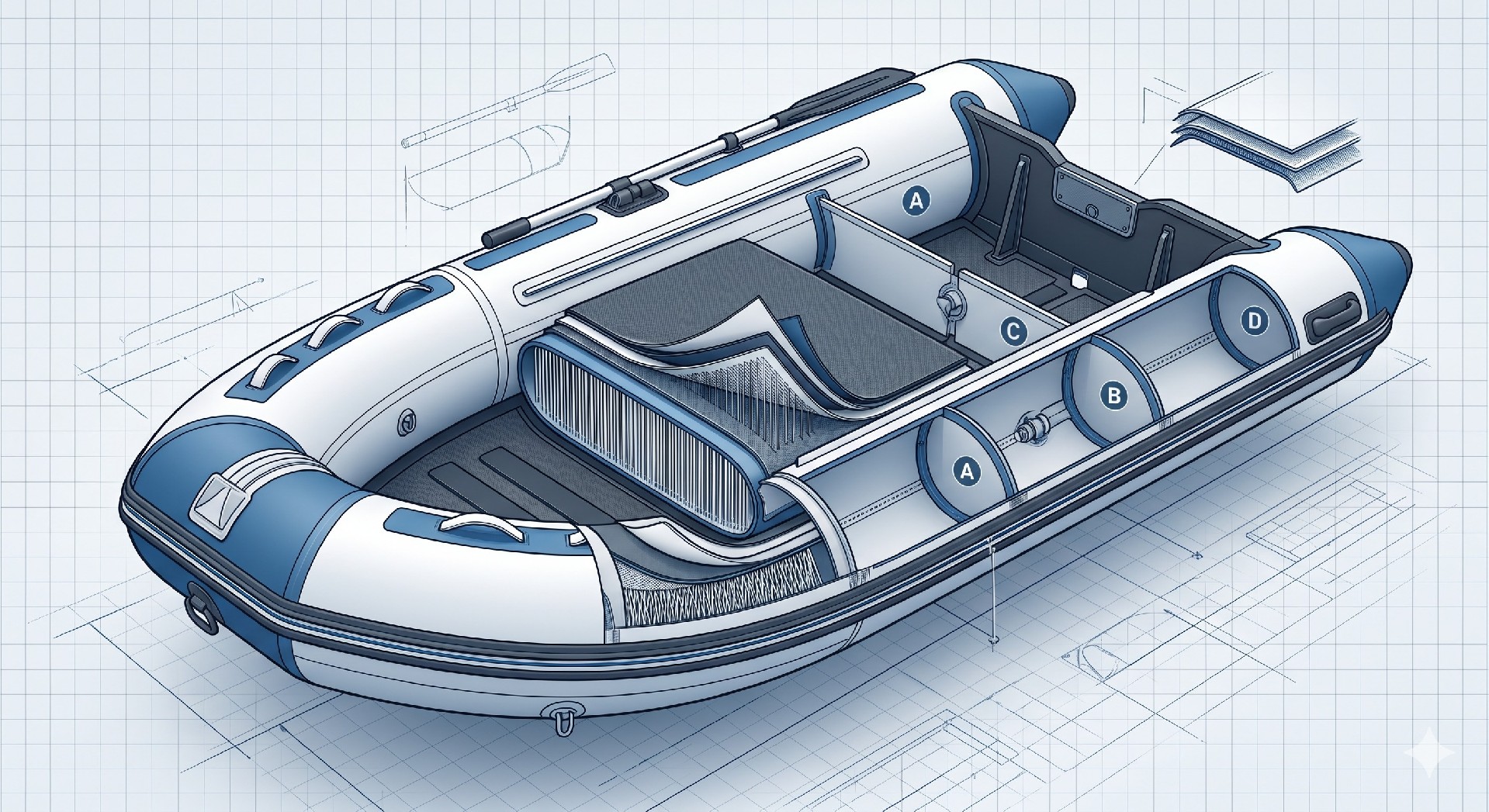
The defining feature of a high-performance inflatable boat with air deck floor is the drop-stitch construction. This creates an extremely rigid, lightweight floor that rivals aluminum alternatives .
How Drop-Stitch Works
Thousands of high-tenacity polyester threads are woven between two layers of PVC fabric. When inflated to high pressures, these threads lock the top and bottom panels together, creating a rigid, flat surface . Unlike traditional inflatable floors, this technology prevents "trampolining" and provides a stable platform for standing, casting, and handling outboard motors.
Pressure Ratings: The recommended tube air pressure is commonly around 0.25 bar (3.6 psi), but drop-stitch floors operate at much higher pressures, typically up to 9 psi, to achieve their rigidity .
Advanced Variants: Some brands, like Mercury's X-Stitch technology, claim even greater rigidity than traditional drop-stitch through innovative fiber placement .
Key Metrics: Look for specifications on floor thickness (e.g., 80mm) and maximum payload, which can range from 400 kg to over 1,000 kg depending on the model .
For commercial operators, this technology translates to faster planning, better fuel efficiency, and a more comfortable ride for passengers.
Technical Specifications Matrix
Below is a comparative benchmark of key technical parameters for commercial-grade air deck boats. This data is aggregated from leading manufacturers to provide a performance baseline.
| Key Parameter | Commercial Standard Specification |
|---|---|
| Material Type | 1100D - 1200D PVC or CSM/Hypalon (0.9mm - 1.2mm) |
| Max. Payload (2.2-2.9m models) | 480 kg - 635 kg (approx. 1050 - 1400 lbs) |
| Max. HP Rating | 5 HP - 15 HP (Short Shaft) |
| Air Floor Operating Pressure | 6 - 9 PSI (Drop-Stitch) |
| Safety Chambers | 3 Tube + 1 Keel + 1 Floor |
| Regulatory Compliance | CE, EN ISO 6185, REACH |
A table with headers: 'Key Parameter', 'Commercial Standard Specification'. Rows: Material Thickness: 0.9mm - 1.2mm PVC / Hypalon (840D-1200D); Max Payload: 480 kg - 635 kg (for 2.2-2.9m models) ; Max HP: 5 HP - 15 HP; Floor Pressure: 6-9 PSI (Drop-Stitch); Air Chambers: 3+Keel+Floor (Multi-Chamber Safety); Warranty: 3-5 Years on Fabric/Seams .
Multi-Chamber Safety and Seam Integrity
Safety is paramount in marine equipment. A key B2B selling point is the multi-chamber design. A typical inflatable boat with air deck floor features 3 to 5 independent air chambers (tubes, keel, and floor) . This ensures that if one chamber is compromised, the boat retains significant buoyancy and can return to shore safely.
Seam Construction: The integrity of the boat relies on its seams. Look for:
Heat-Welded Seams: Preferred over glued seams for their strength and longevity.
Four-Layer Seam Construction: Used by premium brands like Achilles to ensure robustness at critical stress points .
These safety features are essential for commercial liability, allowing fleets to operate with confidence in compliance with CE and ISO 6185 safety standards .
Commercial ROI and Deployment Scenarios
The true value of the air deck floor is realized in commercial applications. The Total Cost of Ownership (TCO) for an air deck boat is significantly lower than traditional hard-shell boats due to:
Portability: When deflated, a 2.9m model packs into a bag roughly 102 x 56 x 40 cm, reducing storage costs and enabling easy transport .
Rapid Setup: Commercial users can assemble and inflate these boats in under 20 minutes, accelerating rental turnaround times .
Durability: The use of reinforced materials like 1100D PVC with rub strakes increases longevity, reducing replacement frequency .
[IMAGE_2]
A high-quality 4K realistic outdoor lifestyle photography showing an inflatable boat with air deck floor in use, beautiful natural landscape, lake or mountain background, professional commercial vibe, generic unbranded gear design, no text.
Sourcing Strategy: Ensuring Quality and Compliance
When sourcing from manufacturers, a rigorous evaluation is crucial. B2B buyers should prioritize suppliers who demonstrate:
Verifiable Certifications: Request documentation for EN ISO 6185, CE, and DIN 7865 to ensure product standards .
Technical Competence: The supplier should provide detailed specifications on material tensile strength, seam weld tests, and air retention protocols.
Operational Reliability: Metrics like a ≥95% on-time delivery rate and a response time of ≤4 hours are indicators of a reliable partner .
Conclusion
The inflatable boat with air deck floor is a sophisticated piece of engineering that offers a compelling blend of performance, safety, and logistical efficiency. By focusing on key metrics such as denier count, drop-stitch PSI, and seam construction, and by insisting on compliance with international safety standards like ISO 6185 and CE, B2B buyers can confidently invest in a fleet that delivers exceptional ROI and durability. Whether for high-volume rentals, resort amenities, or professional marine operations, this technology represents the future of portable commercial watercraft.
