

Introduction: The Procurement Fork in the Road
For the discerning B2B buyer, the decision between sourcing a PVC inflatable canoe and a kayak is rarely about personal preference—it is a strategic choice with profound implications for your fleet's operational costs, customer satisfaction, and overall ROI. While both offer the portability advantages of inflatable watercraft, they represent divergent engineering philosophies, material specifications, and performance envelopes. This guide provides a technical deep dive into the core architecture, material science, and performance metrics that define these two categories, empowering you to make a data-driven sourcing decision.
Engineering Architecture: Single-Chamber vs. Drop-Stitch Rigidity
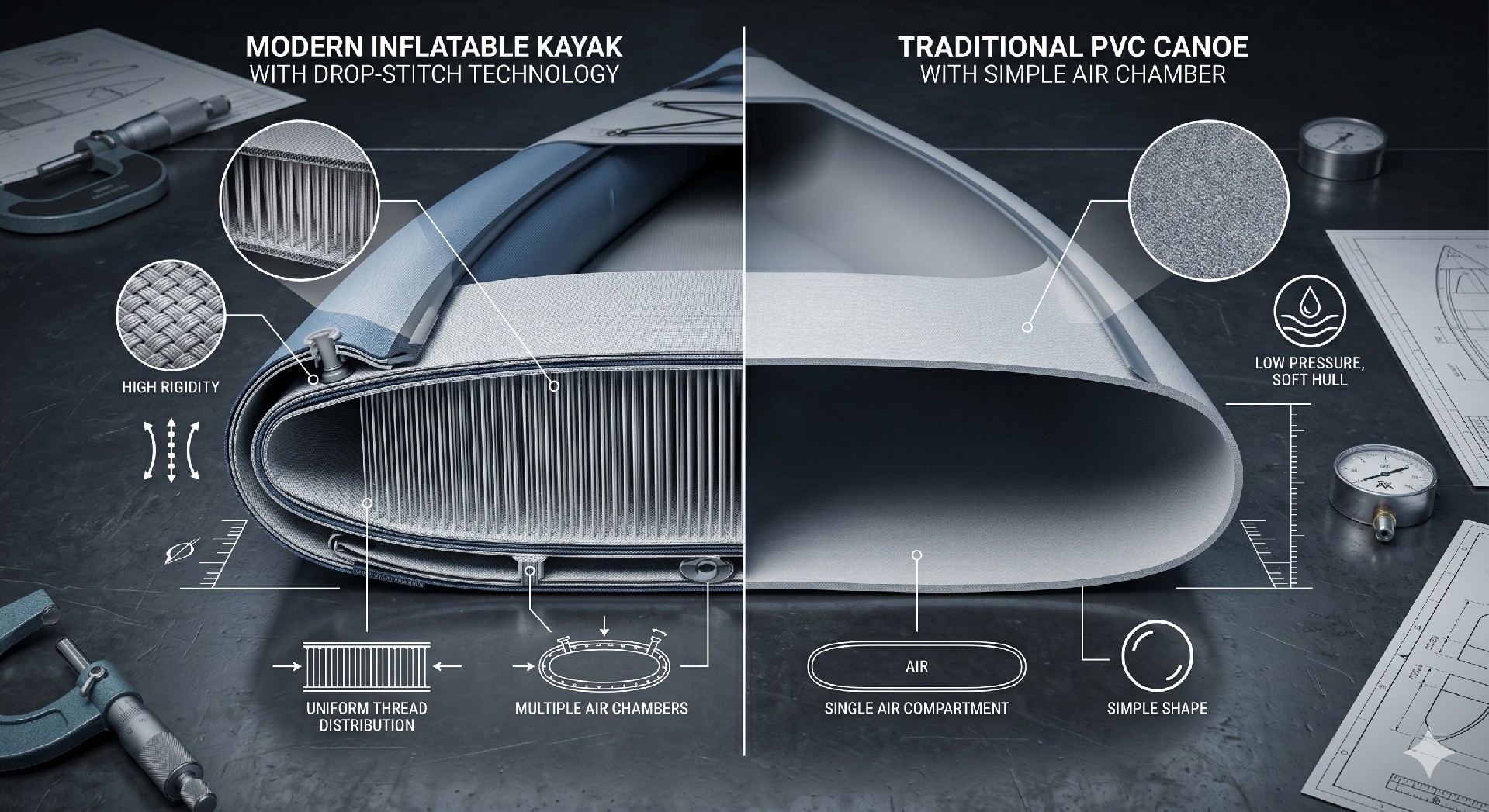
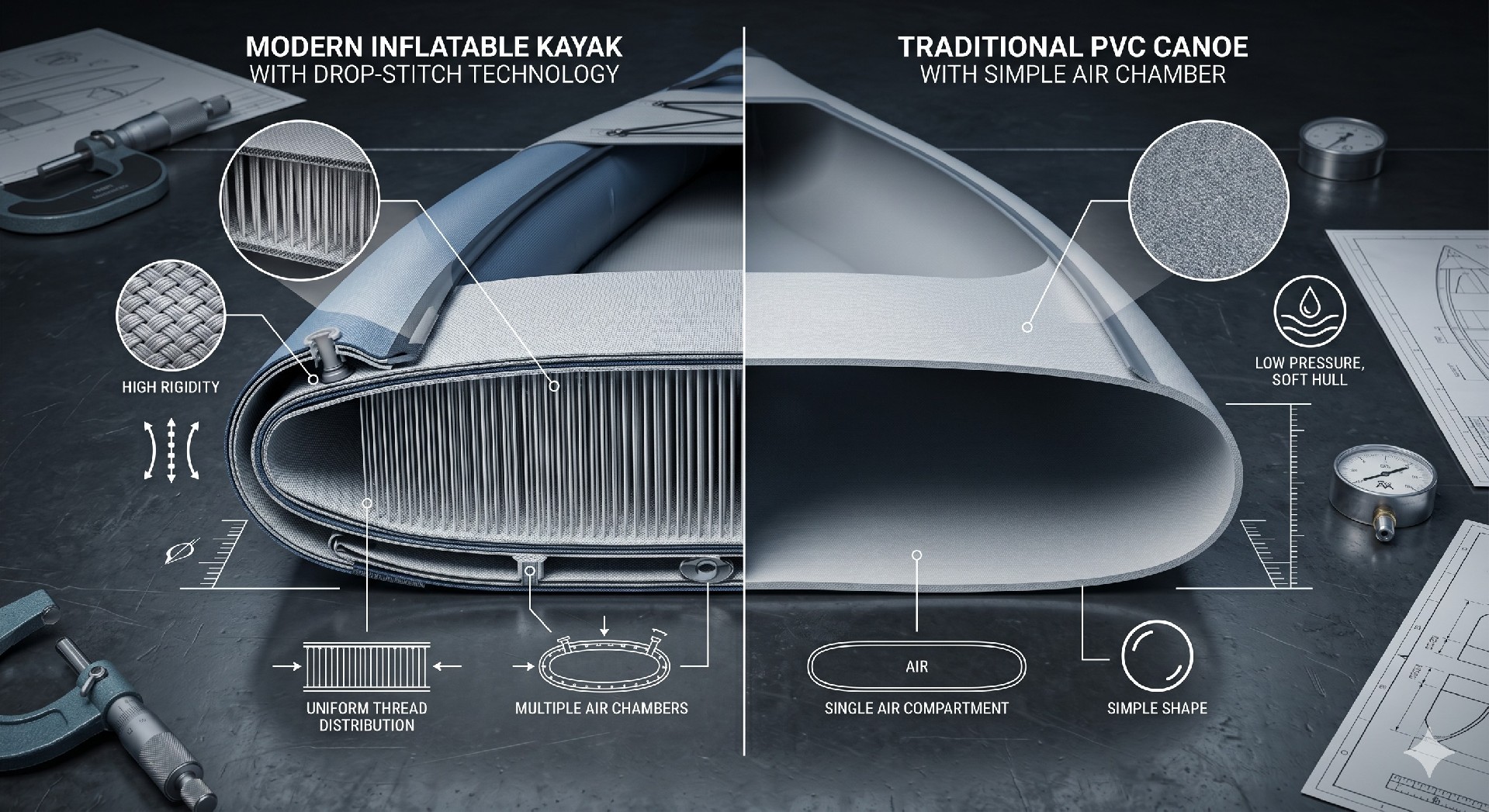
The most critical distinction between a traditional PVC inflatable canoe and a modern inflatable kayak lies in their internal construction and resultant operating pressure, which dictates performance on the water.
Traditional PVC Canoe: The Low-Pressure Foundation
Standard PVC inflatable canoes typically utilize a single-chamber or multi-tube design constructed from multi-layer PVC fabric. These are low-pressure vessels, generally operating between 2 to 4 PSI . Without an internal structural frame, they rely on this air pressure to maintain their shape. This results in a softer, more flexible hull that absorbs paddling energy, compromising tracking and speed . While ideal for calm lakes and gentle rivers, these boats are vulnerable to pressure loss from a small puncture, which can lead to a significant loss of rigidity far from shore .
High-Performance Kayak: The Drop-Stitch Revolution
Modern commercial-grade inflatable kayaks leverage drop-stitch technology. This advanced construction consists of thousands of vertical polyester yarns connecting the top and bottom PVC skins. When inflated, these yarns create a rigid, monolithic panel capable of withstanding high pressure—typically 8 to 12 PSI . This high-pressure rigidity allows a drop-stitch kayak to achieve performance characteristics that rival a hard-shell kayak, including superior tracking and speed . The trade-off is a significantly higher unit cost and the need for a high-pressure pump .
Technical Specifications: A Comparative Analysis
The following technical specifications are critical for evaluating fleet durability, safety compliance, and operational suitability.
| Key Parameter | PVC Inflatable Canoe | Drop-Stitch Inflatable Kayak |
|---|---|---|
| Operating Pressure | 2–4 PSI | 8–12 PSI |
| Material Thickness | 0.3mm – 0.9mm / 500-1100D PVC | 0.9mm+ / 1100D Reinforced PVC |
| Maximum Payload (Tandem) | 180–220 kg (up to 400 kg for heavy-duty) | Varies by model (commercial specs available from supplier) |
| Seam Construction | Often glued (prone to failure) | High-Frequency (HF) welded (molecular bond) |
| Commercial Lifespan | 18 – 30 months | 4 – 6 years |
| Typical FOB Cost (Single) | $65 – $120 | $145 – $235 |
| Safety Certification | CE, EN71 possible | CE, ISO 6185, REACH compliant |
| Tracking Performance | 25-40% worse than hard-shell | Within 5-10% of hard-shell |
Manufacturing and Durability: Seams and Materials
Material Composition
Material thickness and composition are key indicators of a product's lifespan under commercial use. Standard recreational PVC canoes often feature material thicknesses around 0.3mm to 0.9mm . In contrast, heavy-duty commercial-grade models may use reinforced PVC with a thickness of 0.9mm / 1100D for enhanced abrasion resistance. For extreme environments, Hypalon, a synthetic rubber, is sometimes used for its superior UV and chemical resistance, though at a premium cost .
Seam Integrity: Welded vs. Glued
Seam construction is the single most critical factor in an inflatable's long-term durability. Hand-glued seams, common in lower-cost PVC canoes, are a primary failure point, often degrading within 14-18 months of regular commercial use . For a fleet that must withstand constant usage, High-Frequency (HF) welded seams are non-negotiable. HF welding uses radio waves to fuse the PVC material at a molecular level, creating a bond as strong as the material itself and ensuring superior air retention and structural integrity .
Operational Metrics and ROI for Fleet Operators
The choice between these two craft has a direct impact on your bottom line.
Inflation and Turnaround Efficiency
For rental operations, turnaround time is revenue. A standard PVC canoe can be inflated in 5 to 10 minutes with a hand pump, or under 3 minutes with an electric pump . While drop-stitch kayaks require more time due to higher PSI targets, many commercial models feature high-volume valves to streamline this process.
Total Cost of Ownership (TCO)
While a PVC bladder canoe has a lower initial purchase price ($65–$120 FOB for a single), its commercial lifespan is limited to 18–30 months . A drop-stitch kayak costs significantly more ($145–$235 FOB) but offers a fleet lifespan of 4–6 years . The annual depreciation for a drop-stitch kayak can be as low as $40/year, compared to $45/year for a cheaper PVC boat, while delivering a vastly superior customer experience .
Safety and Compliance
Safety standards are paramount for commercial operators. Reputable manufacturers ensure their products meet or exceed international standards such as ISO 6185 (inflatable boats), CE certification for the European market, and REACH compliance for chemical safety. Look for multi-chamber designs for added safety—if one chamber is punctured, the others maintain buoyancy, allowing a safe return to shore .
Conclusion: The Strategic Verdict
The choice between a PVC inflatable canoe and a drop-stitch kayak ultimately hinges on your target market. A PVC inflatable canoe serves as a cost-effective entry point for casual, low-stress recreational rentals on flatwater. However, for commercial operators seeking to maximize customer satisfaction, safety, and long-term ROI, the high-pressure drop-stitch kayak is the superior investment. Its enhanced rigidity, performance, and extended lifespan make it the new standard for professional fleets.
