

The Economic Impact of Ignoring Weight Limits in Commercial Procurement
For B2B buyers and commercial fleet managers, the inflatable kayak weight limit—often labeled as maximum payload, capacity, or load—is more than just a number on a spec sheet. It's a critical determinant of your Total Cost of Ownership (TCO), operational safety, and end-user satisfaction. Underestimating this metric leads to premature material fatigue, increased warranty claims, and potential safety liabilities. Whether you are sourcing for high-turnover rental operations, glamping resorts, or outdoor education programs, the capacity of your fleet dictates your business's resilience.
Unlike recreational consumers, commercial entities must analyze payload in the context of cumulative stress. A kayak rated for 400 kg might see daily loads averaging 200 kg, but the dynamic forces from rapids, waves, and high-frequency dismounts in sandy environments put unique strain on the fabric, seams, and drop-stitch core. This guide provides a technical deep dive into the engineering specifications, material science, and compliance standards that define a commercial-grade payload.
Fabric Technology Deep Dive: The Core of Capacity
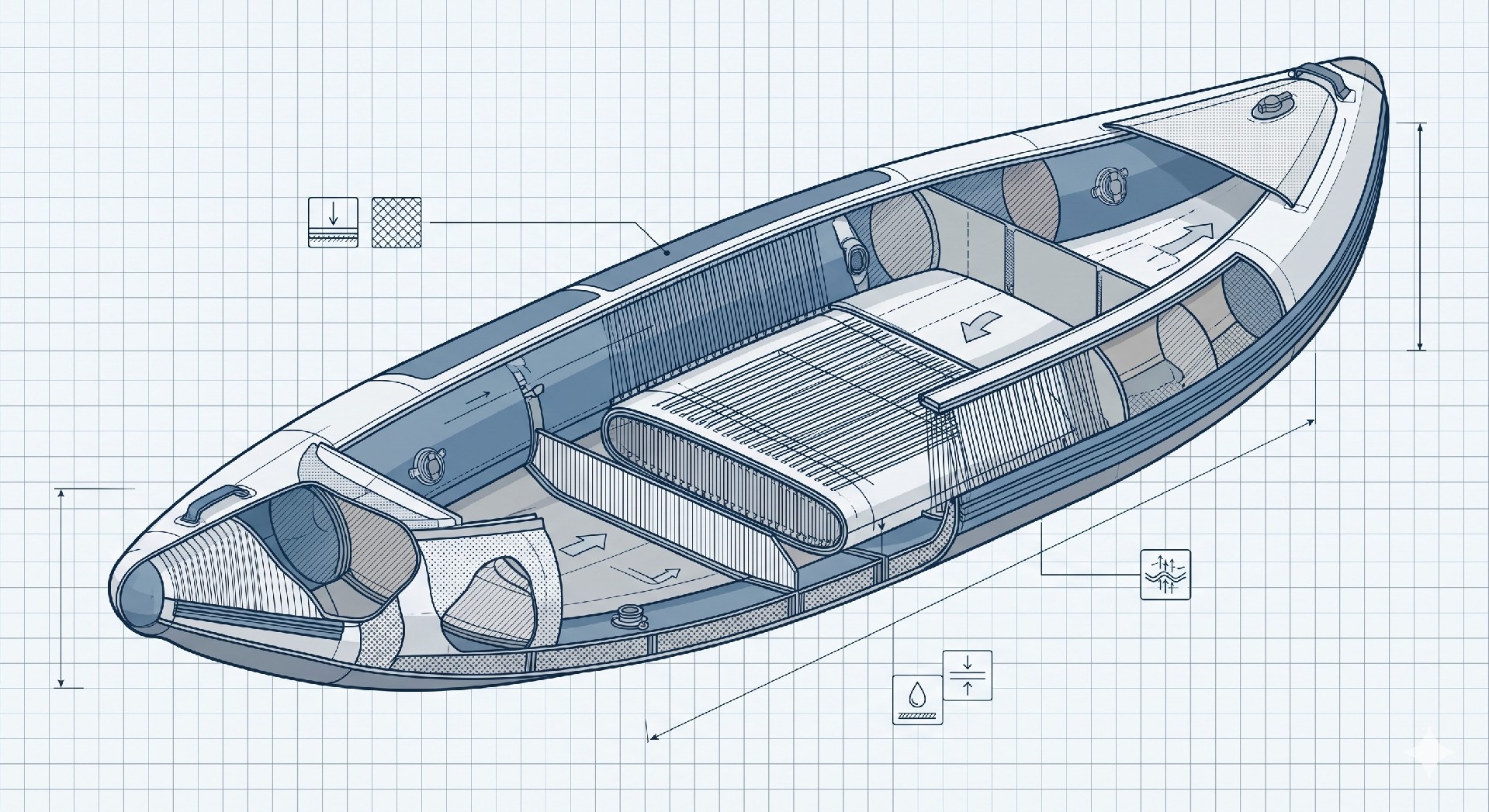
The maximum weight a kayak can support is fundamentally tied to the structural integrity of its material composition. In the B2B landscape, the material choice determines whether a kayak withstands 300 rental cycles or fails after 50.
Reinforced PVC vs. High-End Nitrilon
The industry standard for commercial applications revolves around high-denier fabrics. Typically, we look at 0.9mm to 1.2mm reinforced PVC with a denier count of 1000D to 1100D, which provides a robust balance between rigidity and weight. For instance, high-capacity models often utilize a sandwich construction of reinforced laminated PVC and mesh to support loads up to 318 kg (700 lbs) . The thickness of the fabric directly correlates to puncture resistance; a 0.9mm fabric is suitable for flatwater touring, whereas a 1.2mm thickness is required for extreme environments.
In the premium segment, materials like Nitrilon (a specialized synthetic rubber compound) are preferred for their superior air retention and abrasion resistance. The Gumotex Twist 1, despite being a lightweight single kayak, utilizes this material to achieve a maximum operating pressure of 3 PSI, significantly higher than standard PVC, which allows it to carry a 100 kg load despite its compact size . This high-pressure capability is crucial for maintaining hull rigidity under heavy loads, reducing drag, and ensuring efficient paddling.
Drop-Stitch Technology: A Structural Revolution
To achieve the load capacities seen in modern inflatable kayaks—such as the 460 lbs (209 kg) capacity on the Itiwit X500 2-Person model—the industry has shifted toward drop-stitch construction . This technology involves thousands of high-tensile polyester threads connecting the top and bottom layers of the fabric. When inflated to high pressures (e.g., 10 PSI to 15 PSI), these threads lock the fabric into a flat, rigid, plank-like structure . This transforms the inflatable kayak from a flexible tube into a rigid hull capable of supporting significant weight without "banana-ing" or flexing in the middle.
For commercial buyers, understanding the PSI rating is key. A kayak with a drop-stitch floor and high-pressure inflation can support a 150 kg solo paddler with gear, as seen in the Gumotex Rush, while maintaining the speed and tracking of a hard-shell kayak . The rigidity prevents the hull from deforming, ensuring that the inflatable kayak weight limit is a functional and safe ceiling, not just a theoretical maximum.
Engineering Integrity: Welds, Seams, and Chambers
Payload capacity isn't just about the fabric; it's about how the pieces are held together. In the commercial sector, the failure point is almost always the seam.
Heat-Welded vs. Glued Seams
High-quality commercial kayaks utilize heat-welded seams rather than glued seams. Heat welding molecularly bonds the PVC or Hypalon layers, creating a joint that is nearly as strong as the material itself. This is critical under heavy payloads, as the internal pressure forces the seams outward. Glued seams, while cheaper, degrade in UV light and heat, leading to delamination and catastrophic failure.
Multi-Chamber Safety Systems
Commercial-grade kayaks often incorporate multi-chamber designs to distribute load and enhance safety. A kayak with 3+ independent air chambers (e.g., the Gumotex Twist 1 and Swing 1) ensures that a puncture in one section does not cause complete loss of buoyancy . This is a non-negotiable feature for guided tours and rentals. Furthermore, models equipped with safety relief valves (as seen in the Swing 1) protect the hull from over-inflation on hot days, a common risk that can warp the fabric and compromise the weight limit .
| Model / Application | Material & Thickness | Max Payload | Max Pressure (PSI) | Key Commercial Feature |
|---|---|---|---|---|
| Expedition / Solo | Nitrilon with Drop-Stitch | 150 kg (330 lbs) | 3.0 PSI | High rigidity, compact pack |
| Fishing / Tandem | Reinforced Laminated PVC | 318 kg (700 lbs) | 8-10 PSI | Puncture/UV resistant, 172" length |
| High-Performance Touring | Drop-Stitch PVC | 209 kg (460 lbs) | 15 PSI | Fast inflation (6 mins), rigid hull |
| Resort / Family | PVC with Canopy | 200 kg (440 lbs) | 2-3 PSI | Detachable sun canopy, 3rd seat |
| Entry Level / Rental | Standard PVC | 100 kg (220 lbs) | 1.5 PSI | Lightweight, beginner-friendly |
Commercial Use Cases and ROI Analysis
Selecting a kayak based on the correct inflatable kayak weight limit has a direct impact on your bottom line. Here is how these specifications translate to different commercial verticals.
[IMAGE_2]
High-Throughput Rental Centers
For rentals, speed and durability are paramount. The Itiwit X500 2-person model, with a 15 PSI inflation limit, can be inflated in 6 minutes using a double-action hand pump . Its 460 lbs capacity allows it to accommodate two large adults and gear. The TCO is favorable due to reduced storage space (deflated, it packs to a manageable 39.4" x 17.7" x 15") and lower shipping costs compared to hard-shells. However, ensure that your staff adheres to the precise PSI settings listed in the technical specification table; under-inflation at these capacities leads to severe handling issues.
Glamping and Eco-Resorts
Resorts require a balance of style, comfort, and stability. Kayaks like the Keystone Peak model (440 lbs / 200 kg capacity) offer amenities like detachable sun canopies and third seats for dogs or children, enhancing guest experiences . For these environments, the ability to carry 200 kg smoothly is essential, but the emphasis is often on stability over speed. The wide 160 cm dimensions and low center of gravity provide a safe, confidence-inspiring ride for novice guests.
Fishing and Expedition Outfitters
In the fishing segment, capacity is king. The Wilderness Systems iATAK 110 offers a whopping 650 lbs capacity (295 kg) at 11 feet in length . This accommodates the angler, tackle, multiple rods, and a heavy battery for a trolling motor. For outfitters, the ROI is measured in the ability to offer specialized trips that competitors with lower-capacity fleets cannot. The VEVOR 2-Person kayak, with its 318 kg capacity and 27.2 kg weight, bridges the gap between recreational and expeditionary use, specifically catering to fishermen carrying large coolers and gear .
Conclusion: Sourcing for Longevity
Navigating the inflatable kayak weight limit requires a shift in perspective from viewing it as a simple number to understanding it as a sum of material science, engineering, and operational strategy. For the B2B buyer, the priority should be on models with drop-stitch technology, heat-welded seams, and multi-chamber safety systems. Always cross-reference the manufacturer's maximum load with the proposed use case; a 150 kg solo kayak like the Gumotex Twist 1 is ideal for children and small adults, whereas a 318 kg tandem kayak is necessary for heavy-duty fishing or family rentals . By aligning your procurement with these technical realities, you minimize fleet downtime, maximize user safety, and ensure a healthier ROI.
