

The Commercial Cost of Punctures: Why B2B Buyers Must Prioritize Repair Strategy
For B2B operators—from high-throughput rental fleets to glamping resorts—the profitability of inflatable watercraft hinges on minimizing downtime. A single puncture in a commercial-grade kayak can translate to significant revenue loss and erode guest confidence if repairs are not executed with precision. This guide provides a data-driven examination of inflatable kayak puncture repair, focusing on material science, industry standards, and lifecycle economics. Understanding the intricacies of repair is not just about maintenance; it is a critical component of total cost of ownership (TCO) and operational efficiency. Our analysis integrates key technical specifications—including Drop-stitch PSI, fabric thickness measured in denier, and ISO 6185 compliance—to provide a definitive blueprint for commercial sourcing and fleet management.
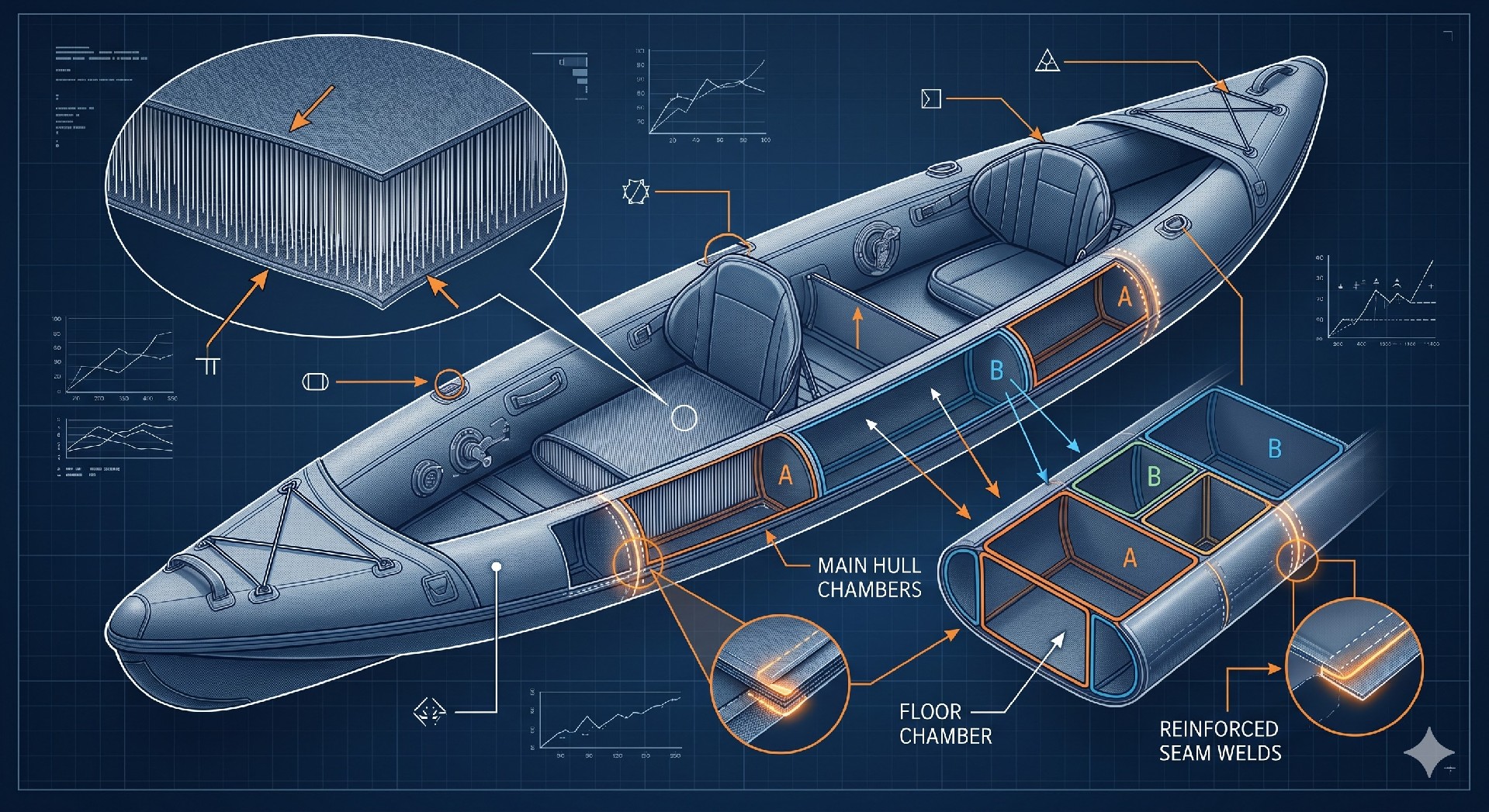
Fabric Tech Deep Dive: PVC vs. Hypalon and Puncture Dynamics
The efficacy of any repair strategy begins with the base material. Most commercial inflatable kayaks utilize either high-density PVC or Hypalon, each presenting distinct repair characteristics. PVC, typically measured in denier (e.g., 0.9mm / 1100D), offers a cost-effective balance of weight and rigidity. However, its susceptibility to UV degradation and specific solvents requires precise adhesive selection. Hypalon, while more expensive, offers superior resistance to UV, abrasion, and chemicals, making it ideal for extreme environments . When a puncture occurs, the repair protocol must account for the material's tensile strength and the pressure it must withstand. For instance, commercial drop-stitch floors often operate at pressures up to 15 PSI, demanding that a repair maintains structural integrity equivalent to the original weld.
Material Thickness and Denier Count
Denier count is a primary indicator of a fabric's abrasion resistance and puncture threshold. Higher denier fabrics (e.g., 1100D to 2000D) are more resistant to sharp objects but require more robust adhesives to bond effectively . B2B sourcing decisions should prioritize materials that meet CE and REACH standards, ensuring adhesives and solvents used in repair do not compromise the fabric's chemical makeup.
Weld Engineering and Adhesive Chemistry: The Science of a Permanent Bond
Commercial repair transcends the patch-and-glue approach of consumer kits. The goal is a vulcanized or chemically welded bond that restores the material's original pressure-holding capacity. This involves understanding the specific chemical formulation of adhesives. Products like AquaPro utilize a liquid PVC formulation that cures to form a permanent patch, effectively merging with the parent material . This is distinct from standard polyurethane-based repair adhesives, which are effective but may not create the same molecular bond with high-denier PVC. For high-pressure seams, heat-welding repairs offer the highest integrity, though field expediency often necessitates advanced cold-cure adhesives that achieve similar adhesion strengths when prepared correctly.
Step-by-Step Commercial Repair Protocol
Preparation: Identify the leak precisely using soapy water. Mark the area and deflate the kayak completely .
Surface Abrasion: Roughen the surrounding PVC or Hypalon to 100-120 grit to create a mechanical key for the adhesive.
Cleaning: Degrease the area with isopropyl alcohol to remove all contaminants, ensuring maximum adhesion.
Adhesive Application: Apply a repair adhesive specifically engineered for the fabric type. For pin-hole leaks, a liquid sealant may suffice; for rips exceeding 1 inch, a mesh cord or reinforced patch is essential .
Curing: Allow the adhesive to cure for the manufacturer's recommended period (often 2-3 hours for initial set, 24 hours for full strength) before reinflating to operating PSI .
Technical Specifications & Critical Output Metrics
For B2B procurement managers, repair kit performance must be quantifiable. The following table outlines the key technical metrics that define repair efficacy and should be part of any sourcing evaluation. These specifications are derived from industry standards including ISO 6185 for inflatable boats and REACH for chemical safety.
| Key Parameter | Technical Specification | Commercial Impact |
|---|---|---|
| Fabric Type | PVC (1100D-2000D) / Hypalon | Determines adhesive chemical compatibility. |
| Operating Pressure | Drop-Stitch Floor: 10-15 PSI | Repair must maintain structural integrity at max PSI. |
| Adhesive Cure Time | Initial set: 2-3 hrs / Full cure: 24 hrs | Directly impacts fleet turnaround time. |
| Material Thickness | 0.9mm - 1.2mm | Defines puncture resistance and repair patch overlap requirement. |
| Safety Standard | ISO 6185, REACH, CE | Essential for commercial liability and compliance. |
Commercial Applications: Rental, Rescue, and Resorts
The commercial landscape for inflatable kayaks is diverse. In high-turnover rental environments, repair speed is paramount; rapid-curing adhesives minimize fleet downtime and maximize rental revenue . For glamping and premium resorts, the aesthetic finish of the repair is critical; transparent adhesives and precise patch application ensure guest experience is not compromised by visible fixes. In rescue and expedition scenarios, repair reliability is non-negotiable; multi-chamber safety systems are designed so a catastrophic failure in one chamber still requires a robust repair to maintain secondary buoyancy .
[IMAGE_2]
Conclusion: Integrating Repair Strategy into the Procurement Lifecycle
Inflatable kayak puncture repair is a strategic function directly impacting fleet profitability and safety compliance. B2B buyers should treat repair kits with the same rigor as the kayaks themselves, evaluating adhesive chemistry, curing times, and material compatibility against industry standards like ISO 6185 and REACH. A proactive repair strategy—including training staff on proper surface preparation and curing timelines—extends the commercial lifespan of assets and delivers a superior return on investment.
