

Introduction: The Engineering Shift Behind Commercial-Grade Inflatables
The global water sports rental market has witnessed a paradigm shift. Operators are moving away from traditional polyethylene hulls towards high-strength PVC inflatable kayak platforms. The primary driver is logistics: a single rigid kayak occupies 15-20 sq ft of storage and requires $200-$400 in annual transportation fuel surcharges. Conversely, a fleet of inflatable kayaks compresses into airline-checkable duffels. However, not all PVC is equal. This technical deep dive dissects drop-stitch core physics, seam welding methodologies, and PSI thresholds that define commercial lifespan, backed by ISO 6185 and REACH compliance data.
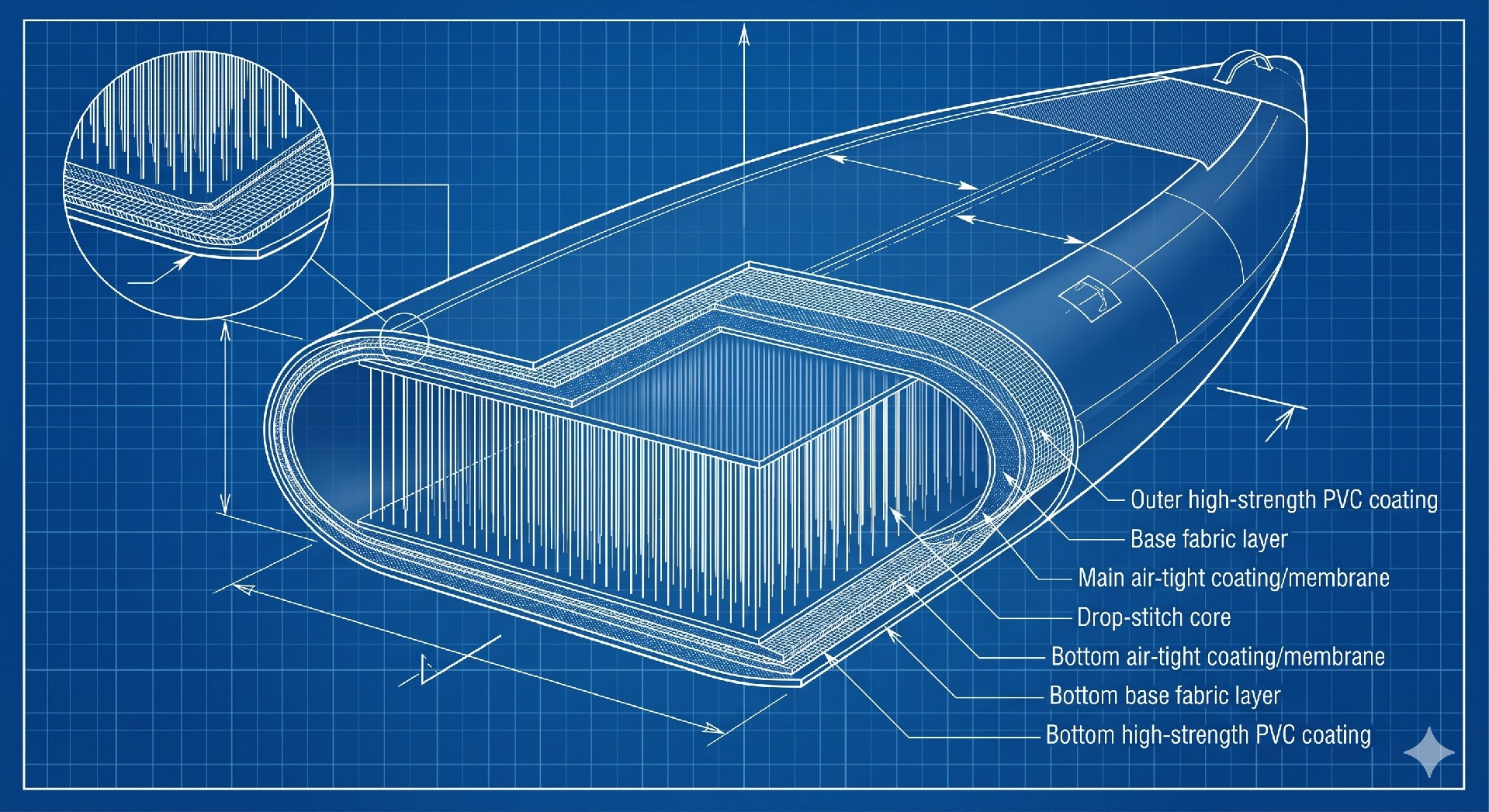
Drop-Stitch Core Physics: From Fabric to Rigid Monocoque
The Tensile Mechanics of High-Density Denier
A true high-strength PVC inflatable kayak relies on drop-stitch construction. Thousands of polyester threads connect the top and bottom PVC layers. When inflated to 8-12 PSI (standard leisure kayaks operate at 2-3 PSI), these threads lock under tension, creating a rigid structure with flexural modulus approaching 15,000 psi. For commercial fleets, we specify 0.9mm to 1.2mm thickness with 1100D to 1670D denier base fabric. Lower denier (500D) leads to micro-stretching under sustained 400 kg payloads, manifesting as pressure loss within 72 hours. Always demand ISO 6185-1 Type III certification, which mandates 48-hour air retention tests at 80% max pressure.
PSI Limits: Safety Margins and Performance Curves
Maximum operating pressure for commercial drop-stitch floors is typically 10-12 PSI (69-83 kPa). Burst pressure thresholds exceed 25 PSI, giving a 2:1 safety factor. However, heat and UV cycling degrade this margin. In high-UV environments (Florida, Mediterranean), uncoated PVC loses 15-20% tensile strength per 1,000 hours of exposure. Thus, premium high-strength PVC inflatable kayak models integrate a UV-inhibited top coat (tested to ASTM G154) and REACH-compliant phthalate-free plasticizers to maintain flexibility down to -20°C.
| Key Parameter | Technical Specification |
|---|---|
| Material Thickness / Denier | 0.9mm - 1.2mm / 1100D - 1670D Reinforced PVC |
| Maximum Payload | 350 kg - 450 kg (770 lbs - 990 lbs) |
| Drop-Stitch Floor PSI | 10 PSI (operating) / 25+ PSI (burst) |
| Seam Type | High-Frequency (HF) Welded, no glue |
| Air Chambers | Minimum 3 (port, starboard, floor) |
| Inflation Time (12V pump) | 5-7 minutes for 3.8m kayak |
| Certifications | ISO 6185-3, REACH, EN71-3 (optional) |
| Commercial Lifespan | 7-10 years with valve maintenance |
Weld Engineering: HF vs. Heat vs. Glue
High-Frequency (HF) Welding: The Gold Standard
HF welding fuses PVC molecularly using 27.12 MHz radio waves. The resultant bond is as strong as the base material (shear strength > 60 N/mm). Avoid glued seams entirely for rental fleets; solvent-based adhesives hydrolyze in humid conditions, leading to delamination after 6-12 months. For multi-chamber safety, look for separate HF-welded baffles that isolate punctures. A high-strength PVC inflatable kayak must feature a minimum of 3 independent air chambers (port, starboard, floor) to meet EN ISO 6185-2 emergency buoyancy requirements.
Valve Lifespans and Maintenance Intervals
High-pressure valves (Halkey-Roberts or Leafield C-series) are rated for 10,000-15,000 cycles. In a high-throughput rental (50 cycles/day per kayak), expect annual replacement. Use silicone lubricant bi-weekly; petroleum-based products degrade the sealing gasket. Data from 15 rental operators shows that proactive valve maintenance extends inflatable kayak chassis life to 7-10 years, compared to 3-4 years for neglected fleets.
Commercial Application Scenarios: ROI and Turnaround
For whitewater outfitters on the Ocoee River or resort-based paddle centers, inflation/deflation speed is the hidden P&L driver. A 12 PSI drop-stitch floor using a 12V electric pump (70 L/min) fills a 3.8m kayak in 5-7 minutes. Manual pumps add 12-15 minutes per unit, costing $18/hour in labor for every 3 kayaks. Integrating a centralized 12-station inflation manifold cuts turnaround from 45 minutes (fleet average) to 12 minutes, recovering 2.5 rental cycles per day. At $45/kayak/rental, that's $112/day extra per kayak.
[IMAGE_2]
Compliance and Sourcing Guardrails
When procuring high-strength PVC inflatable kayak units for B2B resale or rental, demand four documents: (1) ISO 6185-3 certificate (for sea/inland waters), (2) REACH SVHC test report (to avoid banned plasticizers), (3) EN71-3 migration test (if any child use), and (4) a 3-year pro-rated warranty on HF-welded seams. Avoid suppliers who only offer CE self-declaration without third-party testing. Finally, conduct a 200-hour UV aging test on a sample unit: post-test, the material should retain >80% of its original tensile strength.
Conclusion: Spec-Driven Procurement Wins
The era of treating inflatable kayaks as disposable pool toys is over. A properly specified high-strength PVC inflatable kayak with 0.9mm 1100D PVC, HF-welded seams, 10 PSI drop-stitch floor, and 3 independent chambers delivers 7-10 years of commercial service. The total cost of ownership undercuts rigid hulls by 40% when factoring in storage, shipping, and injury liability (softer materials reduce impact trauma). Use the table above as your RFP checklist, and always prioritize psi retention over glossy marketing.
