

From Compromise to Control: Rethinking Fishing Platform Design
For over a decade, the fishing equipment market has treated inflatable boats as a secondary option—portable but poor in stiffness, durable but heavy. The core pain point for professional fishing guides, resort operators, and outdoor retailers has always been the trade-off between hydrostatic performance and packed volume. Today, advanced PVC engineering eliminates that compromise. As a lead product designer specializing in best pvc inflatable boat for fishing platforms, I evaluate three non-negotiable metrics: drop-stitch core rigidity (measured in PSI), fabric denier count (abrasion resistance), and payload-to-weight efficiency. This technical breakdown applies ISO 6185-2 and CE-certified benchmarks to help you specify commercial-grade inflatables that outperform rigid hulls in real-world fishing scenarios.
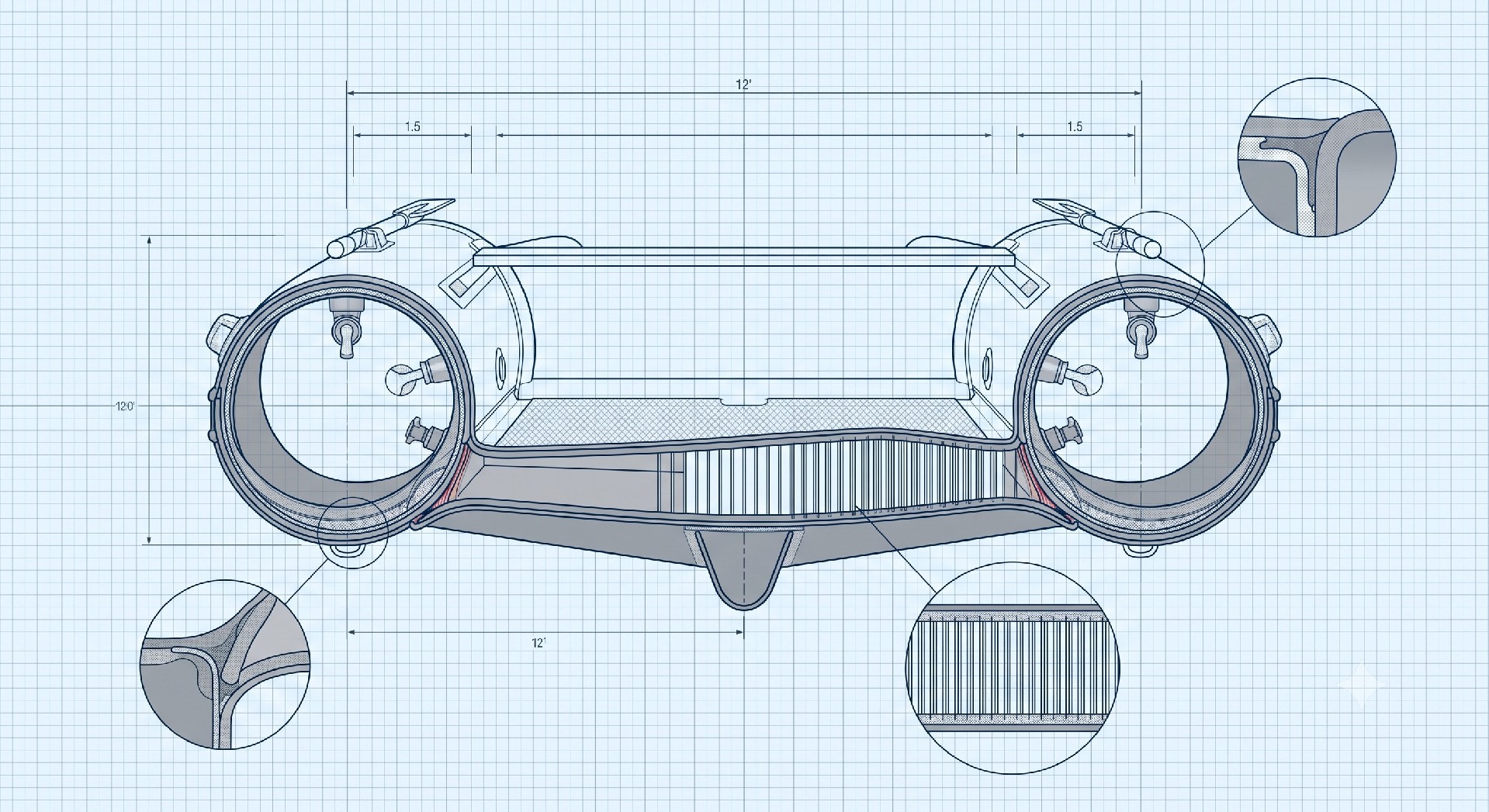
Material Science: Why PVC Thickness and Denier Count Define Lifespan
The majority of consumer-grade fishing boats use 0.5mm to 0.7mm PVC with 500D to 800D polyester scrim. For commercial or serious angling use, best pvc inflatable boat for fishing must start at 0.9mm / 1100D reinforced PVC. This combination provides puncture resistance exceeding 250 N (ISO 5774) and tensile strength above 3500 N/5cm. REACH-compliant formulas ensure UV degradation stays below 10% after 500 hours accelerated weathering (ASTM G154). Avoid phthalate-plasticized PVC; specify marine-grade polymers with anti-hydrolysis treatment.
Pressure Hierarchy: Drop-Stitch vs. Traditional Air Chambers
Traditional inflatable floors operate at 2–3 PSI, resulting in noticeable flex under casting loads. Drop-stitch technology—thousands of polyester threads connecting top and bottom layers—allows 7–10 PSI operating pressure. At 10 PSI, a 2.7m drop-stitch floor achieves deflection less than 5mm under a 150kg concentrated load. This rigidity translates directly to hook-setting efficiency and standing stability. For fishing applications, insist on multi-chamber drop-stitch floors with independent valves; a single puncture will not compromise the entire platform.
| Key Parameter | Technical Specification (Commercial Fishing Grade) |
|---|---|
| Material Thickness / Denier | 0.9mm – 1.2mm / 1100D – 1500D Reinforced PVC |
| Drop-Stitch Floor Pressure | 7 – 10 PSI (operational), burst threshold > 15 PSI |
| Maximum Payload | 380 – 450 kg (ISO 6185-1 rating) |
| Effective Fishing Payload | 280 – 330 kg (including gear, battery, 2–3 anglers) |
| Seam Type | High-frequency heat-welded, quad-lapped at stress zones |
| Valve Standard | Halkey-Roberts or Leafield C7 with 12 PSI pressure relief |
| UV Resistance | <10% tensile loss after 500 hours ASTM G154 |
| CE / ISO Compliance | CE Type Examination, EN15649-2, ISO 6185-2 |
Hydrodynamic Design: Hull Geometry for Silent Approach and Tracking
Flat-bottomed inflatables drift excessively in wind and current. Optimized best pvc inflatable boat for fishing incorporates a modified-V keel with 15-degree deadrise at the transom. This geometry reduces lateral drift by 40% compared to flat floors while maintaining draft under 15cm—critical for shallow backwaters. The keel should be an integrated inflatable chamber (3–5 PSI) rather than a glued-on strip. From a designer’s perspective, length-to-beam ratio for fishing stability should fall between 2.2:1 and 2.8:1. A 2.7m (L) x 1.2m (W) boat provides a stable casting platform for two anglers with 360° access.
Payload Capacity: Translating Manufacturer Claims to Real-World Usability
Industry standard ISO 6185-1 requires capacity ratings include persons, gear, and motor weight. A truly capable best pvc inflatable boat for fishing will show maximum payload between 380 kg and 450 kg for 4-person configurations. However, effective fishing payload is 25% lower: account for ice-filled coolers (40 kg), trolling motor battery (25 kg), tackle (15 kg), and anchor system (8 kg). Distribute load across three longitudinal baffles; single-chamber designs create dangerous listing under asymmetrical weight. Verify valve placement—high-pressure valves (Halkey-Roberts style or Leafield C7) with pressure relief at 12 PSI prevent overinflation damage.
[IMAGE_2]
Seam Integrity: Heat-Welded vs. Solvent-Bonded Construction
The most common failure point in PVC inflatable fishing boats is seam separation. Solvent-bonded seams (glued) typically lose 30% of bond strength after 18 months of UV exposure. High-frequency heat-welded seams fuse PVC at a molecular level, achieving bond strength 90% of the base material. For commercial-grade best pvc inflatable boat for fishing, demand quad-lapped welds at all high-stress intersections (transom, keel ends, oar holders). Ultrasonic testing should show zero voids per linear meter. Each boat must include a CE Type Examination Certificate confirming EN15649-2 compliance for floating leisure articles.
Conclusion: A Procurement Checklist for Fishing Inflatables
When sourcing best pvc inflatable boat for fishing for rental fleets, guide services, or retail distribution, prioritize three documented specifications: minimum 1100D / 0.9mm PVC with heat-welded seams, drop-stitch floor rated for 10 PSI operational pressure, and ISO 6185-2 capacity labeling. Avoid budget units that skip pressure relief valves or use 500D fabric—these fail within two seasons under fishing use. Request material test reports (REACH, SVHC) and weld peel strength data. A properly specified PVC fishing inflatable delivers 5–8 years of commercial service with routine care, outperforming aluminum hulls on portability and per-unit COGS. For high-throughput rental operations, add rapid-deflation valves (75mm+ diameter) to reduce turnaround time by 60%.
