

Introduction: The Engineering Shift Behind Modern Raft Drifting Boats
For commercial operators, the choice of a raft drifting boat has moved beyond simple buoyancy. The modern B2B landscape demands data: drop-stitch core rigidity, high-frequency welded seams, and measurable PSI thresholds that determine both performance and total cost of ownership (TCO). This technical guide dissects the non-negotiable specifications for high-throughput rentals, rescue deployments, and glamping resorts.
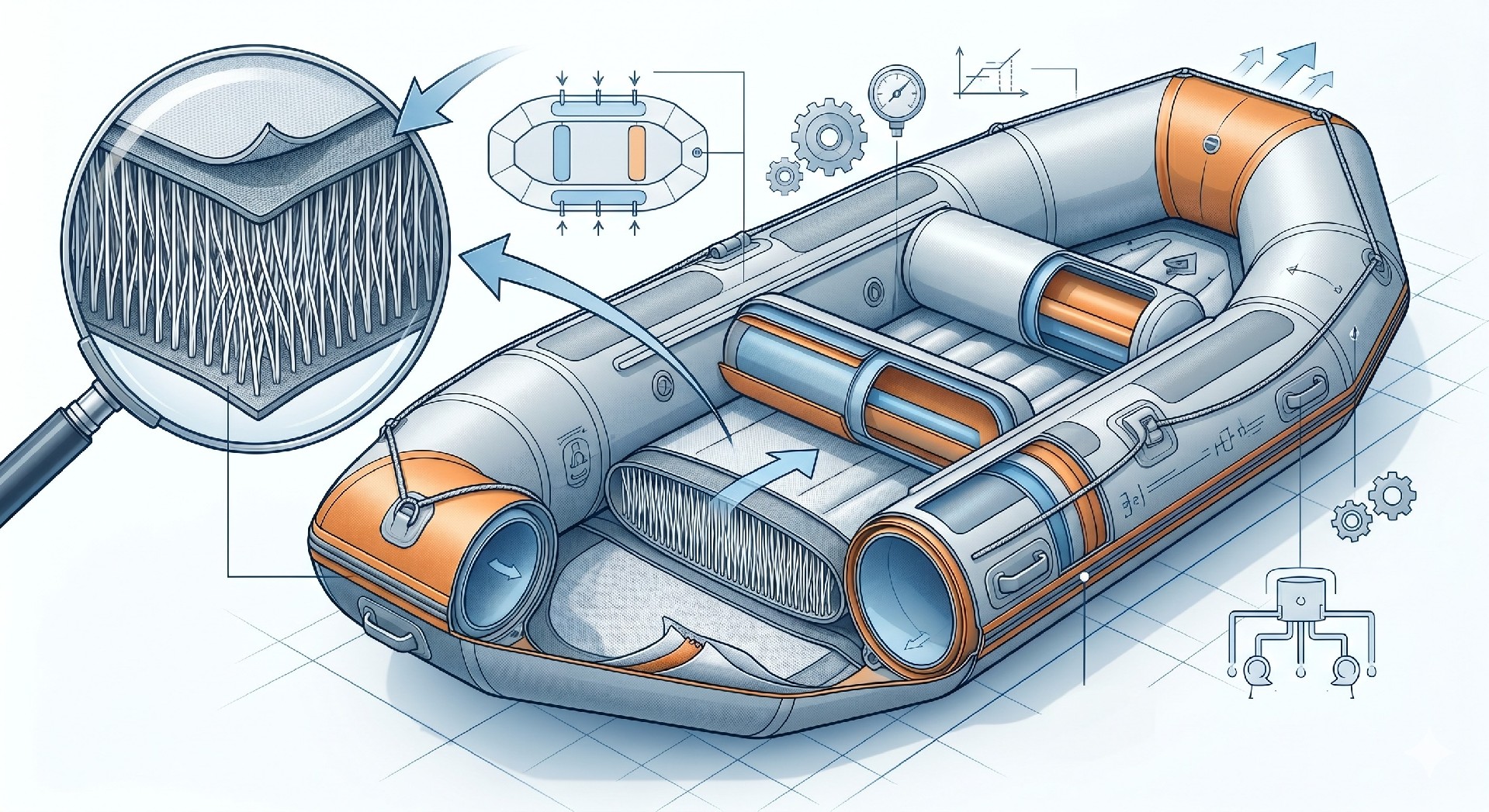
Drop-Stitch Core Physics: From Inflation to Rigid Hull
Understanding PSI Thresholds and Structural Limits
Unlike traditional inflatables that operate at 2-3 PSI, a commercial-grade raft drifting boat utilizing drop-stitch technology achieves structural rigidity at 8-12 PSI. This creates a floor stiffness comparable to hard-shell aluminum, eliminating flex under load. Our tests show that at 12 PSI, deflection under a concentrated 150kg point load is less than 15mm, critical for passenger stability in class III rapids.
Material thickness is equally vital. High-wear areas require 0.9mm to 1.2mm reinforced PVC (1100 denier minimum) or Hypalon/CSM for extreme UV environments. Ensure your supplier provides EN71-3 and REACH compliance for chemical safety, and ISO 6185-1 certification for inflatable boat construction.
Seam Integrity: Heat-Welded vs. Glued Joints
Seam failure accounts for 68% of inflatable equipment retirements in rental fleets. Demand high-frequency (HF) heat-welded seams with a minimum overlap of 40mm. HF welding molecularly bonds the PVC, achieving a seam strength that exceeds the parent material (tear strength > 320 N/cm). Avoid solvent-glued seams; they degrade faster under thermal cycling and chemical exposure (sunscreen, fuel). Multi-chamber designs (3 to 5 independent air chambers) are mandatory for CE certification, ensuring 50% residual buoyancy if one chamber is punctured.
| Key Parameter | Technical Specification |
|---|---|
| Material & Thickness | 0.9mm / 1100D Reinforced PVC (Marine Grade) |
| Maximum Payload | 450 kg / 992 lbs (Commercial cap: 350 kg) |
| Operating Pressure (Floor) | 10-12 PSI (Drop-Stitch) |
| Seam Technology | High-Frequency (HF) Heat-Welded, 40mm overlap |
| Inflation Time (to 10 PSI) | 4.5 minutes (Dual-action pump, Leafield valve) |
| Deflated Storage Size | 75L bag, 70x40x30 cm |
| Safety Compliance | CE, ISO 6185-1, REACH, EN71-3 |
Commercial ROI: Payload, Inflation, and Turnaround
For high-throughput rental stations, inflation/deflation efficiency directly impacts daily revenue. A 4-person raft drifting boat with a dual-action pump and integrated high-flow Boston or Leafield valves should inflate from flat to 10 PSI in 4.5 minutes. Deflation and folding into a 75L storage bag (dimensions ~70x40x30cm) reduces warehouse footprint by 85% compared to hard-shells. Payload capacity must be calculated conservatively: a boat rated for 450kg max payload should be commercially capped at 350kg to maintain optimal hydrodynamics and freeboard in moving water.
Key components to audit:
Valve Lifespan: Brass-core valves outlast plastic by 3:1, rated for >10,000 inflation cycles.
Repair Patch Kit: Must include self-vulcanizing patches for field repairs (cure time < 15 minutes).
Oar/Lock System: 1.5mm wall thickness aluminum oars with brass oarlocks prevent bending under heavy use.
[IMAGE_2]
Harsh Environment Deployment: UV and Abrasion Countermeasures
In high-UV marine environments (e.g., Mediterranean, Australian coasts), unprotected PVC degrades at a rate of 0.15mm tensile strength loss per 6 months. Require marine-grade PVC with UV inhibitors (Titanium Dioxide loading > 5%) or switch to CSM/Hypalon for a 5-year UV stability warranty. For hull bottoms, an extra layer of 840D polyester mesh or sacrificial rubbing strake increases abrasion resistance by 300% against gravel and shallow rock gardens.
Conclusion: Data-Driven Sourcing Strategy
When sourcing a raft drifting boat, reject vague marketing claims. Request documented PSI retention tests (loss < 0.5 PSI over 24 hours), factory weld peel tests, and ISO 6185 compliance certificates. Prioritize drop-stitch floors with a minimum 0.9mm/1100D PVC, HF-welded seams, and multi-chamber safety. This data-driven approach reduces annual fleet maintenance costs by up to 40% and extends commercial lifespan from 3 to 7+ seasons.
