

Introduction: The Procurement Challenge with Two Person Canoe Units
For B2B buyers—ranging from rental fleet operators and outdoor resorts to military and rescue procurement departments—selecting the right two person canoe involves far more than comparing retail prices. The primary pain points include unpredictable material degradation, inconsistent PVC/Hypalon thickness, and hidden costs from valve failures. This guide provides a data-driven framework to evaluate commercial-grade two person canoe models, focusing on verified metrics such as maximum payload capacity (kg/lbs), drop-stitch PSI limits, and ISO 6185 compliance levels.
Fabric Technology Deep Dive: PVC vs. Hypalon for Two Person Canoe
The longevity of any two person canoe in a commercial setting hinges on the fabric matrix. Entry-level models often use single-coated PVC with a thickness of 0.55mm, which typically yields an abrasion resistance of under 500 cycles (Martindale test). In contrast, heavy-duty commercial options utilize reinforced 1100 Decitex (Denier) PVC or CSM (Hypalon) with a thickness of 0.9mm to 1.2mm. Hypalon offers superior UV and chemical resistance, maintaining over 90% tensile strength after 1000 hours of accelerated UV exposure, while high-grade PVC must include REACH-compliant stabilizers to avoid brittleness. Always request the exact denier count and coating weight (e.g., 1100 g/m²) from your supplier.
The Role of Drop-Stitch Core Rigidity
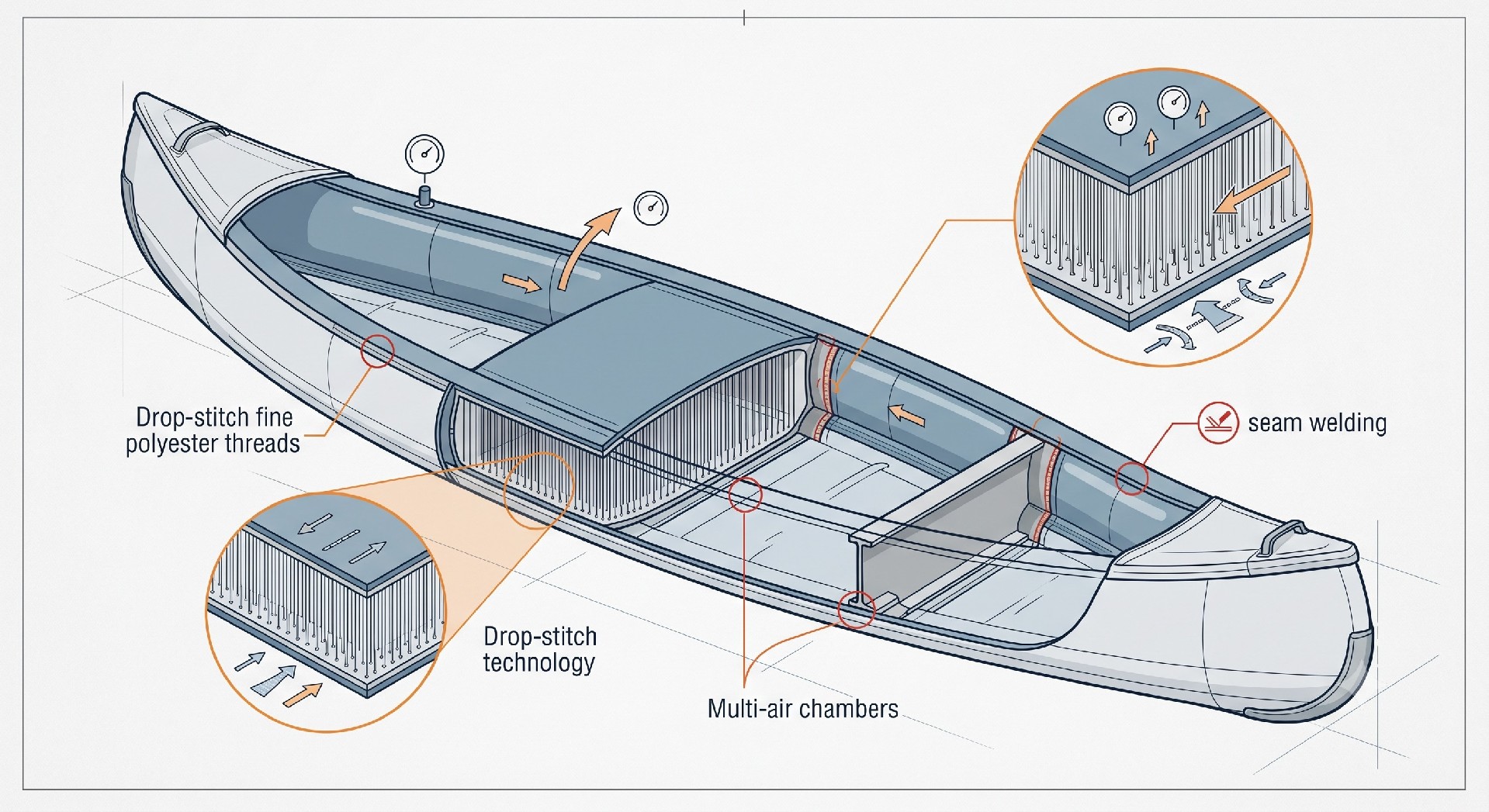
For a rigid, hard-shell-like experience, premium inflatable two person canoe models integrate a drop-stitch floor or full hull. This technology allows for operational pressures of 10-15 PSI (0.7-1.0 bar), compared to 2-3 PSI for traditional inflatable floors. At 15 PSI, the deflection under a 150kg point load is less than 5mm, which is critical for secondary stability during whitewater navigation or rescue operations.
Standard manufacturing specifications for commercial fleets should include the following data matrix:
| Key Parameter | Technical Specification for Commercial Two Person Canoe |
|---|---|
| Material Composition | 0.9mm - 1.2mm / 1100D-2000D Reinforced PVC or CSM (Hypalon) |
| Drop-Stitch Core Pressure | 12 PSI (0.83 bar) optimal / 15 PSI (1.03 bar) maximum |
| Maximum Payload | 350 kg (770 lbs) to 450 kg (990 lbs) |
| Seam Technology | High-Frequency (HF) Heat-Welded, Peel Strength >8 kg/cm |
| Safety Chambers | Minimum 3 independent air chambers (ISO 6185-2 Type IV) |
| Inflation/Deflation Time | < 8 min inflation / < 5 min deflation (dual-action pump) |
| Valve Type | Stainless steel Halkey-Roberts, >10,000 cycle rating |
| Certifications | CE, ISO 6185, REACH, EN71 (for non-toxic materials) |
Engineering Integrity: Heat-Welded Seams and Multi-Chamber Safety
Glued seams remain the most common failure point in budget two person canoe units, with bond strength dropping by 40% after 2 years of humid storage. B2B procurement must prioritize high-frequency (HF) heat-welded seams, which create a molecular bond between fabric layers. HF-welded lap seams in a two person canoe achieve a peel strength exceeding 8 kg/cm, compared to 3-4 kg/cm for solvent-based adhesives. Furthermore, CE and EN71/ISO 6185-2 standards mandate that canoes designed for offshore or whitewater use (Type III or IV) incorporate at least 3 independent multi-chamber air compartments. This ensures that even with one chamber fully punctured, the remaining buoyancy (over 250 kg residual payload) provides safe self-rescue capability.
Valve Lifespan and Inflation Efficiency
Fleet downtime is often linked to high-pressure valve failures. Commercial-grade two person canoe models should feature stainless steel or reinforced nylon Halkey-Roberts style valves with a spring life rated for >10,000 cycles. Inflation time to 12 PSI using a dual-action pump (e.g., 80 liters/minute) should not exceed 8 minutes per unit. Deflation and folding time, optimized for rapid turnaround rentals, should be under 5 minutes, yielding a packed volume of roughly 70 x 40 x 30 cm—reducing storage footprint by 80% versus a hard-shell two person canoe.
[IMAGE_2]
Total Cost of Ownership (TCO) and ROI for Rental Fleets
From an ROI perspective, a heavy-duty two person canoe with a 5-year lifespan (approximately 1500 rental cycles) at a wholesale cost of $350-600 USD offers a per-use equipment cost of $0.23-$0.40. Assuming a daily rental rate of $40-60 USD, the payback period is often 10-15 rentals. Include maintenance: annual valve replacement ($5), patching material ($10), and seam sealer ($8). Hard-shell alternatives have a longer lifespan (10+ years) but require separate storage trailers, roof racks, and dedicated transport, costing an additional $2000-5000 in logistics annually. Inflatable two person canoe models also dramatically reduce shipping costs—40 units fit in a single 20ft container versus 6-8 hard-shell units.
Conclusion: A Data-Driven Sourcing Action Plan
For the B2B buyer, the optimal two person canoe is not defined by aesthetics but by quantifiable specs: 0.9mm HF-welded 1100D PVC, minimum 350 kg (770 lbs) max payload, drop-stitch PSI of 12-15, and ISO 6185-2 (Type IV) certification for high buoyancy. Demand from suppliers a detailed CE/REACH test report, perform a 24-hour air retention test (pressure loss < 0.5 PSI), and prioritize multi-chamber designs for safety compliance. By applying these engineering-based procurement metrics, you de-risk your investment, maximize rental turnover, and ensure end-user satisfaction across any aquatic environment.
