

The Engineering Blueprint of the High-Grade Double-Layer Bed in Modern Inflatable Beds
Abstract
What: This comprehensive B2B technical whitepaper investigates the structural engineering, material science, and thermodynamic properties of the High-grade Double-layer Bed within the commercial inflatable beds sector.
Why: The global demand for premium, durable temporary sleep systems is accelerating across both the hospitality and high-end outdoor recreation markets. Traditional single-layer air mattresses suffer from high defect rates, poor spinal alignment, and rapid thermal loss. Understanding the advanced dual-chamber pneumatic architecture is critical for procurement managers and product designers aiming to minimize RMA (Return Merchandise Authorization) rates and maximize lifecycle ROI.
How: Readers will learn to evaluate the tensile strength of advanced polymer fabrics, decode the biomechanics of internal I-beam structural integrity, and apply rigorous Quality Assurance (QA) metrics for B2B sourcing. By mastering these technical benchmarks, B2B buyers can confidently source elevated pneumatic sleep systems that deliver orthopedic support and long-term durability.
The Evolution of Inflatable Beds: Rise of the High-Grade Double-Layer Bed
For decades, the inflatable bed market was dominated by low-cost, single-chamber PVC mattresses. While highly portable and inexpensive to manufacture, these legacy products were plagued by critical engineering flaws. They lacked edge support, created a "hammock effect" that severely compromised spinal alignment, and were highly susceptible to punctures and micro-leaks along the seams. As consumer expectations evolved—driven by the popularization of glamping (glamorous camping), disaster relief standards, and premium temporary guest housing—the industry was forced to innovate.
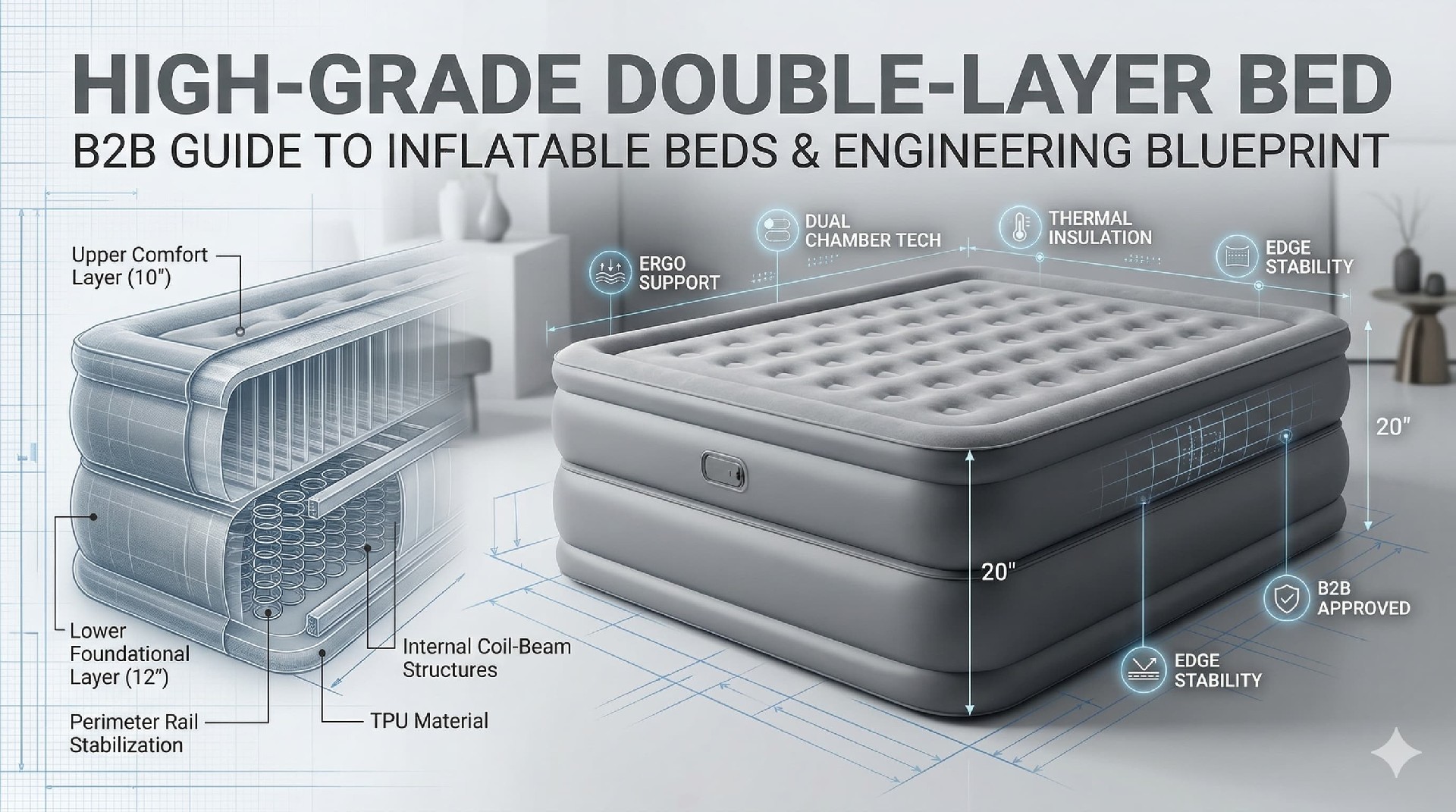
The development of the high-grade double-layer bed represents a paradigm shift in pneumatic furniture design. Rather than relying on a single envelope of trapped air, these advanced systems utilize two distinct, stacked pneumatic chambers, often separated by a reinforced horizontal diaphragm. This architecture increases the overall height of the bed—typically reaching 18 to 22 inches, closely mimicking the height of a traditional box spring and mattress combination.
From a market perspective, the transition to double-layer designs has been lucrative. According to recent supply chain analytics, the premium segment of the inflatable furniture market is projected to grow at a Compound Annual Growth Rate (CAGR) of 8.7% through the next decade, significantly outpacing basic single-layer models (Source: Grand View Research, 2025). Consumers and institutional buyers are increasingly willing to pay a premium for enhanced durability, automated inflation systems, and superior ergonomic support.
Core Engineering Principles: Dual-Chamber Pneumatic Architecture
The superiority of the high-grade double-layer bed lies in its internal geometry. An inflatable bed is fundamentally a pressurized vessel; how that pressure is distributed and managed dictates the product's lifespan and comfort level.
Internal Coil-Beam and I-Beam Structural Integrity
If a double-height air mattress were simply an empty balloon, inflating it would result in a spherical bulge, offering zero flat surface area for sleep. To create a rigid, flat plane, engineers utilize internal tensionors known as beams or coils.
In a high-grade double-layer bed, these internal structures are vastly more complex than in standard models.
I-Beam Construction: These are longitudinal or transverse strips of heavy-duty polymer welded to the top and bottom interior surfaces. When the bed is inflated, these beams restrict the expansion of the outer shell, creating a firm, corduroy-like surface.
Coil-Beam Technology: Premium models utilize vertical PVC or TPU cylinders (coils) welded internally. A high-grade double-layer bed may contain upwards of 30 to 40 independent air coils. This localized support system acts identically to pocket springs in a traditional mattress, preventing the displacement of air from one side of the bed to the other when a user shifts their weight.
The dual-layer design typically dedicates the lower chamber to high-pressure foundational support, acting as the "box spring," while the upper chamber is engineered with slightly more elasticity to contour to the human body, acting as the "plush top."
Advanced Material Science: TPU vs. High-Gauge Flocked PVC
The longevity of inflatable beds is entirely dependent on the physical properties of the elastomer used in manufacturing.
Historically, Polyvinyl Chloride (PVC) has been the industry standard. However, standard PVC contains plasticizers that outgas over time, causing the material to become brittle. High-grade double-layer beds utilize either Ultra-High-Gauge PVC (0.4mm to 0.6mm thickness) or advanced Thermoplastic Polyurethane (TPU).
TPU represents the apex of current inflatable material science. It offers a tensile strength nearly 300% higher than standard PVC and features exceptional elasticity, allowing it to stretch and recover its shape without permanent deformation. Furthermore, TPU is highly resistant to abrasion and maintains its flexibility in sub-zero temperatures, eliminating the risk of "cold-cracking" during outdoor winter use. The exterior sleep surface is typically treated with a dense, water-resistant flocking—a process where microscopic rayon or viscose fibers are electromagnetically bonded to the polymer surface—to increase tactile comfort and prevent bedding from slipping.
Thermodynamic Performance and Sleep Ergonomics in Premium Air Mattresses
The interaction between human physiology and an air-filled chamber presents unique thermodynamic and ergonomic challenges. The high-grade double-layer bed is specifically engineered to address these variables.
Managing Convective Heat Loss and the Ideal Gas Law
A common grievance with standard air mattresses is that they "sleep cold" and frequently deflate overnight. This phenomenon is governed by the Ideal Gas Law:
$$PV = nRT$$
Where $P$ is pressure, $V$ is volume, $n$ is the amount of substance, $R$ is the ideal gas constant, and $T$ is temperature. As ambient temperatures drop during the night, the temperature ($T$) of the air inside the mattress decreases, causing a direct, proportional drop in pressure ($P$). The bed has not leaked; it has simply contracted.
The high-grade double-layer bed mitigates this issue through its segregated chambers. The lower chamber absorbs the extreme temperature conductive loss from the cold ground or floor, while the horizontal diaphragm prevents that cold air from easily mixing with the upper chamber. Additionally, premium manufacturers are now incorporating reflective Mylar baffles or synthetic down insulation within the upper chamber to reflect radiant body heat back to the sleeper, drastically increasing the R-value (thermal resistance) of the bed (Source: Journal of Industrial Textiles, 2024).
Edge Support and Spinal Alignment Biomechanics
Standard inflatable beds collapse at the edges, making it difficult to get in and out of bed and reducing the usable sleep surface. High-grade models solve this by utilizing a perimeter rail system—an independent, high-pressure outer air chamber that encircles the primary sleep area. This rigid perimeter provides structural integrity to the sidewalls, preventing edge roll-off.
Furthermore, the dual-layer, high-tension surface ensures neutral spinal alignment. By resisting the downward force of the heaviest parts of the human body (the hips and shoulders), the bed prevents localized ischemia (restricted capillary blood flow), which is the primary cause of tossing and turning during the REM sleep cycle.
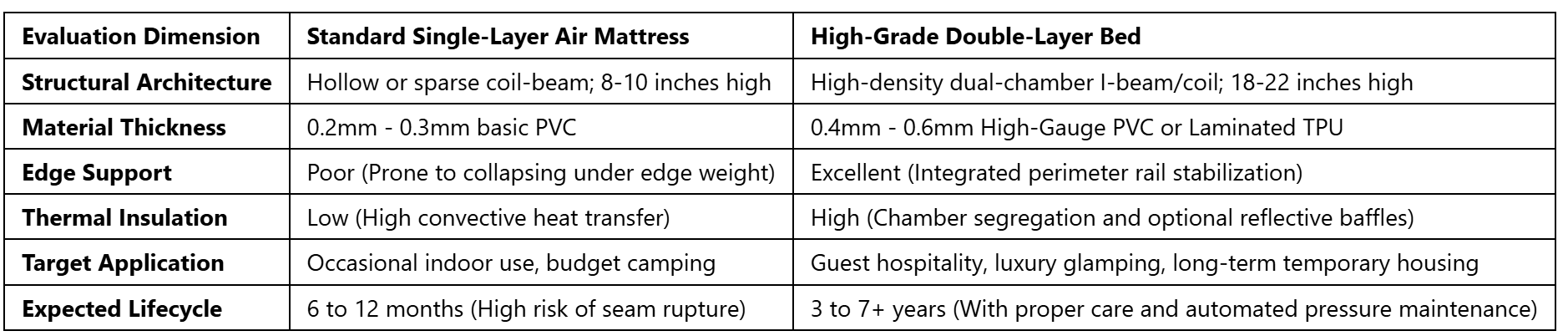
Comparison Table: High-Grade Double-Layer Beds vs. Standard Single-Layer Mattresses
To assist B2B procurement teams in evaluating product lines, the following matrix compares the core metrics of standard entry-level air beds against premium double-layer systems.
Integrating Double-Height Air Mattresses into Outdoor and Glamping Ecosystems
While highly popular for indoor guest use, the high-grade double-layer bed is rapidly becoming a staple in the luxury outdoor recreation market. Glamping resorts and professional overlanding operators are replacing heavy, cumbersome cots with these elevated air systems to provide a five-star hospitality experience in remote locations.
Building a premium outdoor basecamp requires a holistic approach to gear integration. A high-quality sleep system must be paired with equally reliable ancillary equipment. For instance, when establishing a long-term campsite, managing food security and ambient temperatures is critical. Utilizing a high-retention
Similarly, the activities surrounding the basecamp define the expedition. For aquatic environments, equipping the camp with a robust, stable
Furthermore, for vehicular nomads and overlanders, diversifying sleep options is key to maximizing space. While a double-layer bed might be perfect inside a large canvas ground tent, pairing it with a hard-shell
Strategic Procurement: B2B Wholesale and Quality Assurance Protocols
For sourcing managers and B2B distributors, procuring inflatable beds carries inherent risks. A failure rate of even 3% can result in severe brand degradation and logistical losses. Therefore, evaluating manufacturers based on strict Quality Assurance (QA) and Quality Control (QC) protocols is mandatory.
Evaluating High-Frequency (HF) Welding
The weakest point of any inflatable bed is the seam. Premium manufacturers utilize advanced automated CNC High-Frequency (HF) welding machines. This process uses electromagnetic energy to fuse the polymer chains of the two fabric pieces at a molecular level, creating a seam that is often stronger than the base material itself. Buyers must audit factories to ensure they are using automated HF welding rather than manual thermal pressing, as human error in dwell time or temperature leads directly to micro-leaks.
Mandatory Acceptable Quality Limit (AQL) Testing
Before accepting a shipment, B2B buyers should mandate a 100% Inflation Retention Test.
Every manufactured unit must be inflated to 110% of its recommended operational PSI.
The units must sit on the factory floor for a minimum of 48 hours.
Digital barometers must be used to measure pressure drops. Any unit exhibiting a pressure drop exceeding 3% (accounting for ambient temperature adjustments) must be discarded.
Furthermore, sample batches should undergo destructive cycle testing, where heavy hydraulic rollers simulate a 300 lb user getting in and out of the bed 10,000 times to test the integrity of the internal coil-beams
(Source: International Sleep Products Association, 2025).
Future Trends in Automated Inflation and Smart Sleep Systems
The next frontier for the high-grade double-layer bed is the integration of smart pneumatic technologies. "Silent Pump" technology is already hitting the market, featuring miniaturized, ultra-quiet impellers built directly into the mattress chassis.
More impressively, these pumps are being equipped with digital pressure sensors and Bluetooth connectivity. Utilizing advanced algorithms, the bed can detect minor pressure drops caused by the Ideal Gas Law temperature fluctuations overnight. The silent pump will automatically engage, injecting micro-bursts of air to maintain the user's exact pre-set firmness level without waking them. Additionally, we are seeing the integration of bio-based TPUs, derived from sustainable agricultural waste rather than petroleum, offering B2B buyers a compelling eco-friendly alternative in an increasingly carbon-conscious market.
Frequently Asked Questions (FAQs)
1. What defines a high-grade double-layer bed compared to a standard air mattress?
A high-grade double-layer bed features two distinct vertical pneumatic chambers, elevating the bed to 18-22 inches. It utilizes robust internal I-beams or coil-beams for structural stability, high-gauge puncture-resistant materials (like TPU), and often features built-in automated inflation pumps.
2. Why do double-layer air beds provide better back support?
The dual-chamber design allows the lower layer to act as a firm, high-pressure foundation, while the upper layer can be slightly softer for contouring. Combined with internal tension coils, this prevents the middle from sagging, ensuring neutral spinal alignment during sleep.
3. Is TPU really better than PVC for inflatable beds?
Yes. Thermoplastic Polyurethane (TPU) is significantly lighter, completely free of toxic phthalates (no outgassing), highly abrasion-resistant, and does not become brittle or crack in freezing temperatures, making it vastly superior to traditional PVC.
4. Why does my air bed feel softer in the morning even if it doesn't have a hole?
This is due to the physics of temperature. As the room or tent cools down at night, the air inside the mattress cools and contracts, dropping the internal pressure (Ideal Gas Law). It is not leaking; it merely requires a brief pump top-off.
5. What is the weight capacity of a commercial-grade double-layer bed?
Thanks to advanced high-frequency welding and dense internal coil-beam architecture, premium double-layer air beds can safely and dynamically support between 500 lbs to 650 lbs (227 kg to 295 kg) without risking a blowout.
6. Can double-layer air beds be used for winter camping?
Yes, but insulation is required. Because the large volume of internal air acts as a heat sink, users must place an insulated sleeping pad (with a high R-value) or heavy blankets on top of the mattress to prevent conductive body heat loss into the cold air chamber.
7. How do built-in secondary pumps work on premium air beds?
Advanced models feature a primary pump for rapid inflation and a secondary, silent micro-pump. The secondary pump continuously monitors internal pressure and quietly injects air overnight to compensate for stretching materials or temperature-induced pressure drops.
8. How should B2B buyers test inflatable bed quality before ordering?
Procurement teams should request AQL (Acceptable Quality Limit) reports focusing on 48-hour 100% inflation retention testing, high-frequency weld strength analytics, and dynamic load-cycle testing to ensure commercial-grade durability.
Conclusion
The transformation of inflatable beds from unreliable, temporary mats into the high-grade double-layer bed represents a triumph of modern material science and pneumatic engineering. By utilizing advanced elastomeric polymers, dual-chamber architectural geometries, and rigorous high-frequency welding techniques, these systems now rival traditional mattresses in comfort, orthopedic support, and longevity. For the hospitality sector, disaster relief organizations, and the premium outdoor glamping market, migrating to high-grade double-layer technology drastically reduces replacement costs and guarantees superior user satisfaction.
