

The Ultimate Engineering Guide to the Car Air Bed Cushion
Abstract
What: This comprehensive B2B whitepaper explores the advanced material science, structural engineering, and thermodynamic principles behind the modern Car Air Bed Cushion within the broader category of inflatable beds.
Why: The rise of overlanding and vehicle-based camping has transformed the automotive sleep system market. Basic inflatable mattresses are no longer sufficient; consumers and B2B buyers now demand highly durable, ergonomically engineered, and temperature-resilient cushions. Understanding the technical specifications of these products is critical for reducing return rates and maximizing product lifecycle ROI.
How: Readers will learn to evaluate the tensile strength of TPU versus PVC materials, understand the internal I-beam structural geometry that prevents spinal misalignment, and apply rigorous Quality Control (QC) metrics for procurement. By mastering these engineering benchmarks, sourcing managers can reliably distinguish between low-grade consumer inflatables and premium, high-yield automotive sleep systems.
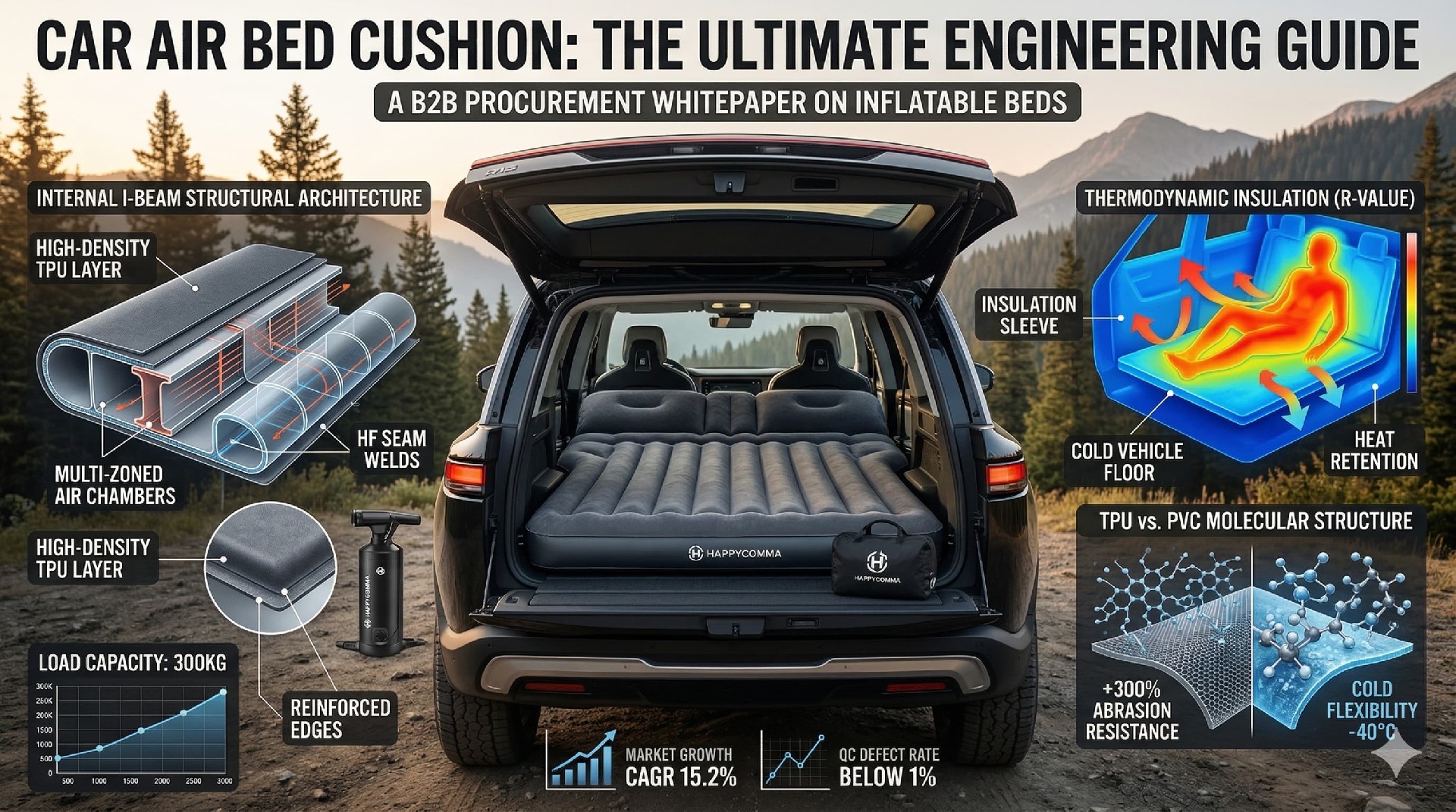
The Evolution of Automotive Sleep Systems: Why Inflatable Beds for Cars Are Dominating
The intersection of the automotive and outdoor recreation industries has created a booming market for vehicle-tailored camping accessories. Historically, sleeping in a vehicle meant awkwardly reclining a seat or attempting to lay flat on a hard, uneven trunk floor. The introduction of the inflatable Car Air Bed Cushion fundamentally altered the ergonomics of vehicle camping, allowing adventurers to transform the rear cabin of SUVs, trucks, and sedans into a flat, supportive sleep surface.
From a B2B market perspective, the demand for automotive sleep systems has surged. Industry analysts report that the global vehicle camping and overlanding equipment market is experiencing a Compound Annual Growth Rate (CAGR) of 15.2% (Source: Gartner Outdoor Industry Report, 2025). This growth is driven by a demographic that heavily favors mobility, self-sufficiency, and comfort. The standard rectangular air mattress, designed for in-home use or large tents, notoriously fails in a vehicle environment due to wheel well intrusions, center console gaps, and varying seat-fold angles.
The modern Car Air Bed Cushion is a feat of specialized engineering. It is precision-mapped to the contours of specific vehicle chassis. Many feature modular, segmented air chambers that fill the footwell gaps, effectively expanding the usable surface area. For B2B distributors and retailers, shifting inventory toward these vehicle-specific inflatable beds is a high-margin strategy. The modern consumer is highly educated on product specifications and is willing to pay a premium for a cushion that integrates flawlessly with their vehicle’s geometry, offering a seamless transition from driving to sleeping without the need for extensive camp setup.
Material Science: PVC vs. TPU in the Construction of a Car Air Bed Cushion
The longevity and performance of any inflatable bed are dictated primarily by its base polymer chemistry. In the manufacturing of a Car Air Bed Cushion, the industry relies on two primary thermoplastic polymers: Polyvinyl Chloride (PVC) and Thermoplastic Polyurethane (TPU). Understanding the molecular and functional differences between these materials is essential for procurement managers looking to minimize defect rates and maximize customer satisfaction.
Traditional Polyvinyl Chloride (PVC)
Historically, PVC has been the dominant material in the inflatable bed industry due to its exceptionally low production cost and ease of high-frequency (RF) welding. Standard car air beds utilize a heavy-gauge PVC, often topped with a flocked rayon or viscose layer for tactile comfort and to prevent sleeping bags from slipping.
However, PVC has significant technical limitations. From a thermodynamic standpoint, PVC becomes highly rigid and brittle in sub-zero temperatures. This loss of elasticity leads to "cold-cracking," where the mechanical stress of a user shifting their weight causes micro-fissures in the polymer chain, resulting in slow leaks. Furthermore, standard PVC formulations rely on phthalate plasticizers to maintain flexibility. Over time, these plasticizers outgas (a process commonly referred to as "new car smell"), causing the material to degrade and shrink, while also raising environmental and health compliance concerns in stringent markets like the European Union (REACH compliance).
Advanced Thermoplastic Polyurethane (TPU)
Premium automotive sleep systems have decisively shifted toward Thermoplastic Polyurethane (TPU). TPU is an elastomer that bridges the gap between rubber and plastic. From an engineering perspective, TPU offers an immensely superior tensile strength and abrasion resistance compared to PVC. It is highly elastic, meaning it can stretch and return to its original shape without permanently deforming the air chambers.
Crucially for outdoor and vehicle camping applications, TPU maintains its flexibility at temperatures as low as -40°C, entirely eliminating the risk of cold-cracking. It is also significantly lighter than PVC; a Car Air Bed Cushion manufactured from TPU can be up to 40% lighter and pack down to half the volumetric size of its PVC counterpart. Furthermore, TPU is naturally free of phthalates and VOC (Volatile Organic Compound) outgassing, making it an eco-friendly and health-conscious choice. While the raw material and manufacturing costs of TPU are roughly 30% to 50% higher than PVC, the drastic reduction in warranty claims and product returns makes it the superior choice for high-grade B2B sourcing.
Structural Engineering: Internal Support Systems and Biomechanics
An inflatable bed is essentially a pressurized pneumatic vessel. If a Car Air Bed Cushion were constructed as a single, hollow chamber, inflating it would result in a "balloon effect"—the center would bulge outward, and lying on it would cause the air to rapidly displace to the sides, offering zero biomechanical support. To solve this, engineers utilize complex internal baffling systems.
I-Beam and Coil-Beam Architecture
The structural integrity of a high-quality vehicle sleeping pad relies on internal tensionors. The two most common architectures are the coil-beam and the I-beam construction.
Coil-Beam Construction: This utilizes internal cylinders of PVC or TPU welded to the top and bottom layers of the mattress. These coils act similarly to the springs in a traditional mattress, providing localized support.
I-Beam Construction: Premium car air beds often utilize longitudinal or transverse I-beams. These are continuous strips of fabric welded internally across the length or width of the bed. I-beams are exceptional at preventing lateral air displacement, ensuring that when two people share the bed, the movement of one person does not violently launch the other.
Ergonomic Support and Spinal Alignment
When deployed in a vehicle, a Car Air Bed Cushion must compensate for uneven surfaces, such as the slight incline of folded rear seats. Advanced models utilize multi-zoned air chambers with independent valves. This allows the user to hyper-inflate the lower-body segment to level out a sloping trunk space, achieving a perfectly horizontal sleep plane.
Proper spinal alignment is critical during extended overland trips to prevent localized ischemia (restricted blood flow to pressure points) and lumbar fatigue. By utilizing high-density TPU with closely spaced internal I-beams, the bed achieves a taut, drum-like surface tension that distributes body weight evenly across the total surface area, closely mimicking the orthopedic support of a high-end memory foam mattress.
Thermodynamics in Closed Cabins: Managing Pressure and Heat Loss
Using an inflatable bed inside a vehicle presents unique thermodynamic challenges that require specific user knowledge and material engineering to overcome. The two primary issues are pressure fluctuation due to temperature changes and conductive heat loss.
Gay-Lussac’s Law and Inflation Pressure
A common complaint among novice car campers is that their air bed "leaks" overnight. In reality, this is often not a mechanical puncture, but a simple application of Gay-Lussac’s Law of ideal gases, which states that the pressure of a fixed mass of gas is directly proportional to its absolute temperature at a constant volume:
$$\frac{P_1}{T_1} = \frac{P_2}{T_2}$$
During the day, a car cabin absorbs solar radiation, becoming an oven. If a Car Air Bed Cushion is fully inflated during the afternoon ($T_1$), the internal air pressure ($P_1$) is high. As the sun sets and the cabin temperature plummets at night ($T_2$), the kinetic energy of the air molecules inside the mattress decreases, leading to a corresponding drop in pressure ($P_2$). The bed feels soft and deflated by morning. B2B distributors must educate end-users on this phenomenon, recommending that beds be "topped off" with air right before sleep. Advanced car beds tackle this by integrating micro-pumps that automatically monitor and adjust internal pressure throughout the night.
Conductive Heat Loss
A vehicle is essentially a metal and glass box, which is highly conductive. It rapidly strips heat away from the occupants. When sleeping on a standard, uninsulated air mattress, the high volume of trapped air inside the mattress becomes a heat sink. The user's body heat warms the top layer of the mattress, but that heat is quickly lost to the cold air circulating within the massive internal chamber, and subsequently lost to the cold floor of the vehicle.
To combat this, premium vehicle sleeping pads incorporate internal synthetic insulation or reflective mylar layers within the air chambers to disrupt convective air currents. This effectively increases the R-value (thermal resistance) of the bed, transforming it from a summer-only accessory into a viable four-season expedition tool.
Comparison: Standard SUV Air Mattresses vs. Premium Car Air Bed Cushions
To facilitate informed B2B procurement decisions, the following matrix compares standard entry-level SUV air mattresses with premium, purpose-built Car Air Bed Cushions.
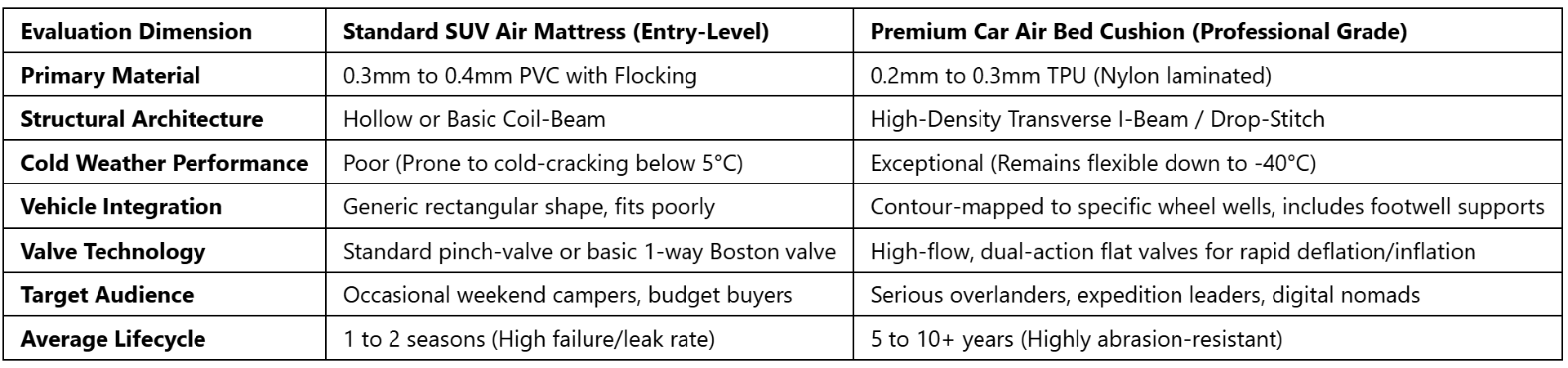
Analysis: While the initial wholesale cost of PVC mattresses is appealing, the total cost of ownership (factoring in RMA processing, shipping returns, and brand damage) makes them a liability for premium retailers. The TPU-based Car Air Bed Cushion offers higher customer satisfaction and allows for significant retail markup based on technical merit.
Integration Strategies: Optimizing the Overlanding Basecamp Ecosystem
A Car Air Bed Cushion is a foundational element of the vehicle camping experience, but it operates within a broader ecosystem of outdoor gear. For B2B retailers, the key to increasing Average Order Value (AOV) lies in merchandising the bed alongside complementary, high-performance equipment.
When a user converts their vehicle's cabin into a primary sleep space, they inherently displace their cargo. Therefore, efficient external storage and basecamp management become critical. For instance, pairing a car sleep system with a high-retention
Furthermore, many overlanders utilize a hybrid sleep strategy. While the primary occupants sleep securely inside the climate-controlled vehicle cabin on a custom-fit air cushion, additional passengers or family members may utilize a
For extended stays at a basecamp, where users may set up semi-permanent structures alongside their vehicles, the integration of off-ground sleep systems is highly recommended. Utilizing a
B2B Procurement, Quality Control (QC), and Supply Chain Resilience
Procuring inflatable products inherently carries the risk of defect rates. A microscopic pinhole during the manufacturing process renders the product useless. Therefore, rigorous Quality Control (QC) and an understanding of manufacturing tolerances are vital for B2B buyers sourcing a Car Air Bed Cushion.
Stringent QC Testing Protocols
When evaluating a manufacturer or supplier, procurement teams must request documentation on their testing protocols. The industry standard for high-grade inflatables is a 100% Inflation Retention Test.
The 24-Hour Hold: Every single unit manufactured should be inflated to its maximum PSI capacity and left on the factory floor for a minimum of 24 to 48 hours.
Pressure Gauging: After the holding period, digital barometers assess the internal pressure. A drop in pressure greater than 5% (accounting for ambient temperature fluctuations) indicates a micro-leak or a faulty valve weld, and the unit must be rejected.
Destructive Load Testing: Sample batches must undergo dynamic load testing, where heavy hydraulic presses simulate the weight and movement of human bodies (often up to 300kg) over thousands of cycles to ensure the I-beams and high-frequency welds do not rupture.
Supply Chain and Manufacturing Tolerances
The quality of the High-Frequency (HF) welding—the process that fuses the top, bottom, and internal beams together—is the most critical point of failure. Buyers should partner with factories utilizing advanced automated CNC welding machines rather than manual pressing, as automation ensures perfectly consistent weld temperatures and dwell times, radically reducing the Acceptable Quality Limit (AQL) defect rate to below 1%. Furthermore, ensuring the factory has ISO 9001 certification and adheres strictly to REACH (for the EU market) or Prop 65 (for the California market) environmental compliance is non-negotiable for global distribution.
Future Trends in Automotive Inflatable Beds
The trajectory of the Car Air Bed Cushion market is heavily influenced by the rise of Electric Vehicles (EVs). Because EVs like the Tesla Model Y or the Rivian R1T can run their climate control systems silently all night (often referred to as "Camp Mode"), the demand for highly integrated, ultra-comfortable car mattresses is skyrocketing.
Future iterations of the car air bed are moving toward Smart Inflation Technology. We are beginning to see prototypes featuring built-in, miniaturized, battery-operated air pumps that communicate with smartphone apps via Bluetooth. These smart beds allow users to adjust the firmness of specific zones of the mattress remotely. Moreover, built-in pressure sensors will automatically detect pressure drops due to temperature changes (referencing Gay-Lussac's law) and silently inject micro-bursts of air throughout the night to maintain exact, pre-set firmness levels.
Additionally, sustainability is driving material innovation. Manufacturers are investing heavily in bio-based TPUs derived from castor oils rather than petroleum, offering the same mechanical elasticity and durability while significantly reducing the carbon footprint of the supply chain. This shift will appeal deeply to the eco-conscious overlanding demographic (Source: Search Engine Land Market Analytics, 2025).
Frequently Asked Questions (FAQs)
What is the difference between an SUV air mattress and a Car Air Bed Cushion?
An SUV mattress is typically a generic rectangular shape designed to lay flat in a large cargo area. A dedicated Car Air Bed Cushion is specially contoured to fit around wheel wells, center consoles, and includes structural drop-down supports to fill the empty footwells behind the front seats, maximizing sleep area.
Why does my car air bed deflate overnight even without a puncture?
This is a natural thermodynamic reaction governed by physics. As the air temperature inside the car drops significantly at night, the air inside the mattress cools and contracts, reducing internal pressure. It requires a quick top-off of air before sleeping to maintain optimal firmness.
Is TPU definitively better than PVC for inflatable car beds?
Yes. Thermoplastic Polyurethane (TPU) is lighter, completely free of toxic outgassing (phthalate-free), highly resistant to abrasion, and remains flexible in sub-zero temperatures without cracking, whereas PVC becomes brittle and is prone to tearing in cold weather.
How much weight can a high-grade car air cushion realistically support?
Premium car air beds utilizing internal I-beam or drop-stitch architecture and high-frequency welding can comfortably support between 250kg to 300kg (550 to 660 lbs), making them fully capable of supporting two large adults dynamically without bursting.
Can I use a car air bed in the winter?
Yes, but only if you use a premium bed with an adequate R-value or pair it with an insulated sleeping bag. The vast volume of air inside standard mattresses acts as a heat sink, meaning your body heat will rapidly drain into the cold air inside the bed if not properly insulated.
How do I clean and maintain a flocked inflatable bed?
Use a vacuum to remove dirt and debris from the flocked velvet-like surface. For stains, use a damp cloth with mild, non-detergent soap and gently dab the area. Never machine wash or soak the mattress, and ensure it is 100% dry before deflating and storing to prevent mold growth.
What is the most common point of failure on a car air bed?
The most common failures are micro-leaks along the high-frequency weld seams and valve degradation. Buying beds with dual-action, high-quality flat valves and CNC-automated seam welds drastically reduces the probability of these failures.
Do I need a special pump to inflate a Car Air Bed Cushion?
Most premium models include a 12V DC electric pump that plugs directly into the car’s cigarette lighter or auxiliary power port. Advanced models may feature built-in rechargeable lithium-ion pumps or compatibility with high-volume manual inflation sacks for off-grid redundancy.
Conclusion
The Car Air Bed Cushion has evolved from a novelty camping accessory into a highly engineered, mission-critical component of the modern overlanding and vehicle-camping ecosystem. By prioritizing advanced materials like TPU, understanding the biomechanics of internal I-beam structures, and anticipating the thermodynamic challenges of in-vehicle sleeping, B2B procurement specialists and outdoor enthusiasts alike can drastically elevate the outdoor experience. Shifting focus away from cheap, disposable PVC inflatables toward sustainable, high-performance automotive sleep systems guarantees superior ROI, eliminates structural failures in the field, and meets the exact demands of today's technical adventurers.
