

Why Most Beach Canopy Tents Fail When the Wind Picks Up
The coastal wind doesn't care about your shade footprint. When specifying a canopy tent for beach shade and wind resistance, the primary failure isn't fabric tearing—it's structural collapse due to inadequate frame geometry and anchoring strategy. Commercial buyers, resort operators, and event rental fleets frequently overlook the fact that beach conditions combine three destructive forces: steady onshore winds, gusty squalls, and soft, shifting sand that undermines standard anchoring. The result is bent aluminum frames, torn shade cloth, and in worst-case scenarios, flying debris that creates liability exposure. This guide focuses exclusively on specification decisions for canopy tents intended for repeated beach deployment, bridging the gap between material science and operational reality. It is written for procurement managers, rental fleet operators, and hospitality buyers who need a technically sound, commercially viable solution for beach shade and wind resistance.
Site-Specific Wind Loading: The First Specification Variable
Before evaluating any canopy tent for beach shade and wind resistance, define the operating wind environment. Typical commercial beach canopy tents are designed for wind speeds of 20 to 35 mph (32 to 56 km/h) in steady conditions, with gust allowances up to 45 mph (72 km/h). However, these ratings are always manufacturer-dependent and often based on ASTM D4939-89 or similar static load tests. It is critical to understand what the wind rating actually tests: structural integrity of the frame and shade fabric under a specific upward lift coefficient, not real-world gust behavior on shifting sand. For beach deployments, the effective load on the canopy is higher because sand reflects wind energy and creates turbulent vortices underneath the shade. Commercial operators should request the specific wind-load test protocol, including the angle of wind attack and whether the test included loaded sandbags or weighted base plates. If the specification sheet simply says 'wind-resistant' without an mph rating and test condition, treat it as a marketing claim rather than an engineering datum. When comparing canopy tents for beach shade and wind resistance, prioritize models that publish wind-speed ratings tied to a clear anchoring method—because anchoring performance is usually the limiting factor, not the frame itself.
Understanding the Aerodynamic Forces at Play
A canopy tent operates like a low-aspect-ratio airfoil. The shade fabric creates a pressure differential: high pressure on the top surface from direct wind, and lower pressure underneath as air accelerates through the opening. This produces an upward lift force that works against the weight of the structure. For a 10x10 ft (3x3 m) canopy, the lift force at 30 mph can exceed 150 lbs (68 kg) depending on the fabric porosity and pitch angle. Porosity is a key technical parameter often overlooked in beach-specific tents. A fabric with higher porosity (e.g., 80/20 mesh) allows some wind to pass through, reducing lift and frame stress, but also reduces shade effectiveness. Dense 200-300 denier polyester or nylon with a PU coating provides maximum UV protection but acts like a solid sail. For beach shade and wind resistance, many commercial operators choose a hybrid approach: a coated fabric that resists UV degradation but incorporates vented sidewalls or roof gables that allow pressure equalization. This design tradeoff directly influences the commercial decision between shade quality and structural stability. Higher stability often requires heavier frame sections, which increases transport volume—a critical factor for rental fleet logistics.
Frame Architecture and Material Selection for Coastal Environments
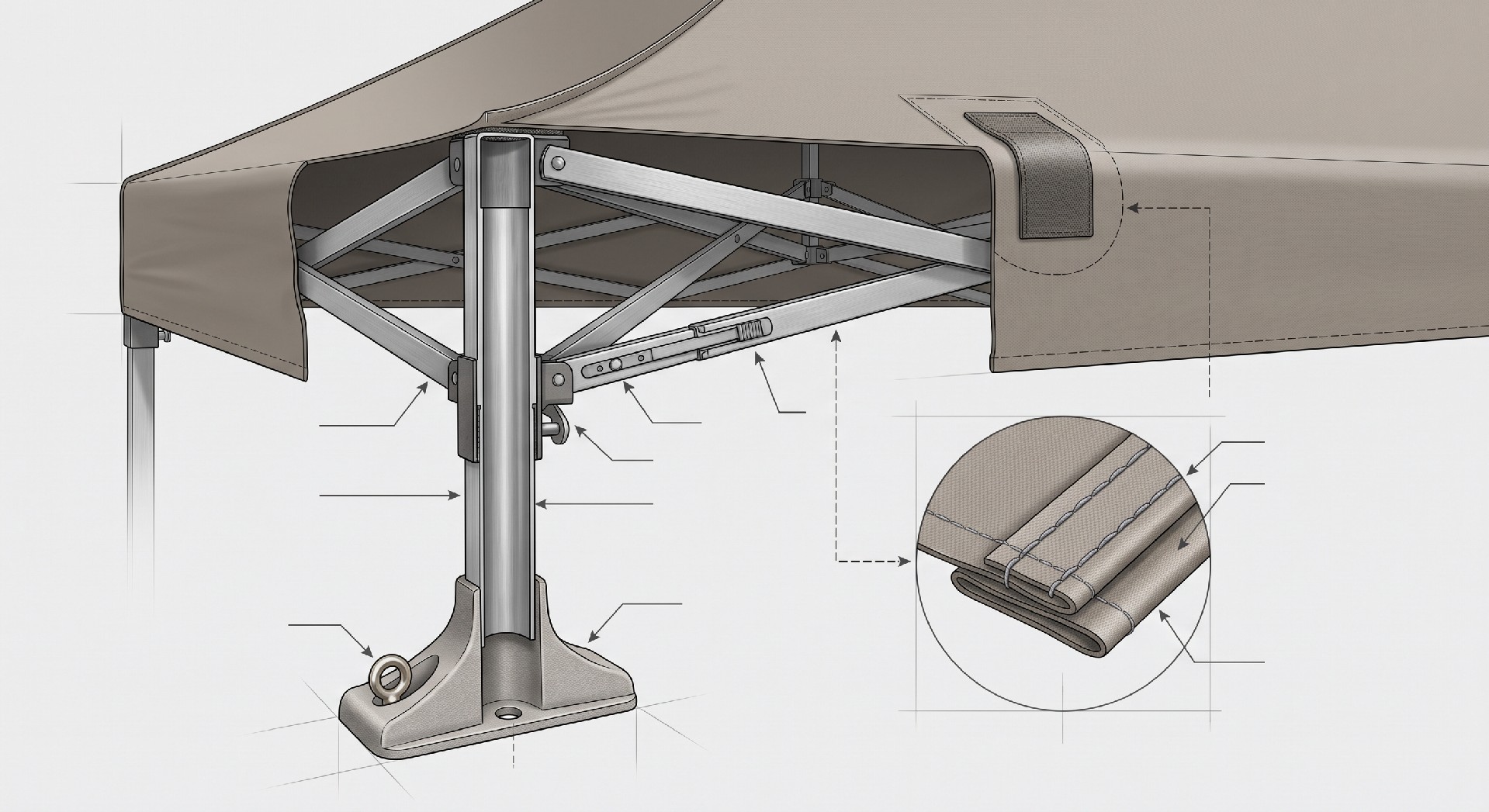
The frame is the skeleton of any canopy tent for beach shade and wind resistance. Four primary frame materials dominate the commercial market: aluminum alloy 6061-T6, aluminum 7000-series, galvanized steel, and fiberglass-reinforced composite. For beach applications, aluminum 6061-T6 is the commercial benchmark because it offers an excellent strength-to-weight ratio and naturally resists saltwater corrosion. 7000-series aluminum is stronger but more brittle and costly; it is typically specified only for high-end event domes where wind exposure is extreme. Galvanized steel provides superior ultimate strength at a lower cost, but the weight penalty is significant: a 10x10 ft steel-frame canopy can weigh 45-60 lbs (20-27 kg) compared to 25-35 lbs (11-16 kg) for aluminum. For fleet operators, this extra weight translates to higher shipping costs, greater setup fatigue, and more difficult handling on soft sand. The thickness and wall profile of the tubing—typically 0.75 to 1.25 inches (19-32 mm) in diameter with wall thicknesses of 0.05 to 0.08 inches (1.2-2 mm)—determines the frame's resistance to bending and buckling. When specifying a canopy tent for beach shade and wind resistance, look for frames with cross-bracing at the top corners and reinforced hubs, because joint failure is the most common frame failure mode in windy conditions. Quick-lock or push-button assembly systems must be evaluated for corrosion resistance; stainless-steel or zinc-plated hardware is essential in saline environments. Avoid nylon or plastic joint components in high-wind beach tents, as UV exposure and salt spray degrade these materials rapidly.
In terms of structural configuration, there are three dominant designs: the classic pop-up dome, the straight-leg event tent, and the slant-leg beach shelter. The pop-up dome uses a collapsible scissor-frame mechanism that is fast to deploy but generally has the lowest wind resistance because the joints are not mechanically locked; they rely on fabric tension to stay open. Straight-leg event tents use a more rigid truss-like frame with telescoping legs that can be locked at various heights—this is the preferred architecture for beach shade and wind resistance because it allows the user to lower the canopy height to reduce windage. Slant-leg beach shelters are a hybrid, offering a wider base for stability at the cost of reduced headroom. For commercial buyers, the straight-leg frame with adjustable leg height is typically the best choice, as it enables a rapid response to changing wind conditions: lowering the canopy by 12 to 18 inches can reduce wind-induced lift by 20-30% while maintaining usable shade. Some manufacturers now offer pre-curved roof bows that improve wind shedding by directing airflow upward over the canopy, a subtle but effective engineering detail that is worth verifying in the product specification.
| Decision Factor | Commercial Target (Beach Use) | Why It Matters | Buyer Check |
|---|---|---|---|
| Frame Material | 6061-T6 aluminum alloy | Corrosion resistance and strength-to-weight ratio are critical in salt air. Steel is heavier; 7000-series is costlier. | Verify alloy type and wall thickness from the supplier datasheet. |
| Frame Geometry | Straight-leg, height-adjustable to lower canopy in wind | Allows reducing windage by 20-30% in gusty conditions. Slant-leg or pop-up designs have poorer wind stability. | Confirm leg locking mechanism and height range (e.g., 6-8 ft / 1.8-2.4 m). |
| Wind Rating (with Anchoring) | 35 mph (56 km/h) with 24-inch auger anchors in dry sand | The rating must specify the anchoring method. No rating without anchoring is valid for beach use. | Request the wind-test report and the exact anchor type used. Test one unit in local sand. |
| Anchoring Capacity | Auger anchors, 300-500 lbf (136-227 kgf) pullout resistance per leg | Provides far superior holding power compared to sandbags or simple stakes. Enables safe operation in sustained winds. | Verify leg base attachment points are rated for the anchor load. Check for corrosion-resistant materials. |
| Shade Fabric Weight | 250-280 g/m² solution-dyed acrylic or coated polyester | Heavier fabric resists fluttering and UV degradation, but increases weight. Lighter fabrics reduce lift but tear more easily. | Obtain a swatch and perform a field tear test. Confirm tear strength > 30 lbf (133 N). |
| Seam Construction | Double-stitched folded seams, UV-stabilized polyester thread | Prevents seam separation under cyclic wind loading. Lapped seams and cotton thread are unacceptable. | Ask the supplier to state seam type and thread specification in writing. |
| Packed Volume per Unit | ≤ 70 x 20 x 12 inches (178 x 51 x 30 cm) for a 10x10 ft (3x3 m) canopy | Directly affects shipping costs, storage space, and fleet transportation efficiency. Larger volumes increase logistics overhead. | Measure the packed carton dimensions and compare to your transport capacity. |
Anchoring Systems: The Decisive Factor in Sand Environments
Anchoring is the single most important commercial decision when deploying a canopy tent for beach shade and wind resistance. In sand, traditional ground spikes or simple stakes have insufficient holding power because the sand grains lack cohesion. The standard commercial solution is a combination of two systems: sandbags or weight plates, and screw-in anchors or auger-style stakes. Sandbags filled with beach sand provide immediate ballast and are very effective for short-term setups, but they have limited capacity—typically 15-40 lbs (7-18 kg) per bag—and require at least 60-80 lbs (27-36 kg) of total ballast per leg for moderate winds. For higher wind resistance, commercial operators use 24 to 36-inch (60-90 cm) auger anchors that screw deep into the sand, using the shear strength of the sand column to resist pullout. These anchors, when properly installed, can achieve pullout resistance of 300-500 lbs (136-227 kg) per anchor in dry medium-grain sand, far exceeding any sandbag solution. However, they require additional setup time and equipment; a four-leg canopy may take 15-20 minutes to securely anchor with augers, compared to 5 minutes with sandbags. The correct approach depends on the deployment scenario: short-term beach concessions benefit from speed and may tolerate a 25-30 mph wind limit, while long-term resort installations or emergency shelters should always specify auger anchors and steel base plates.
Another commercial consideration is the anchoring interface between the frame leg and the anchor. Many canopy tents for beach shade and wind resistance feature reinforced leg bases with pre-drilled holes for stakes or straps. However, the weakest point is often the connection itself—if the strap or cordage used to tie the leg to the anchor fails, the entire anchoring system is useless. For commercial specifications, insist on heavy-duty polyester tie-down straps with a minimum breaking strength of 1,200 lbs (544 kg), and ensure that the frame's leg base has a robust mounting bracket that does not deform under load. Stainless steel D-rings or weld-on anchor plates are preferable to plastic clips, which become brittle in UV light. When specifying a canopy tent for beach shade and wind resistance, always verify that the anchoring system is included in the wind-load calculation provided by the manufacturer. Some suppliers conveniently omit the anchoring method from their wind rating, which is a red flag. A complete specification should state: 'Wind rating of 35 mph (56 km/h) with four 24-inch auger anchors installed in medium-density sand.' If the wind rating assumes concrete or hard ground, it is not applicable to beach use.
Shade Fabric and UV Resistance: Balancing Protection and Durability
While wind resistance is the primary technical challenge, the shade performance of a canopy tent for beach shade and wind resistance is equally important for commercial applications. Fabric materials fall into three categories: polyethylene (PE) shade cloth, polyester (PES) with polyurethane (PU) coating, and solution-dyed acrylic. For beach environments, solution-dyed acrylic—such as Sunbrella or similar brands—is the premium choice because the color is locked into the fiber, providing excellent UV resistance without the risk of coating delamination. However, it is heavy and expensive. Polyester with a PU coating offers good UV resistance and water repellency at a more accessible price point, but the coating degrades over time, typically requiring replacement after 2-3 seasons of continuous beach exposure. PE shade cloth is the lightest and least expensive option; it allows good airflow and reduces lift force, but its UV resistance is poor and it tears more easily under flutter conditions—the constant cyclic loading from wind gusts can cause fatigue failure at the stitch lines.
From a commercial specification standpoint, three metrics dominate fabric selection: fabric weight (expressed in ounces per square yard or g/m²), tear strength (ASTM D2261), and UV resistance (measured by UV-blocking percentage or UV degradation time). For beach shade, a minimum fabric weight of 180 g/m² is recommended for intermittent use, while 250-280 g/m² is the commercial benchmark for daily rental or resort applications. Tear strength should be at least 30 lbf (133 N) in both warp and fill directions. UV resistance is typically expressed as a UPF rating; look for UPF 50+ as a minimum. Additionally, consider the shade factor—how much visible light is blocked—which ranges from 80% to 95% for most commercial canopies. A 90% shade factor is usually optimal for beach settings, as it provides significant cooling without creating an overly dark or disorienting space. When specifying a canopy tent for beach shade and wind resistance, request a sample swatch and perform a simple field abrasion test: rub the fabric against a rough surface to check for pilling or coating flaking. This quick check can reveal inferior materials that will not survive a season of beach use.
Reinforcement and Seam Construction
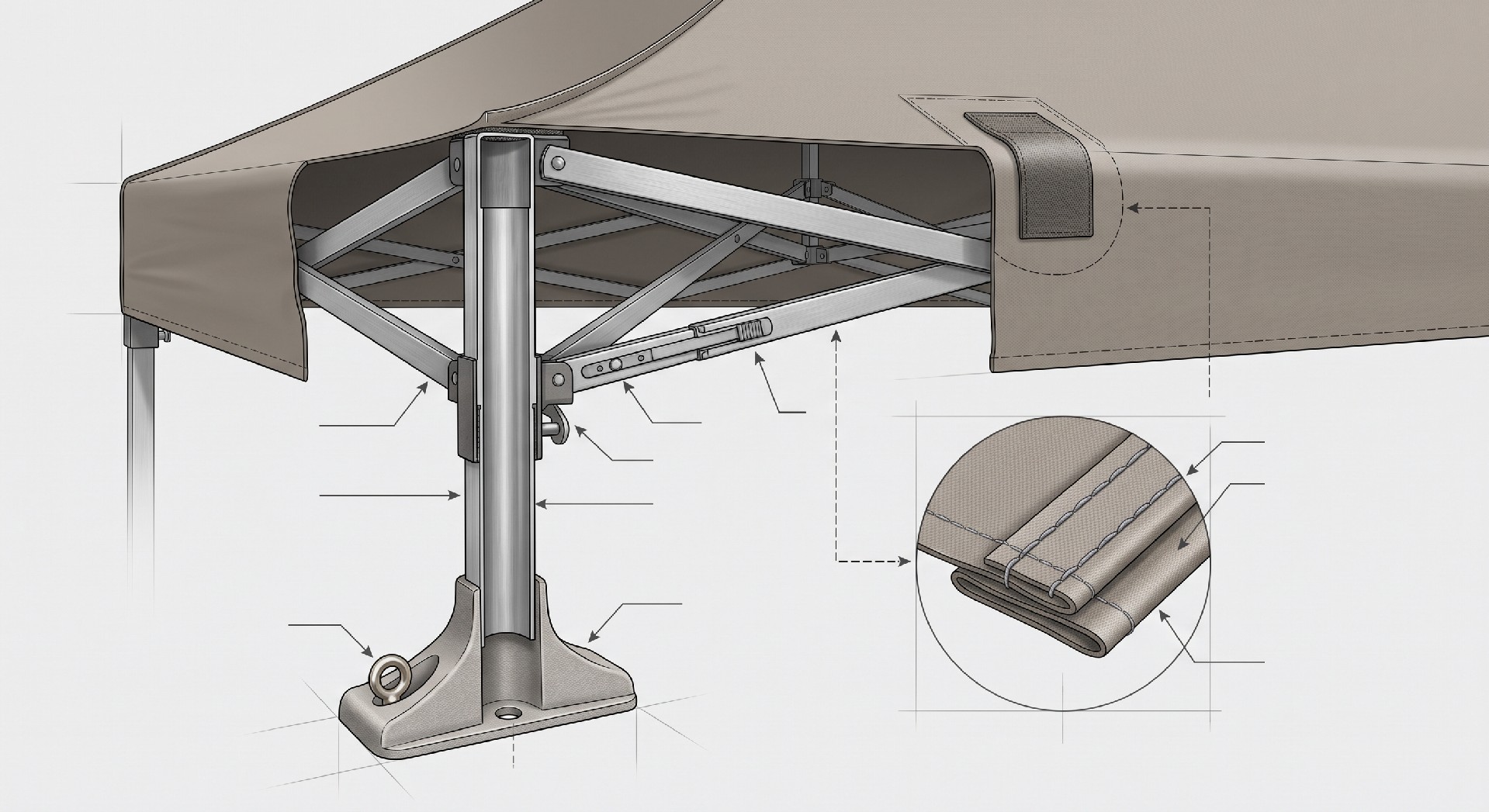
Seam failure is another common failure point. The seams of a beach canopy are subjected to constant tension and vibration from wind. Commercial-grade canopy tents for beach shade and wind resistance should use double- or triple-stitched folded seams, not simple lapped seams. The thread must be UV-stabilized polyester or nylon; avoid cotton or natural fiber threads, which rot. Some high-end products now incorporate heat-sealed or welded seams, which eliminate needle holes and provide superior water resistance and strength. However, welded seams can be more brittle in cold weather, so they are best suited for tropical or temperate beach environments. Another detail often overlooked is the edge hem of the canopy. A reinforced edge with a 1.5-inch (38 mm) fold and a non-abrasive binding tape prevents the fabric from fraying and reduces fluttering, which in turn reduces stress on the frame connections. In commercial specifications, ask the supplier to state the seam construction method and the thread type used—this is a simple but reliable indicator of overall quality.
Commercial Decision Checklist for Beach Canopy Tents
This section provides a concise verification workflow for procurement teams evaluating a canopy tent for beach shade and wind resistance. Use this checklist to compare suppliers and avoid common specification gaps.
Wind-Load Verification: Request the exact wind speed rating and the anchoring method used in the test. Ensure the rating is based on ASTM D4939 or similar and specify the sand type if applicable. If the supplier cannot provide this, move them to the bottom of the shortlist.
Frame Material and Geometry: Confirm the alloy type (6061-T6 preferred), tube diameter and wall thickness, and the presence of cross-bracing. Verify that all fasteners are stainless steel or coated for corrosion resistance. Straight-leg, height-adjustable designs are preferred for beach use.
Anchoring System Compatibility: Check the leg base design for compatibility with auger anchors or sandbag pockets. The leg base should have a minimum attachment point rating of 500 lbs (227 kg). Ask for the supplier's recommended anchor specification and purchase one unit for field testing.
Fabric and Seam Integrity: Obtain the fabric weight, tear strength, and UPF rating. Confirm seam construction (double-stitched folded seams minimum) and thread type (UV-stabilized polyester). Request a swatch for physical inspection.
Operational Logistics: Calculate the packed volume and weight per canopy unit. For fleet operators, consider how many units fit on a pallet and the total setup time per unit with your standard crew. A canopy that takes 25 minutes to anchor securely may be operationally acceptable for a resort but not for a quick-turnaround rental event.
After-Sales Support: Inquire about spare parts availability—specifically frame joints, leg components, and replacement shade fabrics. Beach environments are demanding, and the ability to repair a damaged leg or replace a torn canopy quickly is a decisive commercial factor. Suppliers that offer modular components and rapid spare parts shipping are preferable.
Specification Recommendation by Buyer Type
For a rental fleet operator serving beach events, the optimal canopy tent for beach shade and wind resistance is an aluminum 6061-T6 straight-leg unit with a 250 g/m² solution-dyed acrylic shade fabric and a reinforced seam construction. The wind resistance should be certified at 35 mph with auger anchors. Prioritize low packed weight and fast setup—typically under 10 minutes per unit with a two-person crew. The investment premium for better fabric and corrosion-resistant hardware is recovered within 1-2 seasons due to reduced replacements.
For a resort or beach club that deploys fixed or semi-permanent shades, the priority is long-term UV resistance and wind reliability. A canopy tent for beach shade and wind resistance in this context should use 7000-series aluminum or a heavy-wall 6061-T6 frame with a 280 g/m² solution-dyed fabric. Consider fixed steel base plates embedded in concrete footings, with quick-release mechanisms for seasonal removal. The wind rating should be at least 45 mph (72 km/h) with gust allowances, as resorts cannot afford to retract shades rapidly in sudden squalls.
For emergency response or temporary shelter procurement, where speed of deployment is paramount, a canopy tent for beach shade and wind resistance should prioritize a fast-lock frame system and sandbag anchoring. Wind resistance targets are lower—20-25 mph—but the packed volume must be compact and the setup time under 5 minutes. Reinforced sidewalls for privacy or weather protection may also be specified.
In all cases, do not rely on generic product brochures. Require the supplier to provide a dated wind-test report, a material certification, and a sample frame component for inspection. These three pieces of evidence will separate genuinely engineered products from inflated marketing claims. The commercial cost of an under-specified canopy is not just the replacement price—it includes liability risk, operational downtime, and potential damage to your organization's reputation. Specify rigorously, test before bulk order, and choose a canopy tent for beach shade and wind resistance that matches your actual deployment conditions, not the supplier's best-case scenario.
