

Why Multi-Chamber Design Is a Non-Negotiable Safety Feature for Lake and River Operations
For commercial operators deploying inflatable rafts on lakes and rivers, the difference between a single-chamber and a multi-air chamber design is not merely a specification detail—it is a fundamental safety and operational risk decision. A single catastrophic puncture in a single-chamber raft can lead to rapid deflation, loss of buoyancy, and potential capsize, creating a life-threatening emergency. Multi-air chamber designs provide critical redundancy: if one chamber is compromised, the remaining chambers retain sufficient buoyancy to keep the raft afloat and stable, allowing for controlled evacuation or rescue. This article explains the engineering, safety, and commercial logic behind why multi-chamber configurations are essential for serious water operations, from rental fleets to professional guiding and emergency response.
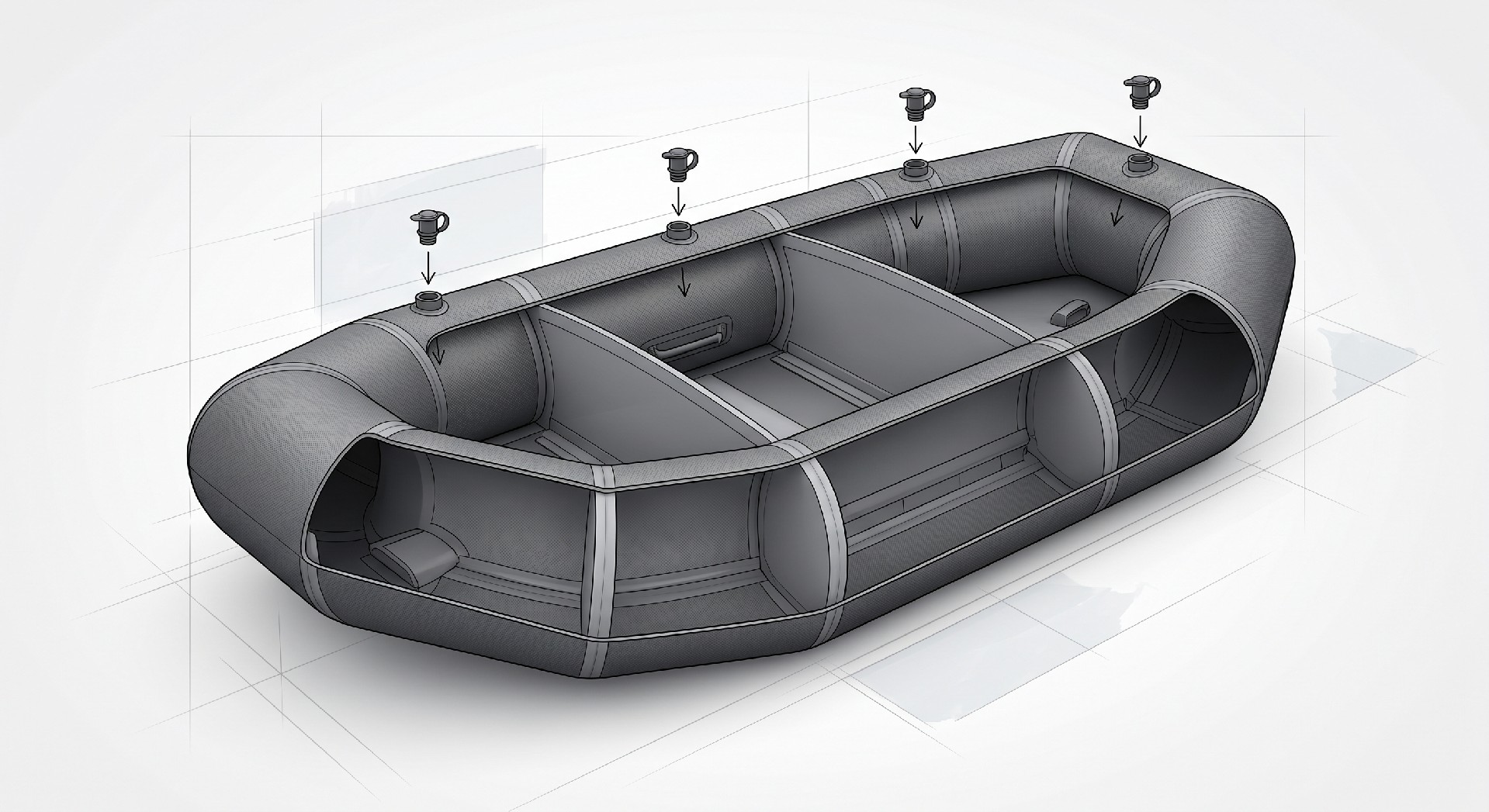
Understanding Multi-Air Chamber Architecture: How Redundancy Is Engineered
An inflatable raft with a multi-air chamber design features a hull divided into multiple independent, airtight compartments. These are typically arranged as separate longitudinal tubes (port and starboard) and a floor chamber, or as multiple transverse sections along the raft's length. Each chamber has its own dedicated inflation valve and pressure relief system. The key engineering principle is compartmentalization: the internal air chambers are separated by internal baffles or heat-welded seams that prevent air from migrating between compartments. In the event of a puncture, tear, or valve failure in one chamber, the pressure in that section drops, but the adjacent chambers remain fully inflated, preserving the raft's overall shape, buoyancy, and stability.
Most commercial-grade multi-chamber rafts operate with a typical working pressure range of 2.5 to 4.5 PSI (0.17 to 0.31 bar) for the main tubes, with floor chambers often specified at higher pressures—up to 7 PSI (0.48 bar) in drop-stitch designs—to achieve rigidity. The chamber count is a primary specification: a 2-chamber design offers basic redundancy, but 3- or 4-chamber configurations are increasingly standard for commercial and professional use, particularly for rafts over 4 meters in length or those operating on fast-moving rivers.
Redundancy and Buoyancy: The Safety Case
The primary safety benefit of a multi-chamber raft is its ability to maintain positive buoyancy and stability after a chamber failure. For a commercial operator, this translates directly into:
Controlled response time: A partially deflated but stable raft allows guides or crew to execute a planned evacuation, deploy rescue equipment, or motor to shore, rather than managing a sudden capsize.
Stability in currents: The remaining inflated chambers help keep the raft upright and prevent it from folding or wrapping around obstacles, a critical factor in river environments with strong currents or strainers.
Payload retention: The remaining buoyancy can often support the raft's structural weight plus a reduced passenger or equipment load, preventing the sudden loss of gear or people into the water.
Commonly specified by OEM buyers for rescue and commercial rafts, a multi-chamber design ensures that the raft remains a viable life raft even after a severe impact or puncture. Buyers should verify against the final datasheet whether the raft meets relevant standards, such as ISO 6185 for inflatable boats, which specifies construction and performance requirements, including buoyancy after flooding or damage.
Multi-Chamber vs. Single-Chamber: A Commercial Comparison of Operational Risk
To frame the decision for a procurement team, it is useful to compare a single-chamber raft against a 3-chamber commercial raft across several operational dimensions.
| Operational Dimension | Single-Chamber Raft | Multi-Chamber (3-4) Raft | Best-Fit Scenario |
|---|---|---|---|
| Post-Puncture Outcome | Rapid deflation, potential capsize, immediate emergency. | Stable platform, controlled deflation, safe evacuation time. | Multi-chamber for any professional operation. |
| Stability in Current | Prone to folding, capsizing, or wrapping around obstacles. | Retains shape and stability, allowing for navigation or rescue. | Multi-chamber essential for moving water. |
| Rescue Operations | Unreliable; mission failure risk is high. | Reliable; vessel remains a viable rescue platform. | Multi-chamber standard for rescue rafts. |
| Commercial Risk & Liability | Higher liability; single point of failure. | Lower liability; demonstrates duty of care. | Multi-chamber strongly advised for commercial fleets. |
| Typical Buyers | Recreational user in calm, protected water. | Rental operators, guides, rescue services, commercial fleets. | Multi-chamber is the standard for any professional buyer. |
Specification Checkpoints for Buyers: What to Verify with Your Supplier
When specifying a multi-chamber raft for lake or river use, commercial buyers should not assume that all multi-chamber designs are equivalent. Key procurement questions and verification points include:
Chamber Isolation Seams: How are the internal baffles constructed and welded? A weld failure between chambers could effectively create a single-chamber raft. Request details on the seam type (e.g., heat-welded, glued, or RF-welded) and the supplier's quality control for seam strength, which is a supplier-dependent parameter.
Valve Quality and Placement: Each chamber requires a reliable inflation valve. Verify the valve type (e.g., leafield, Halkey-Roberts) and its cycle life rating. Consider whether valves are positioned for easy access in a partially deflated state, which is important for field repairs.
Independent Pressure Relief: Ensure each chamber has its own pressure relief valve to prevent over-pressurization from thermal expansion, which could cause a seam or weld failure.
Material and Construction: The raft material must be compatible with the operating environment. Typical commercial ranges for tube material include heavy-duty PVC (e.g., 0.9 mm to 1.2 mm thickness) or Hypalon/CSM for its superior UV and chemical resistance. Seam construction is often a critical failure point, so buyers should understand the supplier's seam taping or welding process.
Certification and Compliance: While CE marking indicates compliance with certain EU safety directives, and REACH restricts hazardous substances, neither is a universal product safety certificate. For a commercial watercraft, the buyer should confirm the product's classification and required standards (e.g., ISO 6185) with the supplier. For example, ISO 6185 is applicable to certain inflatable boats based on their length, intended use, and powering, so it is essential to verify if it applies to your specific model.
Repair and Spare-Parts Strategy: A multi-chamber raft is only as reliable as its ability to be repaired. Discuss with the supplier the availability of repair materials, patching procedures, and the recommended spare parts (e.g., valves, repair patches). A robust maintenance plan is a key factor in lifecycle optimization.
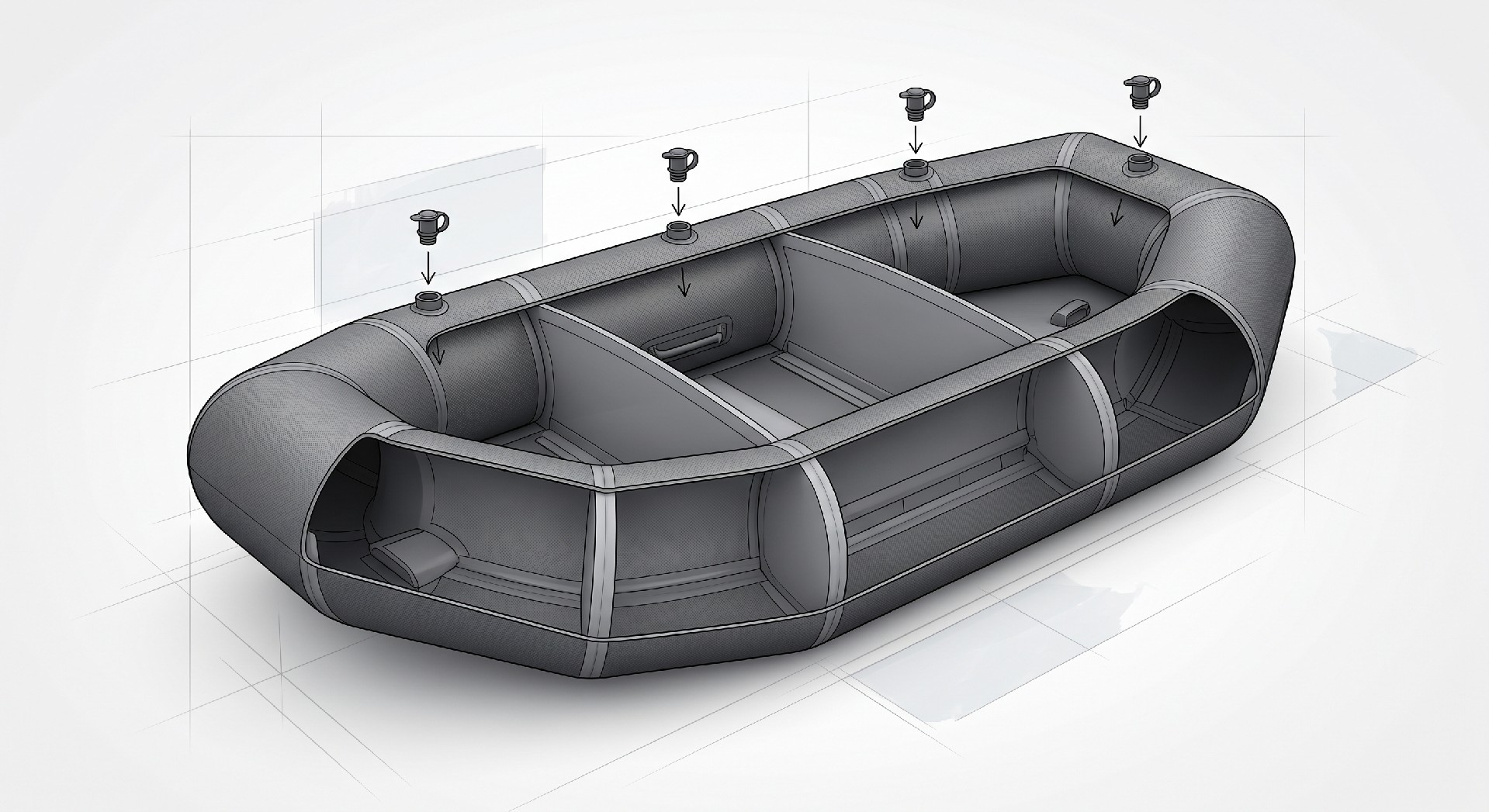
Field Repair and Lifecycle Management: Maintaining the Redundancy
Owning a multi-chamber raft introduces specific maintenance considerations. The very feature that provides safety—multiple chambers—also increases the number of valves, seams, and potential leak points. Therefore, a rigorous inspection and maintenance protocol is essential to ensure the safety margin is preserved throughout the raft's service life.
Inspection Checklist for Multi-Chamber Rafts
Visual Inspection: Before each deployment, check the entire hull for abrasions, cuts, or damage. Pay special attention to high-wear zones such as the bottom, chines, and areas around tie-down points.
Valve Integrity: Regularly check each valve for leaks. Soapy water can be used to detect bubbles around the valve base and the seal.
Pressure Test: At least annually, a full pressure test should be conducted on each chamber to identify slow leaks. Common leak sources include valve seals, seam edges, and D-ring attachments.
Cleaning and Storage: Rafts should be thoroughly cleaned of sand, dirt, and debris after use in rivers. The raft should be stored partially inflated or completely deflated in a cool, dry, and UV-protected environment to prevent material degradation. Do not store a fully inflated raft for extended periods in hot or sunny locations, as thermal expansion can stress seams.
Commercial Decisions and Buying Recommendation
The decision to invest in a multi-air chamber inflatable raft is a direct function of your operational risk tolerance and the environment in which you work.
Best for: All commercial and professional applications on lakes and rivers, including rental fleets, guided trips, rescue operations, and scientific surveying. The safety and stability benefits are non-negotiable for any operation carrying passengers or valuable equipment.
Avoid when: For a very small, single-user craft used exclusively in calm, protected water (e.g., a small pond) and with a clear exit to shore, a single-chamber design might be acceptable. However, even in these situations, the risk of a simple puncture is not eliminated.
Choose when: You require a platform that can withstand impact, maintain stability in current, and provide a safety margin for evacuation and rescue. This is particularly crucial for any raft operating in environments where a rapid deflation would be catastrophic, such as fast-moving rivers, large lakes, or during rescue operations.
Verify when: You are evaluating a quotation. Always request detailed specifications on chamber count, seam type, valve quality, and the material thickness. Obtain copies of quality control records and discuss the supplier's warranty policy. A multi-chamber raft is a safety-critical asset, and the procurement process should treat it as such.
