

Introduction: The Motor is the Weak Link
For a commercial operator or OEM buyer, selecting an electric trolling motor for a small inflatable fishing boat (typically 2.5m to 3.8m) often presents a greater engineering challenge than specifying the boat itself. The boat is passive; the motor is an active system that introduces variables of power, control, corrosion, and mounting integrity. A mismatch between the motor’s thrust, shaft length, and battery system and the boat’s hull dynamics and intended use will result in poor performance, rapid battery drain, and potential damage to the transom. This guide is tailored for B2B buyers—importers, rental fleet operators, and OEM brand owners—who need to make a technically sound procurement decision. We will move beyond simple horsepower equivalencies and focus on the commercial criteria that define a successful specification for an electric trolling motor for small inflatable fishing boats.
Understanding the Application: Small Inflatable Fishing Boats
Before evaluating motor specifications, it is crucial to define the platform. 'Small inflatable fishing boats' in this context typically fall into two categories: the popular PVC or Hypalon/CSM inflatable floor models (often 3.0m to 3.6m with a 38cm to 48cm tube diameter) and the more rigid drop-stitch floor models (usually 2.8m to 3.8m with a rigid, high-pressure floor). These boats are commonly specified for sheltered coastal fishing, lake fishing, and as tenders for larger vessels. A rental fleet operator in a calm water lagoon will have very different requirements than an OEM selling a boat for river fishing with a moderate current. The primary performance bottleneck for these small craft is not their theoretical top speed, but their ability to maintain steerage and control in wind and current for extended periods.
For commercial buyers, key metrics often include the boat's working pressure, payload capacity, and floor type. However, these parameters become critical when cross-referenced with the motor's capabilities. For instance, a boat with a working pressure of 0.8 bar in the tubes and 1.0 bar in a drop-stitch floor will be significantly more rigid and offer less hull flex than a low-pressure, inflatable-floor model. This hull flex directly impacts the motor's transom mount stability and steering responsiveness. A motor that is too heavy for a small, light boat will exacerbate poor handling, causing the boat to squat in the stern and making it difficult to turn. This is a primary consideration for an OEM designing a package or a rental operator standardizing a fleet.
The Critical Dimensions of Selection
When specifying an electric trolling motor for small inflatable fishing boats, three core dimensions dominate the buying decision: Static Thrust, Shaft Length, and Battery Architecture.
Static Thrust: The Misunderstood Metric
Thrust, measured in pounds-force (lbf) or kilograms (kg), is the most quoted specification, yet it is also the most misunderstood. For commercial or OEM applications, do not rely on the often-cited '2 lbs of thrust for every 100 lbs of boat weight' rule. This rule of thumb is for displacement hulls and does not account for wind drag, current, or the high-profile nature of an inflatable boat's hull. For a small inflatable fishing boat, we recommend a thrust range of 45 lbs to 55 lbs for typical operation. A 45 lbs motor is adequate for a 3.2m inflatable floor boat in calm conditions, allowing for 3-4 hours of operation on a standard 100Ah deep-cycle battery. However, a commercial fleet operating in an estuary with a 2-knot current or an OEM targeting a 3.8m boat with a drop-stitch floor should specify a 55 lbs motor. This higher thrust provides the reserve power needed to maintain control in adverse conditions without running the battery at its maximum draw. It is better to have a motor that operates at 70% of its maximum thrust for 70% of the time than a motor that is constantly at 95% of its maximum thrust, leading to rapid battery depletion and motor overheating.
Shaft Length: Avoiding Ventilation and Cavitation
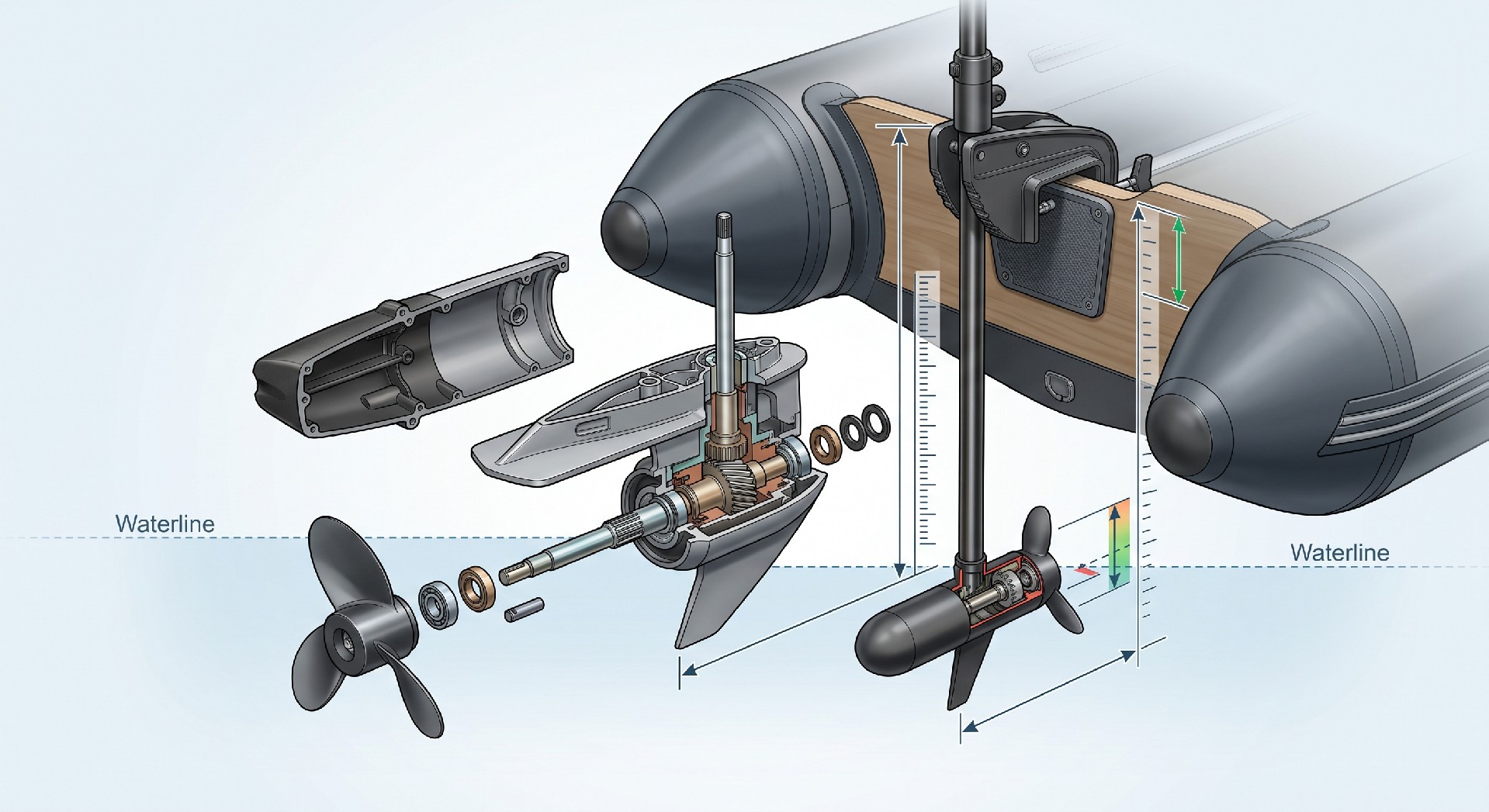
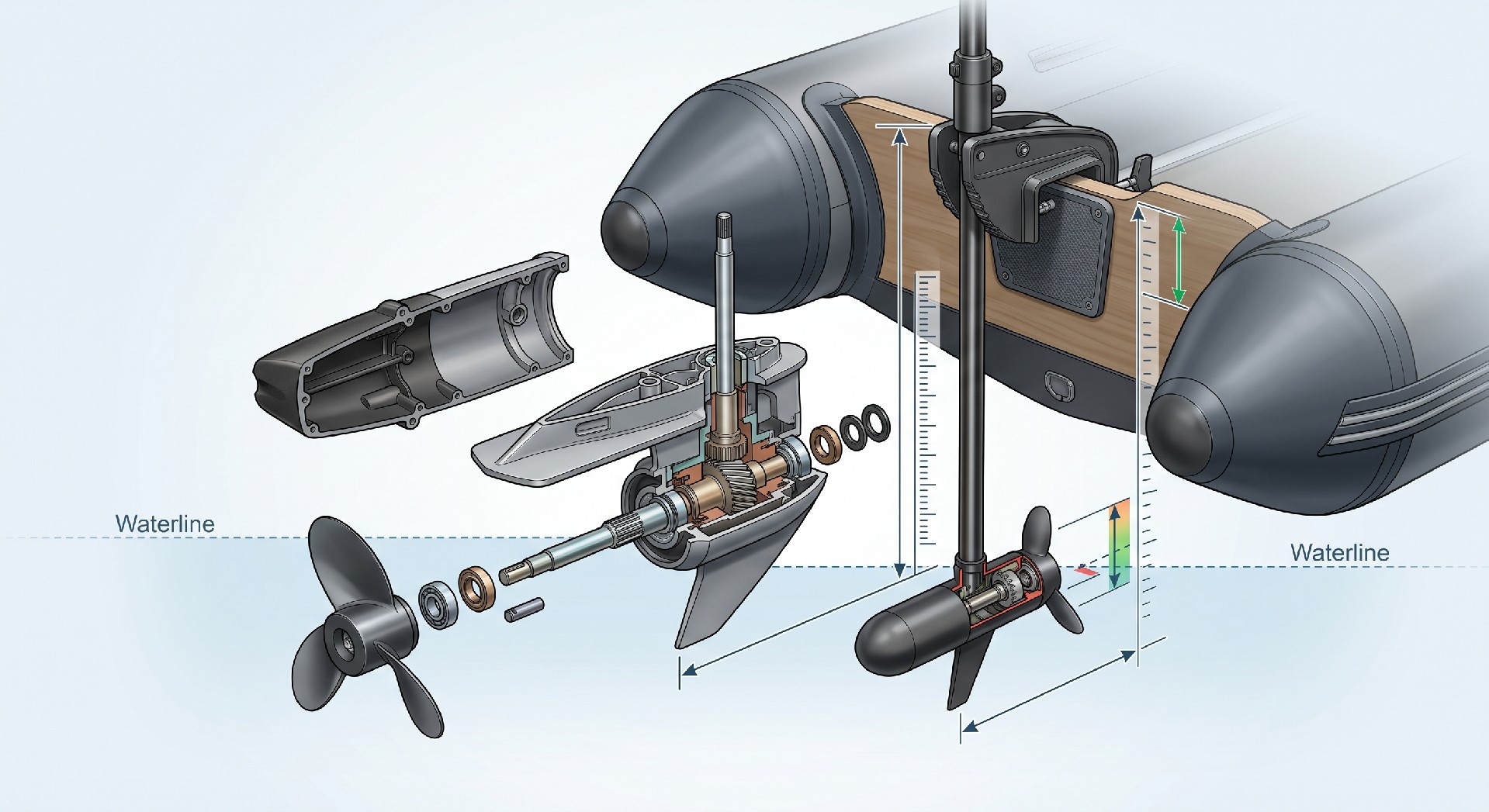
Selecting the correct shaft length is a frequent oversight that directly compromises performance. The shaft is the distance from the motor's mounting bracket to the propeller. If the shaft is too short, the propeller will be too close to the surface, leading to ventilation (the propeller drawing in air from the surface) and cavitation (the formation and collapse of water vapor bubbles), which drastically reduces thrust and can damage the propeller. If it is too long, the motor's head will be too low, the lower unit is more susceptible to impact with obstacles, and the center of gravity is shifted awkwardly.
For small inflatable fishing boats, a shaft length of 30 inches is the typical commercial range for most applications with a standard transom height. However, you must verify this against the final boat datasheet. A 30-inch shaft is usually sufficient for boats with a transom height of approximately 15 to 17 inches. For boats with a deep-V hull or a significantly higher transom, or for those operated in rough water where the boat pitches, a 36-inch or 42-inch shaft may be required. The buyer check here is to measure the transom height of the production boat and ensure that the motor's mounting bracket can adjust to place the propeller at least 8 inches below the waterline when the motor is in the down position. For a rental fleet, standardizing on a single shaft length is advantageous for logistics, but it may compromise performance on boats of differing transom heights.
Battery Architecture and Power Management
The motor selection is fundamentally a decision about power management. The boat's hull design, its primary use, and the expected run time will dictate the battery system, which in turn limits the motor choice.
12V Systems: This is the most common system for small inflatable boats. It is simple, cost-effective, and batteries are readily available. A 12V system paired with a 55 lbs motor is the practical limit for a single battery setup. This configuration is ideal for rental operations where charging is done overnight and battery swaps are minimal.
24V Systems: These are often targeted by OEM buyers for larger or heavier boats (e.g., a 3.8m heavy-duty inflatable) to gain the efficiency of running higher voltage, which reduces current draw for the same power output. This results in cooler motor operation and potentially longer battery life. However, it introduces the complexity of series wiring and balanced battery charging, which is not ideal for a rental operator with variable maintenance capability.
Lithium vs. Lead-Acid: From a lifecycle cost perspective, the decision is clear. While the initial CapEx is higher, Lithium Iron Phosphate (LiFePO4) batteries offer a significantly lower total cost of ownership. They are lighter (about 50-60% of the weight of a comparable lead-acid battery), offer a longer cycle life (typically 2,000-5,000 cycles versus 300-500 cycles), and can maintain a more stable voltage under load, which is critical for a trolling motor's maximum thrust. For a rental operator, the weight savings alone translates to easier handling and transport of the battery, which is a considerable commercial advantage.
| Decision Factor | Commercial Target | Why It Matters | Buyer Check |
|---|---|---|---|
| Static Thrust | 45-55 lbs | Provides sufficient power to maintain control in wind and current for boats 2.8-3.8m. | Match thrust to typical boat weight and operating environment. 55 lbs for estuary or 3.8m boats. |
| Shaft Length | 30-42 inches | Ensures propeller is deep enough to prevent cavitation and maintain thrust. | Measure transom height. Aim for propeller at least 8 inches below waterline. |
| Battery System | 12V (common) / 24V (larger boats) | Defines capacity, weight, and charging logistics for the operation. | 12V is simple and cost-effective. 24V is more efficient but complex. |
| Motor Material | Corrosion-proof composite or anodized aluminum | Determines resistance to saltwater corrosion and UV degradation. | Composite is lower-maintenance for saltwater. Aluminum offers strength but requires coating. |
| Propeller Design | Durable nylon or metal composite | Impacts thrust efficiency and replacement cost. | Nylon is affordable and impact-resistant for rental fleets. |
| Ingress Protection (IP) | Minimum IP67 for lower unit | Prevents motor failure from water ingress. | Request IP test report from the supplier. Do not accept verbal assurance. |
Motor Architecture and Material Choices for Durability
A small inflatable fishing boat is an extreme environment for electrical equipment. The motor is frequently subjected to saltwater spray, freshwater immersion, UV radiation, and physical impact. The material choices for the motor's housing and lower unit are therefore not just aesthetic but are critical commercial decisions.
Housing Materials: Composite vs. Metal
The motor's head and shaft are typically made from either a high-impact composite material or aluminum. Composite materials are lighter, corrosion-proof, and resist UV damage. They are an excellent choice for freshwater applications and for operators who want to minimize weight. Aluminum offers superior strength and heat dissipation, which can be an advantage in high-thrust applications. However, it requires a robust powder-coating or anodizing process to protect against corrosion, especially in saltwater. For a commercial rental fleet in saltwater, a corrosion-proof composite is often the preferred choice to minimize the risk of galvanic corrosion at the electrical connections and mounting hardware.
Propeller Design and Material
The propeller is the interface between the motor's power and the water. A 3-blade or 4-blade propeller is common. A 4-blade propeller provides more 'bite' and reduces cavitation at low speeds, which is advantageous for trolling. The material, usually a glass-reinforced nylon or a metal composite, should be chosen for durability and ease of replacement. For a rental fleet, a durable nylon propeller that is inexpensive and easy to replace is a superior commercial choice to a high-performance metal propeller that is costly to replace when a user inevitably strikes a submerged object.
Compliance, Standards, and Buyer Evidence
For a B2B purchase, verifying compliance is non-negotiable. While the boat itself may fall under standards like ISO 6185, the electric trolling motor has its own set of requirements. The buyer should request specific evidence. CE marking for the motor is an essential market access requirement for the EU, but it is not a standalone quality mark.
Ingress Protection (IP) Rating: The motor must have an appropriate IP rating to protect against water ingress. An IP67 rating indicates it is dust-tight and protected against immersion in water up to 1 meter for 30 minutes. This is a typical commercial specification for a trolling motor's lower unit, though a lesser rating may be acceptable for the motor head.
RoHS Compliance: The motor should be RoHS compliant, restricting the use of hazardous substances in its electronics. This is a common requirement for import into many markets.
Electromagnetic Compatibility (EMC): The motor must not interfere with other electronic devices, such as fish finders or GPS units that are often mounted on small inflatable fishing boats. EMC compliance, often indicated by CE marking, is a critical but often overlooked check.
Do not accept a supplier's verbal assurance. Request copies of test reports from accredited labs. A common red flag is when a supplier cannot produce an IP test report or EMC compliance documents. This is a sign of a low-quality OEM that may not have proper quality management systems, such as ISO 9001, in place. Distinguish between a factory quality management certification (ISO 9001) and a product-specific test report. Both are important but serve different purposes.
Supplier Questions and Sample Evaluation
Before placing a bulk order, a sample evaluation is not a luxury—it is a necessity. Use the sample to conduct a physical and operational test. Here is a compact buyer checklist for evaluating a sample electric trolling motor for small inflatable fishing boats.
Mounting Bracket Integrity: Does the mounting bracket fit securely on the transom of your standard boat model? Does the clamp mechanism apply consistent pressure and resist loosening from vibration?
Steering Control: Is the steering action smooth and responsive? Is there any play or slack in the steering mechanism? Is the tiller or foot pedal (if applicable) user-friendly?
Variable Speed Control: Test the variable speed control. Does it provide a smooth and linear power delivery, or is it jumpy?
Noise and Vibration: Run the motor at its maximum speed. Is there excessive mechanical noise or vibration that would annoy a user? This is a sign of a poorly balanced propeller or a low-quality motor.
Battery Connection: Inspect the battery connector quality. Are the terminals designed to resist corrosion and provide a secure, low-resistance connection?
For an OEM or importer, this is also the time to verify the packaging. Is the motor packaged to prevent damage during shipping? Are the correct accessories (propeller, mounting bolts, wiring harness) included, and are they of adequate quality? For a rental operator, this is the time to assess the motor's integration with your existing fleet's battery system and charging infrastructure.
Commercial Decision: Buy, Standardize, or Customize?
The final decision is not just about which motor to buy, but which buying strategy is right for your business model. Each buyer type has a different path to a final decision.
For OEM Brand Owners: The goal is specification control. Work with the motor supplier to create a custom SKU with your own logo, packaging, and potentially a modified wiring harness or mounting bracket tailored to your specific boat model. This creates a differentiated product that is not a 'me too' offering. The primary risks here are supplier inventory commitments and ensuring the supplier's production quality remains consistent across multiple batches. Insist on a rigorous quality control (QC) plan with in-line and final inspection points.
For Rental Fleet Operators: Standardization is your priority. Choose a single motor model (same thrust, shaft length, battery voltage) for your entire fleet. This simplifies maintenance, spare parts stocking, and operator training. The critical decision is choosing a motor with a reputation for durability and low maintenance, even if it has a higher upfront cost. The lifecycle cost of a motor that fails and is out of service for a week is far higher than the cost of a better, more reliable model. Prioritize a motor that is easy to service and has readily available spare parts.
For Importer/Distributors: Your decision is a balance of price, performance, and market demand. You need a motor that is competitively priced, meets the performance expectations of the end-user, and complies with the import requirements of your target market. The 'sweet spot' is often a mid-tier motor with a proven track record of reliability. Avoid the temptation to buy the cheapest motor; the returns and warranty claims will erode your profitability. Look for a supplier with a strong track record in the region and clear communication on lead times and Incoterms.
In all cases, verify the spare parts ratio and warranty terms. A motor is a system of components, and its long-term performance depends on the availability of service parts like propellers, drive pins, and o-rings. A supplier who cannot guarantee parts availability for at least 3 years is not a reliable commercial partner.
