

Why Puncture Prevention Starts Before the First Night Out
For commercial fleet operators, outdoor gear distributors, and rental outfitters, a torn or punctured inflatable sleeping mat is not merely a warranty claim—it is a revenue interruption, a customer-satisfaction failure, and often a preventable lifecycle-cost problem. The dominant search intent behind “How to Prevent Tears and Punctures in Inflatable Sleeping Mats” is maintenance engineering with a clear commercial edge: how do we keep these mats operational longer, reduce field failures, and control the total cost of ownership? Unlike generic camping advice, the B2B perspective demands systematic inspection, material understanding, seam integrity, and a repair-versus-replace protocol. This guide delivers exactly that: a technical, commercially useful framework for preventing damage to inflatable sleeping mats used in rental fleets, hospitality, expedition support, and government procurement.
Understanding the Failure Modes: Where and Why Mats Fail
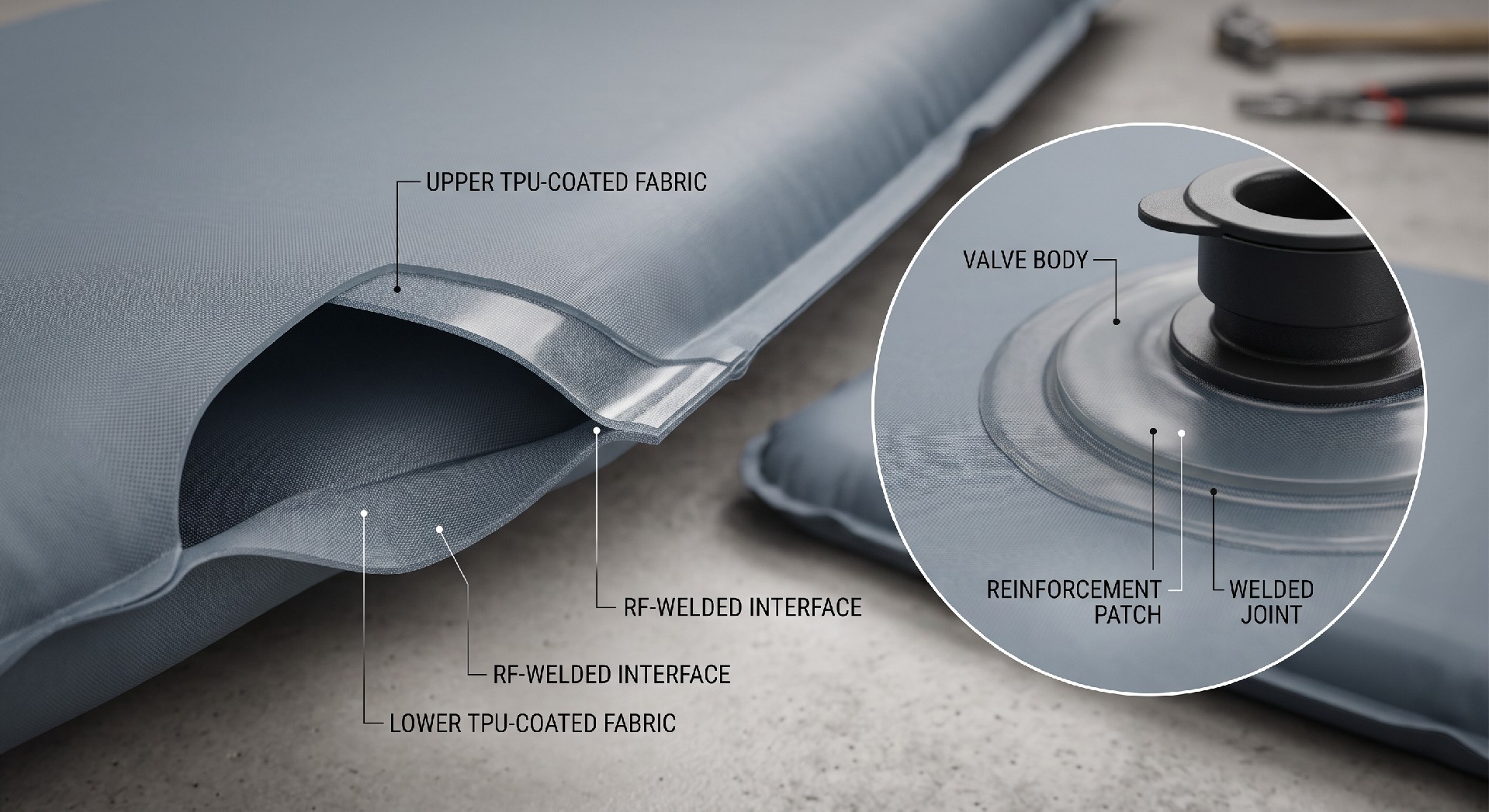
An inflatable sleeping mat is a laminate structure under cyclic loading. Its primary failure modes fall into four categories:
Abrasion puncture: Repeated contact with rough tent floors, rocky ground, or debris gradually wears the exterior coating until the base fabric or inner bladder is exposed and breached.
Impact puncture: Sharp objects—pebbles, twigs, zippers, or even boot studs—concentrate force on a small area, exceeding the material's burst or tear strength.
Seam delamination: The welded or glued seam is the most vulnerable structural joint. Cyclic pressure, flexing, and temperature changes cause the seam to separate, often leading to a slow leak rather than a catastrophic tear.
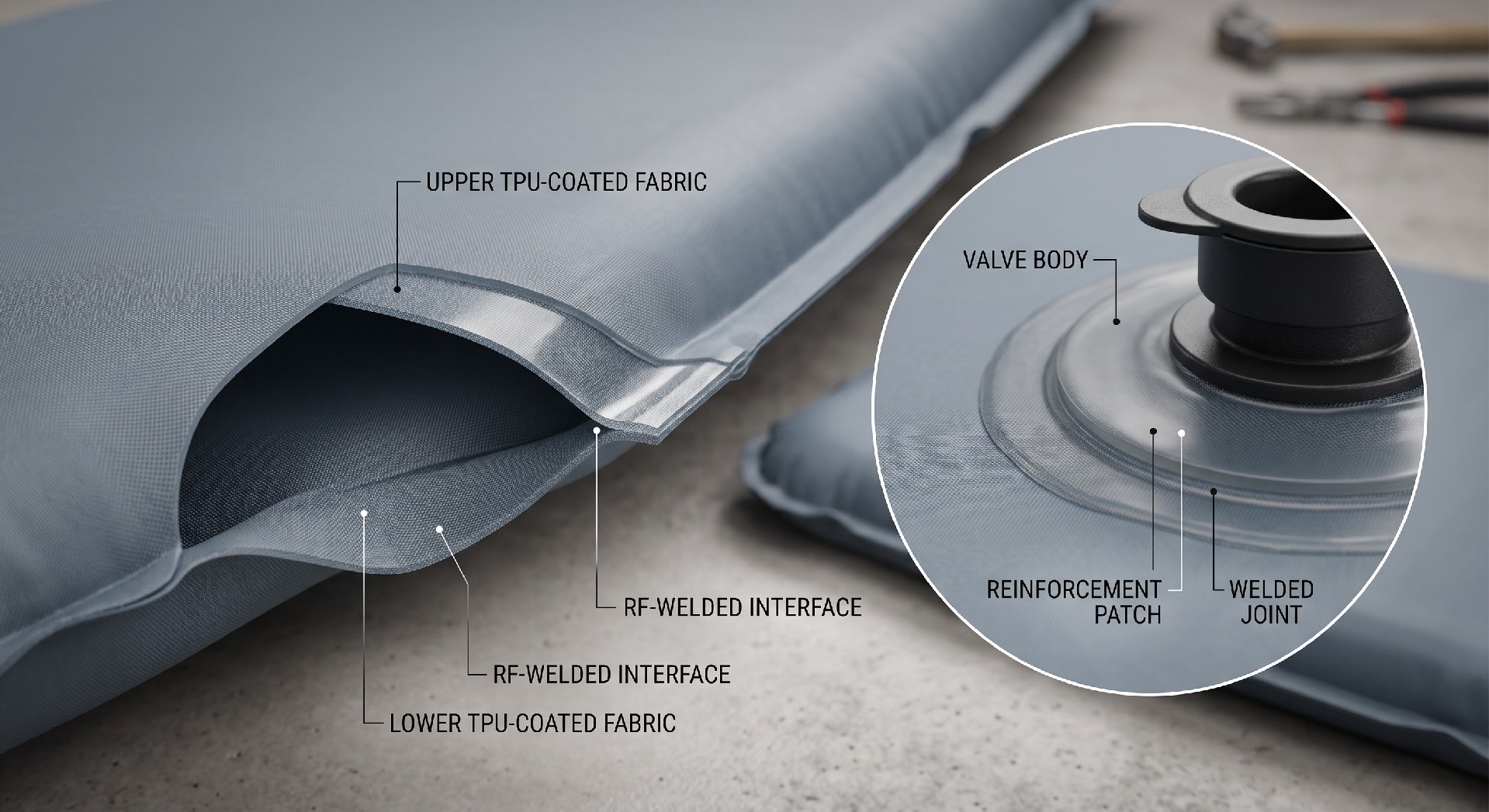
Valve-base tear: The interface between the valve flange and the mat body experiences high stress during inflation, deflation, and rolling for storage. This is a frequent failure point in commercial rotation.
Each failure mode has distinct prevention strategies. The table below maps the most common commercial causes to the correct preventive actions.
| Failure Mode | Commercial Cause | Primary Prevention Strategy | Inspection/Test Method |
|---|---|---|---|
| Abrasion Puncture | Setup on rough ground without a groundsheet | Use a dedicated groundsheet; deploy clean area | Visual inspection for coating wear; weight loss test |
| Impact Puncture | Debris (stones, twigs) or careless handling | Sweep deployment area; use padded transport bags | Visual inspection; pressure hold test (12-24 hrs) |
| Seam Delamination | Over-inflation; poor initial weld quality | Use pressure gauge; verify seam peel strength >4.0 N/mm | Visual for stress whitening; pressure hold test |
| Valve-Base Tear | Rolling/folding with valve stressed; excessive torque | Roll with care; avoid folding at valve; inspect often | Visual check; soapy water leak test at valve |
Material Selection: The First Line of Defense
Not every inflatable mat uses the same materials, and the choice heavily influences puncture resistance. Two material architectures dominate the commercial segment:
TPU (Thermoplastic Polyurethane) laminates offer excellent abrasion resistance, high tensile strength, and good cold-flexibility. They are commonly specified for premium expedition and rental-grade mats. TPU's puncture resistance is typically superior to PVC in the 0.3-0.8 mm thickness range used for sleeping mats, but it comes with a higher material cost.
PVC (Polyvinyl Chloride) laminates are more cost-effective and widely used in entry-level and mid-range products. Their puncture resistance depends heavily on the denier of the internal scrim (e.g., 150D vs. 210D) and the coating weight. PVC can become stiff in cold conditions, increasing the risk of stress fractures and seam failure.
For commercial buyers, the key specification is not just the material name but the coating weight (gsm) and base fabric denier. A typical target for heavy-use mats is a 210D polyester base fabric with a TPU coating weight of at least 200 gsm on both sides. This combination provides a balance of puncture resistance, tear strength, and weldability. When evaluating samples, test for abrasion resistance using a simple field check: rub a standardized abrasive block (or a coarse stone) across a material sample under a 1 kg load for 100 cycles. The weight loss or visible wear should be minimal.
Seam Construction and Integrity: The Structural Core
Seams are the Achilles' heel of any inflatable structure. Two methods are common:
Radio-frequency (RF) welding uses high-frequency electromagnetic energy to fuse the material layers. This produces a homogeneous bond that is as strong as the parent material, provided the welding parameters (power, dwell time, pressure) are correctly set. RF-welded seams are the gold standard for commercial durability.
Heat sealing uses heated dies to melt and fuse layers. It is effective but can be more sensitive to material thickness variations and contamination. A poorly executed heat seal creates a weak point that can delaminate under pressure.
Buyers should request seam peel strength test results from suppliers. A typical acceptance criterion for a commercial sleeping mat is a peel strength of at least 4.0 N/mm width, tested at a 90° angle on a tensile machine. Additionally, the seam's width should be a minimum of 12 mm for the main perimeter and 20 mm for critical stress areas like the valve base. Do not accept a mat where the seam width is less than 10 mm, as it indicates a cost-reduction compromise.
Field prevention of seam failure involves two practices:
Avoid over-inflation: Over-pressurization strains the seams. Use a pressure gauge (recommended) or the manufacturer's specified feel. The typical working pressure for commercial mats ranges from 1.5 to 2.0 PSI (0.1-0.14 bar). Exceeding 2.5 PSI significantly increases seam stress.
Regular seam inspection: Before each deployment, visually inspect the perimeter seam for signs of whitening (stress whitening), delamination, or tiny bubbles that indicate a bond failure. This is a critical step in a rental check-in/check-out process.
Field Protocol: Handling, Setup, and Storage
More inflatable mats are damaged during handling and storage than during actual use. A commercial field protocol must address:
Groundsheet placement: Always deploy a dedicated groundsheet under the mat, even inside a tent. The groundsheet acts as a sacrificial layer, absorbing the impact of sharp objects. For rental operations, a groundsheet with reinforced corners is a standard accessory.
Clean, dry deployment area: Sweep the intended area to remove stones, twigs, and other debris. This simple step drastically reduces the incidence of impact punctures.
Proper folding and rolling: Folding or rolling a mat while it is dirty or moist creates abrasion points and allows micro-particles to work into the laminate layers, leading to delamination. Always clean and dry the mat thoroughly before storage. When rolling, avoid sharp creases; instead, fold lengthwise into thirds and then roll loosely. Store in a breathable bag to prevent mildew, which can degrade the fabric.
Transport protection: Use padded transport bags or sleeves. Stacking heavy gear on top of a folded mat can create pinch punctures at the folds. This is a common oversight in fleet logistics.
Commercially Relevant Inspection and Repair Strategy
For B2B buyers, a reactive approach to punctures is costly. Instead, implement a proactive inspection and repair cycle.
Inspection Checklist
Visual inspection: Check the entire surface for cuts, embedded particles, and stress whitening. Pay special attention to the edges and the valve area.
Pressure hold test: Inflate the mat to its working pressure and leave it for 12-24 hours. A drop of more than 15% indicates a slow leak. This is a non-destructive acceptance test for rental returns.
Leak detection: For a mat that fails the pressure hold test, use a soapy water solution on the suspected areas. Bubbles will form at the leak point. The most common sites are seam terminations and the valve base.
Repair Protocol
Field repair: For punctures up to 3 mm in size on the main body, use a self-adhesive TPU or PVC patch, depending on the mat material. The patch should be rounded at the corners to prevent peeling. Clean the area with isopropyl alcohol before applying the patch. This is a temporary measure to get through a trip.
Permanent repair: For larger punctures (3-15 mm) or seam repairs, a two-part adhesive patch kit is preferred. The patch should overlap the damaged area by at least 25 mm on all sides. The repair must be cured under pressure and at room temperature for 24 hours. For commercial fleets, consider a dedicated repair workbench with a curing press to ensure consistent patch adhesion.
Retirement trigger: A mat with a seam failure longer than 20 mm, a puncture larger than 15 mm, or a valve base that has been repaired more than twice should be retired from the active fleet and relegated to spare parts. The cost of repeated repairs and the risk of field failure outweigh the value.
Buyer Acceptance and Supplier Verification
When procuring inflatable sleeping mats for a fleet or distribution, the prevention plan begins at the supplier audit. Ask for:
Material test reports: Include tear strength (e.g., ASTM D2261 or ISO 13937), tensile strength, and abrasion resistance. Insist on values that exceed the typical commercial range for your anticipated use.
Seam peel strength data: As mentioned, a target of >4.0 N/mm is a good benchmark for high-usage mats.
Seam sample: Request a cross-section cut of the seam from a sample to visually verify the weld penetration and bond quality.
Proof of chamber pressure testing: Ensure the supplier tests 100% of production units to the working pressure and a short-term over-pressure (e.g., 3.0 PSI for 5 minutes) as part of their quality control.
A robust prevention strategy is not about a single 'magic' material; it is a system. It combines:
Correct material specification (high-denier scrim, adequate coating).
Quality seam construction (RF-welded, minimum width, verified peel strength).
Disciplined field protocol (groundsheet, cleaning, rolling, storage).
Proactive inspection and repair (pressure tests, visual checks, defined repair methods).
Clear retirement criteria to remove failing assets from the fleet.
This system ensures that your inflatable sleeping mats are not a recurring maintenance headache but a reliable, revenue-generating asset.
Decision Guide: Choose Your Prevention Priority
The ideal prevention strategy depends on your commercial role. Use this checklist to prioritize your efforts:
For rental fleet operators: Focus 60% of your efforts on field protocol—groundsheets, cleaning, and post-use inspection. These actions have the highest immediate impact on damage reduction.
For distributors and OEM buyers: Invest in supplier verification—material reports, seam samples, and pressure tests. These ensure the product arriving at your warehouse is fit for the intended use.
For hospitality/resort buyers: Prioritize a combination of field protocol (educating guests and staff) and a defined repair/replacement cycle to maintain a luxury standard of equipment.
For government/expedition buyers: Place the highest importance on material selection (TPU over PVC) and seam integrity, as field repairs in remote settings are often impractical and mission-critical.
Preventing tears and punctures is a continuous process, not a one-off fix. By adopting a systematic, commercially-focused approach, you protect your capital, enhance your reputation, and reduce operational friction. The real cost is not the mat; it is the failure.
