

Introduction: The High-Stakes World of Commercial Water Sports Procurement
For B2B buyers, procuring water sports rushing equipment—whether for high-volume rentals, glamping resorts, or rescue operations—is a high-stakes decision. The global market is flooded with options, but the difference between a reliable, long-lasting fleet and a costly maintenance nightmare lies in the details of material science and manufacturing standards. As industry standards evolve, with new national guidelines for inflatable water sports goods being formalized to address safety and quality gaps, buyers must be more informed than ever to ensure safety, performance, and profitability . This guide provides a deep dive into the critical technical specifications and supplier evaluation metrics you need to make a sound investment.
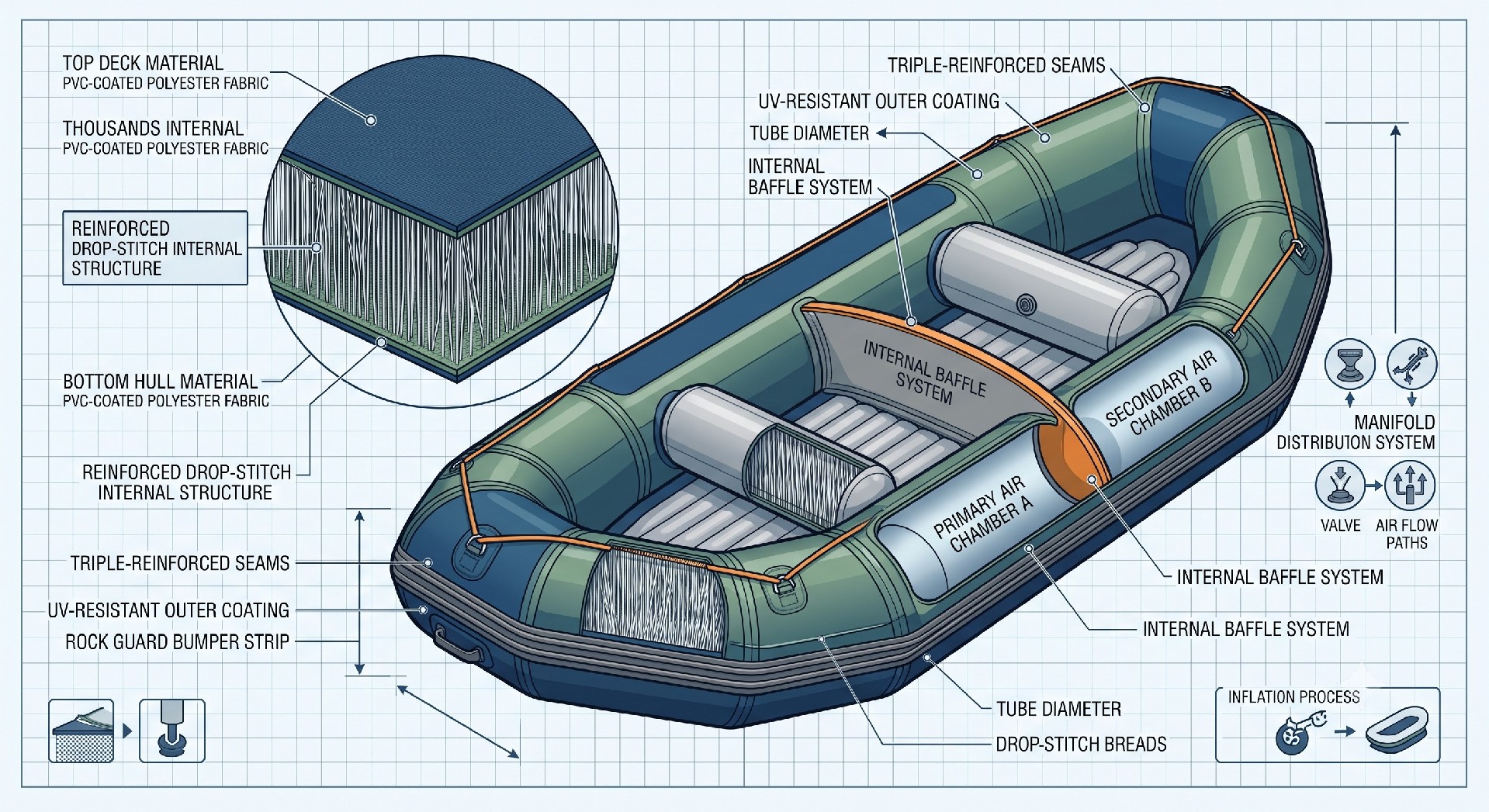
Fabric Engineering: The Core of Durability and Performance
The foundation of any high-performance inflatable is its fabric. For water sports rushing equipment, the choice is almost exclusively between standard airtight PVC and advanced drop-stitch technology. Understanding this distinction is the first step in supplier evaluation.
Drop-Stitch vs. Traditional PVC: A Material Science Overview
Traditional airtight PVC acts like a balloon, limited to low pressures (0.05–0.2 PSI) and prone to deformation under load . In contrast, drop-stitch construction involves thousands of polyester threads connecting two PVC skins. When inflated to high pressure, these threads lock the structure into a rigid, flat panel, creating a surface that rivals hard-shell alternatives in strength and stiffness. This technology is the benchmark for commercial-grade gear, with operating pressures reaching up to 20 PSI, offering a rigidity that traditional PVC cannot match .
Critical Fabric Metrics: Denier, Thickness, and PSI
When evaluating supplier specs, focus on these quantifiable metrics. The denier count (e.g., 1100D) indicates the density and abrasion resistance of the PVC layer. Higher denier correlates with better durability against sharp rocks and high-UV environments. The maximum payload capacity is a direct result of the fabric's tensile strength and structural integrity. For marine-grade products, look for a recommended inflation pressure of 12–15 PSI, which ensures the structure can support substantial loads without deformation. The patent for advanced inflatable watercraft specifies an inflation range of 7-25 PSI, with a recommended sweet spot of 15 PSI for optimal rigidity .
| Parameter | Entry-Level Specification | Commercial-Grade Specification |
|---|---|---|
| Material Type | Standard PVC / Airtight | Drop-Stitch PVC / 1100D-1500D |
| Recommended Inflation PSI | 0.5 - 1.5 PSI | 12 - 15 PSI (Marine-Grade) |
| Maximum Payload per Unit | ~120 kg | ~400 kg to 700 kg/m² |
| Seam Construction | Glued Seams | Heat-Welded Seams |
| Safety Feature | Single Air Chamber | Multi-Chamber Safety System |
Manufacturing Integrity: Seams, Welding, and Chambers
Even the best fabric is only as good as its assembly. A supplier's manufacturing process determines the long-term air retention and structural safety of the equipment.
Heat-Welded vs. Glued Seams
Heat-welded seams are the gold standard for commercial inflatables, as they create a molecular bond that is stronger and more durable than glued seams, which can degrade over time. The upcoming national standards for inflatable water sports goods emphasize the need for clear technical guidelines on such manufacturing practices . For high-pressure applications, heat welding is non-negotiable.
Multi-Chamber Safety Systems
Safety and uptime are paramount for commercial operators. Look for equipment with multi-chamber designs. A hull divided into three or more independent air chambers ensures that if one chamber is compromised, the craft retains its buoyancy and structural integrity, preventing catastrophic failure and allowing for a safe return to shore . This is a critical feature for mitigating risk and liability, aligning with ISO 6185-3 standards which exclude single-chambered boats from their safety specifications .
Regulatory Compliance and Supplier Verification
Navigating the complex web of global regulations is essential for B2B procurement. Ensuring your supplier adheres to recognized standards protects your business, your customers, and your brand reputation.
Key Certifications: CE, ISO 6185, REACH, and EN71
Prioritize suppliers who can demonstrate compliance with international and industry-specific standards. CE marking is mandatory for products sold in the European market. For motorized inflatable boats, ISO 6185-3 specifies minimum safety characteristics for design, materials, and testing, including requirements for buoyancy tube attachment strength and structural integrity . Additionally, REACH and EN71 compliance are crucial for ensuring materials are free from harmful chemicals and safe for use by the public. The new Chinese national standard is also being developed to align with these international practices, providing a unified global benchmark .
The Supplier Audit: Metrics that Matter
Beyond certifications, evaluate suppliers on operational metrics. The following data from leading manufacturers highlights key performance indicators (KPIs) that can guide your selection process.
When evaluating potential partners, look beyond the unit price. Consider the total cost of ownership (TCO) by analyzing factors such as on-time delivery rates, reorder rates, and responsiveness . A supplier with a perfect 100% on-time delivery record, like Suzhou Topdive, is invaluable for seasonal inventory planning . Meanwhile, a high reorder rate (e.g., 35% for Zhejiang Kaisi) can signal strong post-sale satisfaction. A responsive supplier (average response time ≤ 2 hours) indicates a well-organized operation that values client communication . For high-tech products like foil boards, suppliers like Shenzhen Chuyuan Mtech, with a 98.8% on-time delivery rate and response times under one hour, are ideal for agile development cycles .
[IMAGE_2]
Conclusion: A Data-Driven Sourcing Strategy
Choosing a reliable supplier for water sports rushing equipment is a strategic decision that requires a deep dive into technical specifications and manufacturing capabilities. By prioritizing drop-stitch construction with high PSI ratings, heat-welded seams, and multi-chamber designs, and by demanding verifiable compliance with CE and ISO 6185 standards, B2B buyers can build a fleet that delivers superior performance, longevity, and safety. Use supplier KPIs to benchmark potential partners, but always request physical samples and conduct thorough due diligence, including factory audits, before placing large orders. Ultimately, a rigorous, data-driven approach to sourcing will protect your investment and ensure your brand delivers the quality and reliability that today's discerning customers demand.
