

Introduction: The Procurement Challenge of Family Tent Selection
For B2B buyers, outdoor equipment rental businesses, and resort operators, selecting the optimal tent type for family camping is a strategic decision that impacts customer satisfaction, operational efficiency, and long-term profitability. The choice between dome, cabin, and tunnel tent architectures is not merely aesthetic—it represents a fundamental trade-off between spatial efficiency, wind resistance, material durability, and logistical costs. This comprehensive guide provides a data-driven analysis of these three categories, incorporating industry-standard specifications and compliance requirements to inform your sourcing strategy. As the outdoor recreation economy continues to grow, with private campground rates climbing and hotel costs averaging $174 per night in the U.S. according to Hotels.com's 2025 Price Index, the demand for premium family camping solutions has never been higher . Whether you are stocking a rental fleet or outfitting a glamping resort, understanding the technical nuances of these tent types is essential for maximizing ROI. This guide will delve into the engineering, material science, and commercial viability of each option, providing you with the critical metrics needed to make an informed procurement decision.
Architectural Fundamentals: Understanding the Core Design Differences
The structural integrity and spatial characteristics of a tent are defined by its framework and geometry. Each design philosophy offers distinct advantages and limitations that directly affect end-user experience and product lifespan.
Dome Tents: The Freestanding Aerodynamic Standard
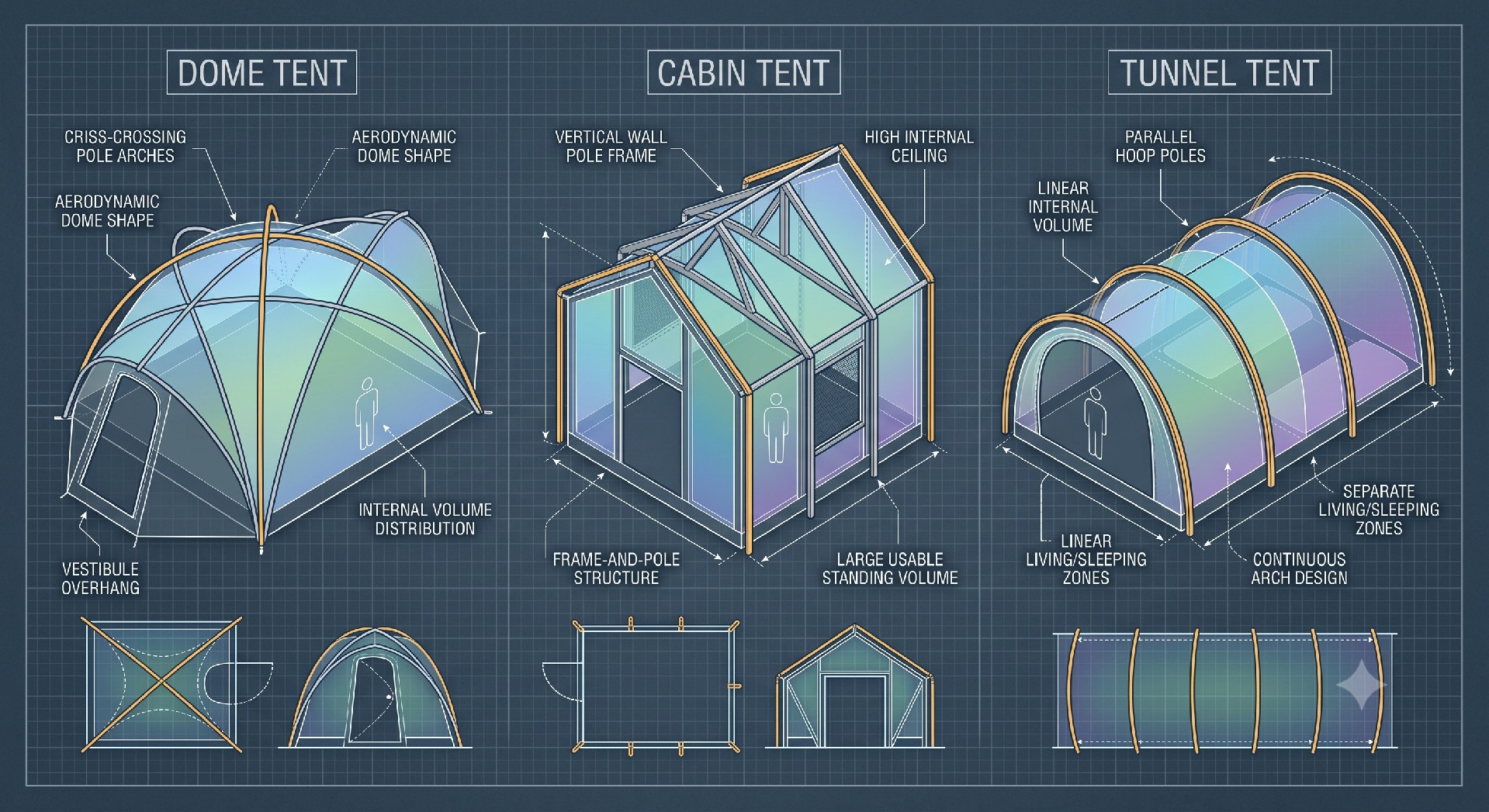
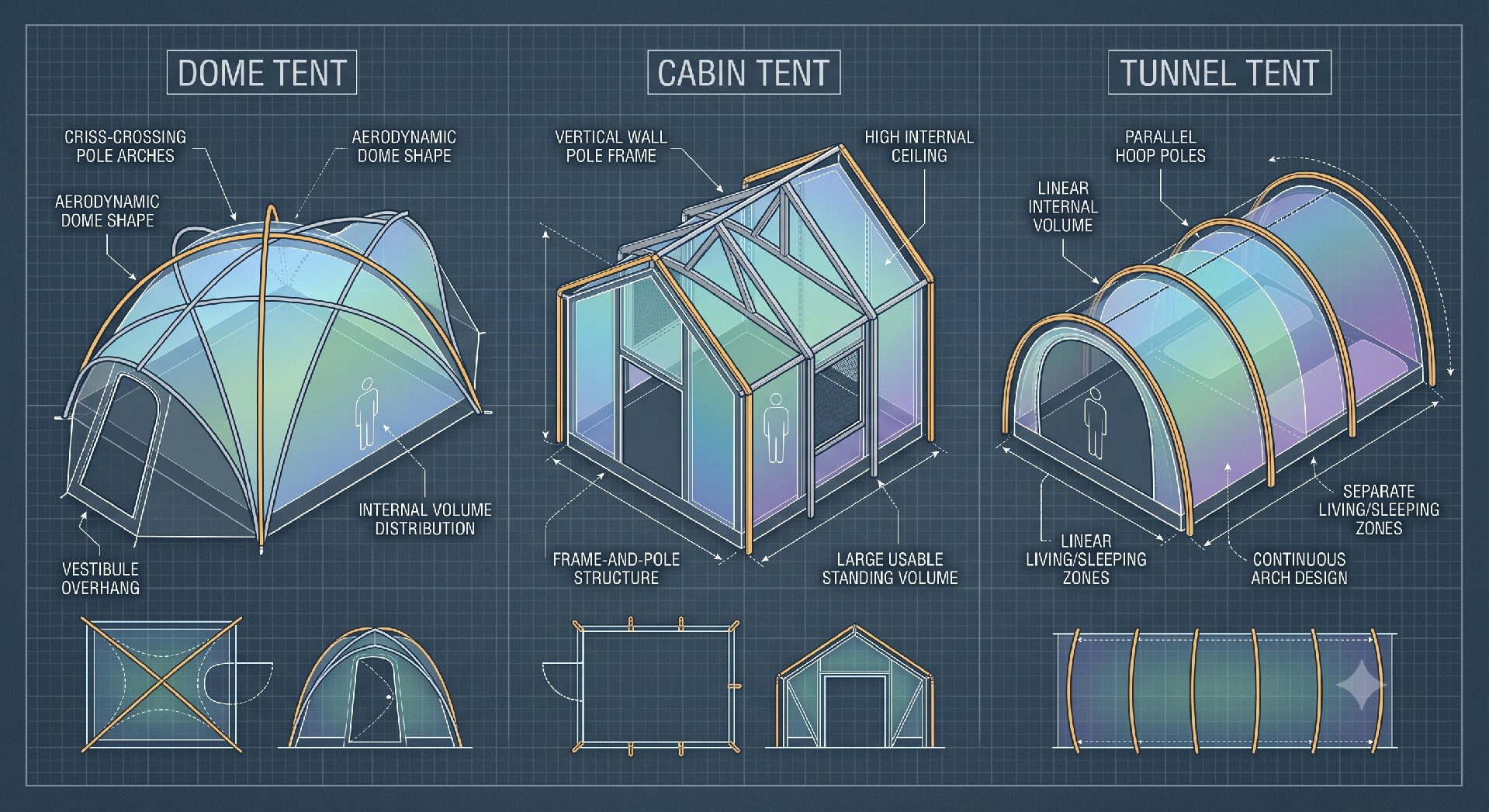
Dome tents utilize two or more flexible poles that cross at the apex to create a self-supporting, semi-spherical structure. This architecture provides excellent stability in windy conditions due to its aerodynamic profile, which allows wind to flow over the surface rather than catching on vertical panels . As a freestanding design, dome tents can be easily repositioned once pitched, offering a significant logistical advantage for campers who may need to adjust their site. However, the sloping walls characteristic of this design inherently reduce usable headroom near the perimeter, which can affect the perceived interior space for family groups .
Cabin Tents: Maximizing Living Space and Comfort
Cabin tents are defined by their near-vertical side walls, which maximize internal volume and headroom to create a 'home-away-from-home' experience. This design is particularly favored for extended stays where comfort and the ability to stand up fully are paramount. Many cabin tents feature internal dividers for creating separate sleeping areas, enhancing privacy for families . The trade-off for this spaciousness is a significant increase in weight and packed size, coupled with reduced aerodynamic performance; cabin tents can act as a 'sail' in high winds, requiring robust staking and guying. For B2B buyers, this often translates to higher shipping costs and lower portability scores.
Tunnel Tents: Optimizing Space-to-Weight Ratio
Tunnel tents, characterized by a series of parallel poles forming a long, curved tube, offer a compelling balance of space and wind resistance. Unlike dome or cabin tents, tunnel tents provide consistent height and width over their entire length, maximizing usable floor space for a given footprint . They are typically lighter than cabin tents of a similar capacity and can be highly wind-resistant when oriented correctly with the wind. The primary disadvantage is their reliance on extensive staking and guying to maintain structural integrity, making them less suitable for rocky or hard ground .
Material Science and Engineering Specifications
For B2B sourcing, the fabric and hardware specifications are non-negotiable indicators of product quality and durability. Compliance with international standards such as ISO 6185 (for inflatable boats, relevant for tent fabrics used in marine environments), REACH (for chemical safety), and EN71 (for child safety if applicable) is paramount. Buyers should demand detailed technical data sheets from suppliers.
Fabric Technology: Denier, Coatings, and Hydrostatic Head
The primary materials used are synthetic polymers: polyester, nylon, and occasionally canvas. Polyester is the workhorse of family camping due to its excellent UV resistance and ability to hold its shape when wet, making it a popular choice for durable family tents . Nylon is stronger for its weight but can stretch when wet, which may affect the pitch of a large tent. The durability is quantified by denier count (e.g., 150D, 210D), with higher deniers indicating a thicker, more abrasion-resistant fabric. Waterproofing is measured by the hydrostatic head (HH) rating—a measure of water resistance. Tents intended for serious use should feature flysheets with a HH of at least 2,000mm to 4,000mm . For example, the Robens Pioneer 4EX features a 75D polyester flysheet with a 3,000mm HH, while high-end models like the Coleman Weathermaster 4XL Air utilize a 4,500mm HH PU-coated polyester for superior weather protection . Groundsheets often feature even higher ratings; the Robens Pioneer 4EX boasts a 6,000mm HH groundsheet .
Structural Components: Poles and Seams
Pole construction is a critical differentiator between economy and premium models. Traditional aluminum poles (often 7001-T6 or similar alloys) offer a superior strength-to-weight ratio compared to fiberglass and are essential for durable, lightweight designs . The seams are the tent's most vulnerable points. In premium B2B products, heat-welded or electronically taped seams are standard, providing a permanent, waterproof bond that far exceeds the durability of standard stitched and taped seams. This is a key area for compliance with safety and durability standards.
Comparative Technical Specifications Matrix
To facilitate a direct B2B comparison, below is a specification matrix based on industry-standard models in each category. These metrics are crucial for calculating shipping costs, storage requirements, and total cost of ownership.
| Parameter | Dome Tent (e.g., REI Base Camp 6) | Cabin Tent (e.g., Coleman Weathermaster 4XL Air) | Tunnel Tent (e.g., Robens Pioneer 4EX) |
|---|---|---|---|
| Architecture | Freestanding, Aerodynamic | Vertical Walls, Non-Freestanding | Longitudinal, Staked |
| Capacity (Berth) | 6 (adults may feel tight) | 4-6 (Luxurious) | 4 (Snug) |
| Peak Height | 74 inches / 188 cm | 215 cm / 84.6 inches | 120 cm / 47 inches |
| Flysheet Fabric | Durable Polyester | PU-coated Polyester (4,500mm HH) | 75D Polyester 190T (3,000mm HH) |
| Groundsheet HH | Standard Coating | Welded PE | 6,000mm PU-coated Polyester |
| Pole Material | Aluminum | Inflatable Air Poles (7 PSI) | Aluminum 7001-T6 |
| Packed Weight | Beefy (Car-camping) | 30.4 kg / 67 lbs | 3.8 kg / 8.4 lbs |
Commercial Application and ROI Analysis
The optimal choice for a rental fleet or commercial operation depends heavily on the target market and business model.
Rental Fleet Durability: Dome vs. Cabin vs. Tunnel
For high-turnover rental operations, durability and ease of maintenance are paramount. Cabin tents, while popular, are often bulkier and heavier, increasing shipping costs and storage requirements. They are also more susceptible to wind damage if not pitched perfectly . Dome tents are generally easier to pitch and robust, but their sloping walls may be a point of customer dissatisfaction regarding space. Tunnel tents offer an excellent compromise, providing ample space while often being lighter than cabin tents . However, they require more skill to pitch correctly, which can be a liability in a rental scenario.
Glamping and Resort Integration: Premium Experiences
For glamping resorts, the 'wow' factor is critical. Cabin tents, with their vertical walls and ability to accommodate real beds and furniture, are the undisputed champions for creating a premium, hotel-like experience in nature . These tents can be equipped with electric hook-ups and internal dividers for a truly luxurious stay. For operators looking to maximize guest comfort and command higher nightly rates, a cabin tent—despite its higher logistical overhead—often represents the best ROI.
Logistics and Storage Efficiency
Deflation efficiency and packed size are often overlooked but represent significant operational costs. Tunnel tents, designed for space efficiency, generally pack down smaller than cabin tents of a similar capacity, reducing shipping and storage costs . Dome tents are generally the most compact, making them ideal for operations where storage space is at a premium or for direct-to-consumer shipments where package size affects freight rates.
Sourcing Strategy and Quality Verification
For B2B buyers, particularly those looking to source from international manufacturing hubs like China's Guangdong province, a rigorous evaluation framework is essential . When engaging with suppliers, the following protocols are non-negotiable:
Certification Verification: Demand proof of compliance with relevant standards such as ISO 9001 (Quality Management), REACH, and specific safety standards for your target market.
Material Testing: Require third-party test reports verifying denier count, hydrostatic head, and UV degradation resistance. The minimum standard for UV resistance should be rated to ensure a commercial lifespan of 5+ years.
Factory Audits: Perform onsite inspections or use third-party services like SGS or Bureau Veritas to assess factory conditions and quality control processes .
Sample Evaluation: Always test pre-production samples under real-world conditions to verify seam integrity and overall durability. A high-quality sample does not guarantee mass production quality; robust quality control during production is essential .
Conclusion: Strategic Selection for Your Business
There is no universally 'best' tent type; the optimal choice is dictated by your specific commercial requirements. For businesses prioritizing guest comfort and premium pricing in controlled environments, cabin tents offer unparalleled livability. For rental operations seeking a balance of durability, space, and logistical efficiency, tunnel tents represent a compelling option. For operations where portability and rapid deployment are key, dome tents remain the industry standard. By carefully evaluating the technical specifications, material quality, and total cost of ownership against your business model, you can make a strategic investment that maximizes customer satisfaction and commercial returns for years to come.
