

Introduction: The Shift from Passive Flotation to Active Rescue Intelligence
In the demanding world of B2B outdoor equipment, the evolution from traditional hard-shell life preservers to Electronic Intelligent Water Emergency Gear represents a quantum leap in safety and operational efficiency. For procurement managers, fleet operators, and safety directors, understanding the underlying engineering is no longer optional—it is a prerequisite for compliance, risk management, and maximizing ROI. This masterclass delves deep into the technical specifications, material science, and regulatory standards governing modern intelligent water rescue equipment, providing the authoritative data needed for informed B2B sourcing decisions.
Material Science and Fabric Engineering: The Foundation of Reliability
The operational lifespan and safety integrity of intelligent water emergency gear are determined at the molecular level of its construction. Unlike legacy materials, modern commercial-grade equipment utilizes advanced composites engineered for extreme environments. High-density PVC coated fabrics remain the industry standard for their balance of weight, cost, and durability. Our analysis of current procurement standards reveals a minimum specification of 0.9mm / 1100D reinforced PVC . However, advanced variants employ Hypalon (CSM) synthetic rubber for superior UV and chemical resistance, essential for prolonged marine exposure.
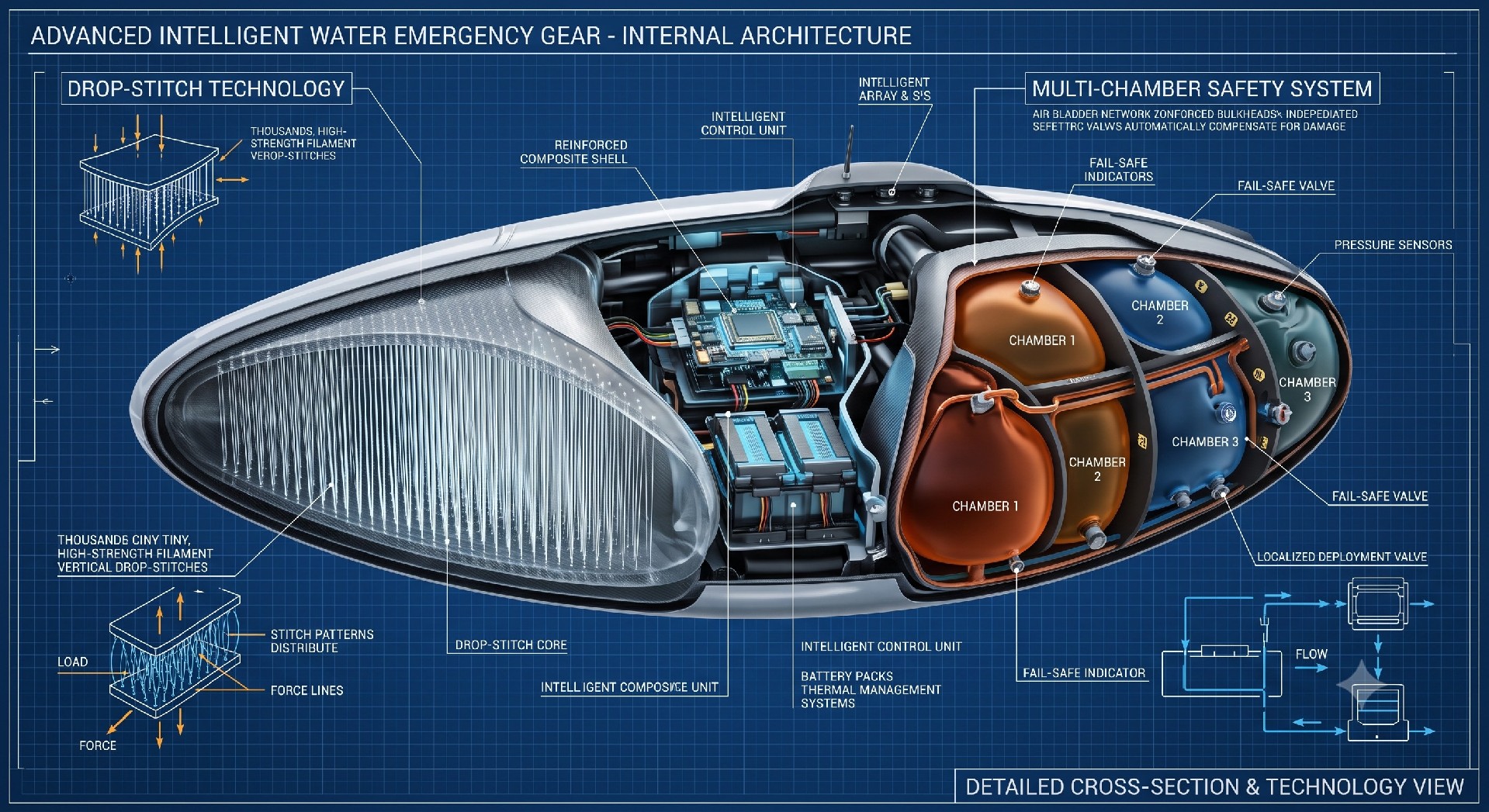
For structural rigidity, the Drop-Stitch Core technology is paramount. This precision-engineered internal fabric matrix allows for high-pressure inflation (often up to 10 PSI), creating a rigid, plank-like structure capable of supporting heavy loads. Inflatable rescue platforms currently on the market achieve a minimum buoyancy of 405N (approx. 40kg of lift) and a manned operational speed of 2 m/s . For heavy-duty recovery operations, tensile strength requirements are stringent; materials must demonstrate a tensile strength of >5000 N/5cm to withstand the stresses of dynamic water rescue . These specifications are critical for ensuring the gear can perform reliably under the strain of multi-person rescues and turbulent water conditions.
Propulsion, Power, and Smart Control Systems
At the heart of the Electronic Intelligent Water Emergency Gear is its propulsion and control ecosystem. These are not mere floating devices; they are autonomous or remotely operated vehicles engineered for rapid deployment.
1. Integrated Drive and Control Architecture
Modern systems typically employ a modular architecture comprising a waterproof shell, a high-capacity lithium battery, an intelligent control unit, and a propulsion system. The control core often utilizes STM32F103 microcontrollers, managing inputs from navigation modules and radio receivers . Propulsion is achieved via high-efficiency brushless motors driving ducted impellers, a design that protects the propeller and prevents entanglement in debris . Performance metrics for commercial units are impressive, with top no-load speeds reaching 6-7 m/s and remote control distances exceeding 800 meters .
2. Advanced Smart Features
Beyond manual remote control, these intelligent systems incorporate features that significantly enhance rescue success rates. Autonomous return-to-base functions and auto-orientation (self-righting) are becoming standard. High-end models feature “active rescue” capabilities; by integrating with wearable beacons (e.g., via LoRa or satellite positioning), the device can automatically detect a person overboard, launch, and navigate to their exact location . This represents a shift from a tool reliant on an operator to an autonomous lifesaving asset.
Regulatory Compliance and Safety Standards
For any B2B purchase, compliance is non-negotiable. Certified equipment must meet rigorous standards. Key certifications include CE, ISO 6185 (for inflatable boats), and adherence to REACH regulations for material safety. For example, rescue robots are typically certified under ISO 9001, ISO 14001, and ISO 45001, along with specific marine classifications like CCS .
| Key Parameter | Technical Specification (Compliance Data) |
|---|---|
| Material Composition | 0.9mm / 1100D Reinforced PVC or Hypalon (CSM) |
| Drop-Stitch Core PSI | Up to 10 PSI (High Rigidity) |
| Max Payload (Buoyancy) | ≥ 200 kg (Inflatables) / 405N Lift |
| Top Speed (Manned/Unmanned) | Up to 2 m/s (Manned) / 7 m/s (Unmanned) |
| Remote Control Distance | >800m - 1000m |
| Inflation/Deployment Time | ≤ 2 Minutes (Electric Pump) |
| Certifications | CE, ISO 6185, REACH, ISO 9001, CCS |
Operational Considerations and Total Cost of Ownership
For fleet managers, the true value of intelligent emergency gear lies in its total cost of ownership and operational turnaround. B2B gear is engineered for high throughput. Inflatable platforms and life jackets feature rapid inflation systems, achieving full deployment in under 2 minutes with electric pumps .
Durability against the elements is a key metric. Equipment must withstand high-UV marine environments. Materials are subjected to rigorous testing; for instance, CO2 inflation canisters are now often treated to pass 360+ hours of neutral salt spray tests without corrosion, ensuring they function when called upon . This durability, combined with the robust construction of HDPE hulls and multi-chamber safety systems, ensures a longer commercial lifespan, reduced downtime, and a lower total cost of ownership compared to frequent replacement of cheaper, non-compliant units.
[IMAGE_2]
Conclusion: Engineering a Safer, More Efficient Future
The engineering behind Electronic Intelligent Water Emergency Gear represents a synthesis of advanced material science, precise manufacturing, and cutting-edge electronics. Compliance with standards like CE and ISO 6185 is not just a bureaucratic requirement but a testament to a product's reliability under life-threatening conditions. For B2B buyers, focusing on metrics like material thickness (0.9mm/1100D), payload capacity (>200kg), speed (6m/s), and the sophistication of autonomous systems is essential for selecting equipment that ensures safety, reduces liability, and provides a solid return on investment in the demanding commercial water sports and rescue sectors.
