

Introduction: The Commercial Case for Custom Flotation Equipment
For B2B buyers, procurement managers, and water park operators, sourcing flotation equipment is a strategic decision impacting guest safety, operational efficiency, and the bottom line. Generic, off-the-shelf inflatables often fail to meet the rigorous demands of high-traffic commercial environments. Whether designing a unique water ride, a floating playground, or a resort amenity, customizing a Special Equipment Flotation Series allows for precise engineering to match specific payload requirements, environmental conditions, and brand aesthetics. This guide provides a technical deep-dive into the material science, manufacturing standards, and cost-benefit analysis essential for making an informed investment.
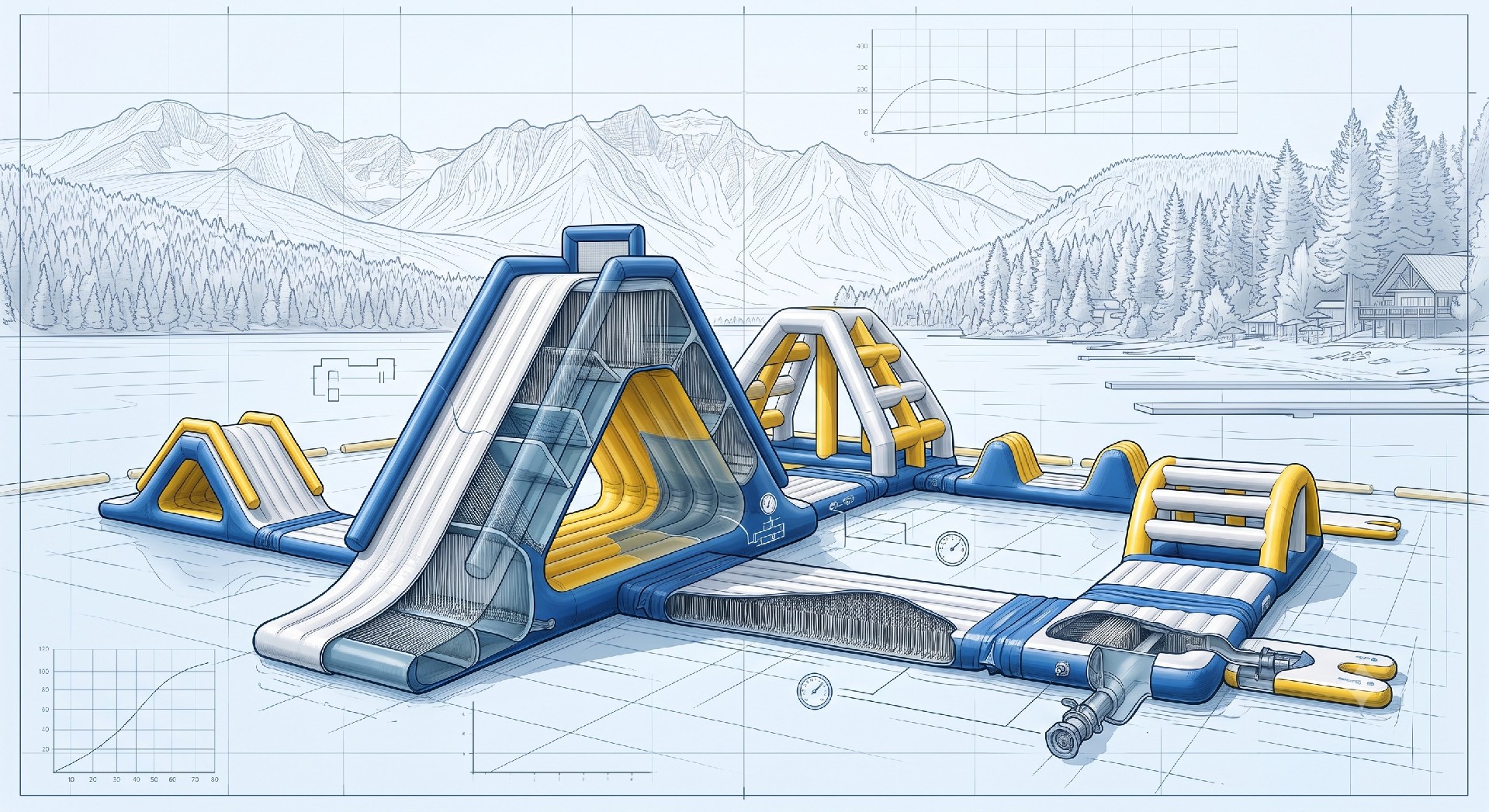
Material Science: PVC, Hypalon, and Drop-Stitch Engineering
The foundation of any durable commercial flotation device lies in its material composition. The two dominant materials are PVC (Polyvinyl Chloride) and Hypalon (CSM). Commercial-grade PVC, often reinforced with a polyester scrim (e.g., 1100 Denier), is the industry standard due to its excellent balance of durability, weldability, and cost-effectiveness. High-quality manufacturers utilize customized anti-UV and heat-resistant PVC blends that extend the operational lifespan by 30% to 50% compared to standard materials .
For specialized applications demanding high rigidity and load-bearing flat surfaces, Drop-Stitch technology is paramount. This process involves thousands of high-tenacity threads connecting the top and bottom fabric layers. When inflated to pressures of 8 to 15 PSI, these threads create a rigid, plank-like structure capable of supporting significant weight without bending. This is critical for water park slides, floating stages, and boarding platforms .
Core Material Specifications
Base Material: 0.9mm to 1.2mm reinforced PVC / Hypalon.
Denier Count: 1100D to 2000D for superior abrasion resistance.
Drop-Stitch Core: High-tenacity polyester yarn, ensuring structural rigidity at high PSI.
UV Resistance: Customized additives to withstand temperatures from -30°C to +85°C .
Manufacturing Integrity: Seams, Welding, and Safety Standards
The longevity of a flotation device is determined by the weakest point: the seam. Heat-welded seams, utilizing high-frequency (HF) welding or hot air welding, are vastly superior to glued seams. This process molecularly bonds the material, creating a seal as strong as the fabric itself. For complex structures, internal baffles and reinforcements are heat-welded to provide structural integrity and prevent deformation.
Compliance with international safety standards is non-negotiable for commercial operators. Reputable manufacturers ensure each component undergoes rigorous testing. Key certifications include:
TÜV & EN ISO 25649: The European standard for floating leisure items, ensuring safety, stability, and buoyancy for water parks .
CE & EN71: Essential for toys and recreational equipment sold in Europe, focusing on mechanical and chemical safety .
ISO 6185 & ASTM F1911: Standards for inflatable boats and pool floats, dictating material strength and construction quality .
REACH & RoHS: Compliance ensuring materials are free from hazardous substances, critical for eco-conscious resorts .
Technical Specification Matrix
The following table outlines typical specifications for commercial-grade custom flotation series, offering a benchmark for procurement decisions.
| Key Parameter | Technical Specification (Commercial Grade) |
|---|---|
| Primary Material | 0.9mm - 1.2mm Reinforced PVC / Hypalon (1100D-2000D Denier) |
| Drop-Stitch Core Pressure | 8 - 15 PSI (High Rigidity Structure) |
| Maximum Payload Capacity | Up to 500 kg (Varies by design, EN ISO 25649 compliant) |
| Inflation/Deflation Time | 3-10 min (Electric blower / High-volume valves) |
| Certifications | TÜV (EN ISO 25649), CE, EN71, REACH, RoHS |
| Material Lifespan | 3-5 seasons (with proper maintenance and anti-UV protection) |
Commercial Applications and ROI
Investing in a custom Special Equipment Flotation Series unlocks diverse revenue streams for B2B buyers. The ability to tailor the equipment to specific water conditions—whether calm lakes or extreme rapids—reduces long-term maintenance costs and increases guest throughput. For instance, high-pressure drop-stitch platforms accelerate turnaround times for water sports rentals, while robust, TÜV-certified floating parks enable operators to secure insurance and licenses more easily .
[IMAGE_2]
Conclusion: Strategic Procurement for Long-Term Gains
Customizing a Special Equipment Flotation Series transcends mere aesthetics; it is a strategic investment in safety, durability, and brand reputation. By prioritizing high-denier PVC, heat-welded seams, and strict adherence to international standards like ISO and TÜV, operators can ensure a lifespan of 3-5 seasons or more . When sourcing, prioritize suppliers who offer transparent material testing data, customization flexibility, and documented compliance to maximize your ROI and deliver unparalleled guest experiences.
