

The High-Stakes Game of Commercial Inflatables: Why Quality is Your Only Sustainable Metric
For procurement managers and amusement park operators, the decision to invest in commercial-grade PVC inflatables for amusement parks is a pivotal one. The market is flooded with options, but the true cost of a "cheap" inflatable is measured not in the initial purchase price, but in maintenance downtime, safety liabilities, and a tarnished brand reputation. A unit that fails mid-event doesn't just cost you a booking; it costs you the referral chain that booking would have generated . As a B2B buyer, you need to move beyond aesthetics and focus on the engineering, materials, and manufacturing processes that guarantee longevity and safety. This guide provides a comprehensive, data-driven methodology to identify high-quality inflatables that maximize your return on investment.
Material Science: Decoding the PVC Fabric and Its Core Specifications
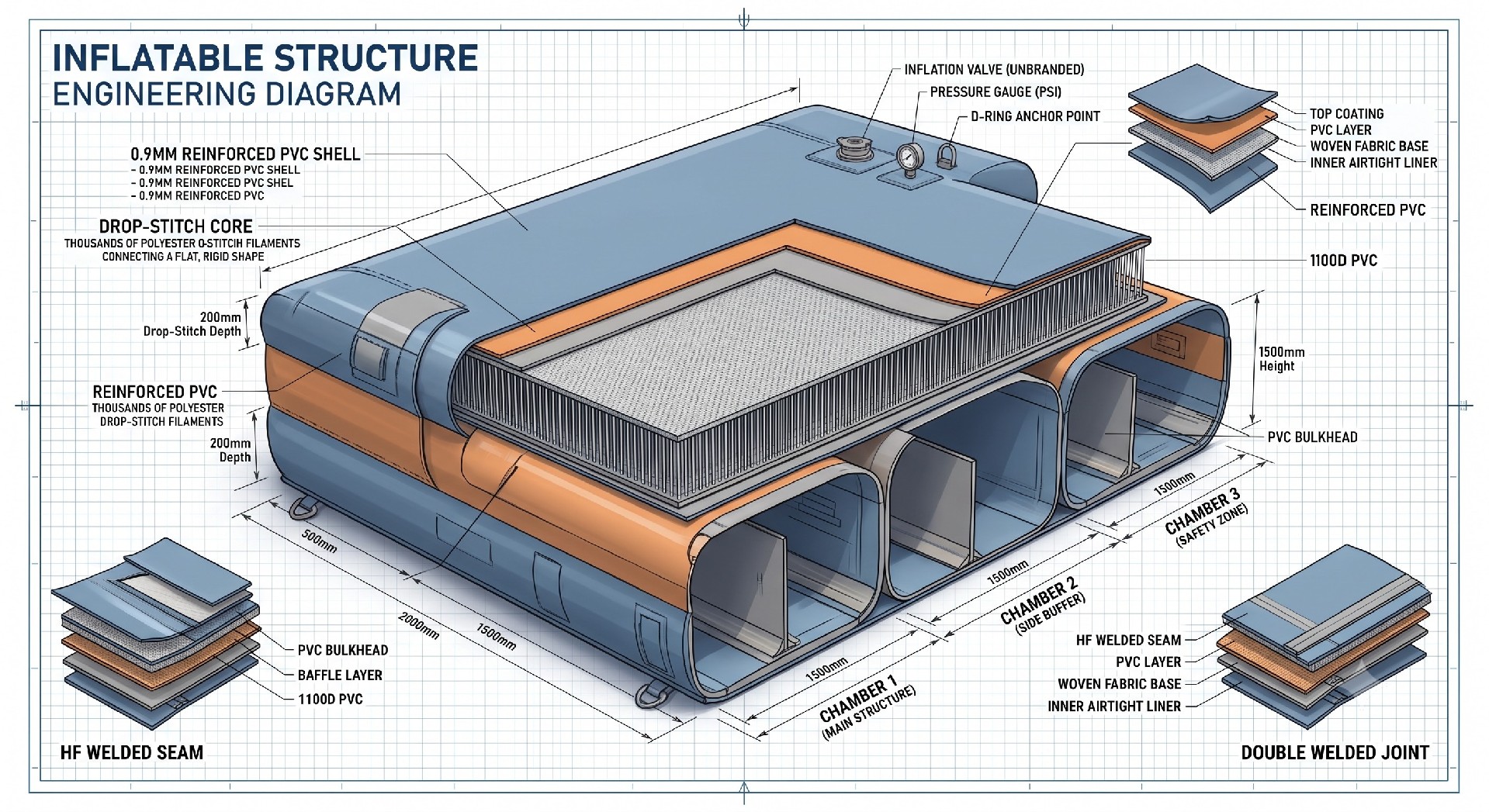
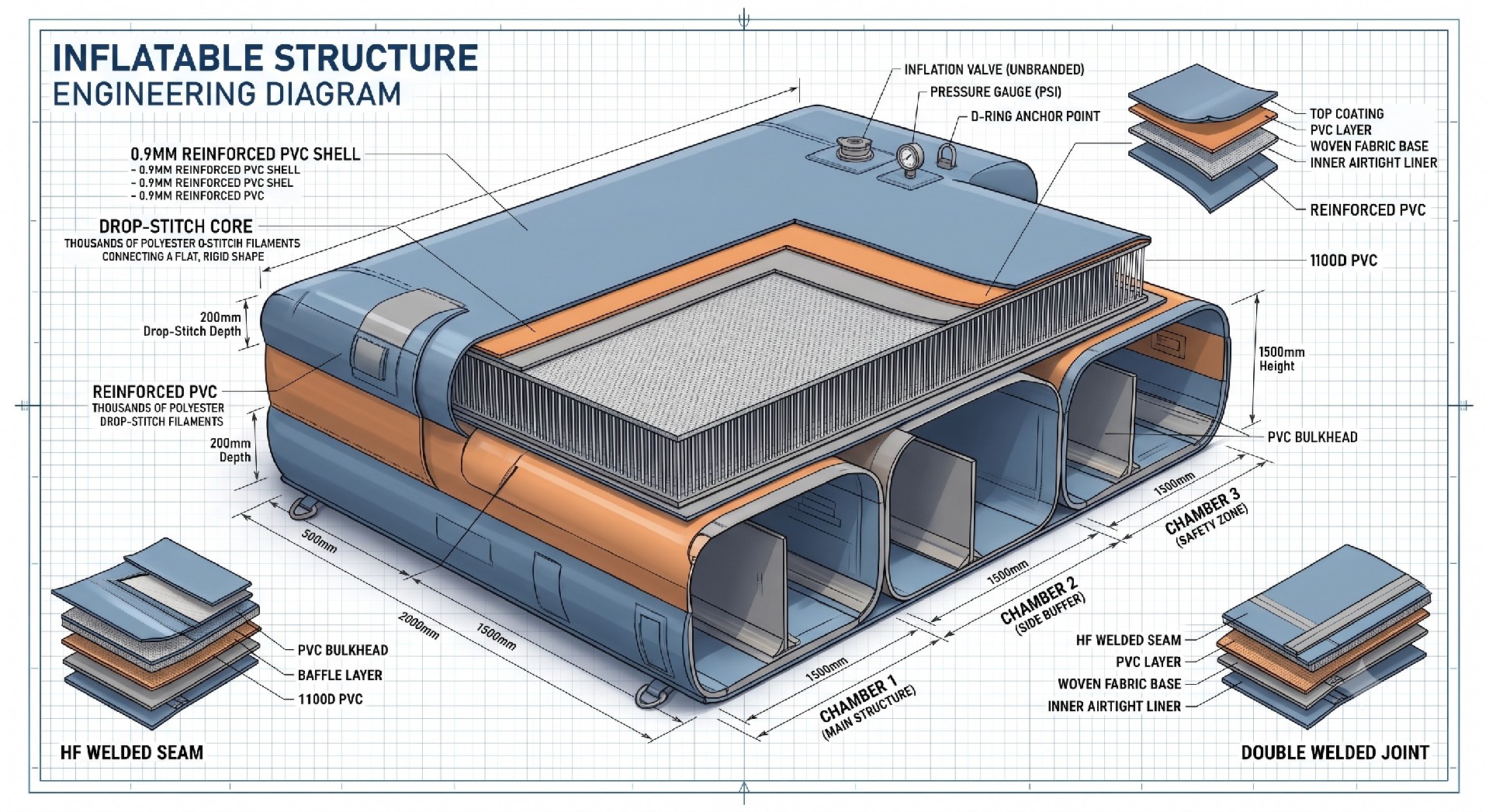
The foundation of any durable inflatable is its material. Many suppliers will simply say "commercial-grade PVC," but the specifics are what separate a unit that lasts 3 years from one that lasts 7. The primary metric to evaluate is the fabric's weight and construction.
Fabric Weight and Denier Count
For high-traffic amusement park applications, you should be looking at a minimum fabric weight of 15 to 18 ounces per square yard (approximately 0.9mm thick) . This weight is often referenced alongside a denier count, such as 1000D, which indicates the density of the polyester scrim used within the PVC laminate . Thicker materials like 22 oz reinforced PVC are available for extreme-use cases . The material should also be lead-free and meet strict safety standards like REACH and RoHS for chemical restrictions .
Resistance to the Elements
Amusement parks are outdoor environments, exposing inflatables to constant UV radiation and wear. A high-quality fabric will be treated with a UV-resistant coating to prevent degradation, fading, and cracking . Seek out materials that are also puncture-resistant and flame-retardant, as per safety standards like EN 71-2 .
The Engineering Core: Seam Construction, Welding, and Drop-Stitch Technology
The material is only as strong as the seams that hold it together. This is where high-quality manufacturing truly stands out.
Heat-Welded vs. Glued Seams
In commercial-grade manufacturing, heat-welded seams are non-negotiable. This process uses heat and pressure to fuse the PVC layers together, creating a bond that is as strong as the material itself. Inferior suppliers may use glue, which is prone to breaking down over time. Look for double or even quadruple reinforced stitching at stress points, combined with heat-sealing to prevent water ingress or air leaks .
High-Pressure Drop-Stitch Technology
For applications requiring high rigidity, such as water park slides or floating docks, drop-stitch technology is used. This involves thousands of polyester threads connecting the top and bottom fabric layers, allowing the unit to be inflated to a very high PSI (often up to 10 PSI) for a hard, stable surface . When evaluating this, ask for the specific PSI rating—higher PSI generally means a more rigid and durable structure.
Critical Safety and Compliance Standards
Compliance is not a checkbox; it is a promise of safety. A credible manufacturer will have certifications at the ready, not scrambling to produce them after you ask .
EN 14960 / ASTM F2374: The primary standards for inflatable play equipment, covering design, structural integrity, and safety requirements .
EN 71 (Parts 2 & 3): Safety of toys, covering flammability and migration of certain elements (heavy metals) .
ISO 6185: Applicable to inflatable boats and some types of larger inflatable structures.
CE and UL Certifications: Indicate compliance with European and U.S. product safety, health, and environmental protection standards .
Fire Retardancy: All materials must pass a flame resistance test to ensure public safety .
Technical Specifications: The Quantifiable Metrics of Quality
When discussing specifications with a potential supplier, you should be able to benchmark their claims against robust industry standards. This table outlines the critical parameters to look for.
| Key Parameter | Industry Standard / Specification |
|---|---|
| Material Thickness / Weight | 0.9mm / 15-18 oz/yd² (Commercial-Grade PVC) |
| Fabric Denier | 1000D to 1100D Reinforced PVC |
| Seam Construction | Heat-Welded / Double to Quadruple Stitching |
| Inflation Pressure (Drop-Stitch) | Up to 10 PSI (for rigid structures) |
| Maximum Payload (Typical Slide) | e.g., 100-500kg per compartment / 175 lbs per user |
| Safety Certifications | EN 14960, ASTM F2374, CE, UL, REACH |
| UV Resistance | UV-Stabilized Coating / +30% resistance vs standard |
| Inflation / Deflation Time | Varies by size; can be up to 30% faster with professional systems |
Commercial Application: From Manufacturing to Your Park
Understanding how the product is made and verified is as important as the final product itself.
Stringent Quality Control (QC) Processes
Reliable manufacturers implement rigorous QC protocols. This includes inspecting the raw PVC for thickness and tensile strength (>900N/5cm) , performing in-process checks during manufacturing, and conducting 24-72 hour inflation tests under load . Pre-shipment inspections are a must to verify the unit holds air and meets all specified dimensions .
Operational Efficiency: Setup and Turnaround
For a busy amusement park, setup speed and storage efficiency are critical revenue drivers. High-quality inflatables are designed for rapid setup, with inflation times that can be up to 30% faster than traditional hard-shell alternatives . Efficient deflation systems with multiple high-quality zippers also ensure quick takedown and compact storage for transport and off-season warehousing .
Maximizing ROI: A Strategy for Fleet Management
View your investment in PVC inflatables through the lens of total cost of ownership (TCO). While a premium unit may have a higher upfront cost, its extended lifespan, lower maintenance, and better performance under high throughput will often make it the more profitable choice . Consider the following:
Warranty: A longer warranty (e.g., 5-10 years on a Pro model) is a strong indicator of the manufacturer's confidence in their product's durability .
Maintenance: Inflatables require regular inspections of seams, blowers, and anchoring points. A service kit with basic repair tools is a sign of a supplier that supports its products .
Supplier Reliability: Evaluate suppliers on more than just price. Check their on-time delivery rates and communication responsiveness. Manufacturers with on-time delivery rates near 100% and response times under 2 hours are more reliable partners .
Conclusion: The Verdict for Your Amusement Park
Identifying high-quality PVC inflatables for amusement parks requires a disciplined, data-driven approach. By prioritizing material integrity (15-18 oz PVC), robust engineering (heat-welded seams), and verifiable safety certifications (EN 14960, CE), you safeguard your investment. The true metric of success is not just the initial price, but the return on investment measured over the equipment's lifetime. Choose a supplier with transparent processes, rigorous quality control, and a track record of reliability to ensure your park's attractions are safe, durable, and profitable for years to come.
