

Introduction: The Commercial Imperative for Next-Gen Water Slides
For B2B buyers, theme park water slide products represent a significant capital investment. The market is shifting from traditional hard-shell fiberglass to advanced inflatable and hybrid designs that offer compelling advantages in portability, cost, and guest throughput. This guide provides a data-driven analysis of modern water slide engineering, focusing on material science, safety certifications, and total cost of ownership (TCO) to aid procurement decisions.
Fabric & Material Engineering: Beyond Traditional Fiberglass
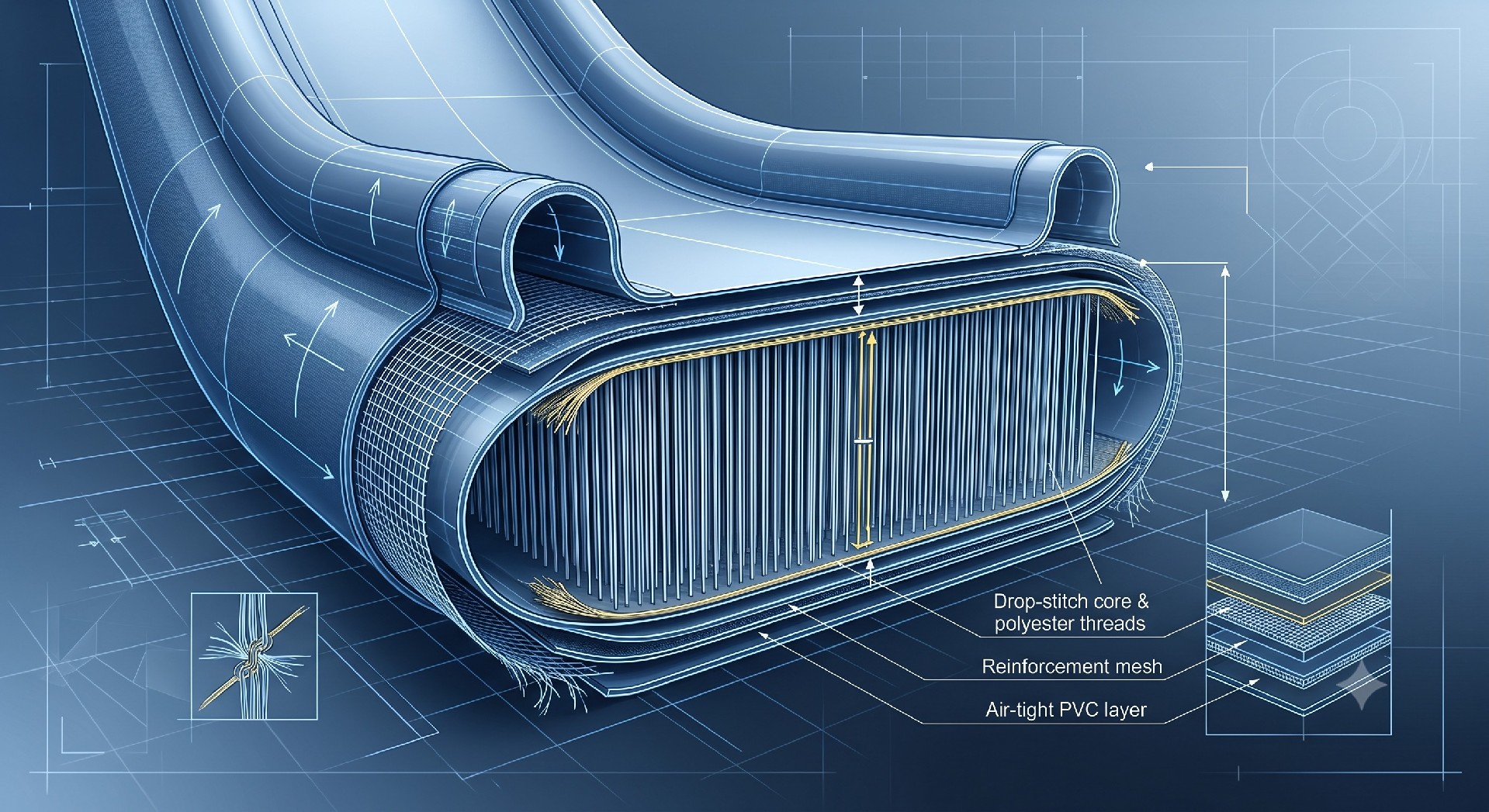
While fiberglass reinforced plastic (FRP) remains a staple for fixed installations, modern inflatable water slides leverage advanced polymer composites. The primary material is high-denier PVC or Hypalon, chosen for their tensile strength and UV resistance. For commercial-grade products, a thickness of 0.9mm to 1.2mm reinforced PVC (1100D to 1500D) is standard. This is not just about thickness; it is about the denier count which directly correlates to abrasion resistance.
Drop-Stitch Core Physics
The structural integrity of modern inflatable slides often relies on drop-stitch technology. This involves thousands of high-tenacity polyester threads connecting the top and bottom layers of fabric. When inflated to the recommended 7-10 PSI (0.48-0.69 bar), these threads create a rigid, plank-like structure capable of supporting significant weight while remaining buoyant. The resulting rigidity-to-weight ratio is superior to traditional hard-shell alternatives for temporary or seasonal deployments.
Seam Integrity: Welded vs. Glued
The longevity of an inflatable water slide is determined by its seams. High-frequency heat welding is the gold standard for commercial equipment, creating a molecular bond stronger than the surrounding material. This is superior to glued seams, which are susceptible to hydrolysis and delamination in high-humidity environments. Look for products that utilize a double-weld or J-weld seam configuration, which provides a redundant layer of safety against air loss and structural failure.
| Key Parameter | Commercial Grade Specification |
|---|---|
| Core Material | Reinforced PVC / Hypalon (0.9mm - 1.2mm / 1100D - 1500D) |
| Drop-Stitch Core Pressure | 7 - 10 PSI (0.48 - 0.69 bar) |
| Maximum Payload | 400 - 650 kg (880 - 1430 lbs) |
| Inflation Time | ≤ 10 minutes (with high-pressure blower) |
| Deflation / Packing Time | ≤ 15 minutes |
| Safety Standards | CE, EN71 Part 8, ISO 6185, REACH, ASTM F1148 |
Safety Standards and Certification Masterclass
Compliance is non-negotiable in the amusement industry. B2B buyers must verify that products meet international safety standards. Essential certifications for theme park water slide products include:
CE Certification: Indicates conformity with health, safety, and environmental protection standards for products sold within the European Economic Area.
EN71 (Part 8): Specifically addresses the safety of activity toys for domestic and public use, including inflatables.
ISO 6185: A critical standard for inflatable boats, but its principles regarding buoyancy, stability, and material strength are highly relevant to water slides, especially those used in open water or with high payloads.
REACH Compliance: Ensures that the materials used do not contain harmful substances, crucial for guest safety and environmental responsibility.
ASTM F1148: The American standard for amusement rides and devices, which includes specific requirements for water slides regarding structural integrity and rider restraint.
Commercial ROI and Operational Efficiency
Total Cost of Ownership (TCO)
The initial purchase price is only one factor. Modern inflatable slides offer a lower TCO compared to traditional FRP slides due to reduced shipping costs (rolled vs. bulky molds), faster installation (hours vs. weeks), and off-season storage flexibility. A typical commercial inflatable slide (e.g., a 4-lane racing slide) can be inflated in under 10 minutes and deflated in under 15 minutes, maximizing turnaround time for high-throughput rental operations.
Maximizing Profit Margins
High-capacity operations are key to ROI. For instance, a multi-lane inflatable slide with a maximum payload of 400-500 kg (approx. 880-1100 lbs) can accommodate multiple riders simultaneously. With strategic pricing, such an attraction can pay for itself within a single peak season in high-traffic resorts.
[IMAGE_2]
Conclusion: Strategic Sourcing for the Future
The evolution of theme park water slide products demands a sophisticated approach to procurement. By focusing on material science—specifically denier count, drop-stitch PSI, and heat-welded seams—and verifying compliance with CE, EN71, and ISO 6185 standards, B2B buyers can secure high-quality assets. The data suggests that modern inflatable solutions are not just cost-effective alternatives but strategic upgrades that enhance guest experience and operational agility.
