

The Summer Water Safety Imperative: A Data-Driven Perspective for Parents and Professionals
As summer approaches, the allure of recreational water activities intensifies across the United States and Europe. For parents, this season brings both joy and profound responsibility. Drowning remains a leading cause of unintentional injury death for children, with the Centers for Disease Control and Prevention (CDC) reporting that it is the leading cause of death for children aged 1-4 and the second leading cause for those aged 5-14 . This sobering reality demands more than just casual vigilance; it requires a comprehensive, multi-layered defense strategy built on education, environmental safety, and the deployment of professionally engineered safety equipment. From the perspective of a lead product designer and B2B equipment sourcing expert, the selection of commercial-grade inflatable devices and personal flotation devices (PFDs) must be governed by stringent technical specifications and international certifications, moving far beyond the false security provided by consumer-grade pool toys .
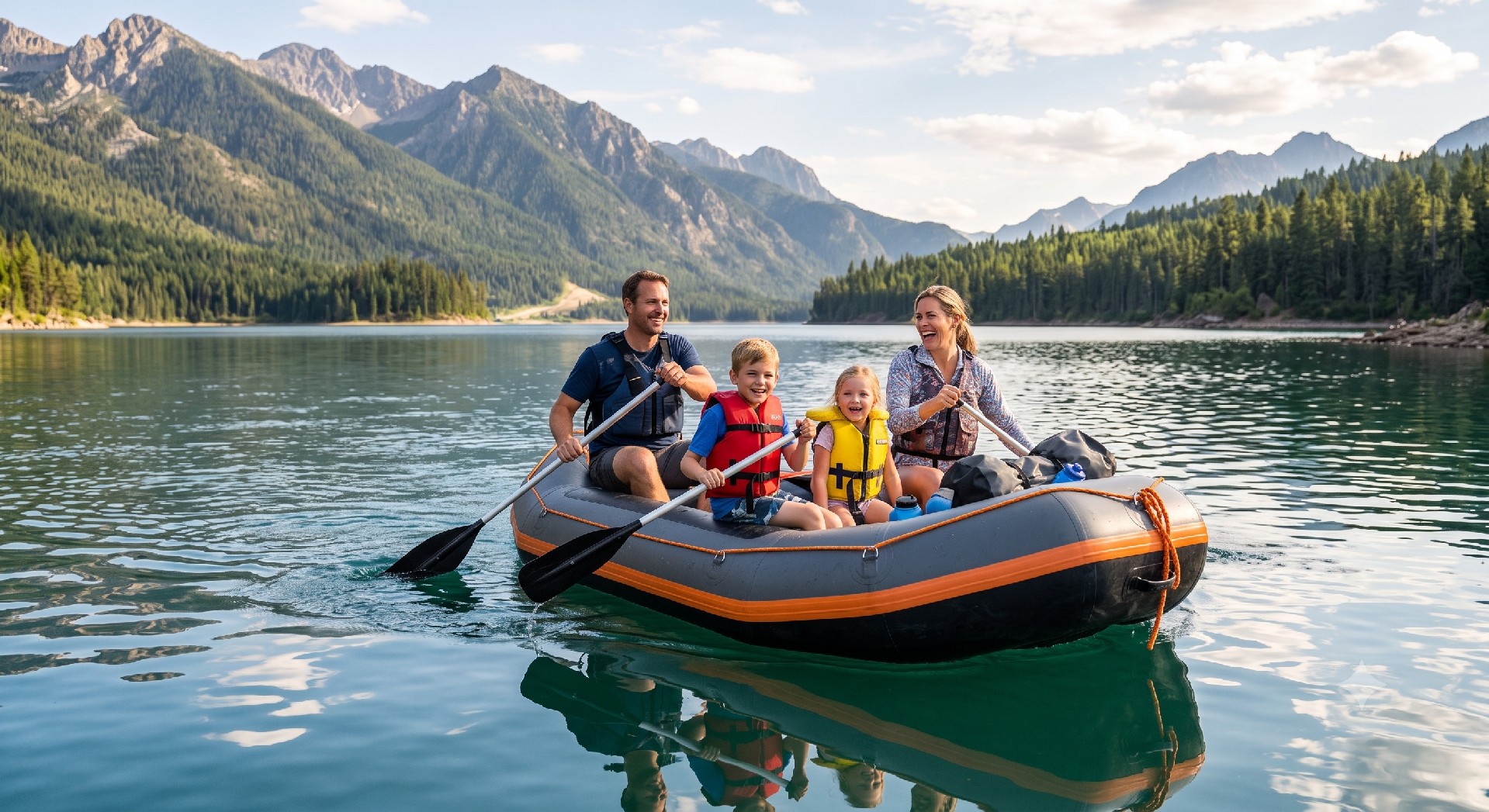
The Engineering Foundation of Water Safety: Materials, Standards, and Certification
Understanding the technical composition of safety equipment is critical for parents and procurement specialists alike. The efficacy of a commercial-grade inflatable structure, such as a robust family raft or a professional rescue platform, hinges on its material integrity and manufacturing precision. For instance, a heavy-duty inflatable designed for B2B rental or resort use will typically feature a reinforced PVC or Hypalon construction with a thickness of 0.9mm to 1.2mm, often utilizing a 1100 Denier (1100D) polyester scrim base for exceptional puncture and abrasion resistance . This is a stark contrast to the thin, single-layer PVC found in inexpensive toys, which offers minimal tensile strength.
Beyond material thickness, the manufacturing process is paramount. High-quality commercial units employ drop-stitch technology for rigid, stable structures, capable of maintaining internal pressures of 8-12 PSI, ensuring they remain firm and performant under heavy loads. The ultimate measure of quality, however, is compliance with international standards. In the context of water safety, parents and procurers must seek out equipment that meets the rigorous requirements of ISO 6185 for inflatable boats, EN71 for toy safety, and REACH for chemical compliance. This is not merely bureaucratic red tape; it represents a quantifiable guarantee of safety, durability, and the absence of harmful phthalates, giving parents and fleet managers alike the assurance they need. As noted by emergency care practitioners, preventative measures like these are the first line of defense .
| Key Parameter | Technical Specification & Compliance |
|---|---|
| Primary Material & Thickness | Heavy-Duty Reinforced PVC / Hypalon, 0.9mm - 1.2mm (e.g., 1100 Denier) with UV and Abrasion Resistance |
| Maximum Payload Capacity | Engineered for 400 kg - 800 kg (880 - 1760 lbs) depending on chamber volume and design |
| Internal Operating Pressure (Drop-Stitch) | 8 - 12 PSI for optimal rigidity and structural integrity |
| Safety & Manufacturing Standards | CE Certified, EN71 (for toys), ISO 6185 (for inflatable boats), REACH Compliant (phthalate-free) |
| Weld Engineering | High-frequency heat-welded seams vs. glued seams for superior strength and air retention |
| Valve System | High-pressure, anti-leak valves (e.g., Halkey-Roberts style) with a guaranteed operational lifespan of 5+ years under commercial use |
Multi-Layer Supervision and Environmental Controls: The Human and Structural Safety Net
While equipment specifications are foundational, they are ineffective without a robust framework of supervision and environmental control. The American Academy of Pediatrics (AAP) emphasizes a 'layers of protection' approach, recognizing that no single measure can prevent all drownings . For parents, this translates to the implementation of a 'Water Watcher' system: assigning a responsible adult to provide constant, distraction-free supervision of children in or near water. This is non-negotiable, as the CDC highlights that nearly 40% of non-fatal drownings treated in emergency departments require further care, often resulting in long-term disability .
Barriers and Pool Safety: The First Physical Defense
Environmental controls are equally critical. Data reveals that over two-thirds (69%) of drownings in children aged 4 and under occur during non-swim times, often due to unsupervised access to water . To combat this, experts from the AAP and the CDC strongly advocate for four-sided pool fencing that isolates the pool from the house. This fence must be at least 4 feet high, with self-closing and self-latching gates. For above-ground pools, ladders should be removed or locked when the pool is not in use . The specific engineering of these barriers—non-climbable, with gaps no wider than 4 inches—is a deliberate design to maximize child safety. Furthermore, removing all toys from the pool area after use eliminates the temptation for a child to attempt entry .
The Role of Professional Flotation: Beyond 'Water Wings'
A critical point of consensus among medical and safety professionals is the inadequacy of recreational floaties. Inflatable swimming devices like water wings, noodles, and inner tubes are not safety devices. They can easily slip off, deflate, or trap a child, creating a dangerous false sense of security . The only acceptable standard for flotation is a U.S. Coast Guard-approved life jacket. These PFDs are engineered with specific buoyancy ratings and are designed to turn an unconscious person face-up in the water. It is estimated that 85% of people who drowned while boating in 2022 were not wearing a life jacket . For any activity on open water—lakes, rivers, or oceans—a properly fitted life jacket is mandatory for children and adults alike .
[IMAGE_2]
Risk Assessment in Natural and Home Environments
Water safety extends far beyond the swimming pool. Around 40% of drowning deaths among children aged 5-14 occur in natural water settings like lakes, rivers, and oceans . These environments present dynamic and unpredictable hazards, including rip currents, sudden drop-offs, and submerged debris. Parents must teach older children to respect these forces. If caught in a rip current, the recommended survival technique is to stay calm, float, and swim parallel to the shore until free of the current's pull . Similarly, the home environment is fraught with often-overlooked dangers. Infants and toddlers can drown in as little as one to two inches of water . This means that bathtubs, diaper pails, buckets, and even pet water bowls must be treated with the same vigilance as a pool. Emptying all containers immediately after use and keeping bathroom doors closed with safety latches are essential practices .
Conclusion: A Shared Responsibility for a Safe Summer
Water safety is a shared responsibility that unites parents, manufacturers, and recreational facility operators. By integrating engineering-led product selection, rigorous compliance standards, and unwavering supervision, we can dramatically reduce the risk of tragedy. For the B2B sector, this means investing in equipment that meets the highest CE and ISO standards and providing clear, technical guidance to end-users. For parents, it demands a commitment to learning swim skills and CPR, understanding the material specifications of the equipment they purchase, and never underestimating the speed and silence with which drowning can occur. As the Johns Hopkins Children's Center emphasizes, a designated water watcher is a simple but powerful tool to ensure that fun in the sun remains safe . With the right knowledge, the right equipment, and a proactive mindset, we can ensure that our memories of summer are defined by joy, not tragedy.
