

Introduction: The Non-Negotiable Standard for Flood Rescue Assets
For procurement officers and fleet managers in the B2B emergency response sector, the acquisition of Professional Flood Rescue Boats transcends a simple equipment purchase; it is an investment in operational capability and public safety. In an era of escalating extreme weather events, rescue teams cannot afford to rely on borrowed or outdated crafts . The cornerstone of reliable deployment is strict adherence to international maritime standards. This masterclass dissects the critical engineering specifications and compliance benchmarks—specifically CE certification and ISO 6185—that define a high-performance Professional Flood Rescue Boat, ensuring your fleet meets the rigorous demands of flood rescue environments.
The Regulatory Framework: CE and ISO 6185 Explained
Understanding the regulatory landscape is the first step in authoritative sourcing. While ISO 6185 specifies requirements for inflatable boats, CE marking provides a legal declaration that the product meets EU safety, health, and environmental requirements. For professional rescue operations, the combination of these standards ensures a baseline of reliability.
Why ISO 6185 Matters for Rescue Operations
The ISO 6185 standard is the global benchmark for the construction and performance of inflatable boats. For Professional Flood Rescue Boats, specific parts of this standard apply based on engine size and operational scope. For instance, boats with larger engine capacities must comply with ISO 6185 Part 3, which details stricter construction and buoyancy requirements . When sourcing, demanding a Certificate of Conformity to ISO 6185 is non-negotiable, and for EU procurement, this certificate must align with CE marking directives . This dual-compliance ensures the vessel has been rigorously evaluated for structural integrity and safety.
SOLAS and Material Standards (ISO 15372)
For boats intended for life-saving appliance duties under the Safety of Life at Sea (SOLAS) convention, the materials used must satisfy ISO 15372:2000. This standard specifies the minimum requirements for coated fabrics used in inflatable chambers . It mandates that the base textile, coated with synthetic elastomers or plastomers, undergoes specific test procedures to guarantee air retention and durability. This is critical for Professional Flood Rescue Boats that may be deployed in contaminated or abrasive floodwaters.
Material Engineering: Hypalon vs. PVC in Rescue Environments
The choice of fabric is the primary determinant of a boat's lifespan and resistance to harsh conditions. The industry standard options for Professional Flood Rescue Boats are Hypalon (CSM) and high-grade PVC. Materials for professional use must conform to rigorous standards like ISO 15372 for coated fabrics .
Superiority of Hypalon for Extreme Deployments
For elite rescue forces, 100% Hypalon (CSM - Chlorosulfonated Polyethylene) is often the mandated material due to its unmatched resistance to UV degradation, ozone, and chemical exposure . As specified by manufacturers like Continental, Boatex® materials feature an outer coating of highly wear and weather-resistant Hypalon with a high-tenacity polyester reinforcement . This construction is specifically engineered for extreme operating conditions, providing dimensional stability that PVC cannot replicate over time.
Reinforced PVC as a Viable Standard
While Hypalon is the premium choice, high-quality reinforced PVC remains a viable and cost-effective option for many rescue teams. The key is the specification. Professional-grade PVC must be thick (e.g., 0.9mm to 1.2mm) and feature a high denier (e.g., 1100D) polyester scrim for tear resistance . However, procurement experts should note that with Hypalon, the expected service life of the boat often extends significantly longer, reducing total cost of ownership and ensuring fleet readiness during critical seasons.
Advanced Manufacturing: Seam Integrity and Chamber Safety
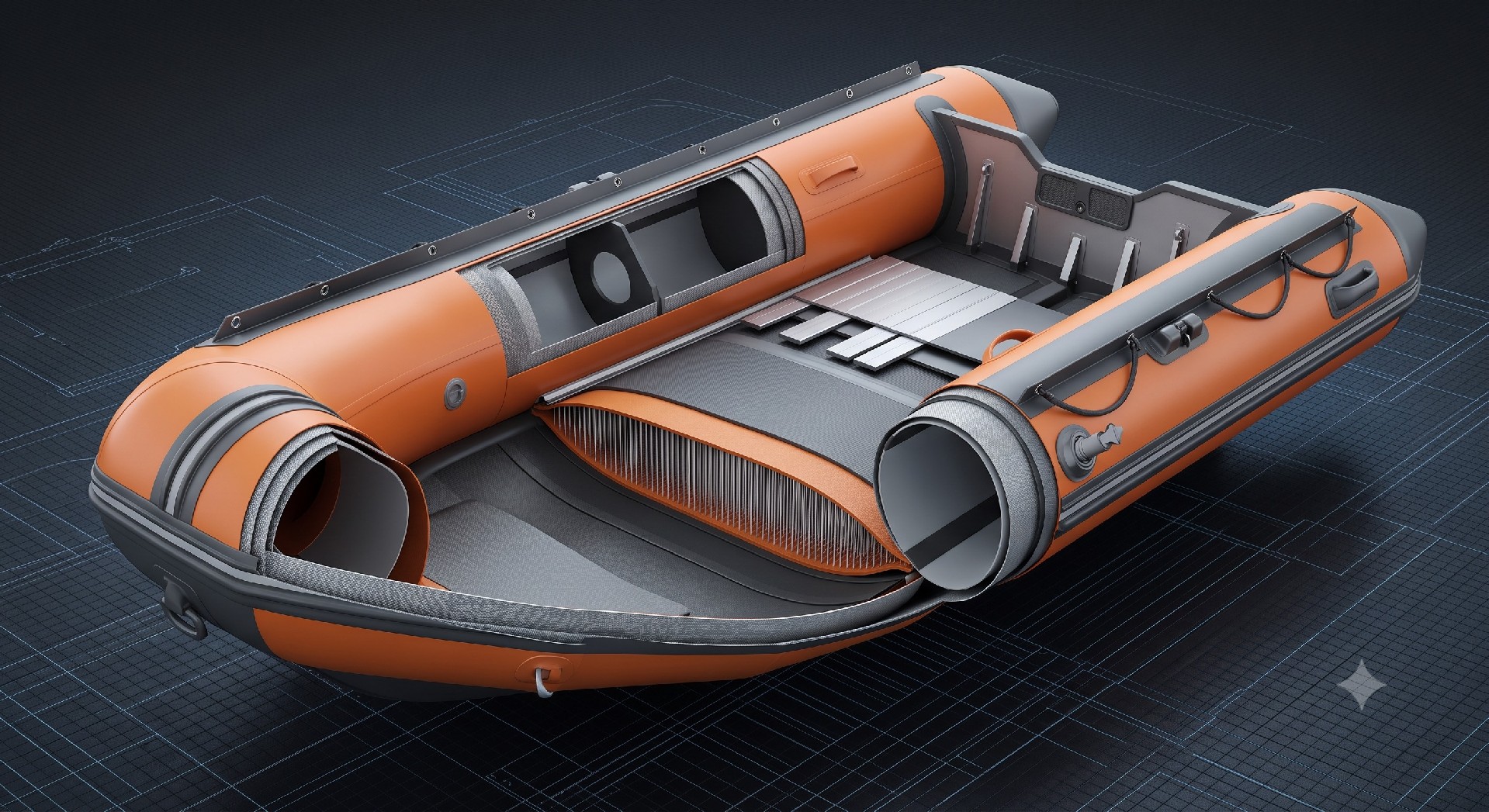
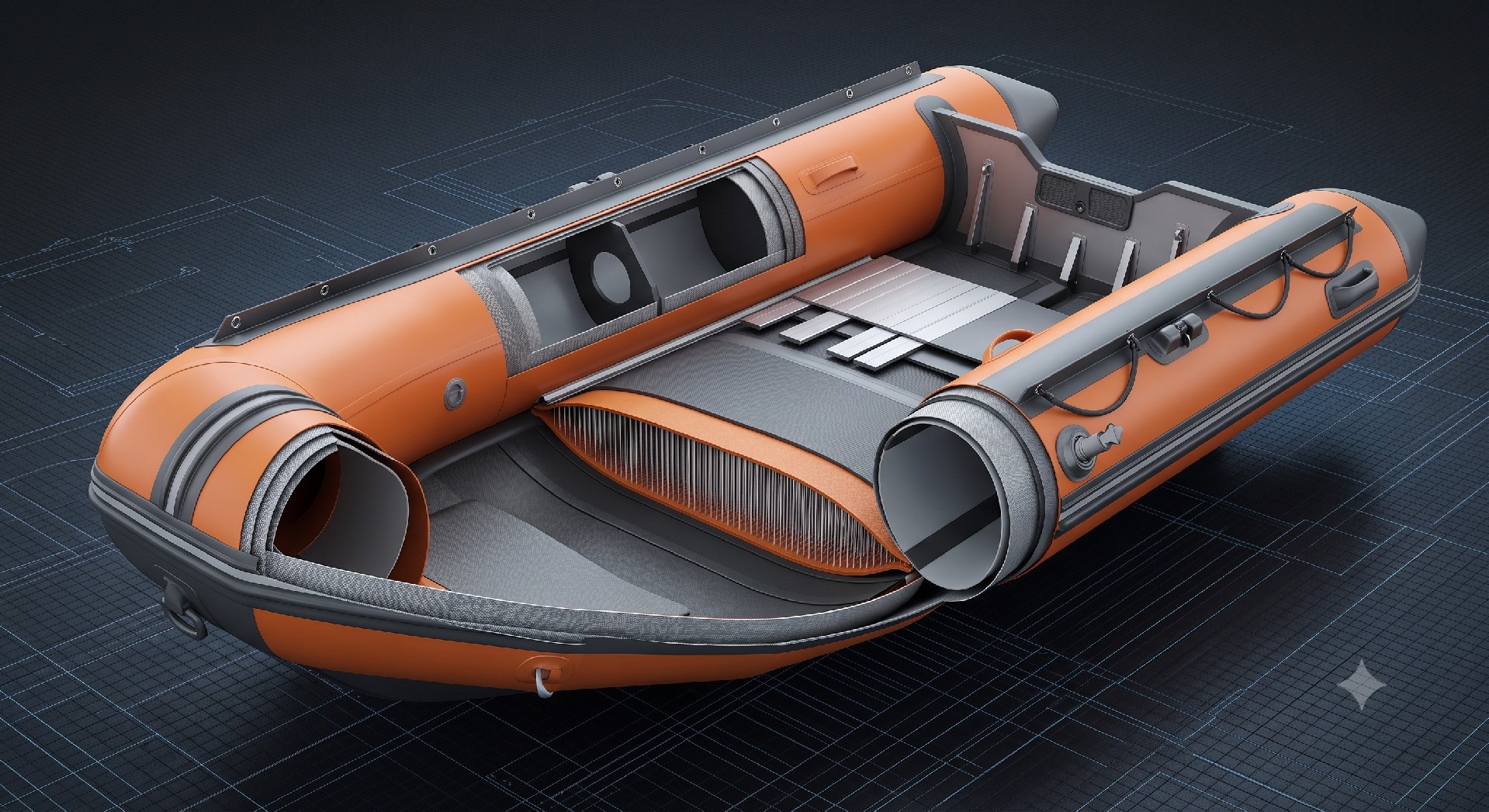
The engineering of seams and air chambers separates professional rescue equipment from recreational gear. In Professional Flood Rescue Boats, the manufacturing process must guarantee airtight integrity under high stress.
Heat-Welded Seams vs. Glued Seams
In commercial and rescue-grade boats, heat welding is the superior method for seam construction. Heat welding fuses the fabric layers at a molecular level, creating a bond that is stronger than the base material itself, whereas glued seams are susceptible to hydrolysis and degradation over time . This is particularly vital for Professional Flood Rescue Boats that are frequently packed wet or stored in varying temperatures.
The Multi-Chamber Safety Standard
Safety standards dictate that Professional Flood Rescue Boats must feature multiple independent air chambers. High-spec models feature at least five separate chambers (including a keel), ensuring that if one compartment is punctured, the boat retains sufficient buoyancy to complete the rescue mission . Advanced integrated valve systems allow these chambers to be either interconnected for rapid inflation or isolated to contain damage, all of which should be operable even with gloved hands in the dark .
| Key Parameter | Technical Specification & Compliance |
|---|---|
| Material Standard | ISO 15372:2000 / SOLAS (Hypalon/CSM or Heavy-Duty PVC) |
| Fabric Thickness | 0.9mm - 1.2mm (High Denier Polyester Reinforcement) |
| Seam Construction | Heat-Welded (Molecular Bond) |
| Independent Chambers | ≥ 5 (Multi-Chamber Safety Design) |
| Maximum Payload | ≥ 900 kg up to 1,250 kg |
| Deployment Time | ≤ 3 Minutes (High-Pressure System) |
Deployment Metrics: Speed, Capacity, and Ergonomics
Beyond materials and compliance, the operational performance metrics are critical to maximizing ROI and saving lives. The design must facilitate rapid deployment and high payload capacities.
Rapid Deployment: Inflation and Turnaround
Time is the enemy in flood rescue. Professional systems are designed for deployment in under three minutes . This is achieved through high-pressure air systems, often utilizing SCBA bottles or integrated 12L cylinders that can fill chambers to operating pressure instantly . For comparison, a standard foot pump would take significantly longer, making high-pressure fill systems mandatory for professional fleets .
Payload Capacity and Passenger Load
Professional Flood Rescue Boats are designed for heavy loads, moving both personnel and essential cargo. Top-tier models boast maximum carrying capacities of up to 1,250 kg, accommodating up to 12 people . This allows rescue teams to transport evacuation supplies, stretchers, and bulky equipment like ATVs (All-Terrain Vehicles) to isolated communities . The integration of drop-down bows facilitates easy loading of wheelchairs and casualties, streamlining the rescue process .
Strategic Procurement: Validating Compliance and Value
For B2B buyers, the final validation step involves auditing the vendor's compliance claims and engineering specifications.
Audit-Proofing Your Fleet
Ensure that the manufacturer provides full documentation, including ISO 6185 certification and CE marking. For critical infrastructure, design life specifications are paramount—valve systems often have a design life exceeding 10 years . Independent verification of the thickness of Hypalon (often specified at 1.0mm for heavy-duty applications) and the denier count is recommended.
Reducing Total Cost of Ownership
While Hypalon-based Professional Flood Rescue Boats require a higher upfront investment, their extended lifespan (often 15-20 years versus 5-10 for PVC) and lower maintenance requirements offer superior long-term ROI. The ability to perform local repairs (or the provision of 5-year extended warranties) further enhances the value proposition .
Conclusion: Engineering Life-Saving Certainty
Selecting a Professional Flood Rescue Boat is a high-stakes decision. The essential features outlined—CE and ISO 6185 compliance, Hypalon or heavy-duty PVC construction, heat-welded seams, multi-chamber safety systems, and rapid deployment capabilities—constitute the minimum requirement for saving lives in extreme conditions. By prioritizing these engineering specs and regulatory standards, procurement leaders ensure their teams operate with the highest level of safety, efficiency, and operational readiness.
