

Introduction: The New Era of Maritime Safety Procurement
For commercial buyers, rescue operation managers, and outdoor equipment distributors, the procurement of rescue watercraft has always been a high-stakes decision. In 2026, the industry has witnessed a definitive shift: the integration of smart electronics into inflatable rescue crafts is no longer a novelty but a baseline for operational efficiency and safety . This guide cuts through the marketing noise, offering a data-driven, technical deep dive into the materials, specifications, and financial returns of modern electronic inflatable rescue crafts. We are moving beyond analog flotation to the Digital Safety Ecosystem, where a rescue craft is a beacon, communicator, and autonomous agent in a single package .
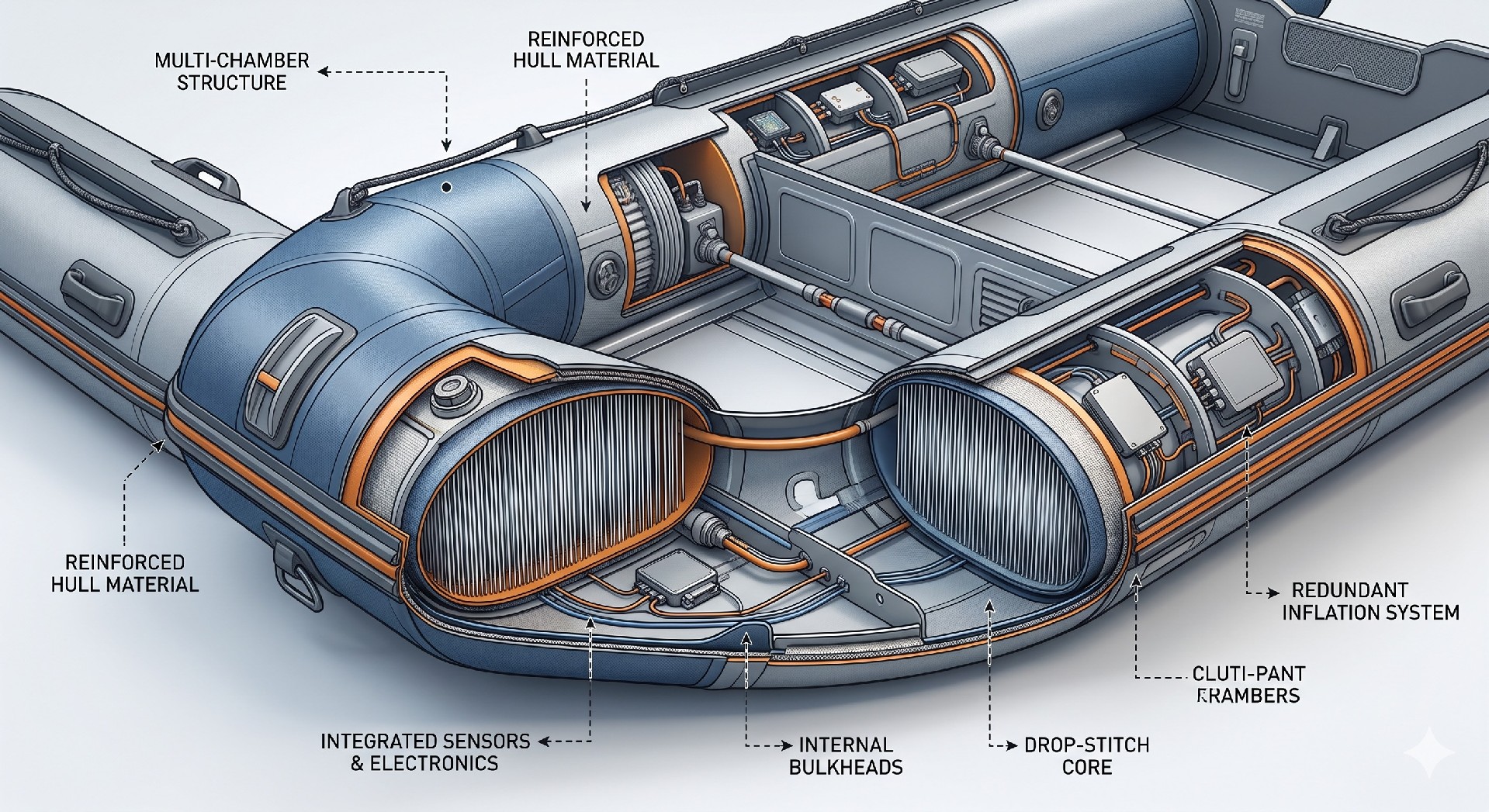
Materials Science: Hypalon vs. PVC and The Electronic Integration Challenge
The durability and reliability of any inflatable craft hinge on its core materials. The debate between Hypalon (CSM) and PVC (Polyvinyl Chloride) remains central, but smart integration adds new layers of complexity. Hypalon remains the gold standard for commercial and military-grade applications due to its superior resistance to UV rays, extreme temperatures, and chemicals . It offers unparalleled puncture resistance, which is critical for craft that may deploy in debris-filled floodwaters or rescue scenarios. However, it is more expensive and requires careful maintenance.
Structural Integrity: Drop-Stitch and Seam Technology
For a craft to carry heavy electronic payloads (batteries, sensors, GNSS modules), structural rigidity is non-negotiable. This is where Drop-Stitch technology becomes essential. Unlike traditional inflatables that are essentially air pillows, drop-stitch construction uses thousands of internal threads to maintain a flat, high-pressure surface, creating a rigid hull that can support high speeds and heavy electronics without flexing . Typical commercial-grade crafts utilize reinforced PVC or Hypalon with thicknesses ranging from 0.9mm to 1.2mm (1100D to 1670D). Furthermore, the integrity of the craft relies on heat-welded seams rather than glued seams, as welding creates a molecular bond that is significantly more robust and resistant to the stresses of high-pressure inflation cycles .
Technology Integration and Control Systems
The 'smart' in modern rescue crafts is defined by sophisticated onboard electronics. For B2B sourcing, understanding the specifics of these systems is crucial for assessing reliability and mission capability. Here are the core electronic components driving the current market:
IoT-Integrated Connectivity: Modern units feature sensors that monitor the integrity of the craft and inflation cylinders, transmitting data to fleet management systems to streamline maintenance .
GPS/Beidou & AIS MOB Technology: High-precision GNSS receivers provide real-time positioning. For search and rescue, the integration of Automatic Identification System (AIS) Man Overboard (MOB) technology is a game-changer. Upon inflation, the craft automatically broadcasts its location to all vessels within a 4-5 nautical mile radius, displaying an MOB icon on electronic chart displays .
Remote Control & Autonomous Features: Advanced craft can be operated via remote control with a 360° omnidirectional joystick, featuring ranges up to 1,000 meters. Features like 'one-key return' and autonomous return in case of signal loss (with an error of<3 meters) are now standard on high-end models .
Water-Activated Inflation Logic: Smart sensors differentiate between immersion and splashes, using dual water sensors to prevent accidental inflation. Inflation can occur in under 50 seconds upon water contact, significantly faster than traditional soluble-pellet systems .
Technical Specifications: Performance Metrics and Compliance
When evaluating suppliers, procurement managers must prioritize quantifiable metrics. Below is a technical comparison based on leading commercial offerings in the B2B space, highlighting the payload capacity, speed, and power requirements of a modern smart rescue craft.
| Specification | Commercial Standard (High-End Model Example) |
|---|---|
| Material & Thickness | 0.9mm - 1.2mm Reinforced PVC / Hypalon (1000D - 1670D Denier) |
| Drop-Stitch Core Pressure | Up to 10 PSI for Rigid Hull Performance |
| Payload Capacity | 250 kg - 1,000 kg (Rescue capacity for 8-10 persons) |
| Max Speed (Loaded) | 1.6 m/s to 3.5 m/s (Remote Controlled) |
| Communication & Positioning | GPS / BeiDou & AIS (Automatic Identification System) MOB Technology |
| Battery Life (Operational) | 60 Minutes (Standard) / 2 Hours (Remote Control) |
| Deployment Time | Under 3 Minutes from storage to full inflation |
| Certifications | ISO 6185, CE, REACH, SGS/BV |
Commercial ROI: The Cost-Benefit Analysis of Smart Features
For rental fleets, resorts, and rescue services, the higher upfront cost of a smart inflatable craft is justified by substantial long-term savings and revenue opportunities. The total cost of ownership analysis breaks down into several key areas.
Operational Efficiency and Maintenance
IoT sensors reduce maintenance overhead by replacing time-consuming manual inspections with automated status checks . This increases fleet uptime and reduces the risk of equipment failure during operation. Additionally, the ability to self-inflate and deploy rapidly (<3 minutes) cuts down on crew time and allows for a faster turnaround in rental scenarios .
Revenue Generation and Risk Mitigation
In the commercial sector (e.g., adventure tourism, offshore wind), providing a higher standard of safety equipment is a powerful competitive advantage and a tool for crew retention . Furthermore, maritime insurers are beginning to offer premium discounts for fleets equipped with AIS-enabled safety equipment, recognizing the reduced liability in a man-overboard scenario. This can offset the initial CapEx within a few years.
[IMAGE_2]
Conclusion: The Future of Rescue Watercraft is Autonomous
The integration of smart electronics is fundamentally reshaping the inflatable rescue craft market. For the discerning B2B buyer, the decision is no longer just about choosing between Hypalon or PVC, but about selecting a platform capable of hosting the sensors and automation features that will define maritime safety in the coming decade. From AI-enhanced casualty detection to uncrewed rescue boats with near-unlimited control ranges, the technology is moving towards fully autonomous rescue solutions . By focusing on material integrity, rigorous compliance (ISO 6185, CE), and the advanced capabilities of current electronic systems, businesses can invest in equipment that not only saves lives but also provides a quantifiable return on investment through efficiency and premium service offerings.
