

The Procurement Challenge: Balancing Cost with Commercial-Grade Durability
For B2B buyers, sourcing a best budget PVC inflatable kayak that aligns with both financial constraints and the rigorous demands of rental fleets, resort operations, or retail distribution is a high-stakes balancing act. The market is flooded with options, but not all budget PVC kayaks are created equal. A seemingly cost-effective choice can quickly devour profit margins through premature material failure, high return rates, and negative end-user experiences. This guide provides a data-driven framework for evaluating budget inflatable kayaks, focusing on critical technical specifications and performance metrics that dictate total cost of ownership.
As a leading authority in the B2B outdoor equipment sector, our analysis prioritizes materials science, manufacturing integrity, and quantifiable performance over superficial marketing claims. We will dissect the engineering behind a genuinely durable budget kayak, offering procurement professionals a clear path to making a sound investment. E-E-A-T is central to our methodology, ensuring every recommendation is grounded in verifiable data and industry standards such as ISO 6185, CE, EN71, and REACH compliance.
Fabric Technology Deep Dive: PVC Denier, Thickness, and Reinforcements
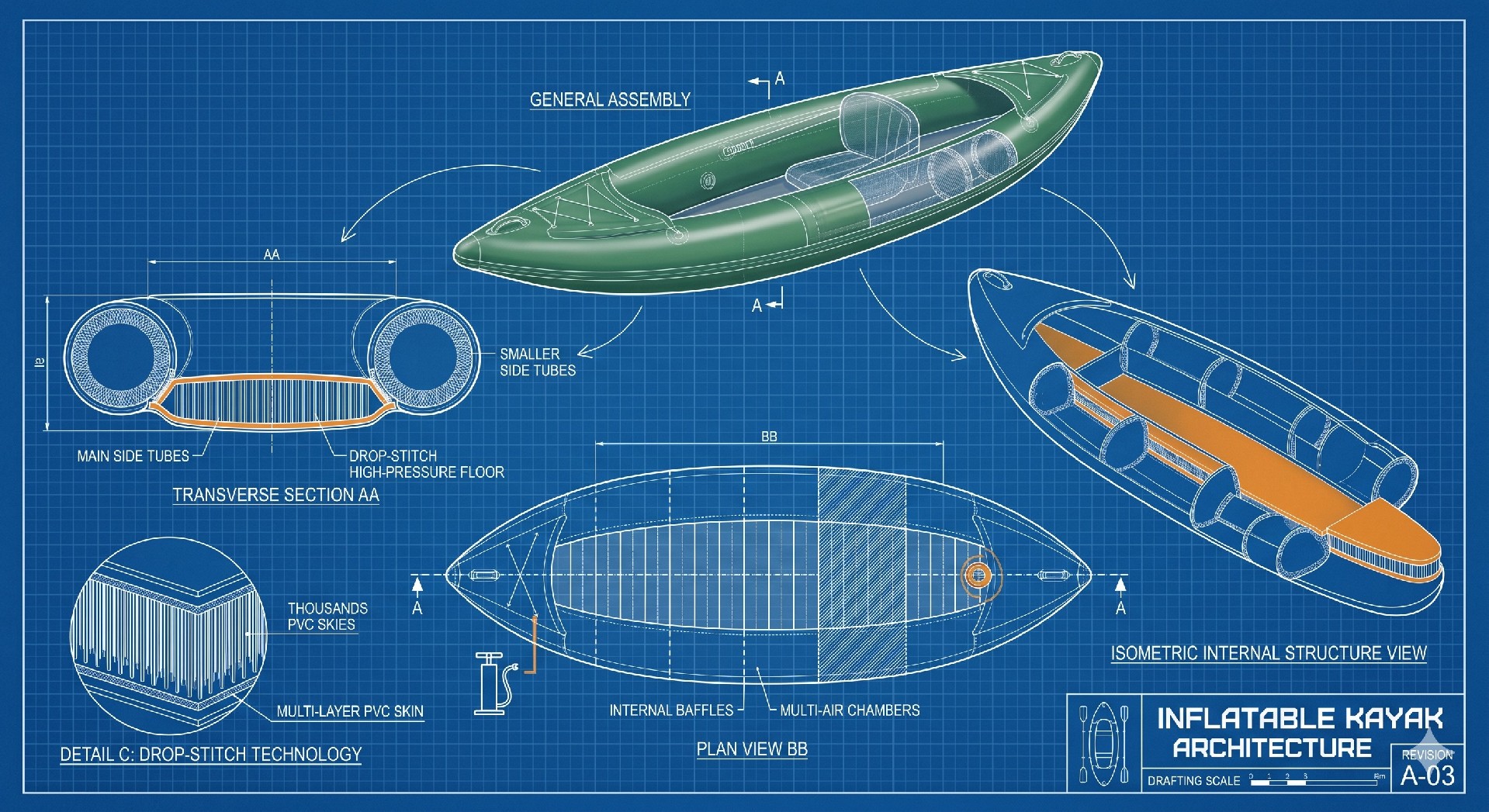
The foundation of any durable inflatable kayak is its material. When sourcing a budget PVC inflatable kayak, the term 'PVC' alone is insufficient. The specific formulation, thickness, and reinforcement (denier count of the polyester mesh) determine its resistance to punctures, abrasion, and UV degradation. Commercial-grade fabrics are measured in millimeters for thickness (e.g., 0.7mm, 0.9mm) and 'Denier' (D) for the tensile strength of the internal scrim. Higher numbers generally indicate greater durability.
Critical Metrics for Fabric Evaluation
Material Thickness & Denier: Look for a minimum of 0.7mm for casual use, but for commercial applications where the kayak will see frequent handling and potential contact with rough surfaces, 0.9mm to 1.2mm with a 1000D to 1100D polyester reinforcement is the gold standard for a budget-friendly yet resilient craft . A kayak like the Sea Eagle SE370 uses a 38-mil (approximately 0.96mm) PVC, which is standard for its class .
Abrasion and UV Resistance: The outer layer must be resistant to UV rays and abrasion. Budget models often use a single-layer PVC, which is less resistant to prolonged sun exposure. Upgraded options incorporate a thicker, reinforced laminate PVC to ensure sun-proof and wear-resistant properties .
Safety & Compliance: For any B2B purchase, verify that the materials comply with relevant safety standards, such as REACH, to ensure they are free from hazardous substances. Certifications like CE and ISO 6185 are non-negotiable for commercial distribution and use .
The sourcing strategy should prioritize suppliers who can provide documentation and certification for their materials. For example, established manufacturers like those in China’s Zhejiang and Guangdong provinces offer high-quality PVC tarpaulin with proven track records in international markets .
Weld Engineering: The Invisible Determinant of Longevity
While the fabric provides the strength, the seams are the most vulnerable points on an inflatable kayak. The method of joining the material is paramount. There are two primary types: heat-welded seams and glued seams.
Heat-Welded vs. Glued Seams
Heat-Welded Seams: This is the superior method. It uses high-frequency (RF) welding to molecularly fuse the PVC layers, creating a bond that is as strong as the material itself. This process eliminates the risk of adhesive failure, which is common with glued seams over time. All commercial-grade and high-performance budget kayaks should feature welded seams for maximum durability and air retention .
Glued Seams: While cheaper to manufacture, glued seams are susceptible to degradation from UV light, temperature fluctuations, and hydrolysis. For a best budget PVC inflatable kayak, glued seams represent a critical failure point and should be avoided for commercial use. Search for 'welded seams' as a key differentiator.
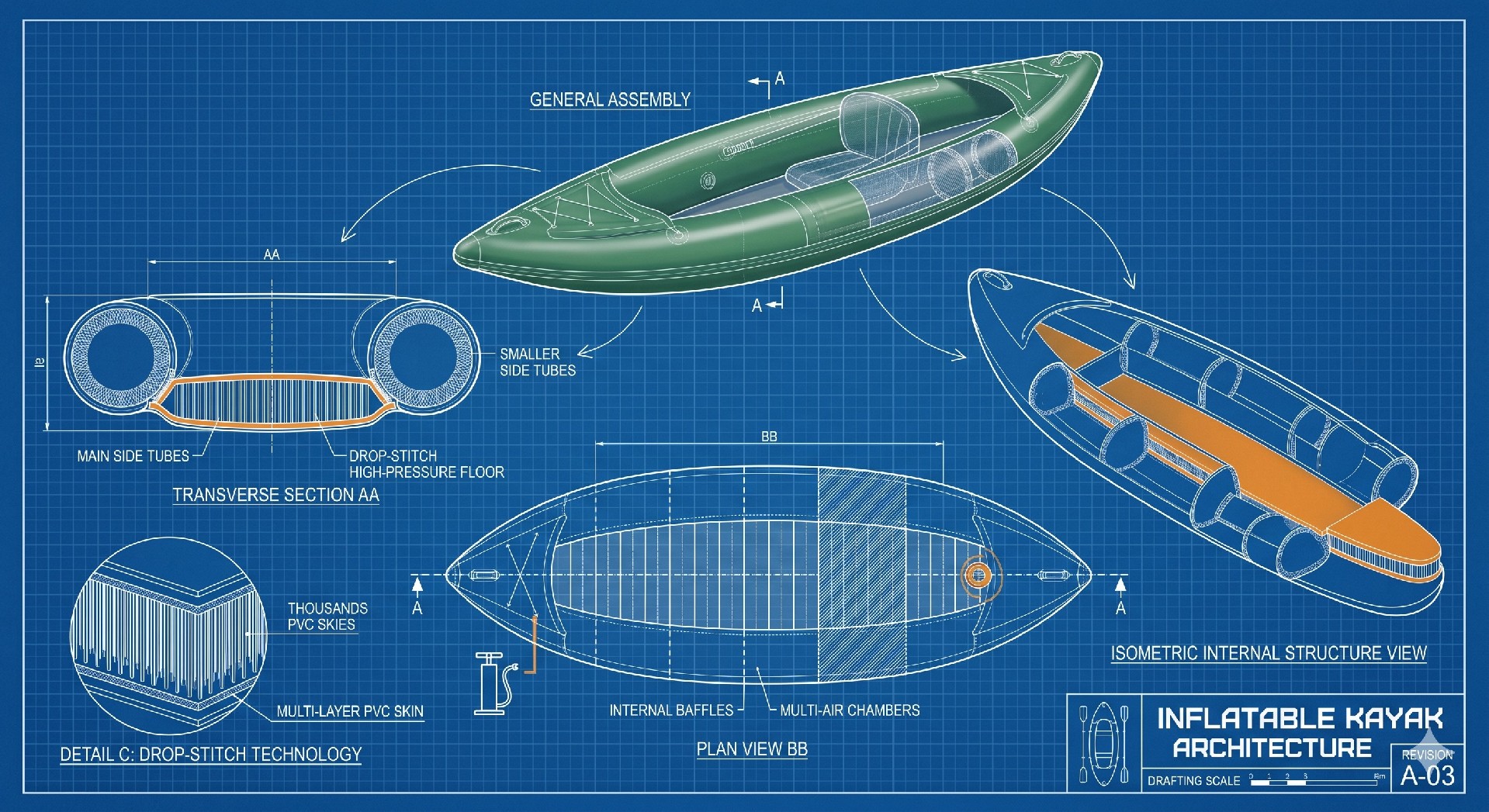
Beyond the seam type, the design incorporates multi-chamber construction. This is a critical safety and redundancy feature. A kayak with separate air chambers for the floor and each side tube ensures that a puncture in one chamber will not compromise the entire vessel, providing essential safety for rental customers and extending the craft's usable life .
Technical Specifications: A Data-Driven Comparison of Key Models
To truly evaluate a budget PVC inflatable kayak, one must compare its physical specifications and performance data against its price point. The following table synthesizes data from several prominent models to provide a benchmark for B2B buyers.
| Model | Material Specs | Max. Load | Weight | Chambers | Seam Type | Est. Price (USD) |
|---|---|---|---|---|---|---|
| Sea Eagle SE370 | 38-mil (0.96mm) PVC | 650 lbs | 40 lbs | 3 | Welded | $300-400 |
| Goplus 2-Person | Reinforced Laminate PVC | 507 lbs | N/A | 3 | Welded | Under $500 |
| Retrospec Coaster | PVC Bladder in 600D Polyester | N/A | ~30 lbs | 3 | Welded | Budget |
Portability, Setup Efficiency, and Commercial Viability
A major selling point of inflatable kayaks is their portability. However, 'portability' and 'packability' are distinct metrics that impact storage and logistics. For a rental fleet or a resort, the weight, packed size, and inflation time directly affect operational efficiency.
Inflation and Deflation Metrics
Inflation Time: A standard manual pump can take 10-15 minutes to fully inflate a kayak . For high-turnover operations, an electric pump is recommended, reducing setup time to 5-7 minutes. The inclusion of a reliable dual-action manual pump is a minimum requirement for any B2B package.
Inflation Pressure (PSI): Most budget models operate at low pressures (1.5 - 2.2 PSI) . Higher-end drop-stitch models can reach much higher PSI for rigid performance, but this comes at a cost. Budget PVC kayaks are designed for stability and comfort at low pressure. Exceeding recommended PSI can damage the seams or bladders .
Packed Size and Weight: A packed kayak should ideally fit into a manageable carry bag. Weights range from approximately 30 lbs for a single-person model to over 40 lbs for a tandem . For fleet management, the ability to stack and store these packages efficiently in a warehouse or vehicle is a key logistical advantage. The Retrospec Coaster, for instance, deflates into a backpack, enhancing its portability .
The design of the valve system also plays a crucial role. Boston valves, or their equivalents, are standard due to their ease of use and reliability. Some systems feature a dual-action design that allows for quick inflation and deflation, drastically reducing turnaround time between rentals .
Commercial Use Cases and End-User Experience
Understanding the target market for the best budget PVC inflatable kayak is essential. These crafts are ideal for specific commercial applications.
Target Markets and Applications
Resorts and Glamping: For calm lake waters and sheltered bays, a stable, comfortable kayak enhances guest experience. Features like adjustable EVA seats and a spacious cockpit add to the premium feel of a resort activity . The ease of storage and transport is a significant benefit for these businesses.
Rental Fleets: High-throughput rental operations require kayaks that are easy to clean, quick to dry, and can withstand continuous use. The kayak's capacity—like the 650 lb limit of the Sea Eagle SE370—allows for versatile use by individuals or groups with gear . Durability against punctures and abrasion is paramount .
Recreational Retail: The primary consumer is a beginner or casual paddler looking for a low-maintenance, easy-to-store watercraft. A model that offers excellent value for money, such as those in the $300-$400 range, appeals to this demographic .
From a B2B perspective, the success of a kayak in these environments is measured by its total cost of ownership (TCO). Factors such as initial cost, warranty length (e.g., 2-year guarantee from some suppliers ), and the cost and ease of repairs determine the long-term ROI. A kayak that uses a PVC shell with a vinyl bladder is generally easier to field-repair than more complex composite structures.
Conclusion: Strategic Sourcing for Long-Term Value
Selecting the best budget PVC inflatable kayak for B2B purposes requires a shift in perspective from 'cheapest upfront' to 'optimal lifetime value.' The data indicates that a sound investment focuses on material thickness (0.9mm+ 1000D fabric), construction integrity (RF-welded, multi-chamber design), and operational efficiency (weight, packed size, and inflation speed).
B2B buyers should prioritize suppliers who offer transparency regarding their materials and hold relevant certifications like ISO 9001 and CE. While a model like the Sea Eagle SE370 offers a compelling balance of capacity and value for general recreation , others like the Goplus kayak emphasize puncture-proof materials at a competitive price point . The final decision will depend on the specific operational context, but by applying the rigorous, data-driven criteria outlined in this guide, buyers can confidently source durable, safe, and cost-effective craft that will meet commercial demands and deliver a positive return on investment.
