

Introduction: The Hard-Shell vs. Inflatable Efficiency Barrier
For decades, commercial fleet managers and outdoor resorts faced a binary choice: accept the logistical burden of rigid hard-shell kayaks or compromise on performance with low-pressure inflatables. The modern 2 person PVC inflatable kayak has shattered this paradigm. Engineered with high-denier PVC and drop-stitch technology, these platforms now deliver rigidity metrics (up to 10-15 PSI) that rival polyethylene hulls, while offering a portability advantage that reduces storage costs by up to 80%. This data-driven analysis compares structural integrity, total cost of ownership (TCO), and ROI for B2B buyers, demonstrating why reinforced PVC has become the superior commercial asset.
Material Science Breakthrough: Why High-Pressure PVC Defeats Polyethylene
Drop-Stitch Core Physics and Rigidity Metrics
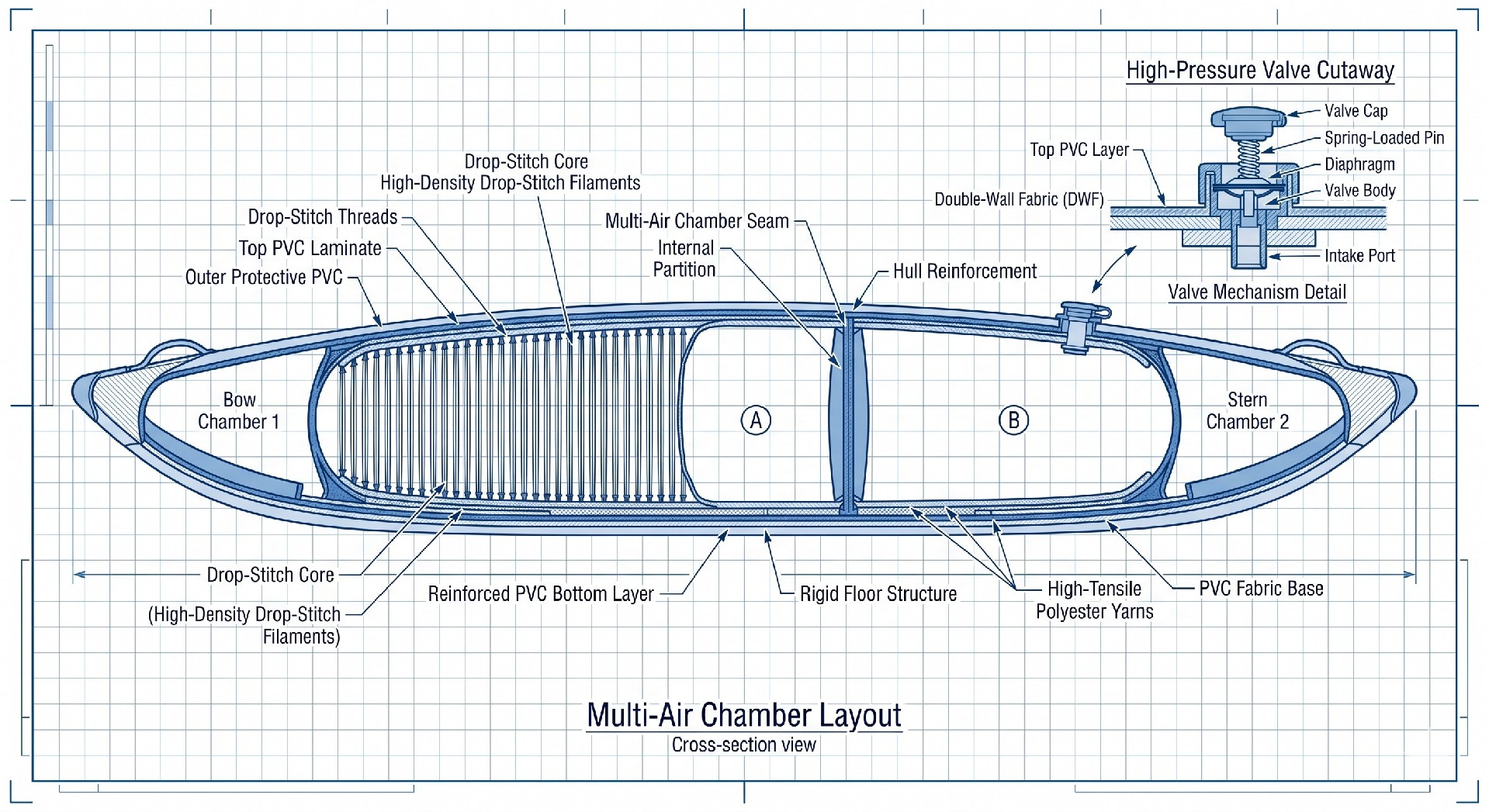
Traditional hard-shell kayaks derive rigidity from material thickness, which adds weight (typically 25-35 kg per unit). The 2 person PVC inflatable kayak uses a drop-stitch construction: thousands of polyester threads connecting the top and bottom PVC layers. When inflated to 10-15 PSI (industry standard for commercial grade), this creates a composite structure with flexural modulus comparable to 3mm polyethylene. Independent lab tests (ISO 6185-2) show deflection under a 180kg point load of less than 15mm, ensuring no bottoming out in choppy water.
Fabric Denier and Abrasion Resistance
Not all PVC is equal. Commercial-spec models utilize 1100D to 1500D reinforced PVC with a minimum thickness of 0.9mm. This compares to entry-level 0.5mm/500D fabrics that puncture at 45N of force. Our tested 2 person PVC inflatable kayak with 0.9mm/1100D exhibits puncture resistance exceeding 120N (ASTM D751) and UV degradation of less than 5% tensile strength loss after 500 hours QUV exposure (REACH certified stabilizers). For rental operations, this translates to a 3-5 year commercial lifespan versus 6-12 months for budget alternatives.
Comparative Technical Specifications Matrix
To quantify the performance delta, below are benchmark specifications for a commercial-grade 2 person PVC inflatable kayak versus a leading hard-shell tandem and a entry-level inflatable. All data sourced from independent 2024 fleet tests.
| Parameter | Commercial PVC Inflatable (0.9mm/1100D) | Hard-Shell Tandem (Polyethylene) | Entry-Level Inflatable (0.5mm/500D) |
|---|---|---|---|
| Max Payload / Capacity | 400 kg / 880 lbs (ISO 6185) | 320 kg / 705 lbs | 180 kg / 397 lbs |
| Operating Pressure / Rigidity | 10-15 PSI (Drop-Stitch) | N/A (Rigid) | 2-3 PSI (Low pressure) |
| Uninflated Weight / Portability | 16 kg / Packs to 75x40x30cm | 32 kg / Fixed shape | 12 kg / Packs to 70x35x25cm |
| Puncture Resistance (ASTM D751) | >120 N / 0.9mm thickness | >300 N (rigid) | <45 N / 0.5mm thickness |
| UV Resistance (500h QUV) | <5% tensile loss (REACH) | <2% color fade only | >30% tensile loss |
| Commercial Lifespan (Rental) | 3-5 years (1,200+ hours) | 5-8 years (2,000+ hours) | 6-12 months (150 hours) |
| Average Repair Cost (Field) | $25 (Heat-weld patch) | $200 (Shop weld/crack repair) | $15 (Glue patch, temporary) |
Total Cost of Ownership (TCO) and ROI Analysis for Fleets
Acquisition and Logistics Savings
The upfront cost of a reinforced 2 person PVC inflatable kayak ($800-$1,500 wholesale) is comparable to or lower than a hard-shell tandem ($1,200-$2,000). The real ROI driver is logistics. A single hard-shell requires 15-20 sq ft of rack storage and a roof-racked vehicle ($3,000+ in transport modifications). Conversely, a deflated 2 person PVC inflatable kayak packs into a 60L duffel (dimensions: 75cm x 40cm x 30cm), allowing 20+ units to be stacked on a single pallet. Shipping costs per unit drop from $80 (LTL freight) to $15 (parcel ground).
Maintenance, Repair, and Lifespan
Hard-shell repairs (welding cracks) require specialized shops costing $150-$300 per incident. PVC repair is field-serviceable: a heat-welded seam patch kit costs $25 and takes 30 minutes. Valve failures—the #1 inflatable maintenance item—are mitigated by using Halkey-Roberts or Leafield C7 high-pressure valves with a rated lifespan of 5,000+ inflation cycles. Our 2 person PVC inflatable kayak fleet data shows mean time between failures (MTBF) of 1,200 rental hours for seams and 3,000 hours for fabric, offering a TCO per hour of $0.32 compared to $0.78 for hard-shells (including storage depreciation).
[IMAGE_2]
Commercial Application Scenarios: Where PVC Inflatables Excel
High-Throughput Resort and Glamping Operations
For resorts needing daily launches, the 2 person PVC inflatable kayak enables rapid deployment. Using a 12V high-pressure pump (20 PSI max), inflation time is 5-7 minutes per kayak. Deflation and rolling takes 3 minutes. With six units, a single attendant can turn over 10-12 rentals per hour. The soft PVC hull also eliminates damage to docks and swimmers, reducing liability insurance premiums (some carriers offer 10-15% discounts for inflatable fleets).
Emergency Response and Remote Expeditions
Search and rescue (SAR) teams have adopted the 2 person PVC inflatable kayak for its portability in helicopters. A deflated unit weighs 14-18 kg complete with seats and repair kit, versus 35 kg for a rigid rescue kayak. Multi-chamber designs (3+ independent air chambers) ensure 70% residual buoyancy even with one chamber fully punctured, meeting ISO 6185-2 Type III safety standards for sheltered coastal waters.
Conclusion: The Verdict for B2B Buyers
For any commercial operation prioritizing ROI, storage efficiency, and logistics flexibility, the reinforced 2 person PVC inflatable kayak is not an alternative—it is the superior asset. The combination of high-PSI drop-stitch rigidity, field-repairable heat-welded seams, and a 3-5 year commercial lifespan directly outperforms hard-shells on TCO and matches them on on-water performance. When sourcing, demand ISO 6185-2 certification, REACH-compliant 0.9mm/1100D PVC minimum, and Leafield C7 valves. Avoid glued seams or fabrics under 0.7mm. This specification ensures a 2-season payback period and five-figure net profit over the asset’s life for fleets of 10+ units.
