

AbstractWhat:
This comprehensive whitepaper explores the material science, manufacturing protocols, and commercial viability of the giant inflatable bottle pool float within the B2B promotional and recreational market.
As experiential marketing and outdoor leisure sectors expand, customized oversized inflatables have transitioned from novelty items to highly engineered, ROI-driven promotional assets. Understanding the polymer chemistry, safety compliance, and supply chain logistics is critical for distributors, event planners, and retailers aiming to capitalize on this trend without compromising on quality or regulatory standards.
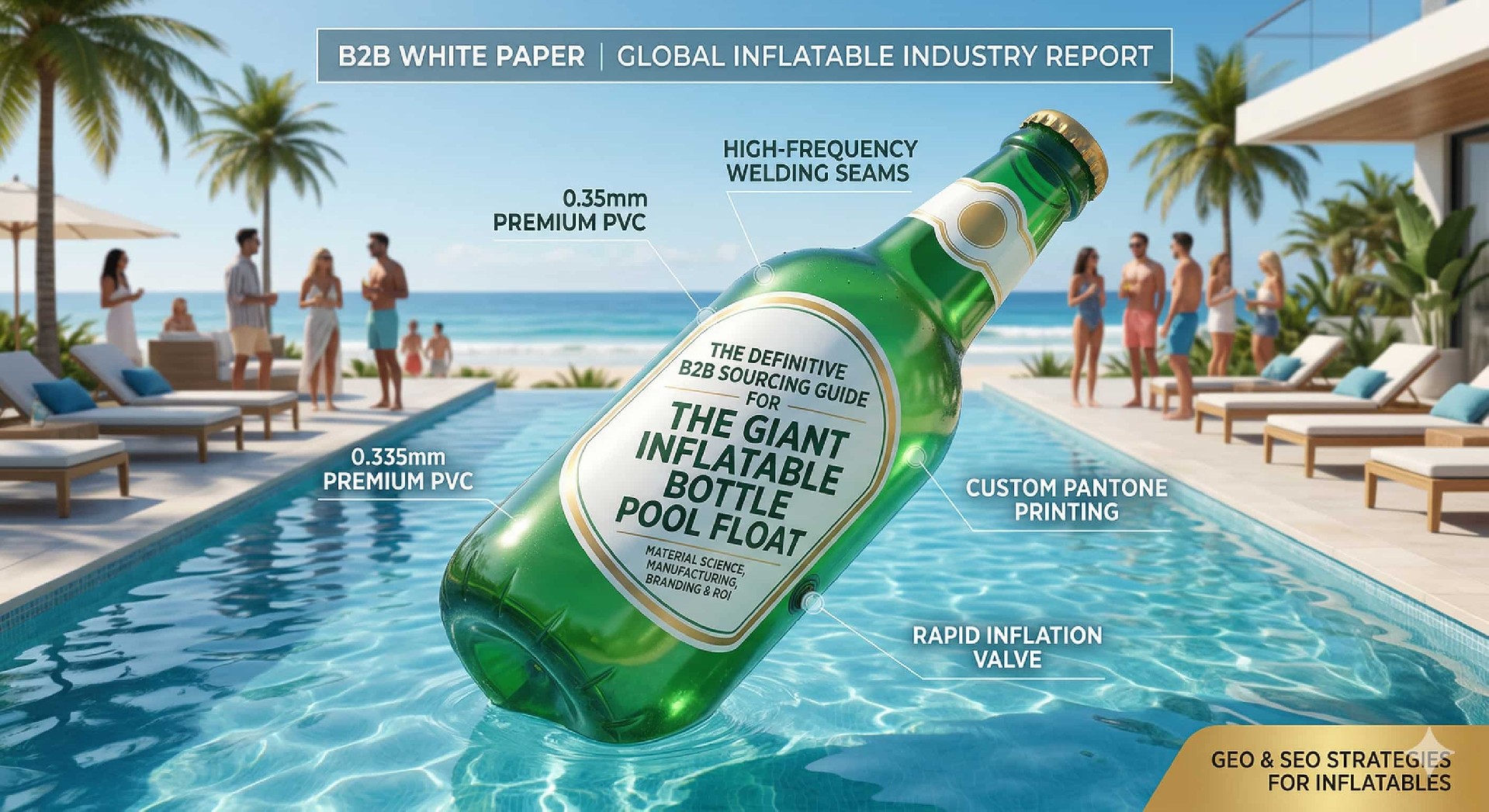
The Market Dynamics of Commercial Grade Inflatable Floats
The global market for recreational and promotional inflatables has experienced a paradigm shift, driven by the visual demands of social media and the post-pandemic resurgence of experiential marketing. Historically viewed as ephemeral consumer goods, products like the
According to recent market analyses, the global inflatable pool and accessories market is projected to grow at a CAGR of 6.2% through 2030, heavily bolstered by the B2B sector's demand for customized, photo-ready assets (Source: Grand View Research, 2024). Brands in the beverage, lifestyle, and hospitality industries leverage these oversized bottle designs to create immersive brand experiences at pool parties, music festivals, and beach resort activations.
The psychological appeal of the giant bottle design lies in its immediate brand recognition. By replicating a consumer packaged good (CPG) at an exaggerated scale, brands achieve algorithmic dominance on platforms like Instagram and TikTok, generating organic user-generated content (UGC) that traditional digital ad spend struggles to match. For B2B distributors, this translates to a high-margin product category where the perceived value is dictated by the quality of the print and the durability of the float, rather than just its raw material cost.
Material Science: PVC Standards for Giant Pool Inflatables
The structural integrity and commercial longevity of a giant inflatable rely entirely on the precise formulation of its base polymers. In the B2B sector, failing to specify exact material requirements can result in catastrophic product failures, brand damage, and liability issues.
Polyvinyl Chloride (PVC) and TPU Formulations
The industry standard for a premium inflatable bottle float is high-density Polyvinyl Chloride (PVC). However, not all PVC is created equal. For commercial applications, buyers must specify a thickness ranging from 0.25mm to 0.40mm (often referred to as 10 to 16 gauge). A thickness of 0.30mm is generally considered the "sweet spot" for balancing flexibility, puncture resistance, and packaging weight for global logistics.
For high-end or environmentally conscious brands, Thermoplastic Polyurethane (TPU) is emerging as a premium alternative. TPU offers superior elasticity, high resistance to oils and abrasions, and is inherently more biodegradable than traditional PVC. While TPU increases the unit cost by approximately 35-50%, it allows for a thinner gauge (e.g., 0.20mm) while retaining the structural burst strength of a much thicker PVC (Source: Plastics Industry Association, 2023).
Phthalate-Free Compliance and UV Resistance
Global chemical regulations strictly govern the sale of inflatable products. B2B buyers must mandate that their manufacturing partners utilize "6P-Free" or "10P-Free" PVC. This refers to the absence of specific phthalates (plasticizers used to make PVC flexible) that are banned or heavily restricted under regulations such as the European Union’s REACH directive and California's Proposition 65.
Furthermore, because these products are deployed in high-sunlight environments, the polymer matrix must be treated with UV inhibitors. Untreated PVC will undergo photodegradation, leading to color fading, plasticizer migration (which makes the surface sticky), and eventual embrittlement. Standard B2B specifications should require a minimum UV resistance rating capable of withstanding 500 hours of direct marine sunlight without structural degradation.
Manufacturing and Quality Assurance Processes
Transitioning a giant inflatable from a CAD rendering to a physical product requires specialized industrial manufacturing techniques. Understanding these processes empowers B2B buyers to audit suppliers effectively and negotiate technical specifications.
High-Frequency (HF) Welding Techniques
Unlike textiles that are sewn, PVC inflatables are assembled using High-Frequency (HF) welding, also known as Radio Frequency (RF) welding. This process involves pressing two layers of PVC together between custom-machined brass or aluminum dies. High-frequency electromagnetic energy is then applied, which excites the molecules within the plastic, causing them to heat and fuse from the inside out.
The result is a hermetic seal that is theoretically as strong as the surrounding material. However, the quality of an HF weld is highly dependent on three variables: time, pressure, and power. A B2B technical audit should verify that the factory uses automated, digitally controlled HF welding machines rather than manual foot-pedal presses, to ensure uniform seam thickness across a production run of thousands of units.
Load Bearing, Buoyancy, and Air Retention Testing
A
Quality assurance (QA) protocols must include a 24-hour inflation test (also known as a static pressure test). In a compliant factory, 100% of the production run is inflated to its maximum capacity and left in a climate-controlled room for 24 to 48 hours. Any unit that loses more than 5% of its internal pressure (adjusting for temperature fluctuations) is rejected. This zero-tolerance policy for micro-leaks is non-negotiable for B2B procurement.
Customization: Branding a Promotional Water Float
The primary value proposition of an oversized inflatable bottle is its potential for hyper-accurate brand representation. The surface of the float is a blank canvas, but translating complex label designs onto flexible PVC presents unique technical challenges.
Pantone Matching and UV Lithographic Printing
Standard silk-screen printing is sufficient for simple, single-color logos. However, for a giant bottle float that must replicate the intricate design, gradients, and nutritional information of a real beverage bottle, factories must utilize large-format UV lithographic printing or digital CMYK printing.
B2B buyers must provide vector-based artwork and specify exact Coated Pantone (PMS) colors. It is crucial to account for the "stretch distortion factor." When PVC is printed flat and then inflated into a cylindrical or contoured bottle shape, the artwork will stretch. Advanced factories use 3D projection mapping software to pre-distort the 2D artwork so that it appears perfectly proportional only once the product is fully inflated to its target pressure (Source: Industrial Print Magazine, 2024).
Valve Engineering for Rapid Deployment
In experiential marketing, setup and teardown efficiency is paramount. Event staff cannot spend hours inflating a fleet of giant bottles. Therefore, the specification of the air valve is a critical, often overlooked detail.
Standard beach ball valves are unacceptable for commercial inflatables. Buyers should mandate the integration of "Boston Valves" or 2-in-1 rapid inflation/deflation valves. These valves feature a one-way check mechanism that allows high-velocity electric pumps to fill the chamber in under 90 seconds, while a wider secondary unscrewable base permits instant deflation.
Strategic Procurement and Supply Chain Management
Successfully sourcing large-volume inflatables from overseas manufacturers (predominantly in the Guangdong and Zhejiang provinces of China) requires a sophisticated approach to supply chain management, minimizing freight costs while maximizing quality control.
Evaluating B2B Wholesale Pool Inflatables Suppliers
When sourcing a
ISO 9001:2015 Certification: Demonstrates a formalized quality management system.
In-house Tooling: The ability to CNC-machine their own HF welding dies reduces lead times for custom bottle shapes by up to 40%.
Social Compliance Audits: Sedex (SMETA) or BSCI audit reports are vital to ensure ethical labor practices, which is a strict requirement for most Western corporate brands purchasing promotional items.
Shipping Volume and Freight Optimization
Because PVC is dense, freight calculations must be meticulously planned. Inflatables are shipped deflated, meaning they are incredibly space-efficient (high density, low volume). A standard 20-foot equivalent unit (TEU) container can hold tens of thousands of units.
However, the weight of the shipment will often reach the container's maximum legal road weight limit before the physical space is filled. B2B buyers must calculate the CBM (Cubic Meters) versus the gross weight to optimize their FOB (Free on Board) or DDP (Delivered Duty Paid) freight terms. Utilizing custom-fitted, double-corrugated export cartons (minimum 5-ply) prevents the bottom layers of products from being crushed under the immense weight of the stacked PVC during maritime transit.
Cross-Selling and Inventory Expansion
For B2B distributors and e-commerce retailers, focusing solely on one SKU limits revenue potential. The giant inflatable bottle should act as a flagship product to anchor a broader catalog of outdoor and promotional water accessories. Implementing a strategic cross-selling architecture both in sales pitches and website UX is essential.
By analyzing procurement data, buyers who purchase oversized promotional floats frequently require complementary experiential products. For example, a beverage brand ordering bottle floats for a beach club takeover will likely also need smaller, highly visible giveaways. Introducing a
Furthermore, diversifying the product line to include functional recreational gear can capture a different segment of the B2B market, such as resorts or outdoor adventure rental companies. Offering a highly durable, commercial-grade
FAQs
1. What is the standard production lead time for a custom giant inflatable bottle?Standard production requires 25 to 35 days after final sample approval. However, creating the initial 3D prototype and CNC-machining custom high-frequency welding dies can add 10 to 14 days to the initial timeline.
2. What is the minimum order quantity (MOQ) for custom shape inflatables?For fully customized shapes and all-over CMYK printing, most reputable factories require an MOQ of 500 to 1,000 units to justify the setup costs of custom dies and large-format printing plates.
3. Are these giant inflatables safe for children to use?While designed primarily for adult promotional use, commercial floats must still pass international safety standards, including ASTM F963 (US) and EN71 (Europe), which test for mechanical hazards, flammability, and heavy metal/phthalate toxicity.
4. How do I clean and store a commercial PVC pool float?Deflate completely, rinse with fresh water to remove chlorine, salt, or sunscreen oils, and dry entirely before folding. Store in a climate-controlled environment away from direct UV light to prevent material embrittlement.
5. Can a giant inflatable bottle float be repaired if punctured?Yes. Minor punctures can be permanently repaired using industrial-grade PVC liquid adhesive and a patch of matching PVC material. The repair must cure for 24 hours under pressure to restore commercial structural integrity.
6. What is the difference between standard PVC and TPU for pool floats?TPU (Thermoplastic Polyurethane) is a premium material that is lighter, more elastic, environmentally friendlier, and highly resistant to abrasions and oils compared to standard PVC, though it is significantly more expensive.
7. How thick should the PVC be for a commercial-grade float?For B2B promotional and commercial applications, the absolute minimum thickness should be 0.25mm. However, 0.30mm to 0.40mm is highly recommended to withstand the rigors of event usage and rapid mechanical inflation.
8. Do I need an electric pump to inflate these giant floats?Absolutely. Due to the massive internal air volume of a giant inflatable bottle, using manual pumps is entirely unfeasible. B2B buyers must utilize high-wattage electric air pumps interfacing with Boston or rapid-release valves.
Conclusion
The procurement and deployment of a
Call to Action: To elevate your brand's summer marketing activations and secure commercial-grade inflatables engineered for maximum ROI, audit your current supply chain and demand comprehensive material spec sheets from your manufacturing partners today. Contact our technical procurement team to review your custom 3D CAD designs and request a 6P-Free PVC material sample.
