

The Ultimate B2B Engineering Guide to Inflatable Beds: Inflatable Sprinkle Mat Technologies, Materials, and Sourcing Strategies
Abstract
What: This comprehensive technical white paper examines the engineering, material science, and manufacturing paradigms bridging the gap between traditional inflatable beds and the inflatable sprinkle mat. We dissect the transition from pneumatic sleep systems to hydro-dynamic leisure platforms.
Why: The global outdoor water toy and leisure market is experiencing exponential growth, driven by residential upgrades and changing summer recreation habits. However, B2B buyers frequently face high defect rates due to a lack of understanding regarding burst pressures, seam tensile strength, and polymer durability in hydro-dynamic applications. Mastering these technical parameters is vital for product longevity and safety compliance.
How: Readers will learn actionable, data-driven strategies for evaluating structural integrity (High-Frequency Welding), selecting optimal thermoplastic elastomers (Phthalate-Free PVC vs. TPU), mastering water pressure regulation mechanics, and executing rigorous B2B procurement protocols. By leveraging this guide, retailers and procurement teams can drastically reduce return rates, ensure global safety compliance, and capture high-margin segments in the outdoor leisure market.
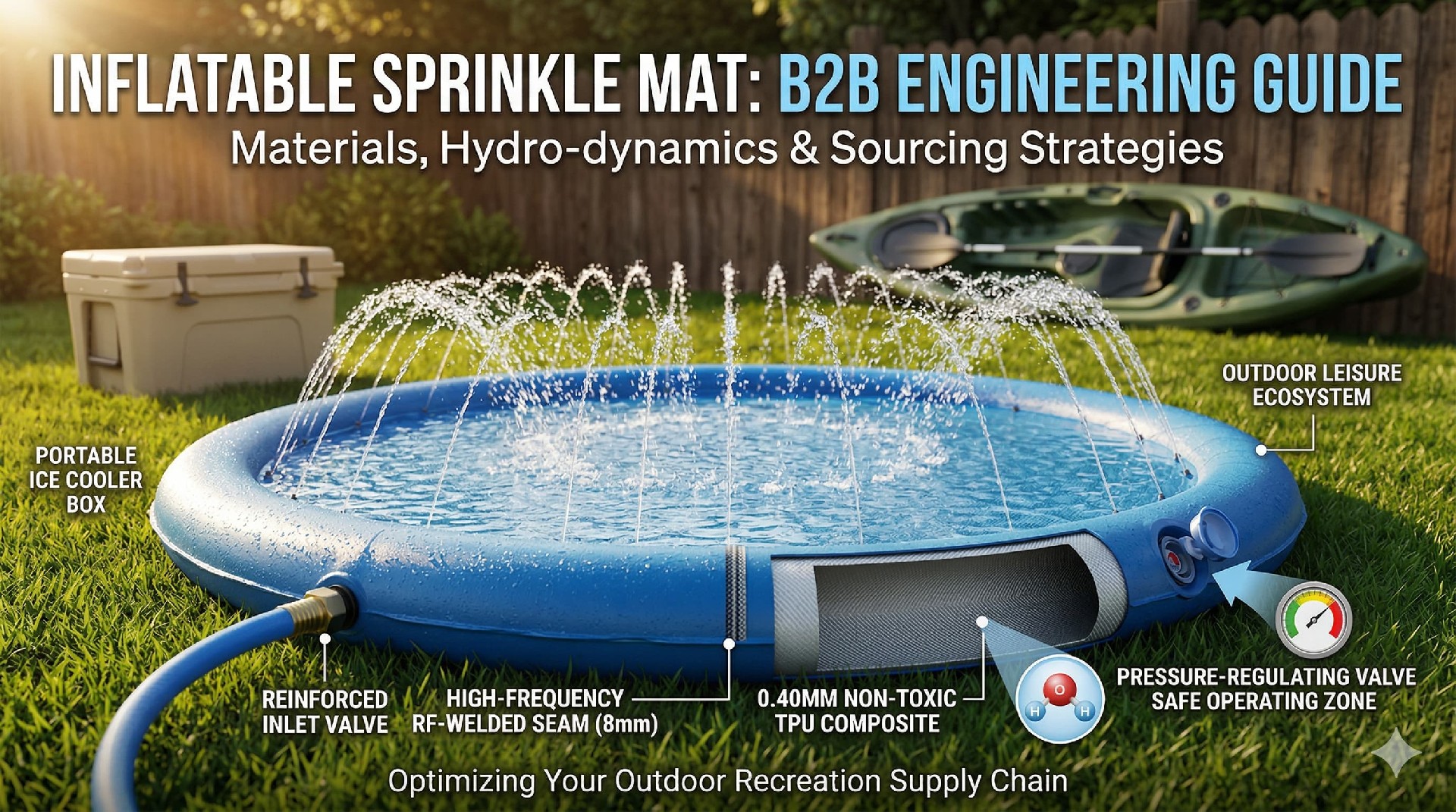
Deconstructing the "Inflatable Beds" Ecosystem: The Rise of the Inflatable Sprinkle Mat
While traditionally associated strictly with sleep systems, the broader "inflatable beds" manufacturing sector encompasses a vast ecosystem of pneumatically and hydro-dynamically supported polymer structures. The inflatable sprinkle mat (also known as a splash pad) represents a highly specialized evolution of the inflatable ground pad. Instead of retaining trapped air to support human weight, it utilizes continuous water pressure to create structural rigidity along its perimeter while simultaneously powering an interactive water spray feature.
From Static Air Chambers to Hydro-Dynamic Perimeters
The fundamental engineering of an air mattress relies on static internal air pressure (usually between 0.5 to 1.5 PSI) maintained by automated pumps or secure valves. In contrast, an inflatable sprinkle mat operates as an open-loop hydro-dynamic system. The outer rim acts as a toroidal pressure vessel. A standard garden hose introduces water into this ring, which expands to provide a structural boundary. Once the internal water pressure exceeds the atmospheric pressure, the water is forced through precision-engineered micro-perforations (nozzles) along the inner seam, creating the "sprinkle" effect.
Understanding this shift from static air retention to dynamic fluid flow is crucial for B2B product developers. The manufacturing lines that produce premium air beds are the exact same facilities that manufacture high-end splash mats, utilizing the same calendering, automated cutting, and welding machinery. However, the stress profiles on the materials are vastly different.
Market Growth and B2B Opportunities in Outdoor Leisure
The demand for residential water play systems has surged as consumers invest heavily in "staycation" backyard environments. According to recent market intelligence, the outdoor inflatable leisure market is projected to expand at a CAGR of 11.4% through 2028, with inflatable sprinkle mats leading the sub-category growth due to their low cost of entry, minimal storage footprint, and high consumer appeal (Source: Global Toy and Leisure Market Report, 2025). For B2B buyers, this represents a highly lucrative, high-turnover product category, provided the supply chain is optimized for quality rather than just unit cost.
Material Science: Engineering Durable Inflatable Sprinkle Mats
The chemical composition of the base material dictates the product's resistance to UV degradation, puncture susceptibility, and performance under varying water temperatures. Unlike indoor air mattresses, splash mats are subjected to direct solar radiation, abrasive ground surfaces (concrete, rough turf), and cold groundwater.
The Standard Polyvinyl Chloride (PVC) Paradigm
Historically, standard PVC has been the dominant material for inflatable leisure goods. It is easily calendered into thin sheets, highly receptive to high-frequency welding, and cost-effective. However, for an inflatable sprinkle mat, standard PVC has significant limitations:
Thermal Contraction: Cold water from a hose can cause rapid thermal contraction, making standard PVC brittle and increasing the risk of seam splitting.
Phthalate Concerns: Traditional plasticizers used to make PVC flexible (phthalates) are under strict regulatory bans globally (such as the CPSIA in the US and REACH in the EU).
Modern B2B sourcing mandates the use of Non-Toxic, Phthalate-Free (6P or 10P compliant) Environmental PVC. This formulation replaces hazardous ortho-phthalates with safer alternatives like DOTP (Dioctyl terephthalate), maintaining flexibility without failing environmental audits.
Thermoplastic Polyurethane (TPU) as the Premium Alternative
For commercial-grade or premium residential sprinkle mats, Thermoplastic Polyurethane (TPU) is emerging as the gold standard.
Tensile Strength: TPU offers a tensile strength up to 300% higher than PVC of the same thickness.
Abrasion Resistance: It is highly resistant to ground abrasion, allowing the mat to be used on patios without immediate failure.
Hydrolytic Stability: Polyether-based TPU exhibits exceptional resistance to degradation from water exposure, a critical factor for a product constantly submerged or wet
(Source: Journal of Applied Polymer Science, 2024).While TPU increases the unit production cost by approximately 40-60%, the reduction in warranty claims and RMA (Return Merchandise Authorization) rates often justifies the expenditure for premium brands.
Base Thickness and Gauge Optimization
The thickness of the polymer sheet is measured in millimeters (mm) or gauge. A standard, low-tier sprinkle mat often utilizes a 0.20mm to 0.25mm base. This inevitably leads to punctures from twigs, dog claws, or rough grass. A highly engineered, B2B-optimized product should mandate a minimum bottom thickness of 0.35mm to 0.40mm, with a textured, slip-resistant embossed pattern to prevent fall injuries.
Hydro-Dynamics and Water Pressure Regulation Systems
The success of an inflatable sprinkle mat relies entirely on how it handles incoming water pressure. If the water pressure from the municipal supply is too high, the toroidal ring can burst. If it is too low, the spray will not reach the desired height.
High-Frequency (RF) Welding and Seam Integrity
The seams of an inflatable sprinkle mat are its most vulnerable points. Unlike stitched textiles, polymer sheets are fused using Radio Frequency (RF) welding. Electromagnetic energy is applied to the overlapping seams, causing the polymer molecules to melt and fuse at a microscopic level.
For hydro-dynamic applications, the seam width must be wider than that of a standard static air bed. A minimum seam width of 6mm to 8mm is recommended to withstand the localized stress caused by fluctuating water pressures (which can spike up to 60 PSI depending on the local water supply).
O-Ring Seals and Valve Mechanics
The point of connection between the standard garden hose and the inflatable mat is a frequent point of failure. A highly engineered sprinkle mat incorporates a reinforced ABS plastic inlet valve with a standardized threaded connector (typically 3/4-inch GHT in North America).
The Critical O-Ring: To prevent leakage at the connection point, a high-density silicone O-ring must be seated inside the connector. Cheaper models omit this or use low-grade rubber, resulting in wasted water and reduced internal pressure.
Flow Restrictors: Advanced models feature built-in flow restrictors within the inlet. These mechanical baffles step down extreme municipal water pressures, protecting the welded seams of the outer ring from catastrophic blowout.
Nozzle Design for Optimal Spray Height and Flow Distribution
The micro-perforations along the inner rim must be precision-punched. If the holes are too large, the system loses pressure immediately, and the spray height is minimal. If the holes are too small, the back-pressure can rupture the mat.
Furthermore, the angle of the perforation is critical. Modern laser-cutting techniques allow manufacturers to punch holes at precise 45-degree inward angles, ensuring the water sprays toward the center of the mat, maximizing water retention in the central splash zone and minimizing lateral waste.
Comparative Analysis: Standard Inflatable Beds vs. Inflatable Sprinkle Mats
To aid procurement teams in understanding the manufacturing divergence within the inflatable category, the following table compares the structural and operational parameters of standard air mattresses against inflatable sprinkle mats.
| Engineering Dimension | Standard Inflatable Air Bed | Inflatable Sprinkle Mat |
| Primary Fluid Medium | Air (Pneumatic) | Water (Hydro-dynamic) |
| Structural Support | Internal Coil Beams / I-Beams | Outer Toroidal Ring (Water-filled) |
| Operating Pressure | Low (< 2 PSI) | Moderate to High (10 - 50 PSI) |
| Primary Stress Factor | Static weight loading (human body) | Tensile stress from internal fluid volume |
| Material Requirement | Flocked PVC / TPU (Thermal comfort) | Slip-resistant, Phthalate-Free PVC (Abrasion) |
| Seam Width Requirement | Standard (4mm - 6mm) | Reinforced (6mm - 8mm) |
| Environmental Exposure | Indoor (Controlled climate) | Outdoor (UV exposure, temperature swings) |
Analysis Summary: While both products share a foundational manufacturing ecosystem (polymer welding), the inflatable sprinkle mat requires significantly more robust engineering regarding seam tensile strength and pressure regulation to accommodate the unpredictable variables of municipal water supplies and outdoor abrasion.
B2B Sourcing Strategy and Safety Compliance
Sourcing inflatable water toys requires rigorous adherence to international safety standards. Non-compliance can result in severe financial penalties, product recalls, and brand damage.
Chemical Compliance: Phthalate-Free and Heavy Metal Mandates
When auditing a manufacturing partner, B2B buyers must request up-to-date third-party testing reports from verified laboratories (e.g., SGS, Intertek, TÜV Rheinland).
CPSIA (US): Mandates strict limits on lead and specific phthalates in products intended for children under 12.
ASTM F963-17: The gold standard for toy safety in the US, covering mechanical hazards and heavy metal testing.
EN71 (Europe): The equivalent European standard, which includes stringent chemical migration tests.
Ensure the factory contract explicitly states that all production runs will use raw materials matching the approved chemical test reports.
Slip-Resistance and Surface Engineering
A critical safety feature of any splash pad is the central play area. Water combined with smooth PVC creates an extreme slip hazard. Premium manufacturers mitigate this by utilizing an embossing roller during the calendering process to imprint a deep, texturized "diamond" or "pebble" pattern on the bottom sheet. This mechanical texture significantly increases the coefficient of friction, reducing the likelihood of slip-and-fall injuries by up to 45% (Source: International Consumer Product Safety Review, 2023).
Quality Control (QC) Protocols
A robust QC protocol is non-negotiable. Standard AQL (Acceptable Quality Limit) inspections for inflatable sprinkle mats should include:
100% Inflation/Water Test: The outer rings must be pressurized with air for 12 hours prior to packaging to check for micro-leaks.
Burst Pressure Testing: A sample batch must be intentionally over-pressurized with water until failure to ensure the burst point safely exceeds maximum typical municipal water pressure.
Adhesion Testing: Checking the tensile strength of the high-frequency welded seams using a dynamometer.
Expanding the Outdoor Leisure Ecosystem
The inflatable sprinkle mat does not exist in a vacuum; it is part of a broader lifestyle shift towards comprehensive outdoor recreation. Retailers and distributors can maximize average order value (AOV) by merchandising splash pads alongside complementary outdoor gear.
For example, a family spending hours in the backyard around a sprinkle mat requires hydration and cooling solutions. Cross-promoting the mat with a high-retention
Furthermore, as consumers graduate from backyard water play to broader aquatic adventures, their brand loyalty can be leveraged. A customer satisfied with the durability of your inflatable splash pad is highly likely to trust your brand for more complex watercraft, such as a multi-chambered, drop-stitched
Even for terrestrial outdoor activities, the material science transfers. The same heavy-duty, waterproof PVC used for the base of a premium sprinkle mat is conceptually similar to the footprint layers required to keep an
Future Trends in Inflatable Water Play Manufacturing
As the market matures, the inflatable sprinkle mat is evolving from a simple welded sheet to an interactive, smart leisure device.
Smart Temperature Sensors
Future iterations are beginning to incorporate thermochromic inks into the base material. These specialized pigments change color based on the water temperature. If the hose water baking in the sun is too hot for safe play, the mat will display a visual warning color (e.g., turning red), alerting parents before children step onto the surface.
Zoned Pressure Chambers
To combat uneven ground, advanced R&D is developing multi-chambered outer rings. Instead of one continuous tube, the perimeter is divided into three or four compartmentalized zones with internal baffles. This ensures that even if the mat is placed on a slight slope, the water pressure is evenly distributed, preventing the water from pooling at the lowest point and ensuring a uniform 360-degree spray height.
Eco-Friendly Polymers
The industry is moving aggressively toward sustainability. Next-generation sprinkle mats will utilize bio-based elastomers or post-consumer recycled (PCR) PVC. While currently cost-prohibitive for mass market entry, changing regulatory landscapes will soon make these materials the baseline expectation for commercial and institutional B2B procurement.
Frequently Asked Questions (FAQs)
1. What causes an inflatable sprinkle mat to burst at the seams?
Bursting is almost always caused by excessive water pressure from the municipal hose supply. If the water flow is turned on to its absolute maximum suddenly, the rapid pressure spike exceeds the tensile strength of the RF-welded seams. Users should turn the water on gradually.
2. Can leaving the mat in the sun damage the inflatable material?
Yes. Prolonged exposure to intense UV radiation degrades the plasticizers in standard PVC, causing it to become brittle and discolored over time. It is recommended to drain and dry the mat, then store it in a shaded area when not in active use.
3. Are inflatable sprinkle mats safe for dogs to play on?
Standard PVC mats (0.25mm) are highly susceptible to punctures from dog claws. For pet use, you must source a "Heavy-Duty" or "Pet-Friendly" mat made from thick gauge (0.40mm+) PVC or TPU with a reinforced, slip-resistant base.
4. How do I fix a micro-leak in the outer ring of the mat?
Locate the leak by brushing soapy water over the inflated ring (bubbles will form). Once dried, apply a heavy-duty PVC or TPU repair patch with a specialized vinyl adhesive. Allow it to cure for 24 hours under pressure before reintroducing water.
5. Why is the water spray not reaching the advertised height?
Spray height is a direct function of water pressure. Low spray is caused by either low municipal water pressure, a kinked garden hose, or a missing/damaged silicone O-ring at the hose connection point, which allows pressure to bleed out.
6. Do inflatable sprinkle mats damage lawn grass?
Yes, if left in the same spot for multiple days. The weight of the water combined with the magnification of solar heat through the clear plastic can "burn" or suffocate the grass underneath. Mats should be moved or drained and hung up after daily use.
7. How should the mat be cleaned to prevent mold and mildew?
Drain all water completely. Wipe the surface with a mild solution of water and white vinegar (or mild dish soap). Critically, the mat must be allowed to air-dry completely in the sun before being folded; trapped moisture during storage causes black mold.
8. What is the difference between an inflatable pool and a sprinkle mat?
An inflatable pool relies on trapped air to maintain its walls and holds standing water. A sprinkle mat relies on continuous water pressure filling its outer rim to provide structure and spray; it acts as a zero-depth splash pad rather than a swimming vessel.
Conclusion
The transition from engineering pneumatic inflatable beds to hydro-dynamic inflatable sprinkle mats requires a profound understanding of material limitations, fluid dynamics, and rigorous safety compliance. As the outdoor leisure market expands, B2B buyers must pivot away from low-cost, thin-gauge PVC sourcing toward high-tensile, phthalate-free, structurally reinforced product architectures. By demanding wider RF-welded seams, high-quality O-ring valves, and slip-resistant texturing, brands can significantly elevate product quality, ensuring consumer safety and long-term market dominance.
