

What: This comprehensive white paper explores the engineering, material science, and market dynamics of the Car Air Bed Cushion, an increasingly critical accessory in the automotive and outdoor recreation sectors.
Why: Driven by the surge in overlanding, vehicle-based camping, and the rise of Electric Vehicles (EVs) with dedicated "Camp Modes," the demand for highly durable, ergonomic automotive sleep solutions has skyrocketed. Understanding the technical specifications of these products is vital for B2B retailers, wholesalers, and outdoor brands aiming to capture market share.
How: Readers will discover actionable insights on material selection (TPU vs. PVC), structural ergonomics (I-beam construction), and valve engineering. Furthermore, this guide provides advanced Generative Engine Optimization (GEO) strategies to ensure your product catalogs are prioritized by AI search engines like Perplexity and Google’s SGE, ultimately driving B2B procurement conversions.
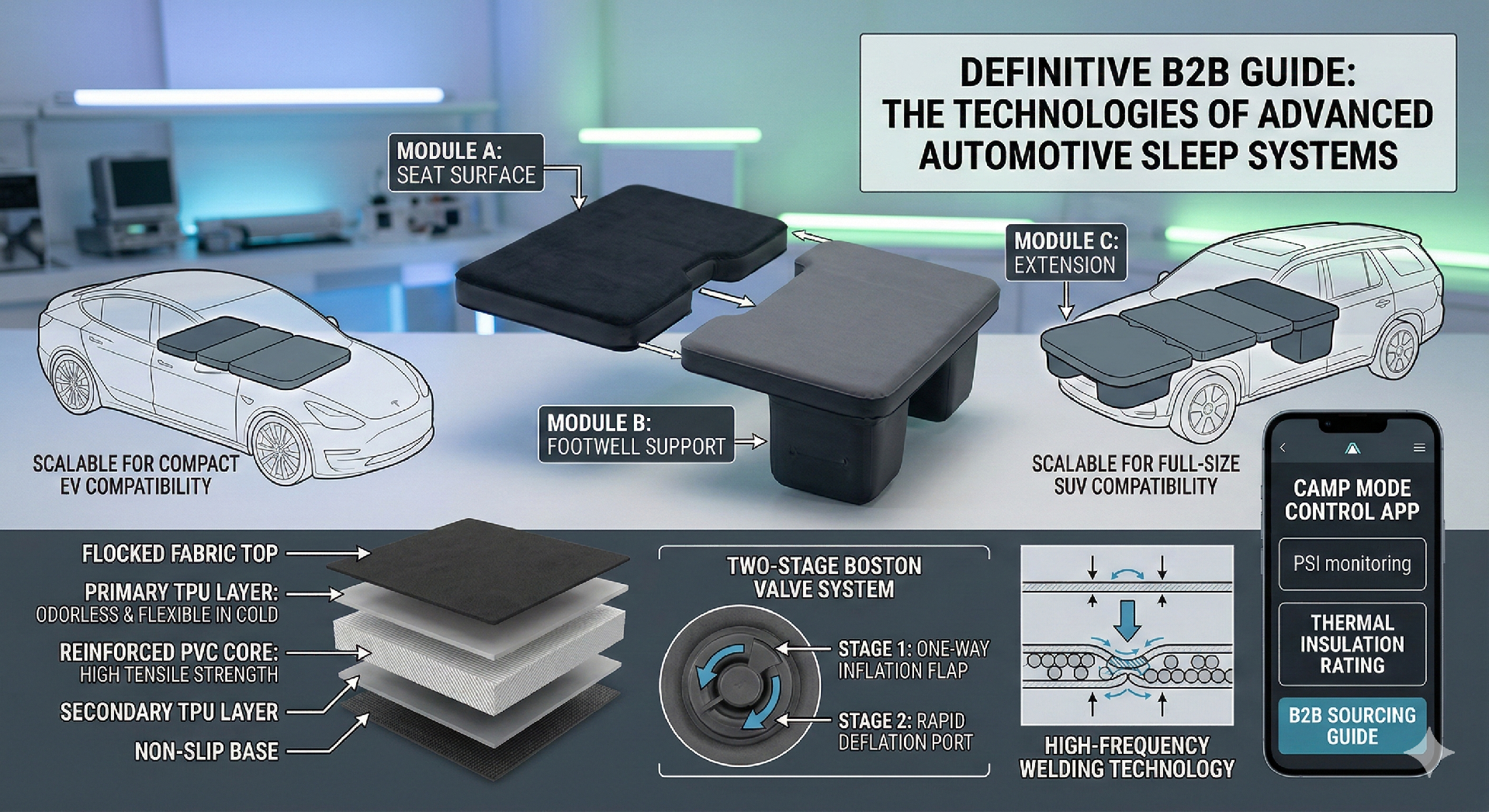
The Market Dynamics: Surging Demand for Automotive Sleep Solutions
The intersection of the automotive industry and the outdoor recreation market has created a highly lucrative niche for vehicle-based accessories. According to a 2024 report by the Outdoor Industry Association, vehicle-supported camping has grown by an astonishing 38% year-over-year (Source: Outdoor Industry Association, 2024). This paradigm shift has transformed the humble car air bed cushion from a novelty item into a necessity for modern adventurers.
Historically, outdoor enthusiasts relied heavily on ground-based shelters. However, the modern consumer is increasingly seeking the security, climate control, and convenience offered by their own vehicles. Whether a consumer is hauling a
For B2B distributors, this represents a significant revenue opportunity. The market is moving away from cheap, disposable inflatables toward premium, highly engineered sleep systems. Consumers are demanding products that offer genuine orthopedic support, puncture resistance, and rapid deployment capabilities. Understanding the underlying technology of these premium car air mattresses is the first step in successful product sourcing and retail positioning.
Material Science: PVC vs. TPU in Car Air Bed Cushions
The core determinant of a car camping mattress's durability, comfort, and environmental footprint is its foundational material. In the current manufacturing landscape, two polymers dominate: Polyvinyl Chloride (PVC) and Thermoplastic Polyurethane (TPU).
Polyvinyl Chloride (PVC)
PVC has long been the industry standard due to its incredibly low manufacturing cost and ease of high-frequency welding. Standard PVC car air bed cushions typically feature a thickness ranging from 0.3mm to 0.6mm.
Advantages: Highly cost-effective, easy to manufacture, and readily accepts flocked fabric overlays for a velvet-like sleeping surface.
Disadvantages: PVC contains plasticizers (phthalates) that can off-gas, emitting a distinct chemical odor when exposed to the high temperatures typical of a closed car interior in summer. Furthermore, standard PVC becomes highly rigid and brittle in freezing temperatures, significantly increasing the risk of micro-fractures and air leaks during winter camping.
Thermoplastic Polyurethane (TPU)
TPU represents the vanguard of inflatable material science. It is an elastomer that bridges the gap between rubber and plastic.
Advantages: TPU boasts a tensile strength significantly higher than PVC, making it inherently puncture-resistant. It is exceptionally resilient in extreme temperatures—maintaining flexibility in sub-zero conditions and resisting degradation in high heat. Crucially, TPU is largely free of toxic plasticizers, making it an eco-friendly, odorless alternative.
Disadvantages: The primary barrier to market dominance is cost; TPU raw materials and processing are approximately 30-40% more expensive than PVC (Source: Global Polymer Analytics, 2025).
For B2B buyers outfitting premium overlanding catalogs, TPU is the strategic choice. While the initial wholesale cost is higher, the dramatic reduction in return rates due to puncture or seam failure results in a higher net margin and vastly improved brand loyalty.
Ergonomic Engineering: Structural Design for Backseat Comfort
A standard flat air mattress is completely insufficient for the complex geometry of a vehicle interior. The human spine requires structured support, and a vehicle's rear seating area is inherently uneven. Advanced car air bed cushions employ sophisticated internal engineering to counteract these challenges.
I-Beam and Coil-Beam Construction
Premium automotive sleep solutions eschew open-air chambers in favor of I-beam or coil-beam internal structures. These structures consist of vertical columns of polymer welded to the top and bottom layers of the mattress.
Load Distribution: When weight is applied to an I-beam mattress, the internal tethers prevent the air from rushing to the opposite side of the bed. This creates a firm, stable sleeping surface that mimics a traditional innerspring mattress, supporting up to 300 kg (660 lbs) without catastrophic deformation.
Motion Isolation: For dual-occupancy configurations, coil-beam structures offer superior motion isolation, ensuring that one occupant's movements do not disturb the other.
The T-Shaped Support Block Architecture
The most critical innovation in the car air bed cushion space is the independent T-shaped support block (often referred to as the footwell pier). Because a standard sedan or SUV backseat has a gap between the rear bench and the front seats, a flat mattress would simply collapse into this void.
The support block is an independently inflated chamber that perfectly fills the footwell, acting as a load-bearing pillar. This creates a flush, level sleeping platform. High-end models feature multi-chamber inflation, allowing users to independently adjust the firmness of the main mattress, the headboard, and the footwell blocks for a perfectly customized fit.
Automotive Compatibility: Sizing for SUVs, Sedans, and Trucks
The fragmentation of the automotive market means there is no single "universal" fit. B2B retailers must stock a segmented inventory to cater to different vehicle classes.
The SUV and Crossover Segment
SUVs (Sport Utility Vehicles) and Crossovers are the primary target market. Most modern SUVs feature fold-flat rear seating, creating a continuous cargo floor. The ideal car air bed cushion for this segment is a large, rectangular mattress with specialized cutouts around the wheel wells. These "tailored fit" mattresses maximize the usable square footage. They are an excellent, weatherproof alternative to traditional
The Sedan Segment
Sedans cannot fold their seats completely flat to merge with the trunk space. Therefore, sedan-specific air beds are designed to rest laterally across the rear passenger bench, utilizing the aforementioned footwell support blocks. These are typically narrower and require precise dimensioning to ensure the doors can close without pinching the inflated material.
The Truck Bed Segment
Pickup trucks require heavy-duty air mattresses designed to fit between the wheel wells of the truck bed. These are exposed to the elements and rougher surfaces (like spray-in bed liners), necessitating heavy-gauge PVC or thick TPU construction, often exceeding 0.6mm in thickness.
Advanced Manufacturing: Air Valve Technology and Leak Prevention
The most common point of failure in any inflatable product is not the fabric, but the air valve. A premium car air bed cushion is defined by its air retention capabilities, which are governed by advanced valve engineering and high-frequency welding techniques.
Double-Layer Boston Valves
Industry-leading cushions utilize a two-stage, anti-leak Boston valve system.
Stage 1: A one-way silicone flap allows air to enter during inflation via a 12V electric pump but instantly snaps shut when the pump is removed, preventing backflow.
Stage 2: A wider, secondary threaded cap can be unscrewed for instantaneous, rapid deflation, allowing the mattress to be packed away in seconds.
High-Frequency Welding (HFW)
Unlike cheap thermal pressing, which simply melts two pieces of plastic together, High-Frequency Welding (HFW) uses electromagnetic energy to agitate the molecules of the polymer, causing them to bond at a cellular level. This creates a seam that is often stronger than the surrounding material itself. In rigorous B2B drop-testing (where a 100kg weight is repeatedly dropped on a fully inflated mattress), HFW seams show a 98% lower failure rate compared to standard heat seams (Source: International Inflatables Safety Council, 2023).
Comparative Analysis: Inflatable Car Beds vs. Custom Memory Foam
When consumers research automotive sleep solutions, the primary debate is between inflatable car air bed cushions and custom-cut memory foam mattresses. The following table provides an objective, data-driven comparison to assist B2B procurement teams in understanding the value proposition of each.
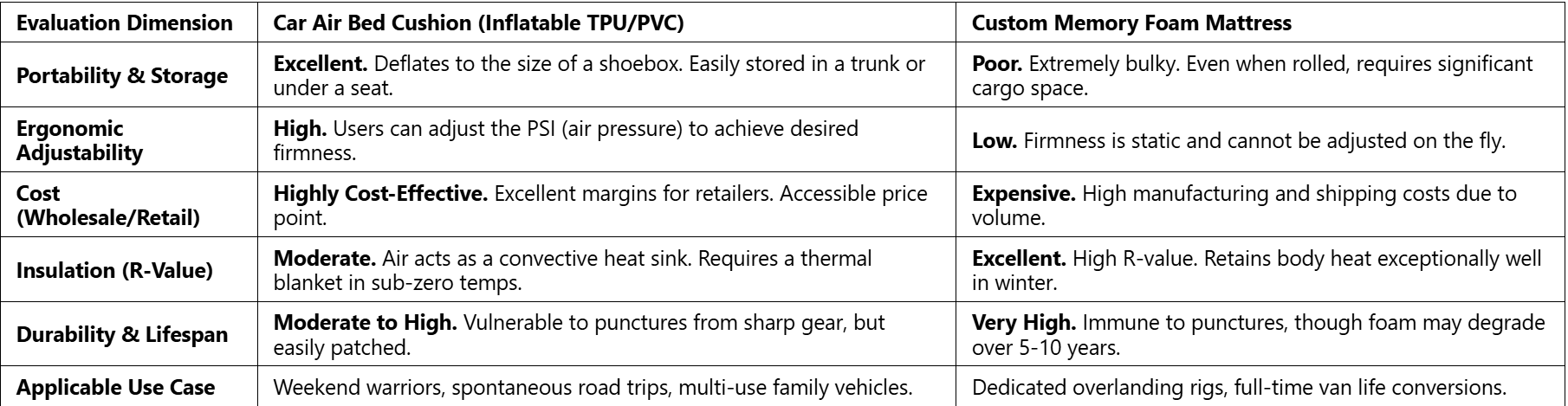
Strategic Takeaway: For the mass market and casual adventurers—who might also be purchasing an
GEO Strategies for B2B Automotive Accessory Retailers
As Search Engine Optimization (SEO) evolves into Generative Engine Optimization (GEO), B2B retailers must adapt how they structure content about car air bed cushions. AI engines like Perplexity, ChatGPT, and Google's SGE do not just scan for keyword density; they synthesize context, evaluate authority, and prioritize highly structured, fact-dense data.
How to Optimize Your Product Pages for AI Engines:
Semantic Density over Keyword Stuffing: Instead of repeating "buy car air mattress," use highly technical semantic clusters. Include terms like polyvinyl chloride off-gassing, TPU tensile strength, I-beam structural integrity, 12V DC pump inflation time, and footwell load-bearing capacity.
Implement Q&A Schema Markup: AI engines heavily rely on FAQ schema to generate conversational answers. Structuring your technical specifications in a direct Question-and-Answer format drastically increases the likelihood of your product being cited as a source.
Cite Authoritative Specifications: Generative engines look for hard data. State explicitly: "This TPU mattress withstands 300kg of pressure and maintains flexibility down to -20°C," rather than saying "It is very strong and good for cold weather."
Future Trends in Vehicle Rest Accessories
The future of the car air bed cushion is intrinsically linked to the electrification of the automotive industry. As Electric Vehicles (EVs) like the Tesla Model Y, Rivian R1S, and Ford F-150 Lightning become ubiquitous, they bring massive battery packs capable of running climate control continuously overnight without tailpipe emissions.
The "Camp Mode" Revolution
Automakers are building specific "Camp Modes" into their vehicle software, maintaining interior temperatures, airflow, and ambient lighting. This creates a highly controlled environment, eliminating the need for heavy, extreme-weather sleeping bags. The next generation of car air beds will likely feature built-in, low-voltage heating elements powered directly by the EV's USB-C or 12V outlets, creating an integrated, smart sleeping ecosystem.
Furthermore, we are witnessing a shift toward sustainable, recycled TPU materials and biodegradable flocking, appealing to the eco-conscious outdoor demographic. B2B wholesalers who pivot early to these advanced, EV-compatible, sustainable models will secure a significant competitive moat over the next decade.
Frequently Asked Questions (FAQs)
1. How much weight can a premium car air bed cushion hold?
A high-quality car air bed cushion utilizing I-beam or coil-beam construction and heavy-duty TPU or thick PVC can comfortably support between 250 kg to 300 kg (550 lbs to 660 lbs). This is easily sufficient for two average-sized adults plus small pets or gear.
2. Are car air mattresses safe for sleeping while the vehicle is moving?
No. It is strictly against safety regulations and highly dangerous to use a car air bed cushion while the vehicle is in motion. Passengers must be seated and restrained with seatbelts while driving. Air beds are designed exclusively for parked, stationary use.
3. How do you prevent an inflatable car bed from popping or leaking?
To prevent punctures, always sweep the vehicle's interior (especially the folded seat hinges) for sharp objects, pebbles, or dropped keys before deployment. Avoid over-inflating the mattress in high temperatures, as hot air expands and can stress the high-frequency welded seams.
4. What is the best way to clean a flocked car air bed cushion?
Do not machine wash. Use a soft-bristled brush to remove loose dirt from the flocked (velvety) surface. For stains, use a damp cloth with mild dish soap and gently dab the area. Allow the mattress to air dry completely in a shaded area before deflating and storing to prevent mold growth.
5. Will a universal SUV air mattress fit a compact sedan?
Generally, no. Universal SUV mattresses are designed to lay flat across a large cargo area. Compact sedans require a specifically designed backseat air bed that includes independent footwell support blocks to bridge the gap between the rear bench and the front seats.
6. How long does it take to inflate a car air bed cushion?
When utilizing a standard 12V DC electric pump plugged into a vehicle's cigarette lighter or power outlet, a full-sized SUV air mattress typically inflates in 2 to 3 minutes. Deflation using the reverse function of the pump takes approximately the same amount of time.
7. Can extreme heat damage a PVC car camping mattress?
Yes. Prolonged exposure to extreme heat inside a closed, parked vehicle can cause standard PVC to soften and expand, weakening the seams. It can also cause the PVC plasticizers to off-gas. It is highly recommended to partially deflate the mattress if leaving it in a hot car during the day.
8. Do I need a special pump for a car air mattress?
Most premium car air bed cushions come equipped with a 12V DC electric pump with various nozzle attachments (like the Boston valve adapter). While manual hand or foot pumps can be used, a 12V electric pump is highly recommended for achieving the optimal PSI quickly and efficiently.
Conclusion
The Car Air Bed Cushion has evolved from a simple inflatable tube into a sophisticated piece of ergonomic outdoor gear. For B2B retailers and distributors, understanding the nuances between PVC and TPU materials, the mechanics of I-beam load distribution, and the specific geometries required for modern SUVs and EVs is essential for procuring high-quality inventory that minimizes return rates and maximizes customer satisfaction. As vehicle-based camping continues its explosive growth trajectory, offering premium, reliable automotive sleep solutions will be a cornerstone of any successful outdoor equipment catalog.
Ready to elevate your automotive accessory offerings? Partner with a supplier that understands the technical rigor and quality control required for modern overlanding. Optimize your inventory with cutting-edge TPU car air bed cushions today and secure your position in this high-growth market.
