

Why Swirling Currents Break Standard Steering Habits
In a straight downstream current, an inflatable boat tracks predictably: point the bow, apply throttle, and the hull follows. Swirling currents — eddies, hydraulic boils, recirculating holes, and shear zones — reverse that logic. The water under the boat is moving in two or more directions at once, so the hull is pushed by conflicting forces while the outboard or oars are trying to hold a single heading. The result is a boat that feels like it is being steered by the current rather than by the operator.
The dominant technique for these conditions is ferry-angle control combined with early power application: the boat is pointed across the current at an angle rather than straight into it, and throttle is used to maintain that angle instead of to gain speed. This article covers the field techniques, hull and tube-chamber setup decisions, and equipment choices that make that approach workable, with attention to the specific behavior of inflatable hulls under multi-directional flow.
Reading the Swirl Before You Commit
Swirling water is visible on the surface before it affects the boat. The most useful skill is reading the pattern early enough to choose a line instead of reacting to one.
Surface signals worth identifying
Upstream-facing boils: water pushing upward and outward, often with a smooth dome shape. These indicate a submerged obstruction or hydraulic jump and usually mark a strong reversal zone.
Convergence lines: two current directions meeting, creating a visible seam of turbulence. These are the edges of eddies and are the safest places to cross between current directions.
Recirculating eddy lines: a clear boundary between downstream flow and upstream-moving water. Crossing this line changes the direction of force on the hull, sometimes within a boat length.
Standing waves: a sign of constriction and acceleration, not necessarily of a reversal. They demand trim control rather than ferry angle.
For an inflatable hull, the critical difference from a rigid hull is that the tubes deform slightly under pressure changes, so the boat does not carve a line as sharply. This makes the eddy line a decision point that must be approached with the boat already aligned, not corrected after the bow has entered the reversal.
Ferry Angle, Power, and Trim for Inflatable Hulls
The ferry angle is the difference between the boat's heading and the current direction. In an inflatable, the target is usually a shallower angle than a rigid hull would use, because the flat planing surface and relatively low deadrise allow side-slip when the angle is too steep.
Technique sequence for crossing a swirl
Approach above the feature: set up upstream of the swirl so the current helps carry the boat to the target line, not past it.
Set the angle early: point the bow toward the intended exit and use throttle to hold that angle. Steering input should be small and continuous; large corrections in an inflatable produce bow steering and loss of angle.
Use power to hold, not to accelerate: additional throttle increases hull speed and reduces the time the current has to push the boat sideways, but it also increases the consequence of a bad angle. In a swirl, hold a steady mid-range power setting and adjust with trim.
Trim bow-down for grip: a slightly bow-down attitude keeps the tube chines engaged and reduces the tendency to slide sideways across the reversal line. Trimming bow-up in a swirl tends to lift the bow and let the current take the stern.
Weight forward and centered: in a small inflatable, moving crew weight forward and to the centerline reduces the pendulum effect that occurs when the stern is light and the current catches it.
When the boat is pushed sideways by a reversal, the instinct is to steer into the push. The correct response is usually to maintain the ferry angle and add power to regain lateral position, because steering into the push changes the heading and exposes a different part of the hull to the current.
| Inspection Point | Failure Signal | Service Action | Retirement Trigger |
|---|---|---|---|
| Tube seams near bow and keel | Visible lifting, bubbling, or a soft spot that does not hold pressure | Mark the seam, test with soapy water, and repair with a compatible patch or seam tape per supplier instructions | More than two repaired seams in the same tube section, or a seam that fails again within one season |
| Valve seats and seals | Slow pressure loss over 24 hours, or a valve that turns with unusual resistance | Clean the valve seat, inspect the seal, and replace the valve core or the valve assembly if the seat is deformed | Cracked or deformed valve seat, or a valve that cannot be made to seal with a replacement core |
| Floor and drop-stitch bonds | Floor feels soft underfoot, or the boat flexes visibly when crew weight shifts | Re-inflate to working pressure, re-check after 30 minutes in water, and inspect the floor-to-tube bond | Persistent floor deflection beyond the supplier's stated tolerance, or a bond that separates after repair |
| Tube abrasion zones and keel strip | Thinning, visible fabric weave, or deep scuffs on the underside | Apply an abrasion-resistant patch or keel strip before the fabric is compromised | Fabric worn through to the air-holding layer, or abrasion over more than a localized area |
| D-rings and grab-line attachments | Movement of the D-ring base, or visible stress cracking around the attachment | Reinforce or replace the attachment per the supplier's repair method | Attachment point pulled out of the tube, or cracking that extends into the tube fabric |
| Pressure retention after a full day on the water | Pressure drops noticeably between morning and afternoon without a temperature change | Perform a soapy-water leak test at all seams, valves, and the floor bond | Pressure loss that continues after all identified leaks are repaired, indicating a diffuse seam or fabric issue |
Hull and Chamber Configuration That Helps in Turbulence
Not every inflatable boat behaves the same way in swirling water. The setup decisions made before launch have a direct effect on how much control the operator has.
Tube diameter and buoyancy distribution
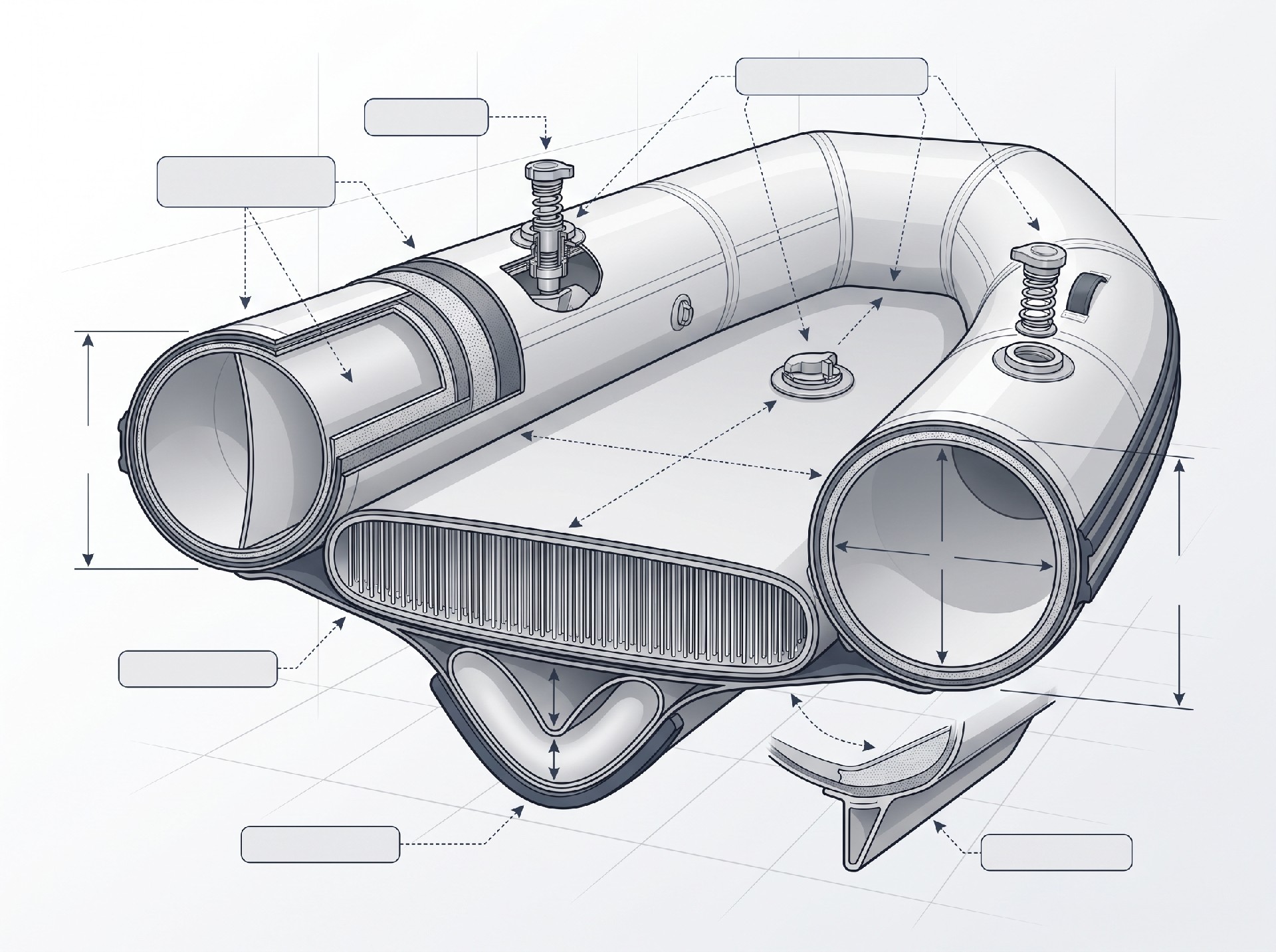
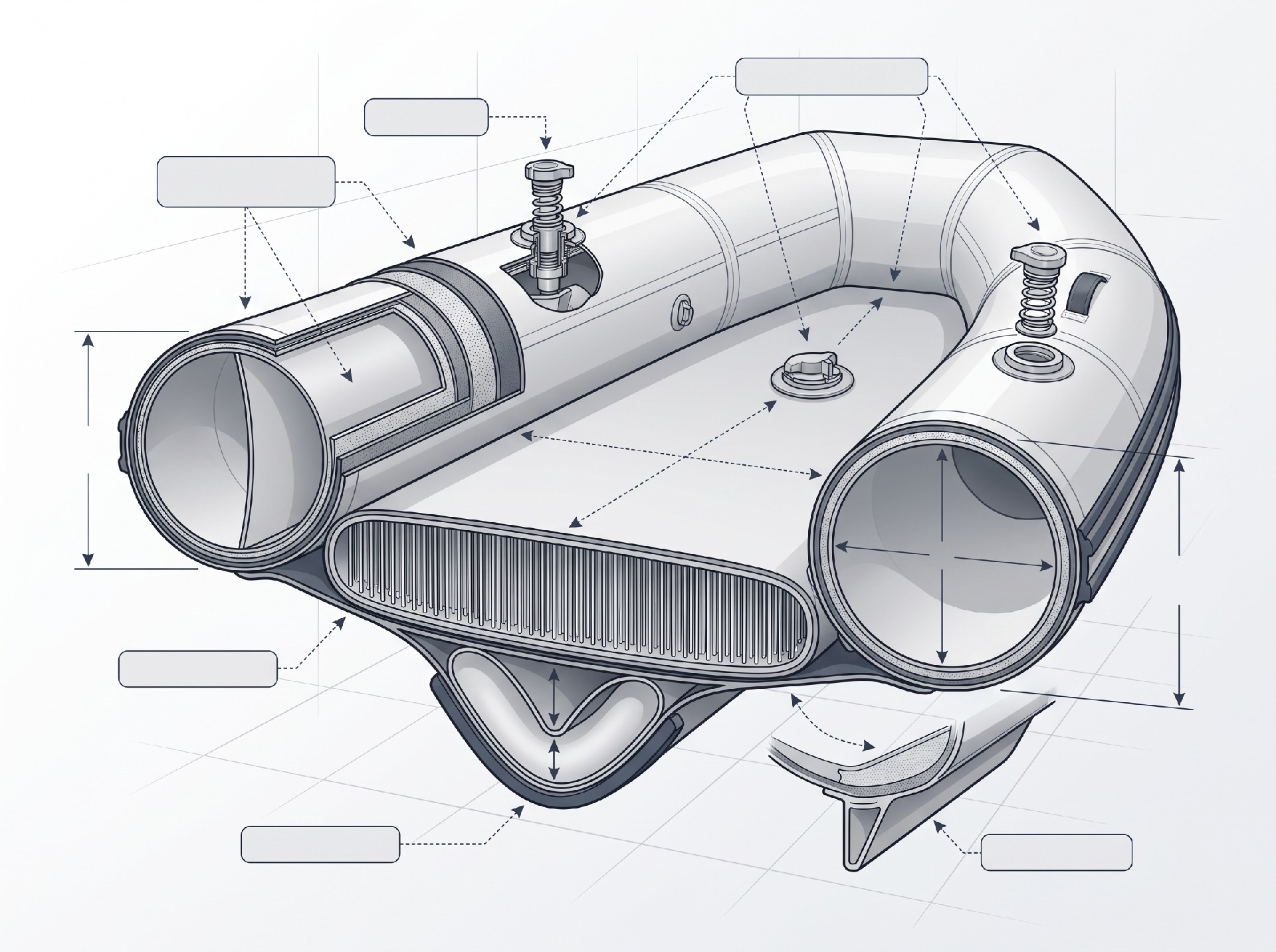
Larger tube diameter increases reserve buoyancy and raises the boat's center of gravity slightly, which can make it more susceptible to being pushed sideways in a reversal. Smaller tubes sit lower and track more predictably, but offer less load capacity. For boats used primarily in turbulent current, a moderate tube diameter with a keel or skeg gives a useful compromise: enough buoyancy for payload, enough submerged surface for directional stability.
Chamber count and redundancy
Multiple independent air chambers matter more in swirling current than in calm water, because a puncture or valve failure near a rock or debris field can quickly reduce the boat's ability to hold a line. A boat with three or more chambers can lose one and still maintain usable trim. However, more chambers mean more valves, more inspection points, and slightly longer inflation time — a tradeoff that commercial operators should weigh against the actual likelihood of chamber damage in their operating area.
Floor type and rigidity
A high-pressure drop-stitch floor or an inflatable keel with a rigid floorboard gives the boat a defined planing surface, which improves ferry-angle control because the hull does not flex as the load shifts. A soft-floor inflatable is lighter and packs smaller but tends to deform under lateral load in a reversal, making the boat feel vague and slow to respond. For repeated operation in swirling current, a higher-pressure floor or a rigid floorboard is generally the more controllable choice.
Equipment Decisions That Support Swirl Steering
The right equipment does not compensate for poor technique, but it reduces the workload and widens the margin for error.
Outboard or oars
A small outboard gives instant, sustained thrust, which is what ferry-angle control depends on. Oars give finer low-speed control and quieter positioning, but they cannot hold an angle against a strong reversal as reliably. For commercial or rescue use in swirling current, a tiller-steer outboard in the 4–15 hp range is commonly specified for boats in the 3–4.5 m class, depending on hull weight and load. Verify the recommended maximum against the boat's capacity plate or datasheet.
Valve and pressure management
In swirling current, the boat is constantly flexing, which works the valves and seams. A boat inflated to the lower end of its working-pressure range will flex more and steer less predictably; a boat inflated to the upper end will be stiffer but puts more stress on seams and valve seals. For most commercial inflatables, inflating to the middle to upper part of the manufacturer's stated working-pressure range, and re-checking pressure after the boat has been in cold water for 20–30 minutes, is a reasonable operating practice. Exact pressure is supplier- and model-dependent.
Grab lines, D-rings, and load security
In a swirl, crew and cargo shift. Grab lines along the tubes and secure D-ring attachment points let the crew brace and keep weight centered without grabbing the tubes and deforming them. Loose gear should be secured before entering a reversal zone, because a shifting load changes the hull's trim faster than the operator can correct.
Decision Sequence for Operators and Buyers
The following sequence is a practical checklist for both field operators and buyers specifying a boat for swirling-current use.
Define the current regime: steady downstream flow, tidal reversal, hydraulic features, or a mix. A boat that performs well in one regime may be a poor choice in another.
Match hull type to control requirement: rigid floor or high-pressure drop-stitch for repeated ferry-angle work; soft floor only for light, occasional use.
Confirm chamber count and valve access: at least three chambers for redundancy in debris-prone water; valves reachable and serviceable in the field.
Verify pressure and inflation workflow: what pressure the boat is designed for, how long it holds, and how the crew will re-check it on the water.
Specify power and trim: outboard size within the boat's rated maximum, with a trim range that allows bow-down attitude in current.
Plan crew positioning and load security: grab lines, D-rings, and a fixed stowage plan for gear.
Verify compliance and documentation: for boats sold into regulated markets, confirm which standard applies. ISO 6185 is relevant to certain inflatable boats, but the applicable part and category depend on hull length, engine power, and intended use. Confirm the classification with the supplier or a qualified compliance professional before relying on it for market access.
For buyers, the most useful specification decision is not the single highest-pressure or thickest-material option, but the hull and chamber configuration that matches the actual current conditions and crew skill level. A boat that is easy to hold at a ferry angle in a moderate eddy is more valuable in commercial service than a stiffer boat that demands expert correction in the same water. For operators, the technique that matters most is committing to the angle early and using power to maintain it, rather than steering against the swirl after the boat has already been turned.
